

Top 5 Free Tools to Track Smart Money in Real-Time in 2026
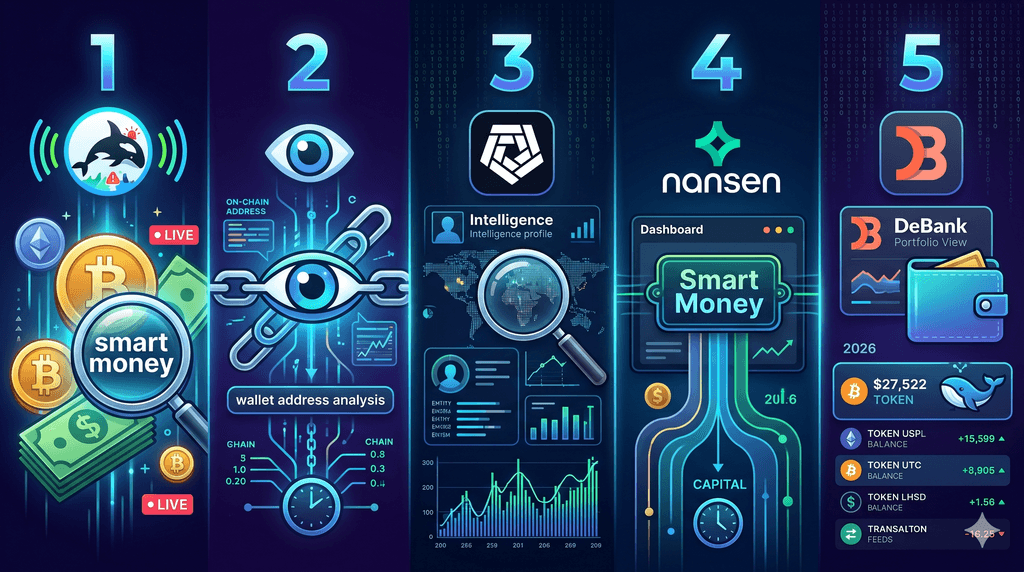
What if you could watch the world's most powerful crypto investors move their money — before the rest of the market reacts? In late 2025, Bitcoin whales absorbed nearly 48,000 BTC in a single month, representing roughly 240% of yearly issuance, even as retail sentiment turned fearful. By the time most traders noticed the accumulation signal, the move was already priced in. That is the brutal reality of crypto markets: whales don't announce their plans, but they do leave footprints on-chain — and free tools now exist to follow every step.
In 2026, whale tracking has graduated well beyond simple "large transaction" pings. Modern platforms now offer AI-driven wallet clustering, entity deanonymization, and smart money labeling that can tell you not just what moved, but who moved it and why it likely matters. Here are the top five free tools you need in your stack right now.
Key Takeaways
-
Whale tracking is essential in 2026 — raw price charts no longer tell the full story; on-chain capital flows are now a primary signal layer for informed traders.
-
Five tools dominate the free-tier landscape: Whale Alert, Lookonchain, Arkham Intelligence, Nansen, and DeBank — each serving a distinct function in your workflow.
-
Context beats alerts — a large transfer only becomes actionable when you know the entity, the destination, and the historical pattern behind it.
-
AI has transformed the space — tools like Arkham's "Ultra" engine and Nansen's smart money clustering now automate work that once required hours of manual blockchain research.
-
The best approach is layered — use Whale Alert for broad pings, Lookonchain for readable narratives, Arkham for entity-level investigation, Nansen for smart money intelligence, and DeBank for deep DeFi portfolio inspection.
-
Free tiers are genuinely powerful — you don't need a $999/month subscription to start tracking smart money effectively in 2026.
Why Whale Tracking Matters More Than Ever in 2026
The crypto market has fundamentally changed how serious traders approach analysis. On-chain data now sits alongside macro events, funding rates, and social sentiment as a core input into every trading decision.
Whale transactions — typically defined as transfers exceeding $1 million, or involving wallets holding more than 100 BTC, 1,000 ETH, or equivalent — carry outsized market significance. Large transfers from private wallets to exchanges often signal incoming sell pressure. Movements from exchanges back to cold storage suggest accumulation and long-term conviction. Even the timing matters: whales frequently reposition during thin liquidity windows like holiday periods, when their outsized orders move prices with minimal friction.
The good news for retail traders is that all of this activity happens on public blockchains. Every transaction is permanently recorded and inspectable — the edge lies in knowing which tools surface the most actionable signal, and which wallets deserve your attention most.
The Top 5 Free Tools to Track Smart Money in Real-Time
-
Whale Alert — The Broadest Early-Warning Radar
Whale Alert remains the cleanest starting point for any trader who wants a broad, market-wide alert layer for large crypto movements. It monitors over 200 different crypto assets across more than 10 blockchain platforms and generates real-time alerts whenever significant transactions occur, tagging known addresses belonging to exchanges, custodians, and recognized institutions.
Its famous social media presence — with over 2.2 million followers on X (Twitter) — means that major moves surface instantly across the crypto community. The platform covers major chains including Bitcoin, Ethereum, XRP, Solana, and more, making it a genuinely multi-chain solution. Custom transaction size thresholds allow users to filter out smaller noise and focus on moves that genuinely matter to their strategy.
The free tier delivers substantial value: public feeds, social alerts, and basic on-chain data are available at no cost. For those needing API access or deeper analytics, paid tiers start at $49/month for the Developer plan, with institutional packages at higher price points.
Best used for: First-signal detection. When Whale Alert fires, that's your cue to open a deeper investigation tool — not necessarily your cue to trade.
Key limitation: Raw transaction data without sufficient context. Knowing that "10,000 ETH moved from Unknown Wallet to Binance" is a starting point, not a conclusion.
-
Lookonchain — Human-Readable Smart Money Narratives
Lookonchain earns its place as the most trader-friendly bridge between raw on-chain data and actionable insight by packaging wallet movements into readable, context-rich narratives rather than just numbers and wallet hashes. Where Whale Alert tells you what moved, Lookonchain tries to tell you what it means.
The platform covers a wide range of chains and is particularly well-regarded for its real-time tracking of whale wallet movements, token flows, and notable on-chain events. Its mobile app — available on iOS — brings real-time whale alerts and on-chain alpha directly to traders' pockets, reducing the latency between signal and awareness.
Lookonchain analysts also track notable wallets with proven track records, flagging when "smart money" addresses begin accumulating or distributing specific tokens. The platform has gained a strong reputation for exposing high-profile market events, including detailed analysis of developer addresses and early sales activity around controversial token launches.
Best used for: Bridging the gap between alert fatigue and meaningful insight. If you don't have time to investigate every raw Whale Alert ping yourself, Lookonchain's pre-digested narratives are a powerful complement.
Key limitation: Even well-framed interpretations need independent validation — narrative framing can introduce bias, and not every "smart money" move plays out as expected.
-
Arkham Intelligence — Entity-Level Deanonymization
Arkham Intelligence is the most powerful free tool available for understanding who sits behind a wallet cluster, and it has reached 3 million registered users as of early 2026 — a testament to the value it delivers at no cost to individual users.
Arkham's proprietary "Ultra" AI engine aggregates raw on-chain and off-chain data to classify wallets into meaningful entity clusters: think "a16z," "US Department of Justice," "Lazarus Group," or "Tesla Treasury." This transforms blockchain addresses from anonymous strings into identifiable actors with history, activity patterns, and strategic context. The platform currently supports 12 chains as of early 2026, including Bitcoin, Ethereum, Solana, BNB Chain, Avalanche, Tron, Arbitrum, Polygon, Optimism, Base, Mantle, and Zcash — the last of which was added in December 2025, making Arkham one of the few analytics platforms tracking a privacy-focused chain.
The Intel Exchange is another unique feature: an open marketplace where users can post or answer "bounties" for on-chain intelligence, with the native ARKM token powering payments and rewards. In 2026, Arkham launched "Season 2" points, offering additional incentives for high-quality, verified analysis. Meanwhile, the Visualizer maps relationships between wallets graphically, showing fund flows in a way that is immediately intuitive for research.
For any given whale wallet, users can freely inspect: full portfolio breakdown, historical performance, counterparties and transaction flows, and exchange deposit/withdrawal activity.
Best used for: Deep investigation. When you need to know whether the wallet behind a large BTC move belongs to a fund, an exchange, a government, or a known exploiter, Arkham is your best free option.
Key limitation: Coverage of newer meme coins and recently launched tokens can be incomplete — a common challenge across all whale tracking platforms.
-
Nansen — AI-Powered Smart Money Intelligence
Nansen delivers the deepest "smart money" intelligence layer available, tracking wallets not just by size but by demonstrated profitability and trading patterns — a crucial distinction that separates genuinely valuable signals from noise.
Rather than labeling wallets solely by the size of their holdings, Nansen classifies entities activity type: institutions, skilled traders, venture capital funds, and whales are all categorized separately. The platform then tracks their portfolio moves, win rates, and realized profit and loss in real time across 30+ chains, including Ethereum, Solana, Arbitrum, and Polygon. Its coverage of over 500 million labeled wallet addresses (claimed as of 2026) gives it unmatched depth for EVM-chain analysis.
Upon login, Nansen Spotlight immediately surfaces volume-based signals and the top tokens by inflows — meaning you can see where smart money is concentrating without manually browsing individual wallets. The Token God Mode feature provides deep token analytics and holder distribution data, while custom AI signals highlight unusual on-chain activity that may not yet be visible in price action.
The free tier offers a meaningful preview of the platform's capabilities, with a step-level paid plan at $99/month making the full feature set accessible to serious retail traders. Advanced institutional plans run higher, but the entry point has become much more approachable in 2026.
Best used for: Identifying where clusters of consistently profitable wallets are deploying capital. This is the tool you use when you want to know not just that large wallets are active, but that proven winners are active in a specific token or protocol.
Key limitation: The depth of functionality can feel overwhelming for new users; the platform is best approached with a specific research question in mind rather than open-ended browsing.
-
DeBank — DeFi Portfolio Intelligence and Wallet Inspection
DeBank rounds out the essential free toolkit by providing the most comprehensive view of any wallet's DeFi activity, making it the natural final step after you've identified which wallets deserve closer inspection via the tools above.
DeBank's core strength is its intuitive interface for viewing any wallet's complete on-chain footprint: crypto asset holdings across protocols, NFT collections, transaction history, LP positions, yield farming activity, and governance participation. It is especially powerful for DeFi-focused research, where understanding a whale's protocol interactions often tells you more about their strategy than their token holdings alone.
The platform is frequently used as a "portfolio inspection" layer — once Arkham or Nansen has flagged a wallet as belonging to a smart money entity, traders use DeBank to understand the full scope of that entity's positions. DeBank's social features also allow users to follow specific wallets and receive updates when activity changes, creating a lightweight alert layer that complements more sophisticated tools.
Best used for: Deep wallet inspection, especially in DeFi contexts. If you've identified a wallet worth watching, DeBank is where you go to understand the complete picture of what that wallet is doing across protocols.
Key limitation: Less focused on real-time alerting than the other tools on this list; it functions better as a research and monitoring layer than an early-warning system.
Quick Comparison: Which Tool Fits Your Need?
| Tool | Best For | Free Tier? | Chain Coverage | Standout Feature |
| Whale Alert | Broad real-time alerts | Yes (public feeds) | 10+ chains | Speed & simplicity; 2.2M+ social followers |
| Lookonchain | Readable whale narratives | Yes | Multi-chain | Human-curated smart money analysis |
| Arkham Intelligence | Entity identification | Yes (full free access) | 12 chains | Ultra AI deanonymization; Intel Exchange |
| Nansen | Smart money intelligence | Limited free tier | 30+ chains | 500M+ labeled wallets; activity-based classification |
| DeBank | DeFi wallet inspection | Yes | Multi-chain | Intuitive full portfolio visibility |
How to Build Your Free Whale Tracking Stack
The most effective approach in 2026 is layered monitoring, not reliance on a single tool.
Start with Whale Alert as your ambient background signal — follow their public social feeds or set up basic threshold alerts to catch major market-moving transfers as they happen. Pair this with Lookonchain to get readable context around the most significant moves without needing to do all the research yourself.
When a specific wallet or entity warrants deeper investigation, move to Arkham Intelligence to identify who or what sits behind the address. Then use Nansen to contextualize the move within the broader smart money landscape — is this an isolated action, or are multiple high-performing wallets making similar moves at the same time? Finally, bring in DeBank for a complete picture of any wallet's DeFi exposure and protocol interactions.
This layered stack costs nothing for a meaningful level of functionality. The key insight that separates profitable whale watchers from those who chase false signals: whale movement is context, not a standalone trade signal. A large transfer only becomes an edge when you understand the entity, the destination, the historical pattern, and whether the move aligns with broader on-chain and macro conditions.
The Evolving Intelligence Layer: What's Changed in 2026
The most significant shift in whale tracking over the past year has been the mainstreaming of AI-driven entity labeling. Platforms like Arkham and Nansen no longer require users to manually piece together wallet clusters — the AI does this automatically, surfacing relationships and transactional patterns at a scale that was impossible for human analysts even two years ago.
The blockchain analytics market itself reflects this growth: valued at approximately $1.76 billion in 2026 and projected to continue expanding, the sector is attracting serious institutional attention. Meanwhile, the free tier across all major platforms has improved dramatically — Arkham's fully free individual access and Nansen's entry-level pricing represent a meaningful democratization of tools that were once exclusively institutional.
For retail traders willing to invest time in learning these platforms, 2026 represents the most level playing field in crypto's history when it comes to on-chain intelligence.
Turn Whale Signals Into Executed Trades on KuCoin
Spotting a whale move is only half the equation — the other half is having a trading platform ready to act the moment a signal crystallizes. This is where KuCoin becomes an essential part of your workflow.
KuCoin's built-in KuCoin Feed — available free to all users — functions as an AI-powered intelligence hub that consolidates on-chain signals, trending token updates, market sentiment, and expert analysis into a single real-time dashboard. When the market moves rapidly due to whale activity or major on-chain events, KuCoin Feed surfaces alerts instantly, so you're never catching up. With over 900 trading pairs and deep liquidity across spot, futures, and margin markets, KuCoin gives you the execution infrastructure to capitalize on the signals your whale tracking stack generates. The gap between insight and execution is where most traders leak edge — KuCoin closes that gap.
💡Further Reading:
Conclusion
Whale tracking in 2026 is no longer a niche skill for on-chain researchers — it is a core component of informed crypto trading at every level. The five tools covered in this guide — Whale Alert, Lookonchain, Arkham Intelligence, Nansen, and DeBank — represent the best free-tier stack available today, covering everything from broad real-time alerts to entity-level deanonymization and deep DeFi portfolio inspection.
The key lesson across all of them is that context transforms a raw alert into a genuine edge. A large BTC transfer means very little until you know whether it came from a dormant early miner, a known exchange wallet, or a cluster of consistently profitable smart money addresses. Building the habit of layering these tools — alert, narrative, entity, intelligence, inspection — is what separates reactive traders from those who consistently position ahead of the crowd.
As AI continues to mature within blockchain analytics, free-tier capabilities will only improve. The on-chain footprints are already there. The tools to read them are already free. The only remaining variable is whether you choose to follow the whales — or wait until they've already moved.
FAQs
Can following whales actually hurt your trading? What are the risks?
Yes — blindly copying whale movements carries significant risks. Sophisticated whales frequently split transactions across multiple wallets, use OTC desks for block trades, and time moves during high network activity specifically to obscure intent. Some deliberately create misleading on-chain signals to manipulate retail sentiment before taking the opposite position. Whale data should always be combined with technical analysis, not used as a standalone trade trigger.
Is it legal to track cryptocurrency whale wallets?
Tracking publicly visible blockchain transactions is entirely legal — all data on public blockchain networks is permanently accessible to anyone. There are no legal restrictions on analyzing on-chain wallet activity using tools like Arkham or Nansen. However, acting on material non-public information — such as advance knowledge of an institution's upcoming crypto purchases — may still be subject to securities regulations depending on your jurisdiction.
How does AI improve whale tracking compared to older methods?
Modern AI-driven platforms like Arkham's "Ultra" engine and Nansen's clustering algorithms can automatically group thousands of wallets into identifiable entity clusters, track activity patterns across millions of addresses simultaneously, and surface unusual activity in real time — work that would previously require days of manual blockchain research. AI has also improved the accuracy of wallet labeling, reducing false positives when identifying whether a large wallet belongs to an exchange, a fund, or an individual.
Are there whale tracking tools specifically for Solana and newer Layer 2 chains?
Yes. Both Arkham Intelligence and Nansen now offer meaningful coverage of Solana, Arbitrum, Polygon, Optimism, and Base, among other chains. Lookonchain is particularly noted for its Solana and multi-chain coverage in its curated analysis. For pure Solana-native tracking, platforms like Step Finance and SolanaFM also provide on-chain wallet visibility. The multi-chain landscape has improved dramatically in 2025–2026, with most leading platforms now covering the major Layer 2 ecosystems alongside Ethereum mainnet.
Disclaimer: This article is for informational purposes only and does not constitute financial or investment advice. Cryptocurrency investments carry significant risk. Always conduct your own research before trading.