

SpaceX Trump Accounts: Elon Musk's $17.8 Billion Stock Giveaway Explained
Introduction
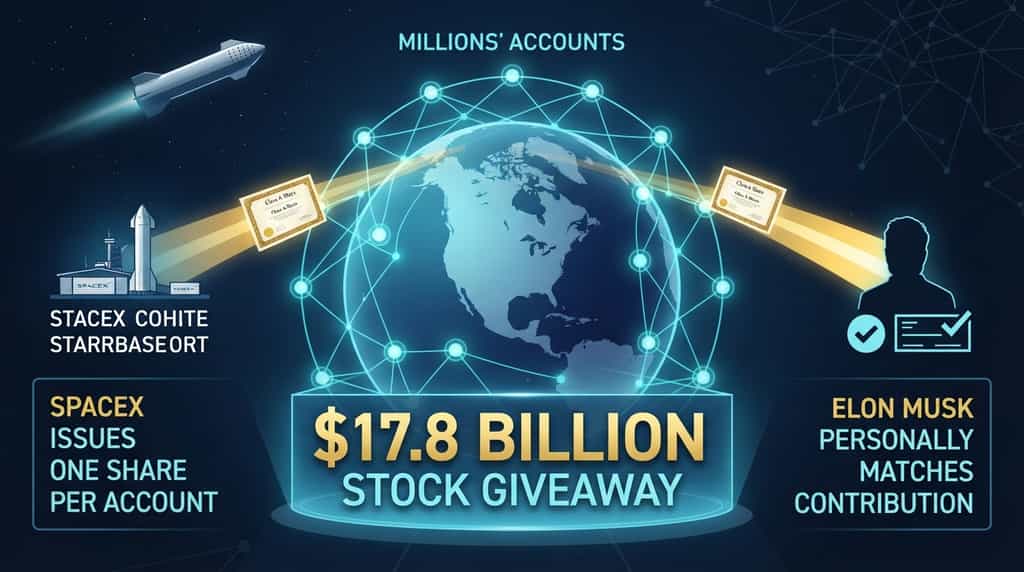
SpaceX and Elon Musk have announced a combined stock donation that could be worth approximately $17.8 billion, making it one of the largest corporate and personal equity-giving commitments in recent years. Under the arrangement, SpaceX will contribute one newly issued Class A share to every currently active Trump Account, while Elon Musk has pledged to personally match the company's contribution with another share.
The announcement, made on November 25, 2026, goes beyond conventional philanthropy. By distributing equity in one of America's most prominent technology companies through a government-backed savings program for children, the initiative creates a potential financial connection between millions of American families and SpaceX's future performance. It also raises broader questions about corporate influence, political relationships, shareholder dilution, and the economic implications of distributing private wealth through public institutions.
Key Takeways
SpaceX and Elon Musk have pledged to distribute two shares of SpaceX stock per eligible active Trump Account, with an estimated combined value of approximately $17.8 billion.
The key details are:
-
SpaceX's contribution: One newly issued Class A common share for every currently active Trump Account.
-
Elon Musk's contribution: One additional share personally donated for each share contributed by SpaceX.
-
Estimated total value: Approximately $17.8 billion, based on an estimated 70 million recipients and a SpaceX closing price of $127.44 on November 25, 2026.
-
Additional contribution: SpaceX President and COO Gwynne Shotwell has separately announced a personal gift of more than 2 million shares.
-
Strategic implications: The arrangement potentially expands public ownership of SpaceX, creates broader financial participation in the company's growth, and strengthens the relationship between a major technology company and a government-supported savings initiative.
Importantly, the $17.8 billion figure is an estimated market valuation, not a confirmed cash expenditure or a finalized transfer value.
What Are Trump Accounts and Why Do They Matter?
Trump Accounts are tax-advantaged investment accounts established under the Working Families Tax Cuts legislation to help American children accumulate long-term financial assets. The program officially launched on July 4, 2026, and is administered through the US Treasury and Internal Revenue Service (IRS).
Unlike conventional savings accounts, Trump Accounts are structured as a type of individual retirement account (IRA) for eligible children. Their purpose is to provide an investment vehicle that can potentially grow over an extended period before beneficiaries reach adulthood.
The program includes several important features:
-
Eligibility: Generally available to children under 18 with a valid Social Security number, subject to the applicable account establishment requirements.
-
Federal contribution: Eligible children born between January 1, 2025, and December 31, 2028, may qualify for a one-time $1,000 government contribution.
-
Automatic enrollment: Beginning October 1, 2026, the Treasury began automatically establishing accounts for eligible children.
-
Additional contributions: Qualified contributions from family members, employers, philanthropists, and other permitted sources can supplement the initial balance.
According to the Treasury Department's fiscal 2026 financial report, more than 60 million accounts were created through automatic enrollment during September 2026, bringing the total number of established accounts to nearly 70 million.
However, an established account and an actively claimed account are not necessarily the same thing. This distinction matters because SpaceX's announcement specifically refers to currently active Trump Accounts. The official IRS Trump Accounts guidance provides further information about eligibility, account establishment, and the government contribution.
How Does the $17.8 Billion SpaceX Stock Giveaway Work?
The arrangement involves two separate contributions: one from SpaceX as a corporation and another from Elon Musk personally. Together, they are intended to provide two SpaceX shares to each qualifying account.
-
SpaceX Issues One New Class A Share per Active Account
On November 25, SpaceX announced its commitment to contribute one newly issued Class A common share to every currently active Trump Account. This is an important distinction.
SpaceX is not simply transferring existing shares from its corporate treasury. The announcement specifically describes newly issued shares, meaning the company intends to expand its outstanding share count to fulfill the commitment.
The company explained that its objective was to extend ownership of the business creating future infrastructure to the next generation of Americans.
The financial implications are different from a conventional cash donation. Rather than transferring billions of dollars from its operating cash reserves, SpaceX is committing equity in the company itself.
-
Elon Musk Personally Matches the Company's Contribution
Musk has separately pledged to match the number of shares donated by SpaceX. This commitment builds on his earlier public statement that every American child would receive a SpaceX share. The November 25 announcement effectively expanded the original proposal into a two-share arrangement.
The distinction between the two contributions is important:
| Contributor | Contribution | Nature of contribution |
| SpaceX | One Class A share per active account | Newly issued corporate equity |
| Elon Musk | One additional share per corresponding account | Personal equity donation |
| Gwynne Shotwell | More than 2 million shares | Separate personal commitment |
The company also stated that Musk's personal commitment would match the number of shares contributed by SpaceX. However, the detailed transfer arrangements and timing are separate implementation questions.
Why Is SpaceX Using Equity Instead of Cash?
The most interesting aspect of this announcement is not simply the amount of wealth involved. It is the choice of equity as the distribution mechanism.
Traditional philanthropy generally involves transferring cash, funding charitable organizations, or financing specific public initiatives. Equity donations operate differently because recipients receive an ownership interest in an underlying business.
There are several potential economic implications.
-
The Company Can Contribute Equity Without an Equivalent Cash Outflow
A newly issued share does not require SpaceX to transfer an equivalent amount of cash from its operating accounts. This makes the arrangement fundamentally different from a conventional cash donation.
However, that does not mean the contribution is economically cost-free. New share issuance increases the number of outstanding shares and can dilute existing shareholders' proportional ownership if the additional shares are not offset by other capital-structure changes.
For existing shareholders, the relevant question is therefore not simply how much cash SpaceX spends, but how the additional equity affects ownership percentages, voting rights, and per-share economic interests.
-
The Donation Creates a Direct Financial Connection With American Families
The second implication concerns incentives. If millions of children become shareholders in SpaceX through their investment accounts, their families may develop a direct financial interest in the company's long-term performance.
This creates a relationship that goes beyond conventional brand recognition or public relations. A parent managing a child's investment account may pay closer attention to SpaceX's commercial development, technological progress, financial results, and future valuation because the company's performance could affect the child's investment balance.
From a corporate perspective, this potentially expands the population of people with a financial stake in the business. However, the actual influence should not be overstated. Beneficiaries do not necessarily control the shares directly, and an investment interest does not automatically translate into political support or favorable public opinion.
-
The Structure Connects Corporate Equity With a Government-Supported Program
Trump Accounts provide an established distribution framework for reaching a large number of eligible American children. Instead of creating an entirely separate charitable distribution system, SpaceX can direct its announced corporate contribution toward an existing program.
This potentially reduces the administrative complexity of identifying eligible beneficiaries and managing individual investment allocations. It also gives the initiative a national dimension. The beneficiaries are not selected solely according to conventional charitable criteria, but through the eligibility rules of a government-supported investment program.
That distinction helps explain why the announcement has attracted attention beyond the aerospace and technology industries.
Is This a Political Strategy Rather Than Just Philanthropy?
The announcement can reasonably be examined through a political-economy perspective, although its underlying motivation cannot be established from the available corporate statement alone. The central issue is the relationship between corporate ownership, political influence, and public participation in economic growth.
Political Contributions and Equity Donations Are Different Financial Mechanisms
In the United States, federal campaign finance law establishes restrictions on contributions made to political candidates and committees. For example, corporations generally cannot use their general treasury funds to make direct contributions to federal candidates.
However, a stock donation to an eligible child's investment account is not automatically equivalent to a political campaign contribution. The recipient, purpose, legal structure, and actual use of the transferred assets matter.
The Federal Election Commission's contribution guidance explains the distinction between corporate contributions and other forms of financial activity. Therefore, it would be inaccurate to conclude that SpaceX has designed this initiative specifically to avoid campaign contribution limits.
There is no established evidence in the company's announcement demonstrating that the arrangement is intended to circumvent campaign finance regulations.
The Broader Strategic Benefit Is Potentially More Significant
A more defensible interpretation concerns the distribution of economic incentives. Consider the following relationship:
-
SpaceX contributes equity to millions of eligible children's accounts.
-
Families become financially connected to the company's future performance.
-
The company's business development becomes more directly relevant to the financial interests of a broader population.
-
This may strengthen public engagement with SpaceX's commercial and technological ambitions.
In this sense, the arrangement can potentially create a wider constituency with an economic interest in the company's success. That does not establish political allegiance, nor does it demonstrate that beneficiaries will support particular government policies.
Nevertheless, it illustrates how corporate philanthropy can simultaneously serve charitable, commercial, and public-relations objectives. The most consequential element may therefore be the creation of a shared financial narrative: the company's future growth is presented as something that could benefit ordinary American families.
Conclusion
SpaceX and Elon Musk's approximately $17.8 billion stock giveaway is significant not only because of its size, but also because of the financial structure behind it. By combining newly issued corporate equity with a personal matching commitment, the initiative potentially gives millions of American children an ownership interest in one of the country's most prominent technology companies.
The arrangement also illustrates a broader evolution in corporate philanthropy. Rather than simply transferring cash, companies can distribute equity and create longer-term financial relationships between their businesses and the communities they serve.
From a strategic perspective, this could expand SpaceX's public ownership base, strengthen its connection with American households, and position its future growth as a source of shared economic opportunity. These are plausible implications, not proof of a specific political motive.
Ultimately, the initiative's success will depend on whether the announced shares are transferred as planned, how they are valued and administered, and whether SpaceX can deliver the long-term business performance that would make the donated equity valuable. A headline valuation of $17.8 billion is substantial, but the actual economic benefit to millions of children remains tied to the company's future.
FAQs
-
How much is Elon Musk and SpaceX's stock giveaway worth?
The combined commitment is estimated at approximately $17.8 billion, based on roughly 140 million shares valued at $127.44 each on November 25, 2026. The actual total depends on the number of eligible accounts and the share price when the donations are completed.
-
Will every American child receive two SpaceX shares?
The arrangement announced by SpaceX specifically covers currently active Trump Accounts, with Musk matching the company's contribution. The exact number of qualifying accounts and the final distribution arrangements have not been fully established.
-
Does SpaceX have to spend $17.8 billion in cash?
No. SpaceX has committed to issuing new Class A shares rather than making an equivalent cash payment. Musk's personal contribution is separate. However, new corporate share issuance can affect existing shareholders through dilution.
-
What are Trump Accounts?
Trump Accounts are tax-advantaged investment accounts established for eligible American children under the Working Families Tax Cuts legislation. Eligible children born between 2025 and 2028 may qualify for a one-time $1,000 federal contribution.
-
Does receiving SpaceX shares guarantee future investment returns?
No. The value of SpaceX shares can increase or decrease depending on the company's financial performance, market conditions, and other factors. Receiving shares does not guarantee profits or provide immediate access to an equivalent amount of cash.
Disclaimer: This general market information may come from third-party, commercial, or sponsored sources and is provided for informational and educational purposes only. It does not constitute financial or investment advice, an offer, a solicitation, or a guarantee. We assume no responsibility for the accuracy, completeness, or reliability of this information or for any losses arising from its use.
Investing and trading involve risks. Past performance does not guarantee future results. Users should conduct their own research, exercise sound judgment, and take full responsibility for their decisions. For more information, please refer to KuCoin's Terms of Use and Risk Disclosure.