

SpaceX Stock Drops Below $135 IPO Price: Is It Time to Buy the Dip in July 2026?
2026/07/17 11:25:00
Introduction
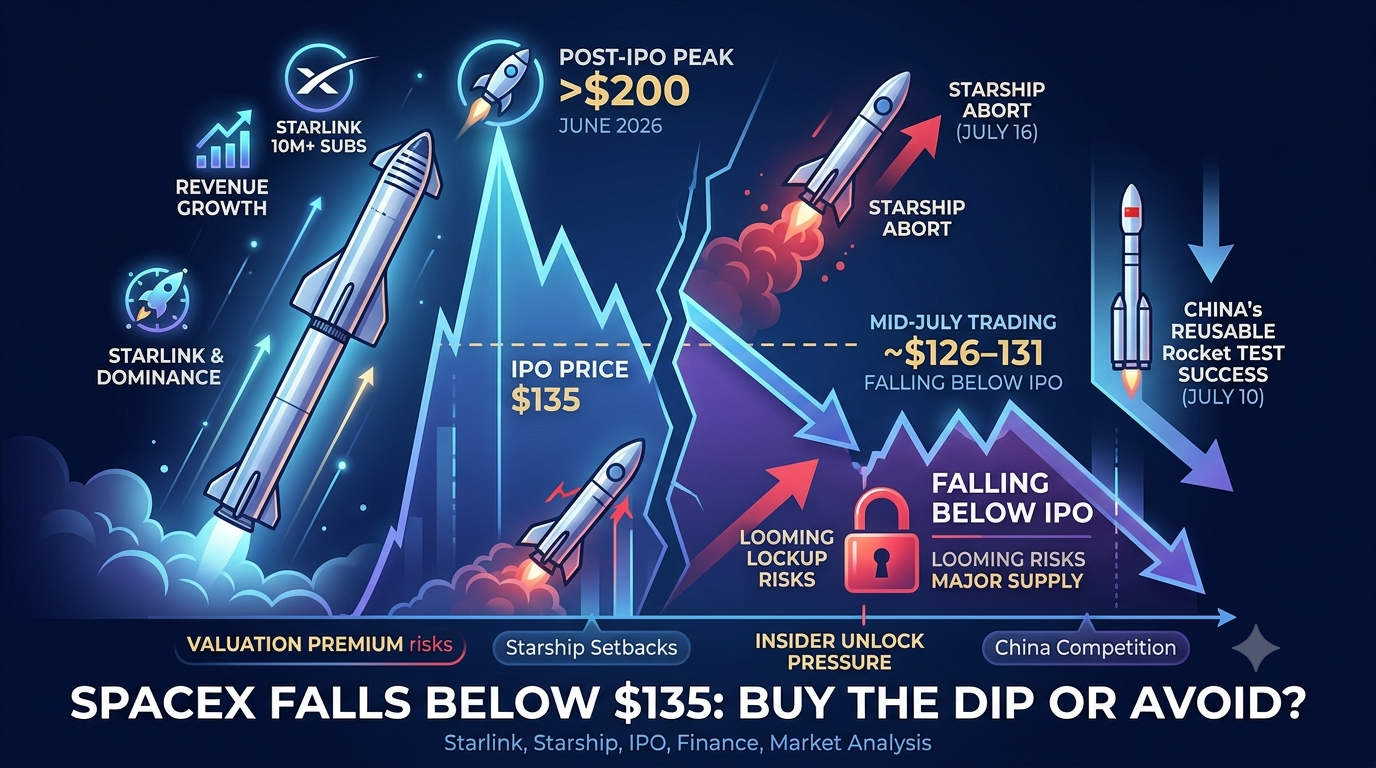
SpaceX (NASDAQ: SPCX) shares have tumbled below their $135 IPO price set in June 2026, trading near $126–131 as of mid-July. This decline follows a post-IPO peak above $200 and raises a key question for investors: Does the drop signal a buying opportunity, or deeper risks ahead?
The short answer may be no—buying the dip at current levels carries significant near-term downside due to upcoming lockup expirations, high valuations, recent operational setbacks, and intensifying competition. While SpaceX dominates reusable launches and Starlink growth, its fundamentals do not yet justify the premium after the initial hype faded.
This article examines SpaceX's post-IPO performance, financial health, competitive pressures, and lockup risks to help investors decide on exposure—especially via platforms like KuCoin for related crypto plays in space tech or blockchain-adjacent opportunities.
Why SpaceX Stock Fell Below the $135 IPO Price
SpaceX shares have declined sharply since their record-breaking IPO, crossing below the offer price due to profit-taking, operational news, and valuation reality checks. The company priced its historic IPO at $135 per share on June 11, 2026, raising $75 billion—the largest ever—and opened trading at $150 before closing near $161 on day one, implying a $2.1 trillion market cap.
By mid-July 2026, shares traded around $126–145 amid volatility, down over 20–25% from peaks near $202–225. Key triggers include a failed Starship launch attempt on July 16 (aborted due to engine issues) and China's successful reusable rocket recovery test on July 10, which challenged SpaceX's technological edge.
Low initial float (around 5%) fueled early gains but amplified swings. As more shares become available, selling pressure mounted. Analysts note this mirrors post-IPO patterns where excitement fades quickly.
SpaceX's Financials: Strong Growth but Massive Losses
SpaceX delivered robust revenue growth in 2025, driven by Starlink, but remains deeply unprofitable with accelerating losses that question its sky-high valuation. According to its S-1 and recent disclosures, SpaceX reported $18.7 billion in 2025 revenue, up 33–43% year-over-year, with Starlink contributing $11.4 billion (about 61%).
Q1 2026 showed $4.7 billion revenue but a $4.28 billion net loss. Full-year 2025 losses reached $4.9–4.94 billion despite $6.6 billion adjusted EBITDA. Capital expenditures surged for Starship, AI, and satellite expansion.
At a ~$1.9–2 trillion market cap in July 2026, the price-to-sales multiple exceeds 100x trailing revenue—far above peers. Traditional DCF models, factoring 2025 revenue, suggest fair value closer to $50–60 per share.
Starlink's subscriber base hit over 10 million, supporting recurring revenue, but heavy R&D spend (including AI integrations) keeps margins under pressure.
Operational Highlights and Recent Setbacks
SpaceX maintains launch dominance with Falcon 9 reliability and Starship progress, yet recent test failures and competition erode short-term momentum. The company completed numerous successful Falcon 9 missions in 2026, including booster landings.
However, the July 16 Starship Flight 13 abort due to engine startup issues followed prior mishaps, including a May booster failure. These "rapid unscheduled disassemblies" are common in testing but highlight execution risks for NASA contracts and Mars ambitions.
China's July 10 Long March 10B sea-based net recovery success marks a direct challenge. This first orbital-class reusable booster recovery narrows the gap in cost reduction, a core SpaceX advantage.
Valuation Risks and Market Sentiment
Even at $135, SpaceX was not "cheap" by traditional metrics, and the current dip does not yet reflect full lockup supply or growth normalization. Median analyst targets remain optimistic (~$238 in June), but history shows large IPOs often underperform in year one due to float increases.
Low free float (~5% initially) enabled volatility; as it expands, downward pressure is likely. Q2 earnings in early August will be pivotal.
The Looming Lockup Expirations: Major Supply Risk
SpaceX's staggered lockup schedule creates near-term selling pressure, with the first major tranche unlocking soon after Q2 2026 earnings. Early insiders and employees (with costs far below $135) gain strong incentives to sell.
Key dates include:
-
Post-Q2 earnings (early August): 20% unlock (+10% conditional if above $175.50).
-
Subsequent 7% tranches through October.
-
Full 180-day expiry around December 2026.
This could nearly double the float quickly, pressuring prices. Elon Musk's shares remain locked longer (into 2027).
Should You Invest in SpaceX on KuCoin?
SpaceX stock is not yet a compelling buy below $135 due to lockup overhang, elevated valuations, and execution risks—consider waiting for further pullbacks or clearer catalysts. KuCoin users focused on crypto can explore blockchain projects in satellite comms, DeFi space economy plays, or related tokens for indirect exposure with higher liquidity and different risk profiles.
For direct SPCX access, monitor post-earnings reaction and lockup flows. Long-term believers in Starlink and multiplanetary goals may accumulate on deeper dips, but near-term patience is prudent. Always diversify and manage risk.
If you worry about the recent volatility, you may resort to KuCoin's copytrading hub or TraderPro campaign, to follow other lead traders' strategies, or register as the lead traders.

Conclusion
SpaceX's fall below its $135 IPO price reflects cooling hype after a record debut, compounded by a Starship abort, China's reusable rocket advance, and impending share supply from lockups. The company boasts impressive revenue growth via Starlink and launch leadership, yet massive losses, sky-high multiples, and operational hurdles temper the bull case.
In summary, this is not the ideal bottom-fishing moment. Upcoming Q2 earnings and August unlocks will likely test support further. Investors should weigh the visionary potential against near-term volatility. For KuCoin traders, space-themed crypto assets may offer more accessible entry points into the broader sector. Monitor developments closely—SpaceX's story remains one of the most ambitious in tech, but timing matters in public markets.
FAQs
What caused SpaceX's recent Starship launch abort?
Engine startup failures on July 16, 2026, halted the Flight 13 attempt at the last moment; SpaceX is investigating before retrying.
How does China's rocket recovery impact SpaceX?
It demonstrates progress in reusability, potentially lowering global launch costs and competing in satellite deployment over time.
When are SpaceX's main lockup expirations?
First major tranche (20%) after Q2 2026 earnings in late July/early August, with more through December 2026.