

S&P 500 Earnings Surge 31% as Wall Street Raises 2026 Year-End Target to 7,894
2026/08/18 17:16:00
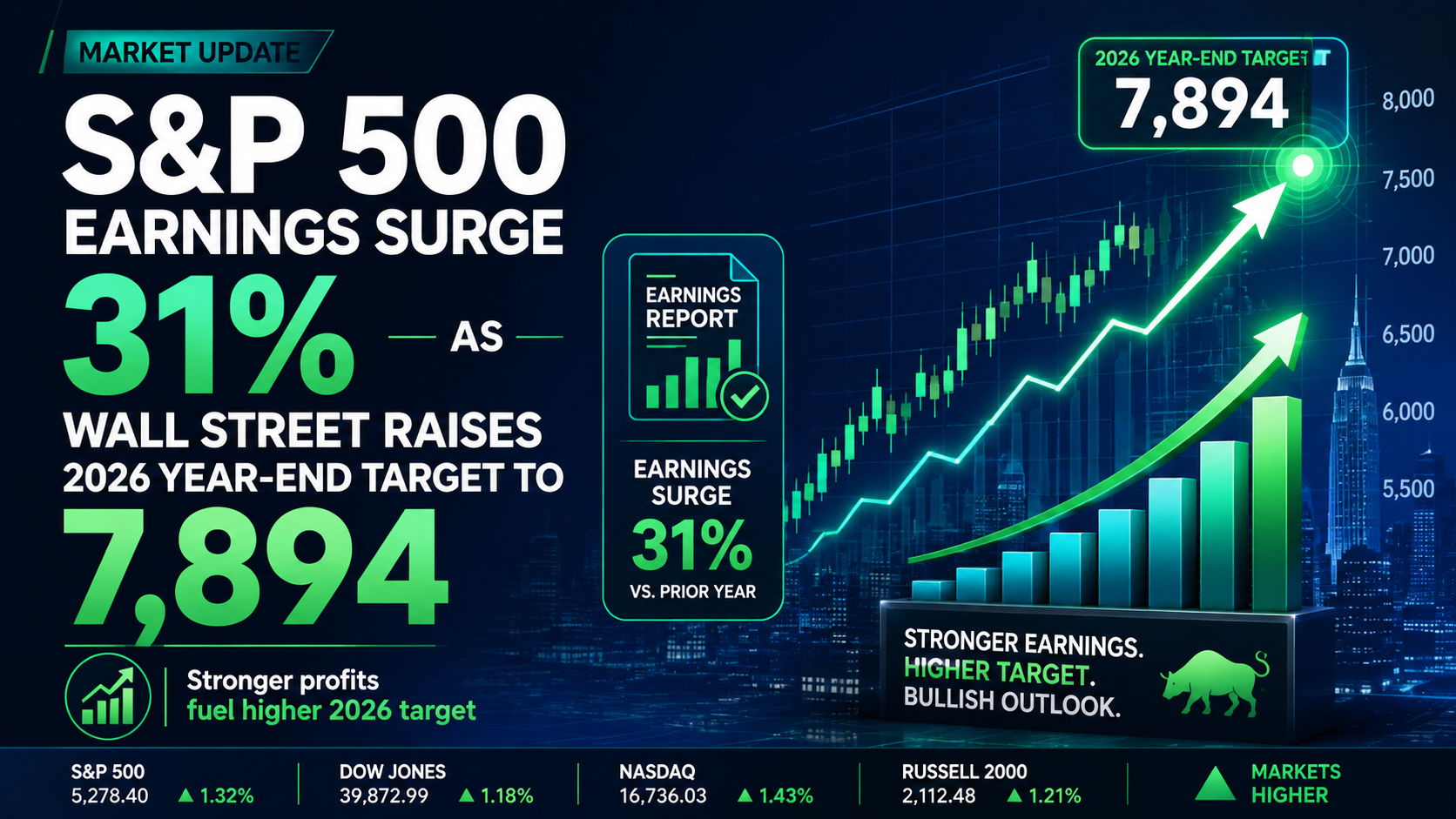
The S&P 500 earnings season has emerged as one of the strongest corporate profit periods in years, giving Wall Street another reason to reassess its outlook for U.S. equities in 2026. Adjusted second-quarter earnings increased by roughly 31% year over year, while an unusually high share of companies exceeded analysts' expectations. Technology and artificial intelligence infrastructure remained major contributors, but the strength of corporate profits also reflected higher revenues, strong margins and broader earnings participation across the index. Despite those fundamentals, Wall Street's average 2026 S&P 500 year-end target remains around 7,894, highlighting a growing tension between improving earnings and valuations that are already historically elevated. The next phase of the market will therefore depend not only on how much companies earn, but on whether those profits can continue expanding fast enough to justify record-level stock prices.
S&P 500 Q2 Earnings Surge 31% as Corporate Profits Beat Wall Street Expectations
The S&P 500 delivered a much stronger Q2 2026 earnings season than Wall Street expected, with adjusted corporate profits rising about 31% year over year according to LSEG data. That pace came in well above earlier expectations near 23% and helped reinforce the view that earnings growth, rather than valuation expansion alone, is supporting the U.S. stock market. Bloomberg Intelligence also described the underlying profit increase as the strongest non-recession-recovery earnings growth in its dataset going back to 1992. Strong revenue growth, resilient consumer and business demand, disciplined cost management and continued strength in technology all contributed to the results, while most S&P 500 sectors reported positive earnings growth. The scale of the upside surprise also matters for forward estimates, because stronger realized profits can encourage analysts to revise full-year earnings forecasts higher and potentially provide additional support for equity valuations.
S&P 500 Companies Beat Earnings Estimates at an Unusually High Rate
The strength of the quarter was not limited to headline profit growth. FactSet reported that roughly 86% of S&P 500 companies had beaten consensus earnings-per-share estimates by early August, well above the five- and 10-year historical averages. Revenue performance was also strong, with blended Q2 sales growth reaching around 15% year over year, suggesting that companies were generating higher profits through expanding business activity as well as margin improvement. Technology remained a major driver, supported by spending on artificial intelligence, cloud infrastructure and semiconductors, but the earnings improvement was broader than the mega-cap technology group alone. This breadth is important for the S&P 500 earnings outlook because a rally supported by rising profits across multiple sectors is generally more durable than one driven by only a small number of companies. It also reduces some of the concern that index-level earnings are being carried entirely by the largest technology stocks. If this broader participation continues through the second half of 2026, investors may place greater confidence in the sustainability of the current profit cycle.
Why S&P 500 Q2 Earnings Growth Is Reported at Both 31% and More Than 50%
Investors may see conflicting figures for S&P 500 Q2 earnings growth because major research providers use different methodologies. LSEG's adjusted data shows growth of roughly 31%, while FactSet's blended earnings figure rose above 50% during the reporting season. Much of that gap reflects unusually large investment-related gains recorded by Alphabet and Amazon, which boosted reported net income but were not generated entirely by their core operations. FactSet estimated that excluding those two companies would bring Q2 earnings growth down to about 32%, close to the LSEG figure. The distinction is important because it shows that the quarter was genuinely strong even without extraordinary gains: underlying corporate earnings were still expanding at roughly 31%–32%, making Q2 2026 one of the strongest profit-growth periods for the S&P 500 in recent years. For investors comparing earnings reports, separating operating performance from one-time investment gains provides a clearer picture of recurring profitability. It also helps explain why different financial data providers can publish sharply different headline growth rates while still pointing to the same broader conclusion of exceptionally strong earnings momentum.
AI, Technology and Record Profit Margins Drive S&P 500 Earnings Growth
Artificial intelligence spending, strong technology-sector profits and historically high corporate margins have become three of the most important forces behind S&P 500 earnings growth in 2026. The latest results show that the market's profit expansion is being supported not only by higher sales, but also by the ability of large companies to convert revenue into earnings more efficiently. AI-related infrastructure investment remains a major catalyst, particularly for semiconductor, cloud-computing and data-center businesses, while improving profitability across other industries is helping broaden the earnings cycle beyond a small group of mega-cap technology stocks. These trends are increasingly shaping the S&P 500 earnings forecast for the second half of 2026, as investors assess whether AI-led capital spending can continue translating into durable revenue and profit growth.
AI Infrastructure Spending Becomes a Major S&P 500 Earnings Driver
Artificial intelligence remains one of the clearest structural drivers of corporate investment in 2026. Goldman Sachs has estimated that AI-infrastructure beneficiaries could account for roughly half of S&P 500 earnings growth this year, highlighting how heavily the current profit cycle is tied to spending on chips, servers, cloud capacity, networking equipment and data centers. Major hyperscale technology companies continue to commit hundreds of billions of dollars to AI infrastructure, creating a powerful revenue pipeline for semiconductor manufacturers, equipment suppliers and cloud-service providers. Estimates cited by major Wall Street research firms place combined hyperscaler capital expenditure at roughly $750 billion to $800 billion in 2026, with spending expected to remain elevated as companies race to expand computing capacity and develop new AI products. This investment cycle is also creating secondary demand for power infrastructure, cooling systems, networking hardware and specialized data-center equipment, extending the economic impact of AI beyond software and chipmakers alone.
However, the earnings impact of AI is still uneven across corporate America. The clearest financial benefits are currently concentrated among companies building or supplying the infrastructure required to train and run advanced AI models, while the productivity gains for ordinary businesses are developing more gradually. Research cited by Goldman Sachs found that only a relatively small share of companies have so far quantified the direct earnings contribution from AI-driven productivity improvements. This suggests that the next stage of the AI earnings cycle could depend less on infrastructure spending alone and more on whether companies in finance, healthcare, industrials, retail and professional services can use AI to reduce costs, improve output and create new revenue streams. A broader shift from AI investment toward measurable productivity gains could become an important catalyst for future S&P 500 profit growth, particularly if adoption spreads across sectors that have so far benefited less directly from the infrastructure boom. Similar technologies are also increasingly being applied to AI-driven market analysis across digital-asset markets.
Technology Earnings Lead as Semiconductor and Cloud Demand Remain Strong
The technology sector has been the strongest contributor to S&P 500 profit growth, benefiting from sustained demand for AI computing, semiconductors, cloud services and digital infrastructure. LSEG data showed technology-sector earnings growing by roughly 72% year over year during Q2 2026, significantly faster than the broader index. Companies exposed to AI accelerators, advanced memory, networking and hyperscale cloud platforms have been among the biggest beneficiaries as global investment shifts toward computing-intensive workloads. At the same time, recurring software and cloud revenue has provided many large technology companies with relatively predictable cash flows, allowing them to maintain strong profitability even as capital spending rises. This combination of high-growth infrastructure demand and recurring digital revenue has helped technology remain the most influential earnings engine within the index.
Technology's dominance remains important, but the S&P 500 earnings outlook is becoming broader than the AI trade alone. Industrial, financial, communication-services and consumer-facing companies have also contributed to improving profits, helping reduce some of the market's dependence on a handful of mega-cap names. Broader earnings participation matters because it can provide a more stable foundation for index-level growth if technology-sector earnings eventually normalize from unusually high rates. Investors are therefore watching whether the second half of 2026 brings further expansion in earnings breadth, particularly among sectors that have lagged the AI-driven technology boom. A sustained improvement outside technology could also make the S&P 500's earnings profile more resilient if semiconductor demand, cloud spending or AI capital expenditure begins to cool from exceptionally strong levels.
Record S&P 500 Profit Margins Strengthen the 2026 Earnings Outlook
High corporate profitability has amplified the effect of revenue growth on overall earnings. FactSet estimated the S&P 500 net profit margin at around 15.7% in Q2 2026, potentially the highest level in its dataset going back to 2009 and close to the roughly 16% level highlighted in other market research. Strong margins suggest that large U.S. companies have been able to absorb higher labor, financing and investment costs while still protecting profitability through pricing power, operating efficiency, automation and disciplined spending. For investors, the key question is whether margins can remain near these elevated levels as revenue growth moderates later in 2026. If companies continue converting sales into profits at historically high rates while AI-related investment spreads across more industries, S&P 500 earnings growth could remain a central support for the market even if valuation multiples stop expanding. Margin resilience will therefore be an important metric to watch in upcoming quarters, particularly if wage costs, financing expenses or input prices begin to rise. Even modest margin compression could slow earnings growth, while stable margins would strengthen the case for continued profit expansion into 2027.
Why Wall Street’s 2026 S&P 500 Year-End Target Is Still Only 7,894
Wall Street’s average 2026 S&P 500 year-end target of 7,894 may look conservative given the strength of corporate earnings, but strategists are balancing strong fundamentals against already elevated stock prices and persistent macroeconomic risks. The index has been trading near record highs, which means much of the positive earnings outlook may already be reflected in valuations. Rather than assuming another sharp leg higher, many analysts are focusing on whether profit growth can stay strong enough to justify current multiples while interest rates, inflation and economic growth remain uncertain. The relatively modest upside embedded in the consensus target therefore reflects caution about how much additional good news the market can absorb without stronger earnings revisions or a more favorable interest-rate backdrop.
Elevated S&P 500 Valuations Limit the Upside Wall Street Is Willing to Price In
Even with stronger corporate results, Wall Street strategists remain cautious about how much further the S&P 500 can climb in 2026 because valuations are already elevated. The index has been trading near record highs, leaving less room for additional gains unless earnings continue to rise faster than expected. LSEG data placed the S&P 500 forward price-to-earnings ratio at roughly 20 times expected earnings in early August, still high compared with longer-term historical norms. This creates a difficult balance for strategists: stronger profits support current stock prices, but paying increasingly higher multiples for those earnings could make the market more vulnerable to disappointing economic data, rising bond yields or weaker corporate guidance. As a result, the average S&P 500 year-end target of 7,894 reflects expectations for continued earnings support without assuming another major expansion in valuations. In other words, Wall Street may be increasingly dependent on actual profit growth rather than investors simply becoming willing to pay more for each dollar of expected earnings.
Wall Street S&P 500 Forecasts Range From 7,100 to Above 8,000
The 7,894 figure is an average rather than a unified Wall Street forecast, and the gap between individual targets shows how divided strategists remain about the rest of 2026. J.P. Morgan raised its year-end target to 8,000 while lifting its 2026 earnings estimate, Citi has maintained a target around 8,100, and Yardeni Research has taken a more bullish view with an 8,400 target. Bank of America, by contrast, has remained considerably more cautious with a target near 7,100. These forecasts reflect different assumptions about economic growth, interest rates, corporate earnings and investor willingness to keep paying premium valuations for U.S. equities. The wide range also means the S&P 500 outlook for 2026 is less about whether profits are currently strong and more about whether those profits can continue growing fast enough to justify prices that already discount a favorable economic environment. The divergence between strategist targets also gives investors a clearer picture of the market's risk-reward balance, with bullish forecasts relying on stronger earnings persistence and cautious forecasts placing greater weight on valuation and macroeconomic risks.
Interest Rates, Inflation and Economic Risks Keep Strategists Cautious
Macro conditions remain one of the biggest reasons analysts are reluctant to push S&P 500 price targets substantially higher. Persistently high Treasury yields can make bonds more competitive with equities and increase the discount rate applied to future corporate cash flows, putting pressure on stock valuations even when earnings remain healthy. Investors are also watching inflation, Federal Reserve policy, labor-market conditions and signs of slower economic activity for clues about whether the current profit cycle can continue into 2027. Any renewed inflation pressure could keep interest rates higher for longer, while a sharper slowdown could weaken revenue and earnings expectations. That combination explains why Wall Street's 7,894 average year-end S&P 500 target remains relatively restrained: strategists are acknowledging strong fundamentals while leaving room for valuation, monetary-policy and economic risks that could limit further gains before the end of 2026. Changes in Treasury yields or Federal Reserve expectations could therefore become just as important for the index as company earnings during the final months of the year.
Conclusion
The S&P 500 earnings outlook for 2026 remains fundamentally strong, with Q2 results showing that corporate America is producing substantial profit growth even after extraordinary investment gains are excluded. Artificial intelligence infrastructure, technology demand, expanding revenues and historically high profit margins have strengthened the earnings backdrop, while improving results outside the largest technology companies could make the market's profit cycle more balanced. Yet strong earnings do not automatically translate into unlimited upside for stocks. With valuations already elevated and Wall Street's average year-end target near 7,894, investors are increasingly focused on whether earnings estimates can keep rising fast enough to offset risks from interest rates, inflation and slower economic growth. The remainder of 2026 could therefore become a test of whether corporate fundamentals can continue doing the heavy lifting as the S&P 500 trades near record territory. For digital-asset investors, tokenized S&P 500 exposure also shows how traditional equity benchmarks are increasingly intersecting with blockchain-based markets.
FAQs
What does strong S&P 500 earnings growth mean for investors?
Strong earnings growth generally suggests that large U.S. companies are generating more profit, which can support stock prices and make elevated valuations easier to justify. However, rising earnings do not guarantee further market gains because interest rates, economic growth, investor sentiment and valuation levels can still influence the S&P 500 outlook.
Is earnings growth more important than revenue growth for the S&P 500?
Both matter, but they measure different parts of corporate performance. Revenue growth shows whether companies are expanding sales, while earnings growth shows how efficiently those sales are being converted into profit. Investors usually view an environment with rising revenue and rising earnings together as healthier than one where profits improve mainly because of cost reductions.
What is an S&P 500 earnings surprise?
An earnings surprise occurs when a company's reported earnings per share are higher or lower than analysts expected. A positive surprise can improve investor confidence, especially when accompanied by strong guidance, while a negative surprise can pressure a stock even if the company remains profitable. During strong earnings seasons, the percentage of companies beating estimates is closely watched as a measure of corporate momentum.
Why can the S&P 500 rise even when some companies report weak earnings?
The S&P 500 is weighted by market capitalization, meaning the largest companies have a much greater influence on index performance than smaller members. Strong results from mega-cap technology and communication-services companies can therefore offset weakness elsewhere, although broader participation across sectors is generally considered a healthier sign for the market.
How do interest rates affect S&P 500 price targets?
Higher interest rates can reduce the present value investors assign to future corporate earnings and make bonds more attractive compared with stocks. Lower rates can have the opposite effect by supporting higher equity valuations. This is why Federal Reserve policy and Treasury yields often influence Wall Street's S&P 500 forecasts even when corporate profits are strong.
Could the S&P 500 reach 8,000 in 2026?
An S&P 500 level of 8,000 is within the range of several Wall Street forecasts, but reaching it would depend on continued earnings strength, stable economic conditions and investor willingness to maintain relatively high valuation multiples. Unexpected inflation, weaker growth or rising bond yields could make that level harder to achieve.
🔥 KuCoin Offers A More Stable Option in A Volatile Market
If you worry about the frequent ups and downs in the market, and pursue a more stable option to earn money passively, KuCoin is the right place to come:

Simple Earn: Deposit and withdraw tokens anytime, earning stable returns.
Kucoin Earn: Earn stable profits with professional asset management.
Hold to Earn: Earn rewards by holding assets in Funding, Trading, Margin, Futures, Mining, and Unified Accounts.
Staking: Unlock the earning potential of on-chain assets.
Advanced Investments: Advanced Investments offer a variety of structured products to help your money grow in any market.
Shark Fin: Principal Protection and Guaranteed Gains
Dual Investment: Buy low and sell high with transparent return calculations.
Snowball: High yields, with price protection.
Discount Buy: Buy crypto at discount prices.
KCS Loyalty: Level up to enjoy exclusive perks by staking ≥ 1 KCS.
KuCoin Wealth: Discover future value and begin your smart investing journey.
KCS Benefits: Hold and stake KCS to access benefits across the platform.
KCS Staking 2.0: Participate in KCS on-chain governance to earn yield.
Disclaimer: This content is for informational purposes only and does not constitute investment advice. Cryptocurrency investments carry risk. Please do your own research (DYOR).