

Sky Protocol Gets Moody’s B3 Rating: What It Means for USDS, DAI, and DeFi Risk
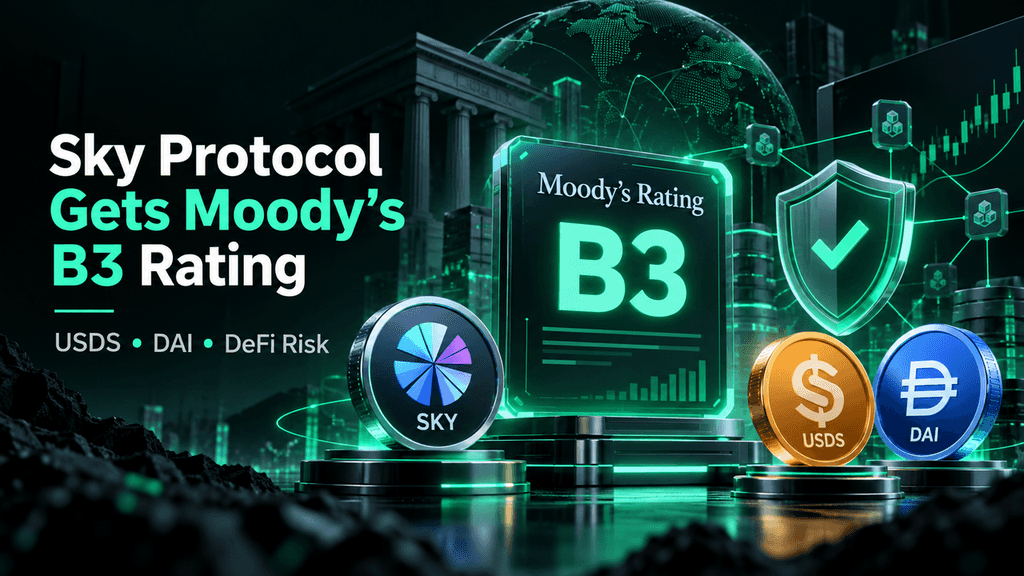
Moody’s Ratings assigned Sky Protocol a B3 counterparty risk rating on October 6, 2026, with a stable outlook announced by Sky Frontier Foundation the following day. The assessment raised concerns about the decentralized finance (DeFi) protocol’s financial resilience, particularly its 0.9% capital ratio, based on approximately $90 million in tangible common equity against $10 billion in managed assets. The decision followed S&P Global Ratings’ reaffirmation of Sky’s B− issuer credit rating on October 1. For holders of USDS and DAI, Moody’s assessment offers additional insight into protocol-level credit risks.
Key Takeaways
-
Moody’s B3 Rating: Moody’s assigned Sky Protocol a B3 counterparty risk rating on October 6, 2026. Sky Frontier Foundation reported a stable outlook, making Sky the first stablecoin protocol assessed by both Moody’s and S&P Global Ratings.
-
0.9% Capital Ratio: Sky held approximately $90 million in tangible common equity against $10 billion in managed assets as of September 2026, raising concerns about its capacity to absorb significant credit losses.
-
USDS and DAI Implications: Moody’s rating applies to Sky Protocol, not directly to its stablecoins. The assessment does not indicate that USDS or DAI has lost its dollar peg or that their collateral coverage is only 0.9%.
-
S&P B− Comparison: S&P Global Ratings reaffirmed Sky’s B− issuer credit rating with a stable outlook on October 1, 2026. Both agencies assigned speculative-grade assessments, although their rating classifications and methodologies differ.
-
Institutional DeFi Adoption: Galaxy Digital announced a $100 million sUSDS treasury allocation on September 23, 2026, before Moody’s rating decision, demonstrating institutional participation despite Sky’s underlying credit risks.
-
Credit Rating Outlook: Moody’s indicated that sustained capitalization above 2.5%, alongside favorable financial conditions, could support an upgrade. Capitalization below 0.5%, recurring losses, or weaker liquidity could contribute to a downgrade.
Moody’s Assigns Sky Protocol B3 Rating With Stable Outlook
Sky Protocol, previously known as MakerDAO, became the first stablecoin protocol to receive a Moody’s credit assessment, according to Sky Frontier Foundation. The foundation announced the decision on October 7, 2026, noting that Sky had already undergone a separate assessment by S&P Global Ratings. The two agencies used their own methodologies to evaluate the protocol’s financial position, governance arrangements, and capacity to meet relevant obligations. The assessments give institutional counterparties additional information about Sky’s creditworthiness, although they do not eliminate the risks associated with decentralized financial infrastructure.
What Does Moody’s B3 Rating Mean?
A B3 rating falls within Moody’s speculative-grade category, indicating high credit risk compared with investment-grade institutions. It is the lowest rating within Moody’s B category, sitting below B2 and immediately above Caa1. The stable outlook reported by Sky Frontier Foundation indicates an expectation of relative rating stability over the applicable assessment horizon. However, it does not guarantee that Sky’s financial position will remain unchanged or that future credit losses cannot occur. Investors must also consider liquidity, asset quality, and operational exposure when evaluating the protocol’s financial strength.
Importantly, Moody’s assigned a counterparty risk rating (CRR) rather than a conventional issuer credit rating. A counterparty risk rating addresses an entity’s ability to meet certain financial obligations, while an issuer credit rating generally evaluates its capacity to meet financial commitments as they come due. The distinction became important after Sky Frontier Foundation corrected the headline of its original announcement on October 8, replacing issuer rating with counterparty risk rating. Moody’s publicly accessible rating listing confirms the B3 classification, although it does not provide full details of the specific obligations covered. The rating should therefore not be interpreted as a guarantee of individual token redemption.
How Does Moody’s Rating Affect Institutional DeFi?
Independent credit ratings provide financial institutions with a familiar way to assess exposure to decentralized finance (DeFi) protocols. For Sky, Moody’s assessment offers an external credit opinion that institutions can consider alongside their own due diligence. Banks, asset managers, and trading firms may use such information when reviewing counterparty relationships or setting internal exposure limits. Nevertheless, a B3 rating is not regulatory approval or an investment recommendation, and it does not replace independent assessments of smart-contract security, collateral arrangements, or operational controls.
The rating also has several implications for Sky’s institutional development:
-
Independent risk evaluation: Institutional counterparties can compare Sky’s credit profile with other rated financial exposures using established rating frameworks, while accounting for methodological differences.
-
Governance scrutiny: Sky Frontier Foundation stated that the rating process involved a detailed review of the protocol’s operations and governance arrangements, introducing additional external scrutiny of its decentralized structure.
-
Long-term financial objectives: The foundation identified stronger reserves and an eventual investment-grade rating as objectives. Achieving these would depend on sustained financial improvements and future independent assessments.
Sky Protocol’s 0.9% Capital Ratio, Credit Risks, and S&P B− Comparison
Moody’s assessment identified weak capitalization as a material constraint on Sky Protocol’s credit profile, despite its history of relatively limited credit losses and substantial liquid-asset holdings. The central concern is whether the protocol can absorb unexpected financial losses while continuing to meet its obligations during periods of market stress. This makes Sky’s capital-management framework particularly relevant as its stablecoin supply, lending exposure, and network of asset managers continue to evolve.
Why Sky Protocol’s 0.9% Capital Ratio Raises Credit Concerns
Sky’s 0.9% capital ratio measures tangible common equity relative to tangible managed assets, indicating the size of its loss-absorbing capital buffer compared with its financial exposures. Moody’s September 2026 figures showed approximately $90 million in tangible common equity supporting $10 billion in managed assets. A relatively small equity cushion can increase vulnerability to unexpected credit losses, particularly when exposures involve volatile collateral or counterparties. However, the ratio does not mean USDS and DAI are only 0.9% backed. Capital adequacy and stablecoin collateral coverage measure different aspects of financial risk.
Sky Frontier Foundation’s September 17 financial update reported that Sky Reserves stood at $76.99 million at the end of August, compared with a governance-set $150 million solvency reserve target. The lower month-end balance followed a $16 million transfer outside the reserve-reporting perimeter, which the foundation stated was not a protocol expense. Moody’s indicated that sustained capitalization above 2.5%, alongside satisfactory profitability, liquidity, and asset risk, could support a future upgrade. Assuming managed assets remain unchanged at $10 billion, reaching a 2.5% tangible equity ratio would require approximately $250 million in equity, or $160 million above September’s reported level. This is an illustrative calculation rather than a separate reserve requirement announced by Moody’s.
What Are the Main Credit Risks Facing Sky Protocol?
Moody’s assessment recognized several financial strengths, including a relatively liquid asset portfolio, profitability, and a limited history of credit losses. Since 2020, Sky has recorded approximately $15 million in cumulative credit losses, while stablecoins and tokenized money-market funds account for roughly 45%–50% of managed assets. These holdings may support liquidity management during changing market conditions. However, Sky’s financial resilience also depends on collateral performance, counterparties meeting their obligations, and the effectiveness of its automated risk-management systems.
Beyond its capitalization concerns, several factors influence the protocol’s credit profile:
-
Crypto-backed lending exposure: Approximately 25% of managed assets consist of cryptocurrency-backed loans. Sharp collateral-price declines or delayed liquidations could increase credit losses if collateral proceeds fail to cover outstanding debt.
-
Stablecoin withdrawal pressure: Concentrated conversion requests could strain available liquidity, particularly if demand for USDC exceeds the assets readily available through Sky’s Peg Stability Module.
-
Smart-contract vulnerabilities: Technical failures, oracle manipulation, or unexpected liquidation-system problems could disrupt operations or create financial losses.
-
Governance and legal uncertainty: Sky’s decentralized autonomous organization (DAO) structure introduces accountability, coordination, and legal-enforcement considerations that differ from conventional financial institutions.
Moody’s also identified potential downside rating conditions, including capitalization falling below 0.5%, consecutive quarterly losses, or deteriorating liquidity. These conditions could contribute to a downgrade, depending on the broader credit assessment, but they should not be interpreted as predictions that Sky will experience financial distress.
Moody’s B3 vs. S&P B−: How Do Sky Protocol’s Credit Ratings Compare
Moody’s B3 and S&P Global Ratings’ B− are broadly comparable speculative-grade assessments, although they reflect different rating classifications and methodologies. S&P initially assigned Sky a B− issuer credit rating on August 7, 2025, and reaffirmed it with a stable outlook on October 1, 2026. Its analysis identified concentrated stablecoin liabilities, governance dependencies, liquidity management, and weak risk-adjusted capitalization as important concerns. S&P’s original assessment reported a risk-adjusted capital ratio of 0.4% as of July 27, 2025. That figure cannot be directly compared with Moody’s September 2026 tangible equity ratio because the agencies use different capital measurements.
S&P’s October 2026 reassessment also reflected changes in Sky’s asset composition and operating structure. Combined USDS and DAI supply had reached approximately $9.5 billion, while USDC and Treasury-backed tokenized money-market funds totaled about $4.92 billion, representing roughly half of circulating stablecoin supply. Meanwhile, Sky’s Prime Agent network, including Spark and Grove, had expanded its role in managing protocol assets. Although these arrangements support diversified capital allocation, they also introduce additional monitoring and management complexity. Both agencies recognize Sky’s liquidity resources and operating history while remaining cautious about its ability to absorb losses and manage financial stress.
What Does Moody’s B3 Rating Mean for USDS, DAI, and DeFi Investors?
Moody’s B3 rating indicates elevated credit risk within Sky Protocol, but it does not mean USDS has received a separate B3 rating or lost its dollar peg. USDS is designed to maintain a value close to $1 through Sky’s collateral-backed issuance system and stablecoin conversion mechanisms. The assessment gives USDS holders additional information about the financial position of the protocol supporting their assets. However, it does not directly measure USDS market-price stability or guarantee redemption under stressed conditions. Financial deterioration within Sky could increase stablecoin risks if it affected available liquidity, collateral values, or confidence in the protocol.
How Does Moody’s Rating Affect DAI and sUSDS Holders?
DAI and USDS share underlying issuance infrastructure, meaning certain financial risks within Sky Protocol are relevant to both stablecoins. According to Sky’s official documentation, holders can convert DAI into USDS and vice versa at a fixed 1:1 ratio through an Ethereum-based smart contract without protocol conversion fees. However, this mechanism does not guarantee that either token will always trade at exactly $1 on external cryptocurrency exchanges. S&P Global Ratings separately assessed the ability of USDS and DAI to maintain their dollar pegs at 4 (constrained) on December 8, 2025. This was a stablecoin stability assessment, not an additional issuer credit rating. Meanwhile, sUSDS introduces savings-related considerations because its value relative to USDS reflects the governance-set Sky Savings Rate, which can change over time.
What Should DeFi Investors Monitor After Moody’s B3 Rating?
For DeFi investors, the credit assessment provides another way to evaluate exposure to Sky Protocol, but it should not be treated as a direct trading signal. USDS and DAI holders are primarily concerned with stablecoin value and convertibility, while sUSDS users must also understand savings returns and withdrawal mechanics. SKY governance-token investors face separate market-price and tokenomics risks. The rating itself does not establish whether the SKY token price will rise or fall, and its announcement should not be treated as proof of a particular market reaction.
Several practical indicators can help investors evaluate their exposure:
-
Stablecoin market prices: Monitor USDS and DAI across major liquidity venues. Persistent deviations from $1 may indicate changing market confidence or difficulties accessing liquidity.
-
Savings rates and withdrawals: Track changes to the Sky Savings Rate and the amount of USDS redeemable for each sUSDS share, particularly when comparing returns across DeFi savings products.
-
DeFi lending positions: Review collateral requirements and liquidation thresholds when using USDS or DAI in borrowing protocols. Price deviations may have greater consequences for leveraged positions.
-
Cross-chain availability: Check supported networks, bridge arrangements, and contract addresses before transferring Sky-related assets. Conversion routes available on Ethereum may not operate identically across other networks.
Monitoring these indicators alongside Sky’s financial disclosures can provide a clearer view of holder-level exposure. Investors should distinguish between protocol creditworthiness, stablecoin stability, and governance-token market risk, since each involves different financial mechanisms.
How Could Sky Protocol’s Credit Risks Affect the Wider DeFi Market
Financial stress within Sky Protocol could affect other decentralized applications that use USDS or DAI as collateral, trading liquidity, or settlement assets. If either stablecoin experienced a sustained deviation from its dollar peg, lending platforms might adjust collateral valuations, potentially increasing liquidation pressure on borrowers with leveraged positions. Liquidity providers could also face imbalanced trading pools or higher withdrawal costs as users attempt to exchange stablecoins. These effects could extend across interconnected protocols, depending on their exposure limits, available liquidity, and risk controls. However, Moody’s B3 rating does not establish that such contagion is occurring or will occur. The potential impact would depend on the severity of any financial stress and how individual DeFi platforms manage their exposure to Sky-related assets.
Conclusion
Moody’s B3 counterparty risk rating adds an independent credit assessment to Sky Protocol’s expanding role in decentralized finance. Although Sky maintains substantial managed assets, relatively liquid holdings, and a history of limited credit losses, its weak capitalization remains an important financial concern. S&P Global Ratings’ separate B− assessment also reflects caution about the protocol’s financial resilience and risk-management structure.
For USDS and DAI holders, the rating provides additional information about the infrastructure supporting their stablecoins without directly determining their market value or guaranteeing redemption. Sky’s ability to strengthen its credit profile will depend on future reserve accumulation, asset performance, liquidity management, and governance decisions. Investors should evaluate these developments alongside the risks of their specific holdings rather than relying on a single credit rating.
🔥 Beyond the Headlines: What KuCoin 5.0 Means for You
Market news moves fast — but where you act on it matters just as much. This October, KuCoin launches KuCoin 5.0, transforming KuCoin into a rebuilt platform. Here's what actually changes for you:
-
One account for everything. Older platforms split your money across separate "spot," "margin," and "futures" accounts and expected you to understand why. KuCoin 5.0's unified account removes that entirely — deposit once, and everything is simply there (only available to VIPs for now).
-
Stocks, indices, and commodities. KuCoin 5.0 expands beyond crypto into global markets. When crypto chops sideways and equities rally (or the reverse), you rotate in minutes instead of opening a brokerage account and waiting days for fiat rails.
-
Real-world assets (RWA). Tokenized exposure to traditional assets like commodities, right inside your crypto account. One of the fastest-growing segments in global finance is no longer reserved for institutions — you access it from the same balance you trade with.
-
Earn while you learn. Not ready to trade? KCUSD lets your stablecoins earn daily, auto-compounding interest. The lowest-stress way to put your idle deposit to work for 4% yield.
-
An AI assistant in plain language. Ask questions, get market context, understand what you're looking at — built into the platform, no jargon required.
-
An app that doesn't overwhelm. Faster, cleaner, and consistent — intuitive from the first tap, not after a tutorial.
-
Safety you can check, not just trust. A MiCAR-licensed EU entity, Proof of Reserves you can verify yourself, and internationally certified security (SOC 2 Type II, ISO 27001:2022).
Create your account in minutes — and start on the platform built for where crypto is going, not where it's been.
FAQs
Can USDS Holders Redeem Their Tokens for US Dollars?
Sky Protocol supports on-chain conversions between USDS and USDC through its Peg Stability Module infrastructure. However, exchanging USDS for USDC is different from redeeming tokens directly for dollars in a bank account. Obtaining fiat currency generally requires an additional service, such as an exchange or eligible redemption provider, subject to its terms and availability.
What Assets Back Sky Protocol’s Stablecoins?
Sky Protocol uses a diversified collateral system that includes crypto-backed lending positions, stablecoin holdings, and tokenized financial assets. Some exposures involve tokenized money-market funds and traditional financial counterparties. These assets carry different credit, custody, and liquidity risks, making collateral quality and accessibility important considerations alongside the total reported collateral value.
Can Sky Protocol Change Its Stablecoin Conversion Fees?
Yes, certain conversion fees can change through governance decisions. Sky’s USDS-to-USDC liquidity infrastructure supports swaps under governance-controlled parameters, which may be adjusted. By contrast, the official DAI-to-USDS converter does not charge conversion fees and is designed to prevent such fees from being introduced. Ethereum network transaction costs may still apply.
What Is the Difference Between sUSDS and stUSDS?
sUSDS and stUSDS serve different financial purposes. sUSDS provides exposure to the Sky Savings Rate through a tokenized savings vault. In contrast, stUSDS is a risk-capital token that supports liquidity for SKY-backed borrowing and is structured to absorb greater system risk in exchange for potentially higher rewards. Its redemption liquidity also depends on lending-pool utilization, making its risk profile different from sUSDS.
Disclaimer
The information provided on this page may originate from third-party sources and does not necessarily represent the views or opinions of KuCoin. This content is intended solely for general informational purposes and should not be considered financial, investment, or professional advice. KuCoin does not guarantee the accuracy, completeness, or reliability of the information, and is not responsible for any errors, omissions, or outcomes resulting from its use. Investing in digital assets carries inherent risks. Please carefully evaluate your risk tolerance and financial situation before making any investment decisions. For further details, please consult KuCoin’s Terms of Use and Risk Disclosure.