

OpenAI’s $30 Billion Funding Round: Valuation, Investors, and Anthropic IPO Competition
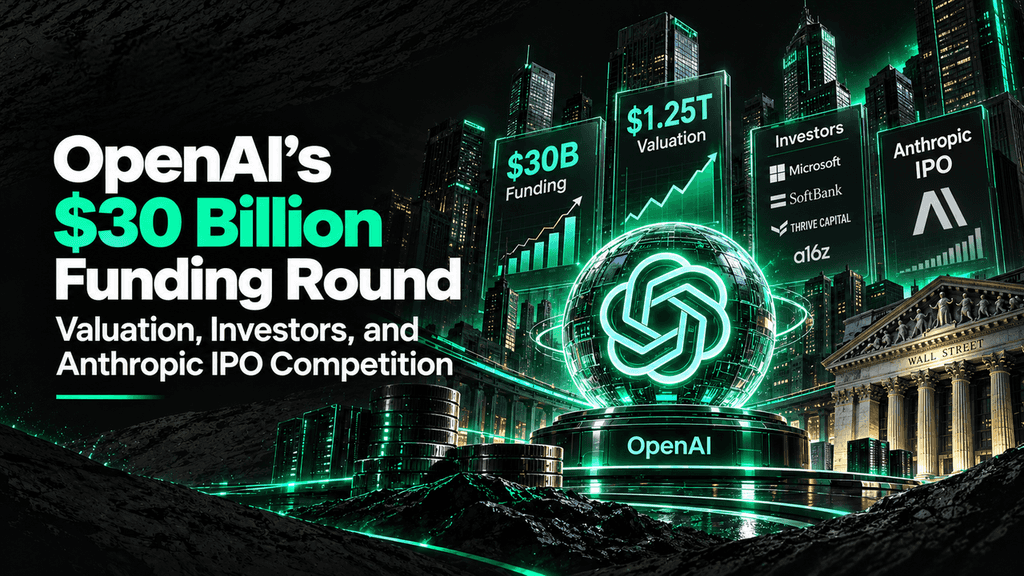
OpenAI is seeking up to $30 billion in private financing at a reported $1.25 trillion pre-money valuation, according to October 22–23, 2026 reporting by CNBC and Bloomberg. Coatue Management and investors from the United Arab Emirates are in talks to lead the deal as rival Anthropic prepares for a possible November initial public offering (IPO). The proposed transaction could strengthen OpenAI's balance sheet ahead of its own potential listing, but its size, pricing, and investor commitments have not been finalized. The figures describe negotiations, not capital already received.
Key Takeaways
-
Financing is still under negotiation. OpenAI is reportedly seeking investor commitments by October 30, 2026, with the final amount and closing terms yet to be confirmed.
-
The proposed valuation has been revised downward. The $1.25 trillion pre-money target is $150 billion below the previously reported $1.4 trillion figure, a difference of approximately 10.7%.
-
Institutional investors are in discussions. Coatue and UAE-based funds are prospective leads, while existing backers SoftBank Group and MGX have also been named in reporting.
-
Revenue growth must be weighed against computing costs. Reuters reported a September annualized revenue figure approaching $50 billion, while model development and deployment require substantial infrastructure spending.
-
Anthropic's prospective IPO adds competitive pressure. Both companies have submitted confidential registration documents, but neither has established a final public listing date.
-
Financial comparisons require caution. Private financing terms, revenue accounting, IPO disclosures, and derivative pricing measure different things and should not be treated as interchangeable.
OpenAI’s $30 Billion Funding Round and $1.25 Trillion Valuation
The latest funding discussions are taking place only months after OpenAI completed its previous major financing. Unlike an exchange-traded share price, a private-market valuation is negotiated between the company and investors, often alongside detailed terms governing the securities being sold. That distinction matters when comparing the latest proposal with earlier funding rounds or potential future IPO pricing.
Latest Funding Terms and Expected Closing Timeline
The Financial Times reported that prospective investors have until October 30, 2026 to make commitments, although OpenAI may raise less than its maximum target if demand or final pricing changes. CNBC reported that discussions began after investors approached OpenAI with proposals in September, and The Information described the new financing as nearing completion. An investor commitment deadline is not necessarily a legal closing date: allocations, definitive agreements, and funding transfers may follow different schedules. OpenAI had not publicly announced the completion of the proposed October round as of October 24.
A pre-money valuation describes a company's estimated equity value before fresh funding is added. At the terms being discussed, receiving the full $30 billion would produce an illustrative $1.28 trillion post-money valuation, calculated by adding new financing to the $1.25 trillion pre-money amount. That simple calculation assumes equity capital is issued without additional adjustments or unusual security terms. It does not establish the price at which shares would trade after an IPO.
Valuation Reduction and Previous Funding Comparison
Bloomberg reported that the valuation target moved from $1.4 trillion to $1.25 trillion, a $150 billion reduction. The Financial Times linked the lower negotiating price to weaker investor demand at the higher level amid greater scrutiny of technology valuations and AI infrastructure costs. This is a change in the proposed price of a private financing, not a realized decline in the market capitalization of a listed company. The following completed and proposed transactions show how the reported figures fit together:
-
March 2025: OpenAI announced $40 billion in funding at a $300 billion post-money valuation, establishing an earlier private financing benchmark.
-
March 2026: OpenAI announced $122 billion in committed capital at an $852 billion post-money valuation; committed capital should not automatically be treated as cash already deployed.
-
October 2026: The new $1.25 trillion pre-money target is approximately 46.7% higher than the March post-money figure, although these figures refer to different transaction stages and valuation bases.
OpenAI’s Major Investors, Revenue Growth, and AI Infrastructure Strategy
The latest investment discussions involve financial institutions with existing exposure to technology and large-scale infrastructure. OpenAI's commercial growth gives it a stronger revenue base to present to prospective backers, while its computing commitments create significant capital requirements. Investors must evaluate both sides of that equation rather than assuming fast sales growth translates directly into profitability. The potential financing also brings together traditional investment capital and negotiations over access to computing capacity.
Coatue, UAE Investors, SoftBank, and MGX Funding Discussions
Coatue Management and UAE-based investment funds are reportedly in talks to co-lead the transaction, according to CNBC and Bloomberg. The participation of these groups could provide OpenAI with a broader pool of long-term institutional capital, but no final October allocation has been announced publicly. Bloomberg also reported discussions with BlackRock-affiliated investors, and Reuters described meetings with sovereign wealth funds and long-only investment managers. The prospective contributors have different histories with OpenAI, so prior backing should not be confused with a fresh commitment to this deal.
-
SoftBank Group: A major investor in OpenAI's March financing, it was identified by Reuters as a possible participant in the new round.
-
MGX: The Abu Dhabi-based investment firm previously backed OpenAI and has been named among investors discussing further participation.
-
BlackRock-affiliated funds: Bloomberg reported talks involving BlackRock, but the size and outcome of any new investment remain unconfirmed.
OpenAI’s 2026 Revenue Growth and Financial Performance
Reuters reported that OpenAI told investors its September annualized revenue was approaching $50 billion. In separate fundraising discussions, the company reportedly projected a $70 billion annualized pace by the end of 2026, a forward-looking target rather than recognized full-year sales. Reuters also said OpenAI attributed stronger usage to the launch of GPT-6 Astra and lower prices for some smaller models. These are investor-presentation claims reported by journalists, not independently audited results for a complete financial year.
Annualized revenue generally extrapolates sales over a shorter period and can change quickly when customers increase or reduce spending. OpenAI earns revenue through ChatGPT subscriptions, business products, API access, and Codex, giving it more than one route to commercial demand. Still, the economics depend on how much computing each service consumes and the prices customers pay. Investors considering the company's financial performance need information on operating margins, cash requirements, and the durability of customer spending, not simply a run-rate number.
AI Infrastructure Spending, Computing Capacity, and Future Funding Needs
Advanced AI systems require significant capacity for model training and for inference, the computing work performed when users send requests to a deployed model. That involves specialized processors, data centers, networking equipment, electricity, and ongoing maintenance. OpenAI has identified durable access to computing resources as a strategic priority in its official financing announcement. The scale of these commitments can put pressure on cash flow even when revenue is growing rapidly.
CNBC also reported negotiations over a separate agreement that could provide OpenAI with additional computing capacity in the UAE. The structure, size, and final approval of that arrangement have not been disclosed, so it should not be described as an operating facility already secured. Additional capacity could support enterprise demand and future model development, but its value would depend on utilization, costs, and reliable delivery. Investors will want to distinguish capital raised from infrastructure commitments made, since the financial consequences differ.
OpenAI vs. Anthropic IPO Competition, Valuation Comparison, and Investor Risks
Anthropic's possible public debut could give investors their first widely traded valuation reference for a frontier AI model developer. That prospect adds urgency to competing fundraising plans, particularly where institutional investors are weighing allocations to both companies. Yet an IPO price reflects the shares and disclosures of one issuer, not a universal benchmark that automatically determines another company's valuation. Differences in revenue, capital requirements, and investor rights make the comparison more complicated.
Anthropic’s Expected IPO Timeline and Competition for Institutional Capital
Anthropic announced its confidential draft Form S-1 submission to the U.S. Securities and Exchange Commission on June 1, 2026; OpenAI disclosed its own submission on June 8. Reuters has reported that Anthropic is aiming for a mid-November listing, while OpenAI has left its timing open and may remain private longer. A confidential registration submission starts regulatory review but does not guarantee that shares will be sold or establish their offering price. SEC guidance generally requires the relevant confidential submissions to become public at least 15 days before a formal IPO roadshow.
A public Anthropic prospectus would give investors more detail about revenue recognition, operating losses, cash flow, and commitments than private fundraising summaries typically provide. Those disclosures could influence how institutions allocate their capital across the two companies. Traders can also observe Anthropic pre-IPO perpetual futures, although derivative quotes reflect contract trading rather than actual Anthropic shares or confirmed IPO pricing. A derivative market is not a substitute for an issuer's filings or an underwritten offering.
OpenAI vs. Anthropic Revenue, Funding, and Valuation Comparison
Anthropic officially announced a $65 billion Series H round at a $965 billion post-money valuation on May 28, 2026. Reuters has reported discussions around an IPO valuation closer to $1.5 trillion, compared with an earlier aspiration near $2 trillion; neither level is an agreed public offering price. Separately, Anthropic told prospective investors that revenue reached $16.8 billion in the third quarter, up about 45% from $11.6 billion in the previous quarter. These figures give analysts evidence of growth, but valuation judgments also require understanding how and when sales are counted.
Reuters reported Anthropic's annualized revenue crossed approximately $65 billion in July, while noting differences between how the two companies account for sales made through cloud partners. Some Anthropic figures include the gross value of transactions handled by third-party providers, whereas OpenAI excludes certain partner sales from its own reported total. Comparisons therefore need consistent periods and accounting definitions before one business can be described as generating more comparable revenue. Similarly, OpenAI pre-IPO perpetual futures provide market exposure to expectations, not an official equity valuation or access to shareholder rights.
IPO Valuation Risks, Financial Disclosures, and Market Conditions
Reuters reported that a draft Anthropic prospectus showed a $80.7 billion net loss for the first half of 2026, including approximately $72 billion in non-cash accounting charges relating to convertible financing instruments. Those charges are important when interpreting net income because they are not equivalent to cash spent on operations. Other expenses, infrastructure commitments, and financial obligations still matter, but they need to be evaluated separately. Investors assessing a future AI IPO should look closely at audited statements, cash flow, securities terms, and the assumptions behind growth forecasts.
Several factors could affect both companies' plans:
-
Investor appetite: Volatility in technology equities and changes in financing costs could affect the valuations institutions are prepared to accept.
-
Business economics: Model pricing, customer retention, and the cost of delivering responses influence whether revenue growth translates into sustainable margins.
-
Disclosure and timing: Regulatory review, updated financial statements, and market conditions may change IPO schedules or final offering terms.
-
Derivative risk: Pre-IPO contracts can involve leverage, funding payments, sharp repricing, and liquidation, which differ from the risks of holding actual company equity.
For readers evaluating synthetic exposure, the mechanics of pre-IPO futures are especially relevant because contracts typically settle financially instead of delivering shares. A strong reception for Anthropic's listing might provide a useful comparison for OpenAI, but the outcome would not establish a guaranteed price for either company. The key unresolved questions concern valuation discipline, reliable financial disclosures, and the amount of capital each business will require after any public offering.
Upcoming Milestones for OpenAI Funding and Anthropic IPO
The next developments in OpenAI's fundraising and Anthropic's IPO preparations will help investors distinguish reported expectations from completed financial transactions. Although both companies have taken steps toward raising additional capital, the final terms, public disclosures, and offering schedules remain important variables. Investors should focus on official announcements and regulatory filings to determine whether the reported financing plans are progressing as expected.
-
Final funding confirmation: Watch for OpenAI's announcement of the completed investment amount, participating investors, share terms, and final valuation.
-
Anthropic's public SEC prospectus: The publication of its Form S-1 would provide greater visibility into financial statements, ownership structure, proposed share offerings, and material business risks.
-
IPO pricing and share allocation: Confirmed offering documents could establish the number of shares offered, expected pricing range, and potential proceeds before public trading begins.
-
AI infrastructure agreements: Any finalized computing-capacity arrangements could provide additional information about OpenAI's future investment commitments and operational costs.
Conclusion
OpenAI's proposed $30 billion funding round reflects the substantial capital requirements of expanding its AI business, while its revised $1.25 trillion valuation shows how investor expectations can influence private financing negotiations. The involvement of major institutional investors and the company's reported revenue growth support its fundraising ambitions, but the final transaction terms remain uncertain. Sustainable profitability, computing costs, and financial transparency will be important in assessing OpenAI's long-term valuation.
Anthropic's anticipated IPO could provide a useful public-market comparison for OpenAI and other major AI developers. However, differences in business models, financial reporting, and infrastructure commitments mean their valuations cannot be compared through headline figures alone. Investors should monitor official funding announcements, SEC disclosures, and confirmed IPO developments before drawing conclusions about either company's financial outlook.
FAQs
How is the final IPO share price determined?
A company and its underwriting banks usually determine the initial offering price after assessing investor demand, financial information, comparable listed businesses, and market conditions. The price may differ from earlier private investment valuations because the securities and market setting differ. Once trading begins, the stock price can move above or below the offering price.
Can a new funding round dilute existing OpenAI shareholders?
Yes. Issuing additional shares can reduce existing investors' percentage ownership, depending on the transaction terms and whether they participate. Preferred-share rights, conversion terms, and other negotiated provisions may also affect the financial consequences. A higher headline valuation does not automatically mean every shareholder's economic position improves.
Why can private funding valuations differ from public-market valuations?
Private financing often involves negotiated rights such as liquidation preferences or conversion provisions. Public-market prices instead reflect trading in securities available to exchange investors, whose rights may not match those of earlier private backers. As a result, a private funding valuation should not automatically be treated as a forecast for an IPO share price.
What financial disclosures should investors review before an AI company IPO?
Investors should examine audited financial statements, the revenue recognition policy, operating cash flow, customer concentration, debt, share structure, and material contractual commitments. For AI developers, computing obligations and the cost of delivering services can be particularly important. Comparing these items over consistent periods provides more insight than headline revenue growth alone.
Disclaimer
This general market information, possibly from third-party, commercial, or sponsored sources, is provided for reference and educational purposes only and does not constitute financial or investment advice, an offer, solicitation, or guarantee. We disclaim liability for its accuracy, completeness, reliability, and any resulting losses. Investments/trading are risky; past performance doesn’t guarantee future results. Users should research, judge prudently, and take full responsibility. For further details, please consult KuCoin’s Terms of Use and Risk Disclosure.