

Monad (MON) Price Plunges 25% After Massive 16.61 Billion Token Unlock in November 2026
Monad (MON) fell 25% in a reported 24-hour snapshot after a 16.61 billion token unlock. Price data, supply changes, and vesting through 2029.
Monad (MON) faced a sharp sell-off around its first major insider token release on November 24, 2026, when approximately 16.61 billion MON became eligible for distribution to team members, investors, and the Category Labs treasury. A November 25 market report recorded a 25.4% decline over a rolling 24-hour period. Daily closing prices tell a more detailed story: MON lost 17.95% on November 24 before recovering 16.83% on November 25, according to CoinGecko. The release was unusually large relative to the supply previously circulating, placing attention on actual wallet movements, market liquidity, and the vesting commitments that continue through 2029.
Key Takeaways
-
MON fell 25.4% in a reported rolling 24-hour snapshot on November 25, following its first major insider token release.
-
CoinGecko recorded a 17.95% closing-price decline on November 24, followed by a 16.83% rebound the next day.
-
About 16.61 billion MON became eligible for release, equivalent to roughly 140.5% of the estimated pre-event circulating supply.
-
The event covered approximately 10.7 billion team tokens, 4.925 billion investor tokens, and 987.5 million treasury tokens.
-
Circulating-supply estimates differed among data providers, and publicly available figures did not establish how much MON unlock recipients actually sold.
-
The next dated release is scheduled for December 24, 2026, alongside continuing team vesting and further releases through 2029.
Why Did Monad (MON) Price Drop 25% After the November 2026 Token Unlock?
The immediate concern was the expiration of a one-year lock-up on MON allocated to insiders. Monad launched its public mainnet on November 24, 2025, and its original token-sale disclosure established that restriction for team, investor, and Category Labs treasury holdings. The November 2026 anniversary therefore marked a major change in who could access previously restricted tokens. A November 25 report recorded a 25.4% rolling 24-hour decline to approximately $0.01012, although the timing alone cannot establish exactly which orders drove the sell-off.
An unlock can affect prices before recipients make any transfers. Market participants know the vesting calendar in advance and may adjust their expectations of future supply, particularly when the release is large compared with the amount regularly changing hands. In a thin market, relatively modest sell orders can move the quoted price sharply. By contrast, tokens that remain in recipient wallets or are delegated for staking add no immediate sell orders, even if their transfer restrictions have expired.
MON was also under pressure before the anniversary. CoinGecko's daily historical series shows the token at about $0.01732 on November 12 and $0.01153 on November 23, a decline of roughly one-third before the unlock date. That earlier weakness matters because a single-day headline can make the November 24 event look like the entire explanation. The more defensible interpretation is that a large, well-publicized supply event coincided with a sell-off already in progress; the precise contribution of insider selling has not been quantified.
Monad (MON) Price Performance Before and After the November 24 Token Unlock
MON's daily close was approximately $0.011532 on November 23, according to CoinGecko's historical data. On November 24, it fell to $0.009462, a 17.95% decline between those two closing readings. Separate intraday market data placed the low near $0.0091, although that figure should not be confused with the closing price. The distinction helps reconcile the headline about a roughly 25% decline with a smaller decline measured over a fixed calendar day.
The original public sale priced MON at $0.025 in November 2025. By the November 24, 2026 close, its value was approximately 62% below that offering price. This comparison provides historical context, not a measure of any individual holder's return: purchases made later or at different prices would produce different results. The Monad (MON) price chart displays market quotations that continue to change, while the figures here refer to dated historical readings.
MON Price Rebound and Trading Volume After the Unlock
The decline did not continue in a straight line. CoinGecko recorded a November 25 close of $0.011055, up 16.83% from November 24. That recovery erased part of the previous day's loss but left MON below its November 23 close. A brief rebound can reflect changing liquidity and demand without revealing whether the underlying supply adjustment has been fully absorbed.
Reported trading activity also rose. CoinGecko's daily volume increased from about $24.04 million on November 24 to $88.96 million on November 25, or roughly 3.7 times the earlier figure. Higher volume shows that more transactions were recorded during the recovery, but it does not separate buying from selling by unlocked-token recipients. The November 25 figure is a historical daily total, not a live estimate of trading activity on November 26.
Monad's 16.61 Billion MON Token Unlock: Team, Investor, and Treasury Allocations
Monad began with 100 billion MON in its initial token supply. Around 16.61 billion MON, or approximately 16.6% of that initial amount, were scheduled to become eligible for release at the first mainnet anniversary. Measured against an estimated 11.825 billion MON circulating before the event, the tranche represented roughly 140.5% of the previous float. The comparison explains why the calendar drew attention, even though eligible supply and tokens actively offered in the market are different measures.
Monad's team, investor, and Category Labs treasury tokens follow different vesting schedules. Team holdings must satisfy both the initial lock-up period and individual vesting requirements, while investor and treasury allocations follow monthly releases after their first-year cliff. At mainnet launch, approximately 50.6% of the initial MON supply was locked, according to the project's original tokenomics disclosure. A subsequent issuer transparency filing recorded an adjustment of roughly 37 million MON between the investor and treasury allocations, helping explain minor differences in figures published by token unlock trackers.
Team Allocation
Approximately 27 billion MON were originally assigned to founders, employees, and contractors associated with the Monad Foundation and Category Labs. About 10.7 billion MON became eligible for release on the first anniversary, representing close to 40% of the team allocation. The rest is subject to additional vesting. Unlike a single fixed payment to every employee, team releases depend on individual service dates and terms, which makes a simplified monthly calendar only an estimate of the actual distribution pattern.
Investor Allocation
Early investors received an initial allocation of approximately 19.7 billion MON. The first anniversary released about 4.925 billion MON, equivalent to one-quarter of that allocation under the original rounded schedule. The remaining portion follows regular monthly installments over the subsequent three years. These tokens arose from earlier fundraising arrangements, rather than from the public token sale, and the release date alone says nothing about how much each investor intends to retain.
Treasury Allocation
The Category Labs treasury was initially allocated approximately 3.95 billion MON, with about 987.5 million MON included in the November anniversary tranche. The original disclosure identifies this treasury as a source of future employee compensation. It is separate from the much larger ecosystem development allocation administered by the Monad Foundation. Treating every treasury release as an immediate market sale would therefore misrepresent both the stated purpose of the allocation and the evidence available about actual transfers.
Did Monad's Token Unlock Increase Circulating Supply and Trigger Insider Selling?
The November release expanded the amount of MON that eligible recipients could potentially transfer, but it did not automatically place the full tranche into exchange order books. Three distinct events are involved: restrictions expire, tokens move between wallets, and tokens are sold. The first can be established from a vesting schedule; the second requires transaction records; the third may require data that public blockchain records alone cannot reveal. That distinction is central to interpreting the reported price decline.
Circulating Supply Estimates
Published supply figures were not uniform after the unlock. KuCoin's MON price page listed approximately 25.81 billion MON in circulation on November 26, 2026, while DefiLlama's unlock dashboard continued to display about 11.825 billion MON. The discrepancy is too large to treat as rounding. Provider methodologies, recognition of released allocations, and update timing may differ, but the public figures do not support a single reconciled post-event circulation total.
There is another accounting distinction. Monad's original 100 billion MON refers to genesis supply, not a permanent cap on all tokens that can ever exist. Network staking rewards create additional MON, while burned transaction base fees remove some supply. Market capitalization, circulating supply, and fully diluted valuation can therefore change for different reasons. Comparing those indicators requires the same date, the same price source, and a clear definition of which token balances are included.
Wallet Transfers and Insider Selling
MonadScan provides publicly visible transfers and wallet balances, making it possible to examine activity associated with known allocation addresses. A transfer from a vesting wallet to another address may indicate distribution or custody changes. Even a transfer to an exchange-linked wallet is not, by itself, a confirmed sale: execution may occur later, and the final buyer or seller is not always identifiable from public transaction records. Aggregate insider selling attributable to the November release has not been reliably established.
MON's price decline does not, by itself, establish that team members or early investors sold their unlocked tokens. Market participants may have adjusted their positions ahead of the event, while selling by unrelated holders could also have contributed to volatility. The broader relationship between token unlocks and price movements helps explain why an increase in available supply does not necessarily cause an immediate decline. For MON, the scheduled release is documented, but the amount actually sold by insiders has not been independently verified.
Monad's Next Token Unlock Date and Vesting Schedule Through 2029
After the November anniversary, the release schedule becomes more gradual. DefiLlama lists December 24, 2026 as the next dated investor-and-treasury event, covering approximately 492.71 million MON. Team tokens follow their own continuing schedule, which DefiLlama models at roughly 104.1 million MON per week. Because calendars may group team vesting differently, an overall monthly total quoted by one tracker may exceed the amount shown for the next dated investor-and-treasury event.
The table below summarizes Monad's upcoming MON token unlocks, including scheduled investor and treasury releases and ongoing team vesting. These figures reflect published vesting estimates, while actual token distributions may vary.
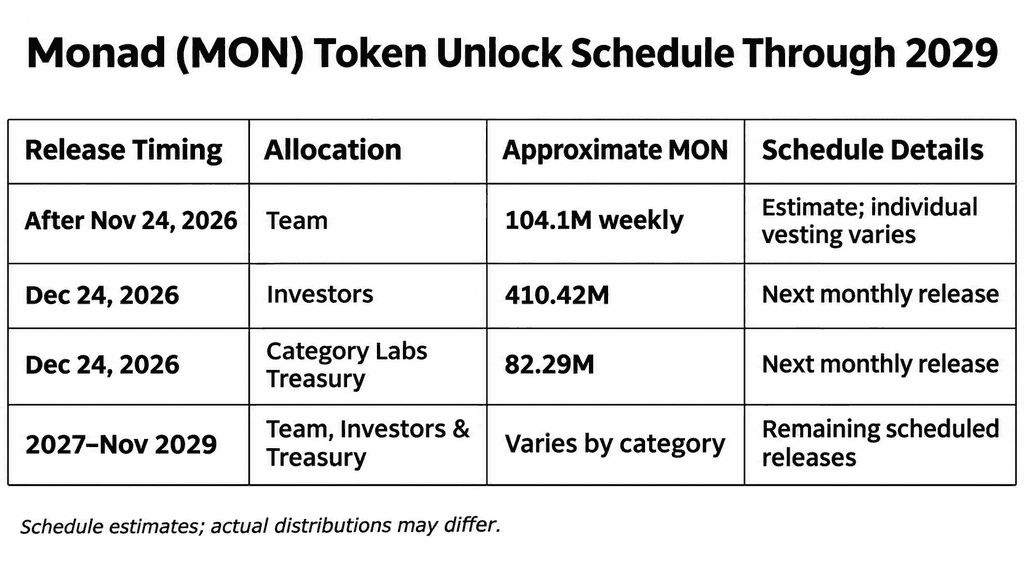
The December figures combine to approximately 492.71 million MON, excluding ongoing team releases. Investor and treasury installments continue after December, while the team's remaining balances follow individual schedules. The original token-sale disclosure and subsequent Q3 2026 tokenholder report both anticipate that the initial locked allocations will be fully released by November 24, 2029, subject to their applicable conditions.
Future Unlocks and Market Liquidity
The shift from one large cliff to recurring distributions changes how future supply reaches the market. Monthly releases are easier to anticipate, but their impact still depends on the market depth available when tokens become transferable. A schedule indicates the maximum quantities reaching eligibility under its assumptions; it does not provide a forecast of sell orders, net exchange deposits, or the MON price on a particular date.
The comparison between each tranche and daily trading activity may be more informative than its headline dollar value alone. Dollar estimates change with MON's price, and even a smaller release can matter when available liquidity is limited. Developments affecting network usage, demand for MON, and broader digital-asset conditions can also change how much supply the market is able to absorb.
Staking Rewards and MON Supply
Vesting is only one part of Monad's supply outlook. MON pays transaction fees, supports network staking, and is used in validator-led protocol governance. The original token-sale disclosure prohibited staking of locked insider allocations, so their release can also change who is eligible to participate in staking. Newly issued rewards add to total supply, while transaction base fees are burned. In July 2026, a protocol upgrade reduced the block reward from 25 to 18 MON per block, a change documented in Monad's Q3 tokenholder report.
That report recorded roughly 443.67 million MON in net issuance during Q3 2026, equivalent to an annualized net inflation rate of approximately 1.7% for that quarter. These figures describe the period ending September 30 and should not be presented as a November outcome. Future total supply will reflect both the release of existing allocations and the balance between newly issued rewards and fee burns; neither mechanism guarantees a particular price direction.
Conclusion
Monad's November 24, 2026, release brought a large block of previously restricted MON into eligibility for distribution and coincided with a sharp but uneven market reaction. A reported 25.4% rolling 24-hour drop captured the immediate turbulence, while daily closing data show both a substantial November 24 decline and a November 25 recovery. The more lasting change lies in token ownership and supply availability: team, investor, and treasury balances now follow a multi-year release path, with the next dated installment scheduled for December 24. Differences between circulating-supply estimates and the absence of a verified aggregate insider-sales figure mean that the unlock's precise contribution to the price movement cannot be isolated from other market activity.
FAQs
1. What happens to existing MON holders when new tokens are unlocked?
A token unlock does not change the number of MON tokens already held in a wallet. However, as more tokens become available for circulation, existing holdings may represent a smaller share of the circulating supply. The price effect depends on how much additional MON reaches trading venues and whether demand absorbs it.
2. How can investors track Monad (MON) token movements after an unlock?
MonadScan allows users to examine wallet balances, transaction histories, and token transfers on the Monad blockchain. Activity from known allocation wallets can help identify large movements following an unlock. A transfer to an exchange-linked address, however, is not sufficient evidence that the tokens were sold.
3. What is the difference between Monad's market capitalization and fully diluted valuation?
Market capitalization multiplies MON's price by the supply classified as circulating. Fully diluted valuation (FDV) uses a broader supply figure that includes tokens not yet circulating. Because MON has ongoing token issuance, the supply definition and reporting date matter when comparing estimates from different providers.
4. Does a Monad token unlock create new MON tokens?
No. Scheduled unlocks remove transfer restrictions from tokens already allocated under Monad's original distribution plan. Minting is a separate process that creates new MON through network rewards. The distinction explains how tradable supply can rise even when the unlock itself does not add to total issued supply.
5. Can Monad's transaction-fee burns offset the impact of token unlocks?
Monad burns the base-fee portion of network transaction fees, removing MON from total supply. It also issues new tokens as staking rewards. The net supply effect depends on the balance between issuance and burns; fee burning does not automatically cancel a large release of previously locked tokens.
6. Did Monad offer early investors an opportunity to sell before the November 2026 unlock?
Yes. In August 2026, the Monad Foundation completed an Early Investor Liquidity Program that offered selected investors a way to sell locked MON at a discount, with a program cap of $60 million. According to the Foundation's disclosures, nearly all approached investors declined. Any tokens acquired through the program remained subject to their original lock-up terms.