

Lighter (LIT) Surges 12% on U.S. CFTC Licensing Plans and Robinhood Chain Expansion: A New Era for On-Chain Derivatives
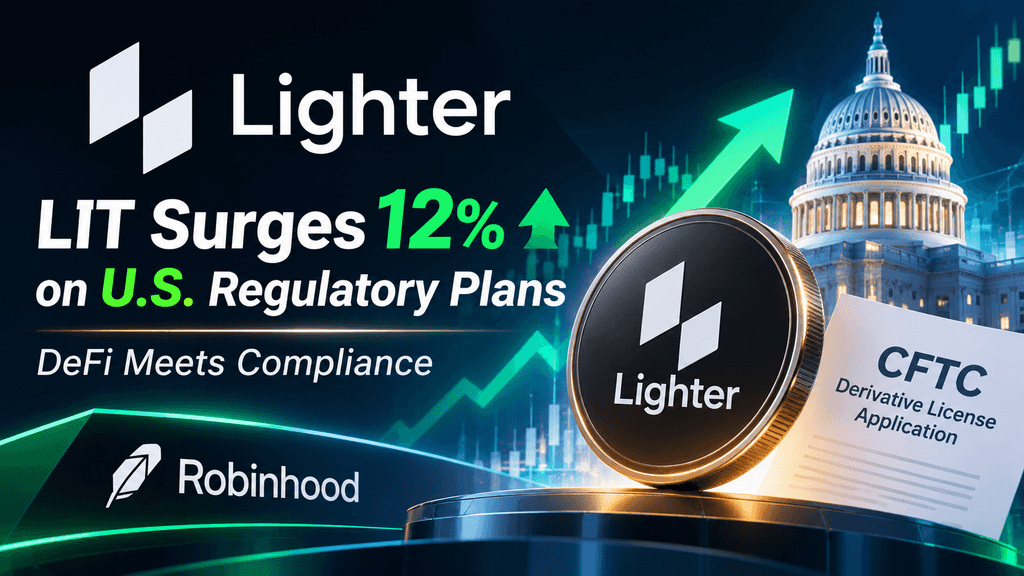
Lighter (LIT) has captured intense market interest following announcements regarding its upcoming U.S. regulatory filings and ecosystem expansion. According to recent data from CoinMarketCap and industry market reports, the native token surged roughly 12% over a 24-hour window, hitting local trading highs near $3.18 alongside robust daily trading volumes of approximately $117 million. This upward momentum reflects growing confidence in decentralized finance (DeFi) infrastructure scaling into institutional compliance and high-performance networks. As the boundary between traditional financial markets and decentralized ledgers continues to blur, protocols that proactively seek federal oversight are increasingly setting the benchmark for the next wave of industry maturation.
What is Lighter and Why is the Market Reacting?
Lighter is a high-performance decentralized perpetual exchange operating as a zero-knowledge (ZK) rollup on Ethereum that provides cryptographic order matching and scalable settlement. The recent price rally was triggered by founder Vladimir Novakovski confirming plans to file for U.S. Commodity Futures Trading Commission (CFTC) derivatives licenses. Based on CoinMarketCap market data, this regulatory milestone positions Lighter to bridge traditional compliance with decentralized trading infrastructure.
The protocol's market valuation responds directly to structural catalysts rather than speculative retail churn. By pursuing Designated Contract Market (DCM) and Derivatives Clearing Organization (DCO) statuses, Lighter aims to establish a compliant legal framework for on-chain derivatives. According to recent on-chain metrics, this strategic clarity has driven notable institutional accumulation and reduced exchange-held supply. Market participants are increasingly rewarding protocols that combine non-custodial asset control with transparent, legally recognized operational structures.
Furthermore, Lighter's underlying architecture addresses the traditional trilemma of speed, security, and decentralization. By leveraging zero-knowledge proofs, the platform achieves throughput capacities that rival centralized order book exchanges while preserving the self-custodial guarantees native to public blockchains. This technical efficiency ensures that traders experience minimal slippage and instant execution finality, even during periods of extreme market volatility. Consequently, institutional liquidity providers view Lighter as a viable alternative to legacy venues that suffer from counterparty risk and opaque clearinghouse mechanisms.
How Does the Robinhood Chain Ecosystem Deployment Drive Adoption?
The integration and deployment within the Robinhood Chain ecosystem have expanded Lighter's addressable user base by embedding its perp-DEX infrastructure directly into mainstream retail channels. Based on recent network ecosystem documentation, the dedicated Lighter instance on Robinhood Chain features tailored sequencer architecture and deep liquidity pools optimized for high-frequency trading.
This deployment allows everyday traders to interact with on-chain derivatives seamlessly through self-custodial wallet environments. According to platform adoption metrics, user accounts surpassing the one-million milestone highlight how ecosystem synergies accelerate protocol throughput and generate sustainable fee revenue. By tapping into a massive retail user base, Lighter bridges the gap between sophisticated financial instruments and everyday cryptocurrency enthusiasts who demand user-friendly mobile interfaces.
The collaboration with Robinhood Chain also provides significant infrastructural advantages. Cross-chain liquidity routing and optimized gas fee subsidization lower the barrier to entry for retail participants, making frequent position adjustments economically viable. As decentralized applications compete for user attention, seamless onboarding experiences and native integrations with trusted consumer platforms become critical drivers of long-term network value and sustained transaction velocity.
What are the Implications of the CFTC Derivative License Application?
Filing for a U.S. CFTC derivatives license establishes a regulatory pathway that could fundamentally alter how institutional capital interacts with decentralized exchanges. Based on regulatory tracking reports, the formal review window can span up to 280 days, meaning final determinations will likely unfold across mid-to-late 2027.
While compliance introduces operational overhead, obtaining federal approval removes a major barrier for institutional market makers. According to industry analysts, securing these licenses would allow Lighter to capture institutional volume that typically avoids unregulated or ambiguous offshore trading venues. Institutional funds, pension portfolios, and corporate treasuries are legally mandated to trade exclusively through regulated clearing channels; thus, Lighter's compliance strategy unlocks access to vast pools of dormant capital.
Navigating this regulatory transition requires rigorous adherence to Know Your Customer (KYC) and Anti-Money Laundering (AML) frameworks without compromising user privacy. Lighter plans to implement zero-knowledge identity verification methods that satisfy federal mandates while shielding sensitive user data from centralized honey-pot vulnerabilities. This innovative compromise between regulatory compliance and cryptographic privacy represents a pioneering model for the entire decentralized finance sector.
How Do Tokenomics and On-Chain Metrics Support LIT Valuation?
LIT tokenomics are structured around utility, governance, and protocol revenue accrual mechanisms that tie token demand directly to platform utilization. Based on recent exchange volume reports, daily turnover holding steady above $100 million demonstrates active market participation.
Token burns funded by protocol fees create a deflationary pressure vector during periods of high network activity. According to historical liquidity analysis, declining exchange reserve balances indicate that holders are moving assets into long-term staking or cold storage, mitigating short-term sell pressure. When token supply on secondary exchanges tightens amidst expanding platform utility, fundamental economic principles naturally support asset appreciation.
Governance participation also plays a crucial role in the LIT token lifecycle. Token holders possess voting rights over key protocol parameters, including fee structures, collateral asset additions, and the allocation of ecosystem development grants. This decentralized governance model ensures that the community retains ultimate control over the network's strategic evolution, fostering deep stakeholder alignment and long-term commitment to the protocol's success.
What Risks and Regulatory Hurdles Face Lighter's Expansion?
Navigating the U.S. regulatory landscape involves significant compliance uncertainties and prolonged administrative reviews. Based on legal assessments of past crypto-derivative filings, the CFTC applies rigorous scrutiny to decentralized automated market makers and order-matching engines.
Macroeconomic volatility and shifts in broader crypto market liquidity also pose risks to sustained trading volume. According to risk management frameworks, users and investors must account for potential delays in the licensing timeline and the possibility of strict geographic access restrictions. If regulatory bodies impose overly restrictive parameters on decentralized front-ends or liquidity pools, protocol growth could experience temporary friction.
Additionally, technical vulnerabilities inherent in smart contract development and zero-knowledge circuit implementations present ongoing operational risks. Although rigorous third-party audits mitigate these concerns, the decentralized finance space remains susceptible to sophisticated exploits. Maintaining an active bug bounty program and continuous on-chain monitoring are essential measures for safeguarding user funds and preserving market trust.
Conclusion
Lighter's strategic progression toward U.S. regulatory compliance via its upcoming CFTC filings, paired with its active deployment within the Robinhood Chain ecosystem, marks a pivotal evolution for decentralized derivatives. The 12% price appreciation and strong $117 million trading volume underscore positive market sentiment. While regulatory timelines remain lengthy and subject to strict federal evaluation, the protocol's focus on institutional integration and scalable zero-knowledge architecture positions it as a notable project to watch within the modern blockchain landscape.
FAQs
What network does Lighter operate on?
Lighter operates as a high-performance zero-knowledge (ZK) rollup on Ethereum while also maintaining a dedicated instance deployed on the Robinhood Chain ecosystem.
What specific licenses is Lighter applying for with the CFTC?
Lighter is preparing applications for Designated Contract Market (DCM) and Derivatives Clearing Organization (DCO) statuses with the U.S. Commodity Futures Trading Commission.
How long is the expected CFTC review process?
The formal regulatory review process by the CFTC can take up to 280 days, with final determinations potentially stretching into late 2027.
What role does the LIT token play in the ecosystem?
The LIT token functions as the native utility and governance asset, tied to protocol revenue sharing, fee mechanisms, and ecosystem reward distribution.
Where can I safely trade Lighter (LIT)?
Lighter (LIT) can be traded on major digital asset platforms, with KuCoin offering robust liquidity, advanced trading tools, and secure market access.
Disclaimer
This general market information, possibly from third-party, commercial, or sponsored sources, is provided for reference and educational purposes only and does not constitute financial or investment advice, an offer, solicitation, or guarantee. We disclaim liability for its accuracy, completeness, reliability, and any resulting losses. Investments/trading are risky; past performance doesn’t guarantee future results. Users should research, judge prudently, and take full responsibility. For further details, please consult KuCoin’s Terms of Use and Risk Disclosure.