

Is "Optical Advance, Storage Retreat" Becoming the New AI Trading Narrative in US Stocks?
2026/08/12 11:17:00
Introduction
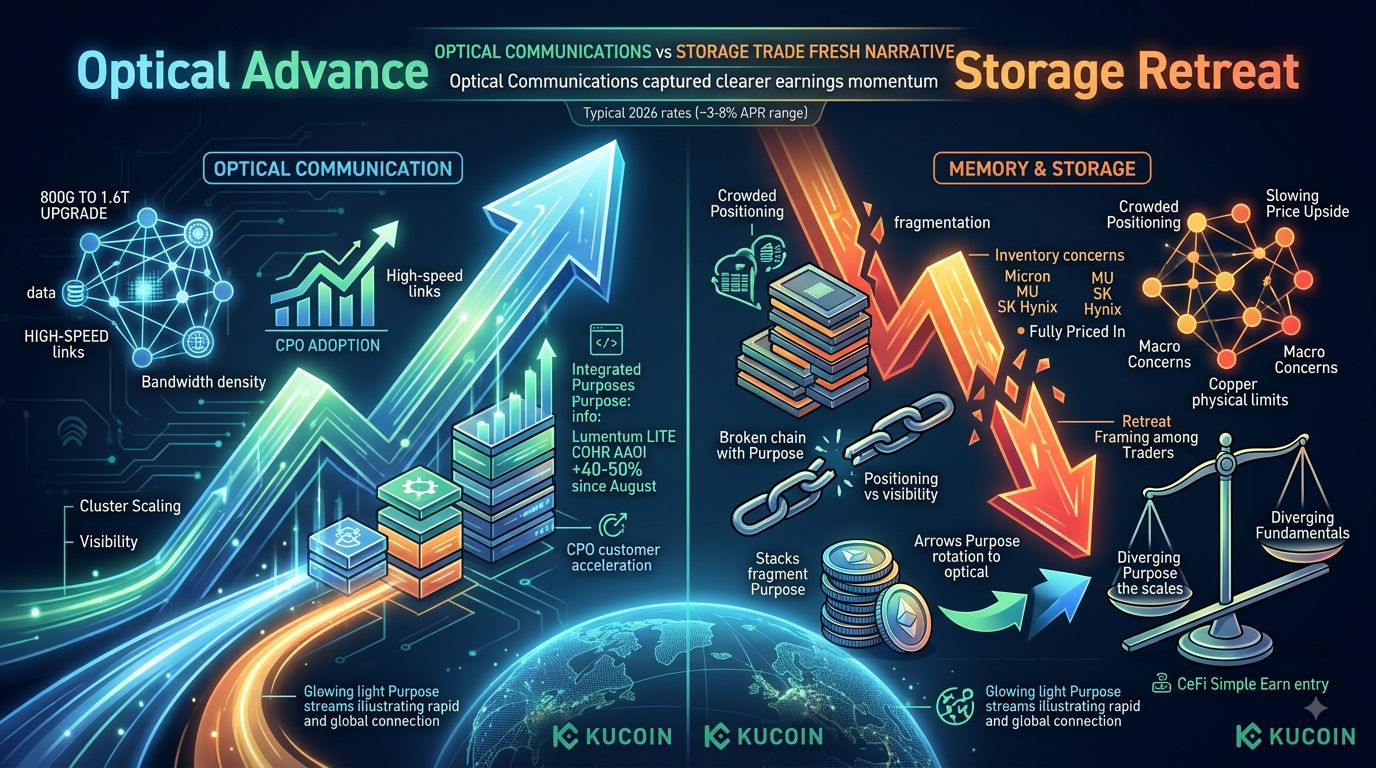
AI chip valuations have largely bottomed, and markets are actively searching for the next clear AI-linked theme. “Optical advance, storage retreat” has emerged as that fresh narrative, driven by diverging fundamentals and stock performance between optical communication names and memory/storage stocks.
Optical interconnects solve the bandwidth and power bottlenecks that copper faces in massive GPU clusters. Recent earnings, particularly from Lumentum, have validated accelerating demand for 800G-to-1.6T upgrades and co-packaged optics, while storage names show signs of crowded positioning and slowing price upside. Capital is rotating accordingly.
What Does “Optical Advance, Storage Retreat” Mean for AI Hardware?
“Optical advance, storage retreat” describes the shift in investor focus from memory and storage stocks toward optical communication companies as the more compelling AI infrastructure trade. Storage names such as Micron Technology (MU) and SK Hynix earlier fully priced in tight supply, rising prices, and upward earnings revisions. Optical names including Applied Optoelectronics (AAOI), Coherent (COHR), and Lumentum (LITE) are now capturing capital on clearer earnings visibility and structural demand growth.
Traditional copper interconnects hit physical limits at higher speeds. Signal attenuation, power consumption, and crosstalk constrain distances once channel rates exceed 100G or 200G. AI training and inference clusters generate enormous east-west traffic of gradients, parameters, and activations. Optical solutions deliver higher bandwidth density, longer reach, and better energy efficiency, making them essential for scaling GPU clusters beyond current constraints.
Optical communication centers on converting electrical signals to light and back. Core products include optical modules or transceivers, lasers, detectors, fiber, and related components. While historically used in telecom backbones and traditional data-center interconnects, the focus has shifted to high-speed links inside data centers (between racks and servers) and across data centers to support AI workloads.
Why Are Optical Interconnects Critical to AI Cluster Scaling?
Optical interconnects remove the scaling bottlenecks that copper cannot overcome in large AI clusters. Higher bandwidth density, extended reach, and improved power efficiency allow hyperscalers to expand GPU clusters without the distance and thermal penalties of electrical cables.
AI models require frequent, high-volume data exchange across accelerators. Copper’s usable distance shrinks dramatically at 100G/200G+ rates, limiting cluster size and raising power and interference issues. Optical links maintain performance over longer distances with lower relative power draw per bit.
Industry data from the past two months confirms the acceleration. Datacom optical component revenue has shown strong year-over-year gains, with 800G modules becoming the workhorse and 1.6T shipments ramping faster than earlier expectations. Co-packaged optics (CPO) and optical circuit switches are moving from development into early deployment, further supporting the optical thesis.
How Have Optical and Storage Stocks Diverged Recently?
Optical communication stocks have significantly outperformed storage names in recent weeks as funds rotate toward clearer earnings momentum. AAOI, COHR, and LITE have posted substantial gains since early August, while memory and storage shares have faced pressure from slowing price appreciation, elevated positioning, and macroeconomic concerns.
Storage stocks benefited earlier from AI-driven demand for high-bandwidth memory and related products. Price increases and capacity tightness drove strong rallies and earnings upgrades. As those gains moderated and positions became crowded, combined with growth worries from labor data, capital began reducing exposure. Optical names, by contrast, delivered successive quarters of accelerating revenue growth tied directly to AI cluster expansion and the 800G-to-1.6T upgrade cycle.
According to recent market observations, the three major US optical communication concepts — AAOI, COHR, and LITE — rose roughly 40-50% from early August levels amid the rotation. This performance gap has reinforced the “optical advance, storage retreat” framing among traders.
What Do Lumentum’s Latest Earnings Reveal About Optical Demand?
Lumentum’s fiscal fourth-quarter 2026 results, released after the market close on August 11, 2026, delivered a near-perfect report that validates the optical narrative. Revenue and profits beat expectations, gross margin crossed 50% for the first time, and forward guidance pointed to further margin expansion at lower revenue levels than previously assumed.
Non-GAAP gross margin reached 50.4%. Non-GAAP operating margin hit 36.6%. Management guided first-quarter fiscal 2027 revenue to $1.225–$1.275 billion with non-GAAP operating margin of 39.5–40.5%. Earlier expectations had assumed operating margins in the 38–42% range only after quarterly revenue approached $2 billion. The company is now projecting roughly 40% margins at about $1.25 billion in revenue.
The company has maintained consecutive quarters of 20–25% year-over-year revenue growth while expanding profitability. On the earnings call, management highlighted ongoing laser capacity constraints: demand continues to exceed supply, and production cannot keep pace with customer needs. The largest CPO customer has accelerated rather than delayed plans, widening the shortage for high-power lasers compared with the prior quarter.
These results underscore that optical demand is not merely speculative. It is translating into tangible revenue, margin expansion, and multi-quarter visibility driven by AI cluster buildouts.
What Are the Key Drivers Behind the Optical Upgrade Cycle?
The move from 800G to 1.6T optical modules and the early adoption of CPO form the core of near-term demand. Higher-speed modules increase bandwidth per port while CPO integrates optics closer to the switch or accelerator silicon, reducing power and latency.
Hyperscalers continue large-scale AI infrastructure spending. Optical interconnects capture a growing share of that capital as clusters expand from rack-level to row- and campus-level fabrics. Industry forecasts from recent months project multi-year growth for high-speed datacom optics, with 1.6T expected to contribute substantial incremental revenue.
Supply remains tight for critical components, especially high-power lasers and certain indium phosphide devices. This tightness supports pricing power and margins for leading suppliers that can expand capacity effectively.
Should You Trade Optical Communication Stocks on KuCoin?
Optical communication stocks offer leveraged exposure to the AI infrastructure buildout beyond pure compute chips. On KuCoin you can access related US stock tokens and trading pairs that track names such as LITE, COHR, and AAOI, allowing efficient participation in the theme without traditional brokerage barriers.
KuCoin provides competitive fees, deep liquidity in crypto-linked equity products, and tools for both spot and derivatives trading. Users can monitor the same catalysts — earnings, module upgrade cycles, and CPO progress — that drive the underlying shares. Registration is straightforward, and the platform supports seamless funding and position management for traders seeking AI infrastructure exposure.
Before trading, review the latest company filings, sector supply dynamics, and broader market conditions. Optical stocks remain volatile and sensitive to changes in hyperscaler capital expenditure plans.
Conclusion
“Optical advance, storage retreat” has gained traction as a coherent US stock narrative because it aligns with observable fundamentals. AI chip valuations have stabilized, storage stocks have already reflected much of the near-term pricing upside, and optical names are delivering accelerating revenue, expanding margins, and confirmed demand from AI cluster expansion. Lumentum’s latest quarter — first-time 50%+ gross margin, 36.6% operating margin, and guidance for approximately 40% margins — provides concrete validation. Capacity constraints on lasers and accelerating CPO timelines further support the multi-quarter runway.
Copper’s physical limits make optical interconnects a structural necessity rather than a cyclical upgrade. The 800G-to-1.6T transition and early CPO adoption translate that necessity into earnings visibility. While storage remains important to the overall AI stack, the relative performance and positioning dynamics currently favor optical names. Investors and traders watching AI infrastructure should monitor module shipment data, laser supply updates, and hyperscaler spending trends as the narrative continues to develop.
FAQs
What is the difference between optical modules and traditional copper interconnects in AI data centers?
Optical modules convert electrical signals to light for transmission over fiber, enabling higher bandwidth, longer distances, and better energy efficiency than copper cables, which suffer from signal loss and power issues at speeds above 100G/200G.
Why is CPO considered important for future AI clusters?
Co-packaged optics places the optical engine closer to the switch or GPU silicon, reducing electrical path lengths, power consumption, and latency compared with traditional pluggable modules.
How does the 800G to 1.6T upgrade affect optical component suppliers?
Higher-speed modules require more advanced lasers, detectors, and packaging. Suppliers that ramp production successfully capture rising average selling prices and volume growth as hyperscalers upgrade their fabrics.
Are storage stocks no longer relevant to the AI theme?
Storage and high-bandwidth memory remain essential for AI systems. The current narrative reflects relative positioning and near-term earnings clarity rather than a complete rejection of the memory thesis.
What risks should traders consider with optical communication stocks?
Key risks include delays in hyperscaler spending, slower-than-expected capacity expansion by suppliers, competition from alternative interconnect technologies, and broader market volatility affecting high-growth technology names.