

How to Choose a Compliant Crypto Exchange in 2026: 6 Verifiable Criteria
Introduction
Two years ago, choosing a crypto exchange was mostly about fees, listings, and liquidity. In 2026, the first question has changed: is this platform compliant — and can it prove it? Regulation has matured across every major market, users have learned painful lessons about what happens on unregulated platforms, and the gap between licensed and unlicensed exchanges is now the widest it's ever been.
This guide maps the 2026 regulatory landscape, distills six criteria that separate genuinely compliant exchanges from marketing claims, and shows you how to run the checklist yourself.
TL;DR
-
Regulation went global: the EU's MiCAR, Hong Kong's licensing regime, and emerging-market frameworks have made compliance the baseline, not the bonus.
-
Six criteria define a compliant exchange: licenses, proof of reserves, asset segregation, security certifications, KYC/AML rigor, and governance.
-
Every criterion is verifiable by you — don't take any platform's word, including ours.
-
KuCoin meets all six — and we encourage you to check.
The 2026 Regulatory Map: Three Paradigms
Global crypto regulation has consolidated into three broad models — and where an exchange chooses to operate tells you a lot about it.
The comprehensive framework model — the European Union. MiCAR created the world's first unified, bloc-wide licensing regime for crypto asset service providers: one license, passportable across the EU/EEA, with strict requirements on capital, governance, asset protection, and disclosure. A MiCAR license is widely regarded as among the most demanding credentials in the industry — which is exactly why it matters when an exchange holds one.
The calibrated sandbox model — Hong Kong and beyond. Hong Kong built a licensing regime designed to bring digital assets inside the regulatory perimeter without stifling the industry. Similar calibrated frameworks are emerging across Asia and the Middle East.
The supervised-pilot model — emerging markets. Regulators in markets like Nigeria are running supervised pilot programs, inviting a small number of platforms to operate under direct central bank oversight while permanent frameworks are built. Being selected for such a program is itself a compliance signal: regulators choose participants they trust.
The through-line: in every paradigm, regulators now distinguish sharply between platforms that submit to supervision and platforms that avoid it. So should you.
Six Criteria That Define a Compliant Exchange
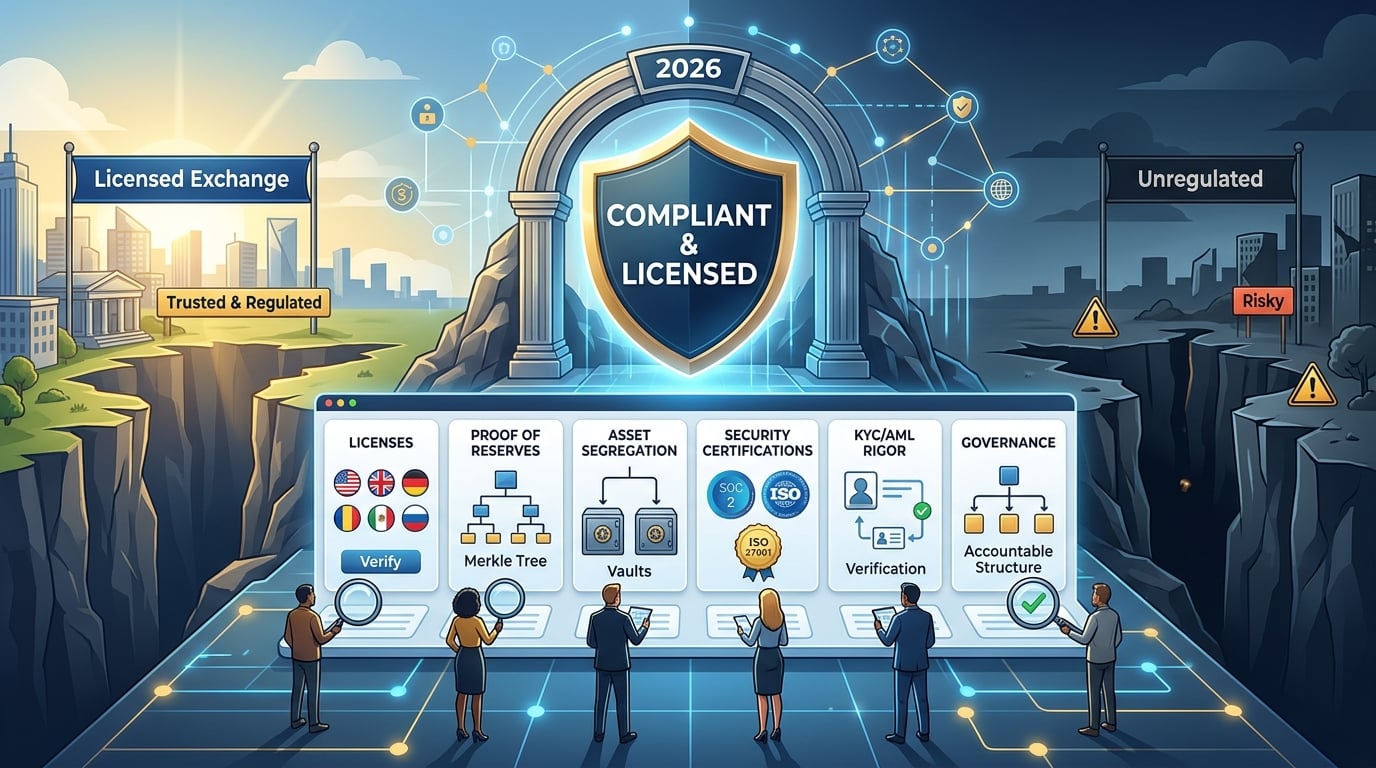
Cut through the marketing. A compliant exchange in 2026 can demonstrate all six of the following — and let you verify each one:
-
Licenses and registrations — of real caliber. Not just a count of registrations, but licenses under demanding frameworks (like MiCAR) that examine capital adequacy, governance, and consumer protection. Check them in regulators' public registers.
-
Proof of Reserves (PoR) — regular and user-verifiable. Cryptographic evidence that customer assets are backed by corresponding reserves, published regularly, with a self-verification tool so you can confirm your own balance is included. Third-party assessment of the methodology is a strong plus.
-
Asset segregation. Customer assets structurally separated from the platform's operating funds — to protect customer deposits from being used for the platform’s operating purposes.
-
Independent security certifications. SOC 2 Type II and ISO 27001:2022 are the reference standards — audited over time, by independent bodies, verifiable through the issuers.
-
KYC/AML rigor. Genuine identity verification and anti-money-laundering controls. A platform with lax onboarding isn't doing you a favor — it's telling you what else it's lax about.
-
Governance and accountability. A clear corporate structure, accountable leadership, and a public track record of engaging regulators constructively. Who runs the platform, and what have they chosen to prioritize?
Running the Checklist on KuCoin
We'll put ourselves through the same six tests — and show you where to verify each answer independently:
| Criterion | KuCoin | How you verify |
| Licenses | MiCAR-licensed EU entity (Austria), Australian registration, only global exchange in the Central Bank of Nigeria's supervisory pilot | Regulators' public registers |
| Proof of Reserves | Regular Merkle-tree PoR | KuCoin PoR page + self-verification tool |
| Asset segregation | User assets held separately from operating funds under regulated-market frameworks | Regulatory framework disclosures |
| Security certifications | SOC 2 Type II + ISO 27001:2022, among four international-grade credentials | Issuing auditors' channels |
| KYC/AML | Full identity verification and AML controls across markets | Experience onboarding yourself |
| Governance | CEO BC Wong previously served as Chief Legal Officer — compliance leadership at the top | Public record |
Two Common Misconceptions
"Big means compliant." Size and compliance are different axes. Large platforms have faced enforcement actions; smaller ones sometimes hold exemplary licenses. Judge the credentials, not the trading volume.
"One license means fully compliant." Licenses are jurisdiction-specific. A platform licensed in one market isn't automatically compliant in yours. What to look for instead: a pattern — multiple credible licenses across demanding jurisdictions, plus the infrastructure (PoR, segregation, certifications) that works everywhere regardless of local rules.
The Bottom Line — and What Comes Next
In 2026, compliance is no longer a checkbox on a comparison page. It's the architecture underneath everything an exchange does — and the platforms treating it that way are the ones built to last through cycles, crackdowns, and whatever comes next.
KuCoin has spent the past two years building exactly that architecture: a US$2 billion Trust Project, four international security certifications, and licenses across demanding jurisdictions. This October, KuCoin 5.0 will be launched under the philosophy of Trust First and Trade Forward. — building compliance you can see, understand, and verify, paired with a unified account, a rebuilt app, global multi-asset access, and AI-assisted trading.
👉 Choosing a new home for your assets? Create your KuCoin account, complete verification, and run every check on this list yourself. When 5.0 arrives this October, you'll already be positioned on a platform that passes its own checklist.
FAQs
What makes a crypto exchange compliant?
A compliant exchange holds credible licenses under demanding regulatory frameworks, publishes user-verifiable Proof of Reserves, segregates customer assets from operating funds, maintains independently audited security certifications (SOC 2 Type II, ISO 27001:2022), enforces rigorous KYC/AML, and operates with transparent, accountable governance.
Is KuCoin a regulated exchange?
Yes. KuCoin operates a MiCAR-licensed entity in Austria serving the EU/EEA, holds registration in Australia, and was the only global exchange invited to the Central Bank of Nigeria's virtual asset supervisory pilot. Verify each in the relevant regulators' public registers.
How do I check if an exchange is licensed?
Search the public registers maintained by financial regulators in the relevant jurisdiction — licensed entities are listed by name. Also review the exchange's compliance page and confirm the claimed licenses match the register entries.
Does MiCAR apply outside the EU?
No — MiCAR governs the EU/EEA. But a MiCAR license is a strong global signal: its requirements on capital, governance, and asset protection are among the world's most demanding, and platforms that meet them typically run the same standards everywhere.
Is a big exchange automatically a safe exchange?
No. Size doesn't equal compliance. Evaluate licenses, Proof of Reserves, asset segregation, certifications, KYC/AML, and governance — all six are independently verifiable regardless of a platform's scale.
What is KuCoin 5.0?
KuCoin 5.0 is the platform's largest upgrade, launching October 2026: compliance as verifiable product capability, a unified account across all products, a rebuilt app, global multi-asset access, and AI-assisted trading.
Disclaimer: This article is for informational and educational purposes only and does not constitute financial advice. Cryptocurrency investments carry risk, including platform and counterparty risk. Past performance does not guarantee future results. Always conduct your own research (DYOR).