

How to Bridge USDC to the XDC Network: Safe Routes for Deposits and Transfers
2026/08/12 18:22:00
Introduction
Bridges remain one of the riskiest steps in crypto because liquidity sits fragmented across chains and one incorrect selection can lock or lose funds. Users who need to move USDC onto the XDC Network—especially for deposits that require the XDC network version—should stick to established infrastructure, double-check the destination chain and asset, and always test with a small amount first.
This guide explains what the XDC Network is, why USDC on XDC matters, the main bridging options available today, and practical steps to complete the transfer safely.
What Is the XDC Network and Why Does It Matter for USDC?
The XDC Network is an enterprise-focused, EVM-compatible Layer 1 blockchain built for trade finance, real-world asset tokenization, stablecoin payments, and emerging agentic commerce use cases. It delivers high throughput, near-instant finality, and extremely low fees while remaining ISO 20022-aligned for institutional messaging standards.
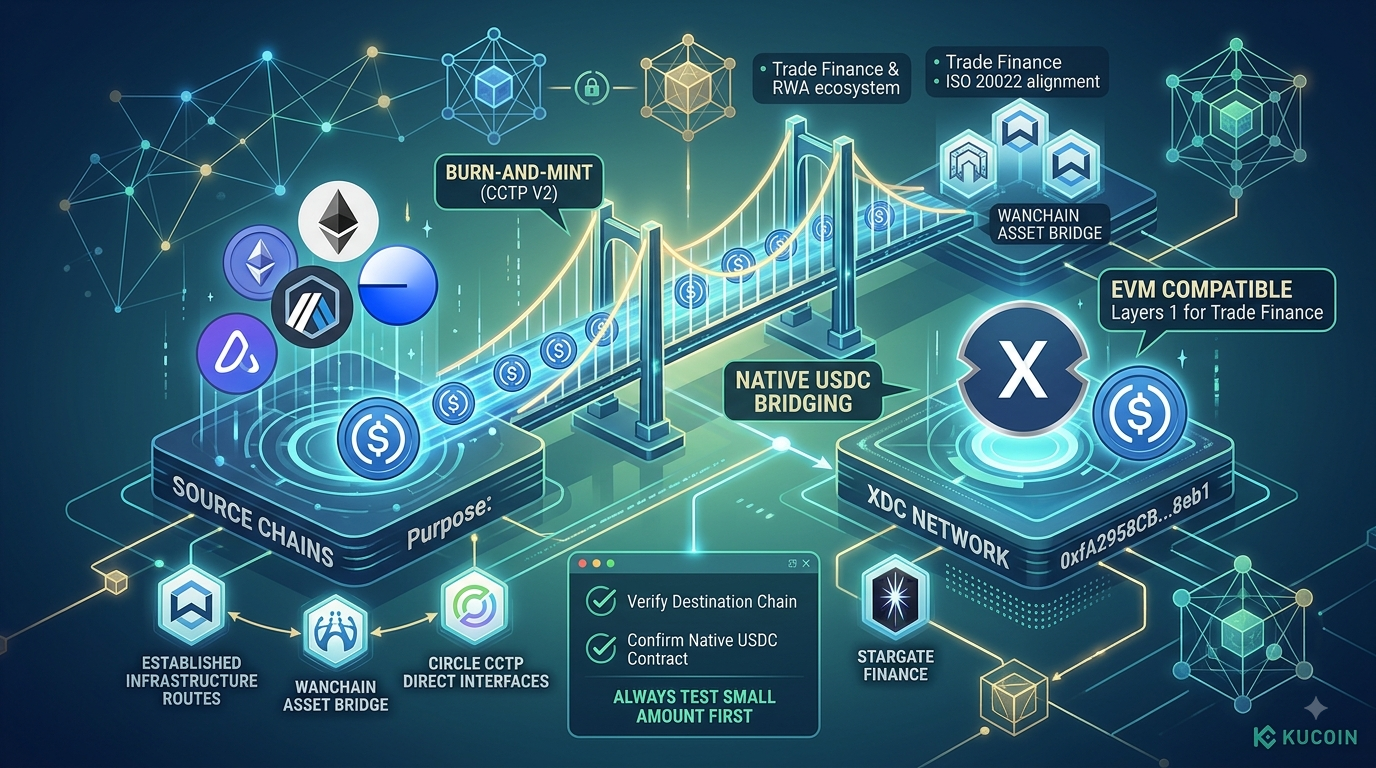
Native USDC has been live on XDC mainnet since September 2025 via Circle’s Cross-Chain Transfer Protocol (CCTP) V2. This means users receive the official, 1:1 redeemable USDC issued by Circle rather than a wrapped or synthetic version. The combination of native USDC, low-cost settlement, and RWA infrastructure makes the network attractive for payments, trade settlement, and liquidity movement.
Why Bridge USDC to the XDC Network?
Bridging USDC to XDC unlocks access to the network’s low-fee environment, native stablecoin liquidity, and growing ecosystem of trade finance and tokenization applications. Many platforms and campaigns specifically require USDC deposited via the XDC network, so users holding USDC on Ethereum, Arbitrum, Base, or other chains must move it across.
CCTP enables native burn-and-mint transfers rather than lock-and-mint wrapped assets. This preserves capital efficiency and avoids the fragmentation that occurs with traditional bridges. Users gain the ability to settle transactions quickly and cheaply once the USDC arrives on XDC, while still retaining the regulated backing of Circle’s USDC.
What Are the Main Options to Bridge USDC to XDC?
Several established routes support moving USDC into the XDC ecosystem. The most relevant options currently include Wanchain’s Asset Bridge, Circle’s CCTP interfaces, and Stargate Finance. Each uses different underlying mechanisms, with CCTP providing native USDC where supported.
How Does the Wanchain Bridge Work for XDC?
Wanchain’s bridge supports transfers involving XDC and has integrated CCTP V2 for native USDC movement across supported chains. Users select the source chain holding their USDC, choose XDC Network as the destination, enter the amount, and confirm the transaction after reviewing fees and estimated arrival time.
Wanchain has operated cross-chain infrastructure for years and connects both EVM and non-EVM networks. When CCTP is available for the pair, the bridge defaults to the native burn-and-mint path. Always confirm that the destination shows the native USDC contract on XDC rather than a wrapped variant.
How Can Users Access Circle CCTP Directly?
Circle’s Cross-Chain Transfer Protocol powers native USDC transfers. Interfaces such as cctp.io and cctp.to allow users to initiate burn-and-mint moves between CCTP-supported chains and XDC. The process burns USDC on the source chain, obtains an attestation from Circle, and mints the equivalent amount of native USDC on XDC.
Because the mint occurs through Circle’s infrastructure, the resulting USDC is the official version with full 1:1 redeemability. Users must connect a compatible wallet, select the correct source and destination chains, approve the burn, and later claim or receive the minted tokens on XDC if the interface requires it. Gas fees apply on both chains.
How Does Stargate Finance Facilitate USDC Transfers to XDC?
Stargate Finance supports USDC routes to XDC Network. Users connect a wallet, choose the source chain (commonly Arbitrum or another low-fee network for cost efficiency), select XDC as the destination, enter the USDC amount, and execute the transfer.
Stargate focuses on efficient cross-chain liquidity movement and has integrated CCTP paths where available. After confirmation, the interface displays progress. Users need a small amount of XDC on the destination chain to cover any subsequent gas costs once the USDC arrives.
What Practical Steps Should Users Follow When Bridging?
Prepare a compatible wallet such as MetaMask configured for both the source chain and XDC Network. Ensure the wallet holds enough native tokens for gas on the source chain and a small amount of XDC for destination-side activity. Add the official USDC contract address on XDC if it does not appear automatically.
Select an established bridge interface. Choose the correct source chain and asset (USDC), set XDC Network as the destination, and enter a test amount first. Review the quoted fees, estimated time, and exact output token. Approve the transaction in the wallet and monitor the status through the bridge interface or a block explorer.
Once the transfer completes, verify the USDC balance on XDC using a reliable explorer. Confirm the contract address matches the native USDC issued via Circle. Only after a successful small test should larger amounts be moved.
Always double-check the destination chain ID and token details. A mismatch can send funds to the wrong network or create an incompatible asset.
Conclusion
Moving USDC onto the XDC Network is a practical step for anyone needing native stablecoin liquidity on an enterprise-oriented Layer 1 focused on trade finance and real-world assets. Native USDC via Circle’s CCTP has been available since September 2025, and established interfaces such as Wanchain’s Asset Bridge, cctp.io, cctp.to, and Stargate Finance provide workable routes.
The process itself stays simple when users follow disciplined habits: choose established infrastructure, verify the exact destination chain and native USDC contract, test with a minimal amount, and confirm balances before scaling up. Bridging continues to carry smart-contract, routing, and operational risks, so independent research and caution remain essential. Once USDC sits safely on XDC, it can support payments, ecosystem activity, or deposits to platforms that accept the XDC network version. Starting small and double-checking every detail turns a potentially stressful transfer into a controlled, repeatable action.
FAQs
What is the official USDC contract address on XDC Network?
The native USDC contract on XDC mainnet is 0xfA2958CB79b0491CC627c1557F441eF849Ca8eb1. Always verify this address against official Circle or XDC documentation before adding it to a wallet or interacting with it.
Do I need XDC tokens to receive bridged USDC?
Yes. A small amount of XDC is required on the destination chain to pay gas for any subsequent transactions or claims after the USDC arrives.
Is CCTP safer than traditional lock-and-mint bridges?
CCTP uses a burn-and-mint model controlled by Circle’s attestation service rather than locking assets in a third-party vault. It eliminates certain bridge-specific risks but still carries operational and smart-contract considerations inherent to any cross-chain transfer.
Disclaimer
This post is for educational purposes only and does not constitute an endorsement of any third-party protocol or bridge. Bridging carries inherent risks including smart contract risk, routing risk, and destination-chain risk. Always do your own research.