

Gonka Bridge Exploit Explained: How a BLS Key Attack Drained $1.05M and Minted 22 Million WGNK
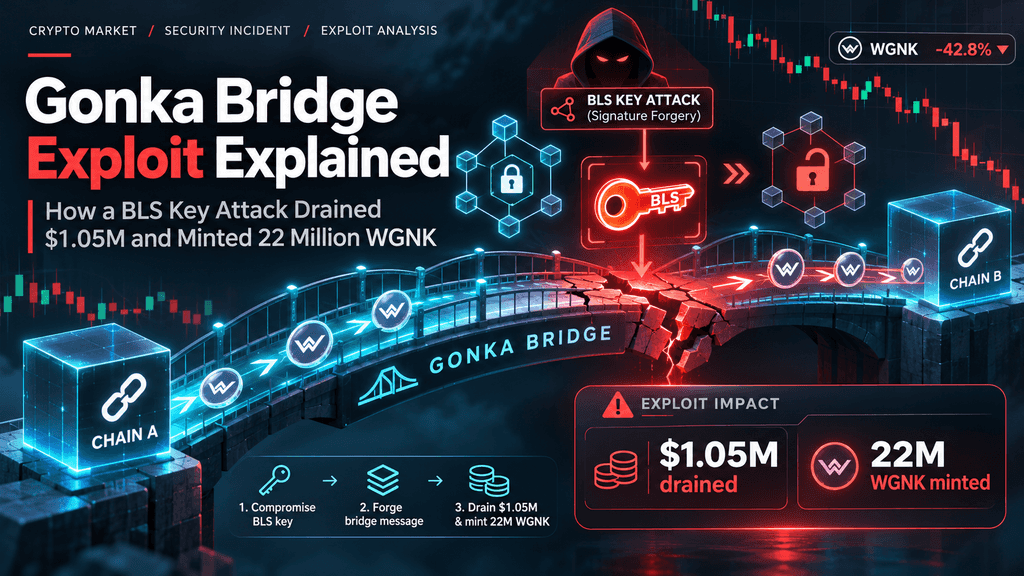
Gonka’s Ethereum bridge was exploited on November 18, 2026, after an attacker registered a new epoch BLS group key and then used the bridge to withdraw stablecoin reserves and mint 22 million Wrapped Gonka (WGNK) tokens. Blockchain security firm Blockaid, as quoted in The Defiant’s report, initially estimated approximately $1.05 million in realized value across roughly five transactions. Separately verified Ethereum transfers show 884,150.87 USDT and 647.74 USDC leaving the bridge. The incident raises broader questions about validator-signature security, wrapped-token collateral, and the risks of cross-chain infrastructure.
Key Takeaways
-
Blockaid reported a Gonka Ethereum bridge exploit on November 18, estimating approximately $1.05 million in realized value at the time of its alert.
-
On-chain reporting identified withdrawals of about 884,151 USDT and 648 USDC, alongside the minting of 22 million WGNK.
-
Gonka’s bridge uses an epoch-based BLS group key to authorize withdrawals and WGNK minting; the exact reason the new key was accepted remains unresolved.
-
Unbacked WGNK issuance can break the relationship between wrapped supply and native GNK held in escrow, creating redemption and liquidity risks.
-
Gonka said its consensus and inference services continued operating, while urging users to avoid the bridge and WGNK; compensation remains a community decision.
What Happened in the Gonka Ethereum Bridge Exploit?
The incident targeted Gonka’s Ethereum bridge, not Ethereum’s base layer. On November 18, Blockaid reported that an attacker had rotated the bridge’s epoch BLS group key, drained the remaining stablecoin reserves, and minted WGNK without corresponding backing. The security firm’s initial alert put the value realized across approximately five transactions at around $1.05 million. That figure should be treated as a preliminary incident estimate, not as a reconciled final loss figure.
The on-chain amounts separately identified by TraceFast and reported by The Defiant were 884,150.87 USDT and 647.74 USDC, a combined nominal value of approximately $884,799 if both stablecoins are valued at one dollar each. The same investigation identified the creation of 22 million WGNK. These figures describe different parts of the event: the stablecoin transfers represent assets withdrawn from the bridge, while 22 million is a token quantity, not an additional dollar loss. The available reporting does not fully reconcile the difference between the stablecoin outflow and Blockaid’s $1.05 million estimate, so the two figures should not be added together or presented as interchangeable.
The incident matters because the bridge both held cross-chain assets and served as the Ethereum ERC-20 contract for WGNK. A failure in its authorization mechanism therefore affected reserve assets and token issuance. It also highlights that cross-chain security depends on more than the destination blockchain: users rely on validators, signing procedures, contract logic, and accurate accounting between networks.
What Is Gonka, and How Does Its Ethereum Bridge Work?
Gonka is a decentralized AI-computing network that connects developers needing model inference or other computing services with hosts supplying GPU capacity. GNK is the network’s native token. The Ethereum bridge allows users to move supported assets between Gonka and Ethereum, including representing native GNK on Ethereum as Wrapped Gonka, or WGNK. The project’s Ethereum bridge documentation states that the bridge contract and the WGNK ERC-20 token are the same Ethereum contract, deployed at
0x972a7a92d92796a98801a8818bcf91f1648f2f68.To move native GNK to Ethereum, the documented process locks GNK in an escrow account on Gonka and generates a BLS signature authorizing the corresponding WGNK mint. When WGNK is returned, the bridge burns it; after Gonka consensus recognizes the burn, the corresponding GNK is released from escrow. This mechanism is intended to keep Ethereum’s WGNK supply aligned with native GNK held on Gonka.
The bridge also handles ERC-20 assets such as USDT and USDC. An Ethereum deposit is locked in the contract; Gonka hosts monitor it, and after Ethereum finality plus confirmation by hosts representing more than 50% of voting power, the network mints a wrapped representation on Gonka. For a return transfer, the wrapped asset is burned and a valid BLS signature authorizes release of the original ERC-20. The bridge’s stablecoin balances are therefore reserves needed to complete withdrawals for users who previously moved assets across chains.
How Did the BLS Group Key Become Central to the Attack?
BLS (Boneh–Lynn–Shacham) is a digital-signature scheme that supports signature aggregation, making it useful when multiple participants authorize an operation. In Gonka’s documented design, the validator set produces a group signature that Ethereum verifies against the current epoch’s BLS group public key. A valid signature under the registered key authorizes the contract to release assets or mint WGNK.
Gonka’s bridge documentation describes a daily key-update sequence. At each epoch change, the network generates a new group key and signs it with the previous epoch’s key. A transaction registers the new key on Ethereum, where the contract is designed to accept only the next sequential key signed by its predecessor. This creates an unbroken chain back to the original key. Anyone can submit the update transaction using the required public data. Therefore, an ordinary wallet submitting the transaction does not by itself prove an authorization bypass; the key question is whether the submitted key and signature were valid under the intended rules.
The on-chain sequence reported by The Defiant shows that a key-registration transaction succeeded at approximately 1:00:59 p.m. Eastern Time on November 18. The subsequent stablecoin withdrawals and WGNK mint used the same epoch identifier. Blockaid described the event as a rotation of the epoch BLS group key. However, the available public evidence does not yet establish how the attacker obtained the ability to register the key, why the contract accepted it, or whether the root cause involved key compromise, signature validation, an implementation defect, or another issue. It would therefore be premature to say that the BLS cryptographic algorithm itself was broken or that Gonka validators’ private keys were definitively stolen.
This distinction matters because BLS is only one component of a wider system that includes key generation, validator participation, signature verification, epoch sequencing, and contract execution. An exploit can occur in how these components are integrated without breaking the underlying cryptographic algorithm. A post-mortem must identify which part of that chain failed.
How Did the Attacker Drain Funds and Mint 22 Million WGNK?
Blockchain investigators traced the activity to an Ethereum address identified by Blockaid as the suspected exploiter. TraceFast reported that the address received 0.05 ETH earlier on November 18, then interacted with the Gonka bridge. At approximately 1:01 p.m. ET, the bridge transferred 884,150.87 USDT and 647.74 USDC to the address. Around one minute later, the same address received 22 million newly minted WGNK. The key-registration transaction immediately preceded these operations, linking the observed sequence to the group-key change.
| On-chain event | Reported detail |
| Key registration | New epoch group key registered at about 1:00:59 p.m. ET |
| Stablecoin withdrawals | 884,150.87 USDT and 647.74 USDC |
| WGNK creation | 22 million tokens minted at about 1:02 p.m. ET |
| Subsequent token action | Approximately 13 million WGNK later burned |
| Initial security alert | Blockaid estimated about $1.05 million across roughly five transactions |
TraceFast also reported that USDT was swapped through Uniswap-related routing and that roughly 606.7 ETH later moved to another address. A swap is not proof of a fiat cash-out, and a transfer does not identify the wallet controller or final beneficiary. The address also burned about 13 million WGNK, but an Ethereum burn alone does not prove that corresponding GNK was released from Gonka escrow.
Why Does Unbacked WGNK Create Risks for Token Holders?
A wrapped token is designed to represent an asset held or locked elsewhere. In this case, WGNK is intended to represent native GNK locked in Gonka escrow. If the bridge mints WGNK without a corresponding GNK lock, the total supply of the wrapped token can exceed the assets available to support redemption. That does not automatically mean every WGNK token has become worthless, but it creates uncertainty about whether all outstanding tokens can be redeemed for the expected amount of native GNK.
The distinction between the stablecoin drain and the unbacked mint is important. The withdrawal of USDT and USDC reduced the reserves held by the bridge for users moving those assets between Ethereum and Gonka. The minting of 22 million WGNK created a separate supply-and-backing problem for holders of the wrapped native token. The two effects can undermine confidence in different parts of the bridge: one affects the availability of underlying ERC-20 reserves, while the other affects the relationship between WGNK supply and GNK escrow.
When backing or redemption capacity is uncertain, holders may sell or withdraw liquidity. That can widen spreads, reduce market depth, and push DEX prices away from the expected value of the underlying asset. Liquidity providers may face additional losses from imbalanced pools. Individual exposure depends on token holdings, acquisition timing, and any eventual recovery or compensation plan. It is therefore inaccurate to assume every WGNK holder suffered the same loss or that every outstanding token was unbacked.
How Did Gonka Respond to the Exploit?
In a response reported by TokenPost on November 18, Gonka said the incident did not affect network consensus and that its network and inference services continued operating normally. The project urged users not to interact with or trade WGNK and not to use the Ethereum bridge until further notice. It also advised liquidity providers to withdraw WGNK from pools on Uniswap and other decentralized exchanges. Gonka said the question of whether WGNK holders would receive compensation would be decided by the community.
The Gonka.gg network explorer subsequently displayed a notice that WGNK bridge transfers were suspended while the core team investigated suspicious activity. This is a meaningful containment step, but suspension alone does not resolve the outstanding questions about the key-registration mechanism, the bridge’s remaining liabilities, the amount of unbacked WGNK, or the recovery of withdrawn assets. As of November 19, the reviewed public reports did not provide a complete technical post-mortem, a reconciled final loss figure, or a confirmed compensation schedule.
Gonka’s broader AI network reportedly remained operational. The target was its Ethereum bridge and associated token contract, not Ethereum consensus or necessarily the core compute network. However, functioning inference services do not establish that bridge deposits, withdrawals, or WGNK redemptions are safe to resume.
What Does the Incident Reveal About Cross-Chain Bridge Security?
The Gonka exploit illustrates why cross-chain bridges are difficult to secure. A bridge must verify events on one chain, communicate them to another, and ensure that assets are released or minted only when the corresponding deposit, lock, or burn has genuinely occurred. Its security depends on multiple layers: validator behavior, signing-key custody, signature verification, smart-contract implementation, transaction monitoring, and the accounting relationship between assets on different networks. A weakness in any one layer can affect assets held by the bridge.
Gonka’s official documentation states that its Ethereum bridge has been audited by CertiK. That is relevant background, but an audit is not a guarantee against every exploit. Audits examine particular code, assumptions, and scope at a given point in time; they do not automatically cover every operational process, key-management procedure, later deployment, or interaction with the live network. The existence of an audit also does not establish that the vulnerability exploited in this incident was previously identified or missed. A meaningful review must compare the audited code with the deployed contract and investigate the signing process that authorized the relevant transactions.
For bridge operators, the incident reinforces the need for secure threshold-key custody, strict validation of epoch updates, monitoring for unusual minting and reserve withdrawals, limits or delays for sensitive operations, and emergency controls. Users should assess not only a token’s market liquidity but also its redemption mechanism and the bridge that supports it.
What Should Users and Investors Monitor Next?
The next developments to watch are a technical post-mortem and a recovery plan. A credible investigation should explain why the new group key was accepted, whether validator or signing infrastructure was compromised, which contract functions were used, and what safeguards will change. A separate accounting should reconcile bridge reserves, WGNK supply against GNK escrow, the status of the 22 million newly minted tokens, and any recoverable assets.
Users should monitor announcements about bridge reopening, WGNK redemption, and any compensation process. Until the project confirms that authorization has been repaired and backing reconciled, the bridge and WGNK should be treated as under an incident warning. Market prices, token burns, or a normal-looking contract status do not prove that collateral and redemption have been restored.
Conclusion
The Gonka exploit shows how a failure in bridge authorization can affect both reserve assets and wrapped-token supply. The reported withdrawals of stablecoins and minting of 22 million WGNK exposed the importance of reliable validator signatures, secure epoch-key updates, and verifiable collateral accounting. Although Gonka said its core network services continued operating, the bridge and WGNK require a separate recovery process. The incident is a reminder that cross-chain security depends on the full system behind a bridge—not just the smart contract or the blockchain on which it operates.
FAQs
How Much Was Lost in the Gonka Bridge Exploit?
Blockaid initially estimated approximately $1.05 million in realized value. Separately verified transfers identified about 884,151 USDT and 648 USDC withdrawn from the bridge. The final net loss has not been fully reconciled in the reviewed reports.
What Is WGNK?
WGNK is the Ethereum ERC-20 representation of Gonka’s native GNK. Under the documented bridge design, GNK is locked in escrow on Gonka before corresponding WGNK is minted on Ethereum.
What Is a BLS Group Key?
A BLS group key is a public key used to verify signatures produced through a group-signing process. Gonka’s bridge uses epoch-based group keys to validate authorization for withdrawals and WGNK minting.
Was Ethereum Itself Hacked?
No evidence in the reviewed reports indicates that Ethereum’s base layer was compromised. The incident targeted Gonka’s Ethereum bridge contract and its authorization process.
Is the Gonka Bridge Safe to Use Now?
Gonka urged users not to use the bridge or trade WGNK, and the Gonka.gg explorer displayed a notice that WGNK bridge transfers were suspended while the team investigated. Users should wait for an explicit project update and verified restoration before interacting with the affected services.
Disclaimer: This general market information, possibly from third-party, commercial, or sponsored sources, is provided for reference and educational purposes only and does not constitute financial or investment advice, an offer, solicitation, or guarantee. We disclaim liability for its accuracy, completeness, reliability, and any resulting losses. Investments/trading are risky; past performance doesn’t guarantee future results. Users should research, judge prudently, and take full responsibility. For further details, please consult KuCoin’s Terms of Use and Risk Disclosure.