

Gold Falls Below $4,000: Why Gold Prices Are Dropping and What Investors Should Watch Next
2026/06/30 11:25:00
Introduction
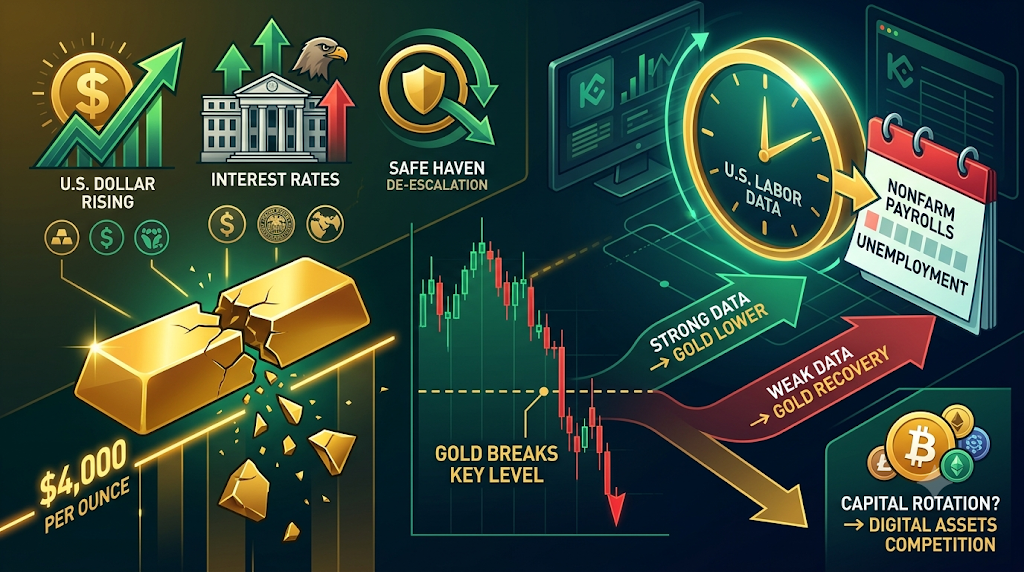
Gold falling below $4,000 per ounce would have sounded unrealistic only months ago. Yet in late June 2026, spot gold broke beneath this key psychological level for the first time since November 2025, reversing part of one of the strongest precious metals rallies in recent years. According to Reuters and market data cited across financial media, gold briefly traded below $4,000 after reaching record highs earlier in 2026.
The short answer is straightforward: gold is weakening because the macro environment has turned less supportive. A more hawkish U.S. Federal Reserve under new Chair Kevin Warsh, a stronger U.S. dollar, fading geopolitical risk after U.S.-Iran de-escalation, and renewed expectations for higher interest rates have reduced demand for non-yielding safe-haven assets.
The next major catalyst now becomes U.S. labor market data — especially June nonfarm payrolls and unemployment figures.
What Caused Gold to Fall Below $4,000?
Gold dropped below $4,000 because multiple macro drivers turned negative at the same time.
Unlike short-term commodity volatility, this move reflects a broader repricing of expectations around inflation, monetary policy, and safe-haven demand.
Gold slipped below $4,000 per ounce as markets increased expectations for elevated interest rates while the U.S. dollar strengthened sharply. Three major forces explain the move.
Hawkish Federal Reserve Signals Reduced Gold's Appeal
The biggest pressure came from the Federal Reserve.
Markets have interpreted recent Fed communication under Chair Kevin Warsh as prioritizing price stability and remaining willing to tighten policy further if inflation does not cool sufficiently. Expectations for at least one additional rate increase later in 2026 increased after the latest policy meeting.
Gold historically performs better during periods of falling real yields or easing monetary policy because it does not generate income.
When interest rates rise:
-
Treasury yields become more attractive.
-
Cash holdings earn higher returns.
-
Opportunity costs of holding gold increase.
This changes portfolio allocation behavior across institutional and retail investors.
A Stronger U.S. Dollar Created Additional Selling Pressure
The second driver is dollar strength.
The U.S. Dollar Index (DXY) recently moved back above the psychologically important 100 level, reflecting stronger expectations for U.S. economic resilience and tighter monetary conditions. A stronger dollar makes gold more expensive for global buyers because gold is priced in USD.
Historically, gold and DXY often show inverse correlation.
| Market Variable | Typical Impact on Gold |
| Higher DXY | Bearish |
| Lower interest rates | Bullish |
| Higher real yields | Bearish |
| Rising inflation expectations | Mixed |
| Geopolitical uncertainty | Bullish |
This recent move combined both rising dollar strength and hawkish policy expectations — an unusually difficult environment for bullion.
Safe-Haven Demand Weakened After U.S.-Iran Tensions Eased
The third catalyst is geopolitical repricing.
For several months, Middle East tensions provided a strong narrative supporting gold accumulation. However, as ceasefire developments and de-escalation reduced immediate systemic risk concerns, part of gold's geopolitical premium began disappearing.
Markets are increasingly shifting attention from geopolitical uncertainty back toward economic fundamentals. That transition matters because geopolitical rallies in gold often fade once investors regain confidence in broader risk assets.
Why Are Nonfarm Payrolls and Unemployment Data Suddenly So Important?
This week's U.S. labor data may determine gold's next major move. The market is heavily focused on the U.S. June employment report scheduled for release on this Thursday.
Employment data matters because labor strength directly influences Federal Reserve decisions. A strong report could reinforce hawkish expectations. A weak report could revive expectations of policy easing.
Scenario 1: Strong Jobs Data Could Push Gold Lower
If nonfarm payroll growth exceeds expectations and unemployment remains stable or declines:
-
Markets may increase pricing for additional Fed tightening.
-
Treasury yields could rise.
-
DXY could strengthen further.
-
Gold may experience renewed selling pressure.
This would reinforce the current bearish momentum.
Scenario 2: Weak Jobs Data Could Trigger a Gold Recovery
If hiring slows materially or unemployment rises:
-
Rate hike expectations may weaken.
-
Bond yields could retreat.
-
Dollar momentum could cool.
-
Gold may recover above major resistance zones.
Markets often react more to changes in expectations than to the headline number itself.
Could Bitcoin and Crypto Benefit if Gold Weakness Continues?
A sustained gold correction may redirect part of capital toward digital assets. Gold and Bitcoin are not direct substitutes, but they increasingly compete for macro-driven investment flows.
Both gold and crypto initially weakened following hawkish Fed repricing. However, capital rotation dynamics may diverge depending on risk appetite and liquidity conditions.
Crypto markets generally respond more aggressively to changes in monetary conditions. Investors should monitor:
-
Dollar strength
-
Interest rate expectations
-
ETF flows
-
Risk sentiment
A stabilization in macro conditions could reopen demand for alternative assets.
How to Trade Gold-Related Market Themes on KuCoin?
Investors who want exposure to macro market shifts do not necessarily need direct gold ownership. Many traders use broader market instruments and crypto sectors to express views on inflation, dollar strength, risk sentiment, and monetary policy.
On KuCoin, users can monitor real-time market movements, evaluate cross-asset sentiment, and access spot and derivatives markets to react to changing macro conditions.
Risk management remains essential. Gold's recent correction shows that even traditionally defensive assets can experience sharp drawdowns when narratives shift quickly.
In addition, KuCoin provides access to a broad range of not only crypto markets, but also stock markets, including MU stock. Now users can also participate in KuCoin's Campaign of Trading US Stock Perps:
-
After complete simple trading missions, users may unlock 100,000 USDT prize pool rewards in TSLA, AAPL, or GOOGL.

Conclusion
Gold falling below $4,000 marks an important macro transition rather than an isolated commodity selloff.
The combination of a more hawkish Federal Reserve, renewed rate hike expectations, a stronger U.S. dollar, and easing geopolitical tensions has reduced support for precious metals in the short term. Recent market data suggests investors are increasingly prioritizing yield and policy expectations over traditional safe-haven narratives.
The next major catalyst is likely to be U.S. employment data. Whether gold stabilizes above $4,000 or enters a deeper correction may depend less on headlines and more on what labor markets reveal about the future path of Federal Reserve policy.
FAQs
-
Is gold below $4,000 considered cheap?
Not necessarily. Price alone does not determine value. Investors should compare gold against interest rates, inflation expectations, and historical valuation ranges.
-
Does a stronger dollar always mean lower gold prices?
Not always, but historically there is often a negative relationship because gold is denominated in USD.
-
What indicator matters most for gold right now?
U.S. labor market data and expectations for Federal Reserve policy appear to be the most important short-term drivers.