

Elon Musk Says Nearly All AI Computing Will Move to Space – Can SpaceX Make Orbital Data Centers a Reality?
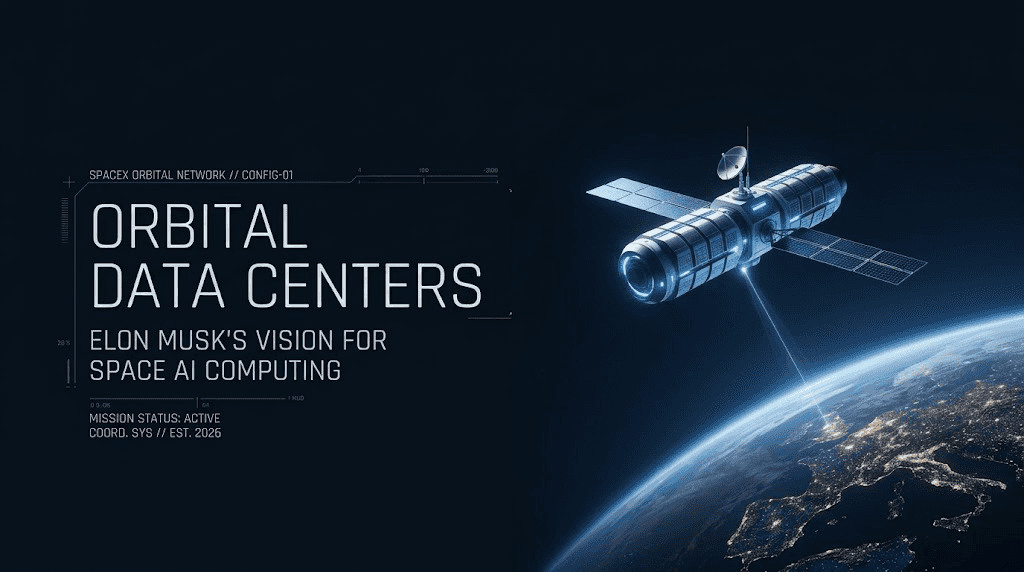
During a series of executive briefings and public statements culminating in late October 2026, Elon Musk asserted that within 30 to 36 months, space will become the most compelling and cost-effective environment for deploying artificial intelligence computing infrastructure, suggesting that virtually all future AI compute could eventually move off-planet. Musk projected that orbital compute capacity could begin scaling faster than terrestrial facilities around 2029. Underpinning this bold forecast is a well-documented industrial bottleneck on Earth: regional electrical grids are struggling to absorb gigawatt-scale data centers, constrained by four-to-seven-year utility interconnection queues, multi-year backlogs for high-voltage transformers, and rising local opposition over power rates and cooling water consumption.
To act on this thesis, SpaceX has initiated concrete infrastructure planning following its recent corporate alignment with xAI. Throughout 2026, the company filed trademark applications for an orbital data center service named "Starmind," submitted ambitious orbital constellation filings with the U.S. Federal Communications Commission (FCC), and began expanding a massive satellite manufacturing complex in Texas. By combining the heavy-lift capacity of its Starship rocket with the optical laser mesh of Starlink, SpaceX aims to test whether continuous solar energy in orbit can bypass the physical bottlenecks of Earth's electrical grids.
Despite the scale of SpaceX's ambitions, aerospace engineers, semiconductor physicists, and rival AI executives point out that moving hyperscale computing into orbit faces daunting obstacles rooted in thermodynamics, radiation physics, and unit economics. While positioning solar arrays in Sun-Synchronous Orbit avoids terrestrial transmission queues, operating thousands of commercial AI accelerators inside a vacuum introduces severe heat-dissipation challenges, cosmic radiation bit-flips, zero-maintenance hardware constraints, and speed-of-light network latency limits.
SpaceX's Orbital Roadmap: The Starmind Constellation and the Gigasat Factory
SpaceX’s push to develop orbital data centers builds directly on the vertical integration of its rocket launch, satellite manufacturing, and optical communications divisions. Rather than treating space-based computing as an isolated research experiment, SpaceX is structuring the Starmind initiative as a high-power computational extension of its existing Starlink network.
The Q4 2027 Demonstration Mission
According to industry disclosures and regulatory filings reviewed in late October 2026, SpaceX is targeting the fourth quarter of 2027 to launch its first dedicated orbital data center demonstration payload. Operating in Low Earth Orbit (LEO), with Sun-Synchronous Orbit (SSO) profiles designed to keep solar panels exposed to nearly continuous sunlight, the demonstration system is expected to test high-density AI accelerator configurations based on NVIDIA’s Vera Rubin platform alongside high-speed optical communication terminals.
The primary goal of the late-2027 demonstration is not immediate commercial cloud profitability, but empirical engineering validation. SpaceX engineers need to measure how advanced High Bandwidth Memory (HBM4) and sub-3nm logic chips withstand orbital radiation, test closed-loop fluid heat pipes connected to large deployable radiator wings, and evaluate end-to-end data transfer rates between orbital compute nodes and ground stations.
The Bastrop Gigasat Factory
To transition orbital compute from one-off prototypes to industrial mass production, SpaceX has begun developing a massive manufacturing facility dubbed the "Gigasat" factory in Bastrop, Texas, located adjacent to its existing Starlink production campus. Traditional commercial and defense satellites are bespoke, low-volume spacecraft that take years to assemble and cost hundreds of millions of dollars apiece. The Bastrop Gigasat facility is designed to apply the high-rate assembly-line techniques perfected on Starlink V2 Mini and V3 satellites to much heavier, high-wattage compute platforms.
By standardizing satellite buses, power regulation units, laser inter-satellite transceivers, and fold-out solar and radiator arrays, SpaceX intends to drive down the manufacturing cost per kilowatt of orbital capacity. Once operational, the Texas facility is meant to supply a steady pipeline of compute satellites matched to the launch cadence of the fully reusable Starship fleet.
Capital Expenditures and the Starship Launch Equation
The economic case for orbital data centers hinges almost entirely on slashing the cost of delivering mass to orbit. On Earth, building the physical shell and electrical infrastructure for a data center typically costs roughly $10 million to $12 million per megawatt before server hardware is installed. At current commercial launch rates of $1,500 to $2,500 per kilogram, lifting heavy server racks, cooling loops, and massive radiator panels into orbit is prohibitively expensive.
Reflecting the capital intensity of this dual buildout, equity analysts at Morgan Stanley projected in late 2026 that SpaceX’s annual capital expenditures will surge to approximately $53 billion in 2026 and surpass $130 billion in 2027, with the vast majority of that spending directed toward manufacturing AI data center satellites and scaling the Starship rocket fleet. Starship is engineered to lift 100 to 150 metric tons to Low Earth Orbit per flight. However, even aerospace proponents acknowledge that Starship must achieve rapid, airline-like reusability and reduce launch costs by an order of magnitude, toward $100 to $200 per kilogram or less, before orbital deployment can begin to compete with terrestrial construction costs.
The Physical Engineering Constraints: Radiative Cooling and Vacuum Thermodynamics
While continuous solar irradiation in orbit solves power generation on paper, space presents an immediate thermodynamic paradox for high-density electronics. A common popular misconception is that because the background temperature of deep space hovers near absolute zero (roughly minus 270 degrees Celsius), cooling hot computer chips in space should be effortless. In reality, aerospace thermal engineers face the exact opposite problem: the vacuum of space acts as a giant thermos flask.
Why Vacuum Insulation Traps Data Center Heat
On Earth, hyperscale data centers remove 40 to over 250 kilowatts of heat per server rack using conduction and convection. Cold plates draw heat away from the silicon, and massive chillers or evaporative cooling towers transfer that thermal energy into the surrounding air and water molecules. In the vacuum of Low Earth Orbit, there is no air and no water to carry heat away; convective cooling does not exist.
Every single watt of electrical power consumed by an orbital GPU—which converts almost entirely into waste heat—must be rejected into space solely through infrared thermal radiation. Under the fundamental laws of thermodynamics (specifically the Stefan-Boltzmann law), the amount of heat a surface can radiate into a vacuum depends on its surface area and the fourth power of its absolute temperature.
Because modern AI processors begin to suffer thermal throttling and permanent silicon degradation if their operating temperatures climb past 85 to 95 degrees Celsius, orbital cooling loops cannot simply run at glowing-hot temperatures to radiate heat faster. Operating within safe semiconductor temperature margins and accounting for incoming heat from direct sunlight and Earth’s reflected glow (albedo), a two-sided aerospace radiator panel can only reject roughly 250 to 350 watts of thermal energy per square meter.
The Massive Radiator Footprint Required for Megawatt Compute
When translated from a single chip to an enterprise data center scale, radiative cooling creates a massive structural footprint. Dissipating just 1 megawatt of heat in orbit requires approximately 3,000 to 4,000 square meters of two-sided radiator surface area. Scaling that up to a 100-megawatt AI cluster, a standard size for a terrestrial training facility, would require 300,000 to 400,000 square meters of radiator panels, equivalent to roughly 50 to 60 regulation soccer fields floating in formation.
These giant radiator wings must fold tightly inside a rocket fairing during launch, unfurl reliably in microgravity without jamming, circulate pumped liquid coolants through hundreds of flexible joints, and constantly pivot edge-on to the Sun while the satellite's solar panels face directly toward the Sun. The added dry mass of those radiators, pumps, and structural trusses eats directly into the rocket's payload capacity, meaning a large fraction of each launch is spent lifting plumbing and metal panels rather than revenue-generating GPUs.
Semiconductor Reliability: Cosmic Radiation, Bit-Flips, and the Zero-Maintenance Dilemma
Beyond thermal physics, placing cutting-edge commercial AI chips into orbit removes the protective shielding of Earth’s atmosphere and magnetosphere, exposing fragile nanoscale circuits to a constant bombardment of energetic particles.
Vulnerability of Sub-3nm AI Processors to Cosmic Rays
Traditional communications and reconnaissance satellites rely on "radiation-hardened" processors manufactured on older, larger process nodes (such as 65nm or 130nm) with specialized insulating substrates and triple-redundant logic gates. However, frontier large language models cannot run on slow, legacy aerospace chips; they require commercial sub-3nm GPUs and densely stacked HBM4 memory containing billions of microscopic transistors.
At these atomic scales, the electrical charge holding a digital
0 or 1 inside a memory cell is tiny. When galactic cosmic rays or solar protons pass through an unshielded commercial GPU, they leave trails of ionized charge that cause Single Event Upsets (SEUs)—spontaneously flipping bits in memory or processor registers. Even worse, heavy ions can trigger Single Event Latch-ups (SELs), creating internal short circuits that permanently burn out chip components unless power is cut within milliseconds.In a synchronized AI training run, a single uncorrected bit-flip inside a floating-point weight matrix can corrupt gradient calculations across the entire cluster, forcing engineers to halt the run and roll back to a previous checkpoint. Adding heavy physical radiation shielding (such as lead or thick aluminum enclosures) increases launch weight, while running redundant error-checking calculations across duplicate chips cuts effective compute throughput in half.
Zero On-Orbit Maintenance vs. Rapid Silicon Obsolescence
Operating a data center on Earth is a hands-on industrial operation. In any 100,000-GPU terrestrial supercluster, optical transceivers, power supplies, memory modules, and cooling pumps fail every week. Data center technicians walk the aisles 24/7 to swap out faulty blades and keep cluster utilization high.
In orbit, there is no technician with a wrench. If a coolant pump seizes, a micrometeoroid punctures a radiator line, or a voltage regulator shorts out, that multi-million-dollar satellite node cannot be repaired. Furthermore, AI silicon iterates on a blistering 18-to-24-month cycle, moving from Hopper to Blackwell to Vera Rubin, with each generation delivering massive jumps in energy efficiency per watt. While an Earth-based data center can reuse its concrete shell, substations, and cooling towers by simply sliding new server racks into existing cabinets every three years, an orbital data center cannot be easily upgraded. Once its onboard chips become outdated after two or three years, the entire spacecraft, solar arrays, radiators, and chassis included, faces economic obsolescence and eventual atmospheric burn-up.
Network Latency and the Training-Inference Divide
To evaluate what workloads could realistically run in space, engineers distinguish sharply between tightly coupled model pre-training and decoupled inference tasks.
Why Frontier Model Pre-Training Remains Anchored to Earth
Training a frontier foundation model requires tens of thousands of GPUs to exchange massive volumes of gradient data hundreds of times per second. On Earth, providers like Oracle and Microsoft pack GPUs into dense racks within a two-kilometer radius, using copper backplanes (NVLink) and high-speed Ethernet to keep communication latencies under a few microseconds.
In orbit, satellites flying in a constellation are separated by tens or hundreds of kilometers to avoid collision risks. Because light travels through a vacuum at 300 kilometers per millisecond, two satellites spaced just 300 kilometers apart face a 1-millisecond one-way communication delay over laser links—roughly 500 to 1,000 times slower than intra-rack interconnects on Earth. Attempting to synchronize a single massive LLM training run across widely separated satellites would leave GPUs stalling on network communications, making Earth-based campuses far superior for monolithic pre-training.
Viable Niches: Orbital Edge Inference, Earth Observation, and Defense
Where orbital compute does make compelling engineering sense is in edge data processing, batch inference, and sovereign resilience. Earth-observation, weather, and defense satellites generate terabytes of raw optical and radar imagery every day, but beaming all of that raw data down to Earth is severely bottlenecked by limited radio-frequency downlink bandwidth.
By placing AI inference chips directly in orbit, as demonstrated in early proof-of-concept tests by startups like Starcloud, which operated an NVIDIA H100 chip in space, satellites can analyze imagery on-board in real time and transmit only compact text alerts or actionable coordinates back to Earth. Similarly, latency-tolerant batch inference jobs, sovereign backup enclaves, and decentralized physical infrastructure networks (DePIN) seeking censorship-resistant off-planet nodes could utilize orbital compute without suffering from multi-millisecond laser link delays.
Industry Reality Check: Google’s Project Suncatcher and Sam Altman’s Critique
SpaceX is not alone in studying the physics of orbital computing, though industry leaders hold sharply differing views on when, or if, the economics will close.
Google’s "Project Suncatcher" and the 100x Launch Cost Hurdle
Rather than dismissing orbital compute outright, Google has quietly established its own exploratory initiative, dubbed "Project Suncatcher," led by executive Travis Beals. According to October 2026 disclosures, Google partnered with satellite imaging firm Planet Labs to launch two prototype satellites carrying Google’s custom Tensor Processing Units (TPUs) to test how its AI chips handle space radiation and thermal dissipation.
At the same time, Google’s internal economic modeling underscores the steep financial hurdle ahead. Google researchers calculated that at current commercial launch prices of $1,500 to $2,000 per kilogram, launching hardware into space is roughly 100 times too expensive to compete with terrestrial data centers on a lifecycle basis. According to Google’s estimates, launch prices must fall below $200 per kilogram, and eventually approach $20 per kilogram, before orbital solar advantages can offset spacecraft manufacturing, radiator mass, and hardware replacement costs. Meanwhile, Jeff Bezos’s Blue Origin has also conducted internal orbital compute studies under "Project Sunrise," reflecting broad aerospace interest in long-term off-grid capacity.
Sam Altman and Aerospace Analysts Urge Caution
Other leaders in the AI and satellite industries remain deeply skeptical of Musk’s 30-to-36-month timeline. OpenAI CEO Sam Altman previously dismissed the idea of building massive orbital data centers in the near term as "ridiculous" and unrealistic, pointing to exorbitant launch costs and the impossibility of repairing failed GPUs in space while focusing OpenAI’s capital on multi-gigawatt terrestrial campuses. Independent aerospace analysts at Quilty Space and university researchers similarly argue that while small orbital edge servers for satellite sensors will grow rapidly over the next five years, solving terrestrial power bottlenecks via nuclear restarts, natural gas turbines, geothermal power, and upgraded grid transmission remains vastly cheaper and faster than lifting gigawatts of server racks into Low Earth Orbit.
Conclusion
Elon Musk’s vision of moving artificial intelligence infrastructure into orbit, backed by SpaceX’s Starmind filings, the Bastrop Gigasat factory, and a projected 2027 capital expenditure budget, underscores just how severely electrical grid bottlenecks are constraining data center growth on Earth. Yet the laws of thermodynamics and semiconductor physics present formidable barriers in Low Earth Orbit. Until Starship cuts launch costs by roughly two orders of magnitude and engineers solve the challenges of kilometer-scale infrared radiators, cosmic ray bit-flips, and disposable two-year chip lifecycles, orbital computing will primarily serve specialized edge inference and satellite data processing rather than replacing terrestrial gigawatt superclusters.
FAQs
When does Elon Musk say AI computing will move to space?
In late 2026, Elon Musk stated that within 30 to 36 months, space will become the lowest-cost place to deploy AI compute, arguing that orbital solar power avoids Earth’s multi-year electrical grid queues and permitting delays. SpaceX is targeting Q4 2027 to launch an initial orbital data center test payload using NVIDIA Vera Rubin hardware.
How do orbital data centers cool GPUs in the vacuum of space?
Because space is a vacuum with no air or water for convective cooling, heat cannot simply dissipate into the cold background. Orbital servers must collect waste heat via internal liquid loops and pump it into massive deployable radiator panels that shed energy slowly as infrared thermal radiation—requiring roughly 3,000 to 4,000 square meters of radiator surface for every 1 megawatt of compute.
What are the main technical challenges of putting AI chips in space?
The four primary hurdles are radiative heat dissipation (requiring giant, heavy radiator wings), cosmic radiation (which causes bit-flips and hardware damage in dense sub-3nm commercial GPUs and HBM4 memory), zero maintenance (broken components cannot be physically repaired in orbit), and inter-satellite laser latency (which makes tightly synchronized LLM pre-training far less efficient than on Earth).
Are other tech companies besides SpaceX testing orbital AI compute?
Yes. While OpenAI CEO Sam Altman has called near-term mass orbital data centers unrealistic, Google is running an exploratory program called "Project Suncatcher". Startup Starcloud has already tested an NVIDIA H100 GPU in orbit, and Blue Origin has studied the concept under "Project Sunrise."
Disclaimer
This general market information, possibly from third-party, commercial, or sponsored sources, is provided for reference and educational purposes only and does not constitute financial or investment advice, an offer, solicitation, or guarantee. We disclaim liability for its accuracy, completeness, reliability, and any resulting losses. Investments/trading are risky; past performance doesn’t guarantee future results. Users should research, judge prudently, and take full responsibility. For further details, please consult KuCoin’s Terms of Use and Risk Disclosure.