

Bitcoin Market Cap Forecast: 7 Key Reasons BTC Could Reenter the Global Top 10 Assets by April 2026
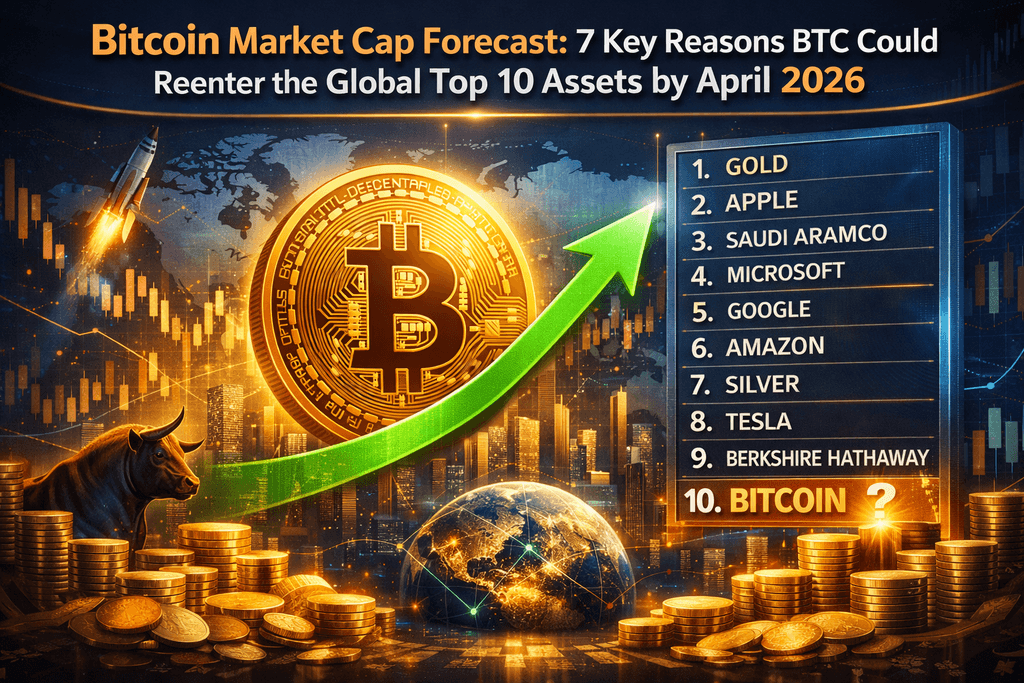
The rapid evolution of the digital economy has placed the Bitcoin Market Cap Forecast at the center of global financial discussions. As traditional and decentralized markets converge, understanding the catalysts that could propel Bitcoin back into the elite circle of the world's most valuable assets is essential for every forward-looking investor.
In this comprehensive analysis, we explore the primary drivers and secondary market shifts that support a bullish Bitcoin Market Cap Forecast, detailing why the leading cryptocurrency is positioned for a historic comeback.
Introduction: How Close Is Bitcoin to the Global Top 10 Assets?
As of mid-April 2026, the global financial leaderboard is dominated by a mix of "Magnificent Seven" tech giants, state-owned energy firms, and the timeless luster of gold. Bitcoin, once an experimental digital code, has matured into a trillion-dollar powerhouse that frequently knocks on the door of this exclusive club.
Bitcoin’s Position in the Global Asset Ranking
To understand the Bitcoin Market Cap Forecast, one must look at the current titans. Gold remains the undisputed leader with a valuation exceeding $14 trillion. It is followed by corporate behemoths like NVIDIA, Apple, and Microsoft, which fluctuate between $3 trillion and $4.5 trillion.
-
Top Tier: Gold, NVIDIA, Apple, Microsoft, Alphabet (Google).
-
Mid Tier: Saudi Aramco, Amazon, Meta (Facebook), TSMC.
-
Bitcoin's Current Standing: Hovering around the $1.4 trillion to $1.6 trillion mark, Bitcoin currently sits just outside the Top 10, often competing with Berkshire Hathaway and Tesla for the #10 or #11 spot.
Why Market Cap Ranking Matters for Bitcoin
The climb up the ranking is more than just a vanity metric; it signals a fundamental shift in institutional perception. When Bitcoin enters the Top 10, it stops being viewed as a speculative "crypto" and starts being treated as a standard portfolio allocation necessity. This psychological threshold triggers "fear of missing out" (FOMO) among sovereign wealth funds and massive pension schemes, further accelerating long-term adoption.
The Key Question for 2026
Can Bitcoin reclaim its Top 10 status by the end of April 2026? With a current price consolidation near $75,000, a move toward $100,000 would likely secure its position. This article breaks down the seven fundamental catalysts—ranging from ETF inflows to nation-state reserves—that make this Bitcoin Market Cap Forecast a high-probability scenario.
-
Institutional Capital Returning Through Bitcoin ETFs
The "ETF Era" of Bitcoin has reached full maturity in 2026. What began as a breakthrough in early 2024 has become the primary highway for institutional capital entering the space, drastically altering any professional Bitcoin Market Cap Forecast.
The Role of Spot Bitcoin ETFs
Spot ETFs have effectively "de-risked" Bitcoin for the traditional financial (TradFi) world. By removing the technical hurdles of private key management and cold storage, these products allow multi-billion dollar funds to gain exposure via their existing brokerage accounts. This simplification has turned Bitcoin into a "click-to-buy" asset for the world’s largest wealth managers.
Major ETF Players Driving Demand
In 2026, a few dominant products control the lion's share of the market:
-
BlackRock (IBIT): The "gold standard" of Bitcoin ETFs, consistently seeing net inflows even during market volatility.
-
Fidelity (FBTC): A favorite for retail-heavy platforms and independent financial advisors.
-
Institutional Custom Products: We are now seeing "Model Portfolios" where Bitcoin is a default 1-3% allocation alongside stocks and bonds.
Why ETF Inflows Matter for Market Cap Growth
The sheer scale of capital access provided by ETFs creates a "sticky" demand. Unlike retail traders who might panic-sell during a 10% dip, institutional allocators tend to follow rebalancing schedules. This provides liquidity and market stability, creating a higher "floor" for Bitcoin’s price and market capitalization.
-
The Post-Halving Supply Shock Is Unfolding
Two years after the 2024 halving, the "supply shock" is no longer a theory—it is a mathematical reality reflected in the Bitcoin Market Cap Forecast.
Understanding the 2024 Bitcoin Halving
In April 2024, the Bitcoin block reward was cut from 6.25 BTC to 3.125 BTC. While the immediate price impact is often muted, the cumulative effect of 450 fewer Bitcoins being produced every single day begins to manifest roughly 12 to 18 months later. By April 2026, the market is feeling the full weight of this "scarcity by design."
Historical Market Cycles After Halving Events
Historically, Bitcoin reaches its cycle peak in the second year following a halving:
-
2012 Halving: Peak occurred in 2013.
-
2016 Halving: Peak occurred in late 2017.
-
2020 Halving: Peak occurred in 2021.
-
2024 Halving: Following this pattern, early 2026 represents the "Golden Window" for price discovery.
Why Supply Reduction Matters in 2026
With miners producing significantly less "new" Bitcoin, any increase in demand—whether from ETFs or retail—must be met by existing holders. When demand vs supply dynamics are this skewed, price movements tend to be parabolic, making a Top 10 market cap reentry almost inevitable if historical trends hold.
-
Improving Global Liquidity Conditions
Bitcoin has often been described as a "liquidity sponge." Its performance is intrinsically tied to the amount of fiat currency circulating in the global economy.
The Relationship Between Bitcoin and Global Liquidity
Bitcoin is a high-beta asset, meaning it reacts strongly to changes in the "M2" money supply. When central banks expand their balance sheets or lower interest rates, that excess liquidity often finds its way into scarce assets like Bitcoin.
Shifts in Global Monetary Policy
By 2026, many major central banks have shifted away from the aggressive tightening seen in previous years. As interest rates stabilize or decline to prevent economic stagnation, the "opportunity cost" of holding Bitcoin (which pays no interest) drops, making it more attractive compared to government bonds.
Liquidity as a Catalyst for Crypto Market Growth
-
Capital Rotation: As liquidity increases, investors move further out on the "risk curve."
-
Alternative Assets: Bitcoin is now the first stop for investors exiting depreciating fiat currencies.
-
Market Growth: The total crypto market cap often expands in lockstep with global liquidity, with Bitcoin leading the charge.
-
Strengthening “Digital Gold” Narrative
The most enduring argument for a bullish Bitcoin Market Cap Forecast is the asset's comparison to gold. In 2026, this narrative has moved from the fringes of the internet to the boardrooms of Wall Street.
Bitcoin as a Store of Value
Bitcoin shares many characteristics with gold: it is scarce, durable, and portable. However, it surpasses gold in "verifiable scarcity." While we can always mine more gold if the price rises high enough, there will never be more than 21 million Bitcoin. This absolute mathematical certainty makes it the ultimate hedge against currency debasement.
Bitcoin vs Gold Market Capitalization
| Feature | Gold | Bitcoin (2026) |
| Market Cap | ~$14 Trillion | ~$1.5 Trillion |
| Portability | Physical / Heavy | Digital / Weightless |
| Scarcity | Natural / Estimated | Algorithmic / Exact |
| Auditability | Difficult / Expensive | Instant / Free |
As Bitcoin's market cap grows, it "cannibalizes" a portion of gold's market share. If Bitcoin were to reach even 25% of gold's market cap, its price would exceed $175,000, easily placing it in the Global Top 5 assets.
-
Gradual Expansion of Nation-State Adoption
Perhaps the most surprising factor in the 2026 Bitcoin Market Cap Forecast is the entry of sovereign nations into the Bitcoin market.
The Impact of Early National Bitcoin Adoption
The "El Salvador Experiment" is no longer an experiment—it's a case study in financial sovereignty. Other developing nations have taken note of how Bitcoin can facilitate remittances and reduce dependence on the US Dollar.
Emerging Government Interest in Bitcoin Reserves
In 2025 and early 2026, the conversation shifted to "Strategic Bitcoin Reserves." Various US states and even some national governments have introduced legislation to hold Bitcoin on their balance sheets. When a nation-state buys Bitcoin, they aren't looking for a "quick trade"; they are performing strategic asset diversification, which removes massive amounts of supply from the open market for decades.
Potential Implications for Global Financial Systems
Sovereign-level legitimacy transforms Bitcoin from a "tech asset" to a "geopolitical asset." This transition creates a permanent floor for the Bitcoin Market Cap Forecast, as the world's most powerful entities begin to compete for a limited supply of the world’s hardest money.
-
On-Chain Data Signals Long-Term Accumulation
While headlines focus on price, the "truth" of Bitcoin's health is found on the blockchain. In 2026, on-chain metrics are screaming "accumulation."
Growth of Long-Term Holder Supply
Data from firms like Glassnode show that the percentage of Bitcoin held by "Long-Term Holders" (those who haven't moved their coins in 155+ days) is at all-time highs. This indicates that the "weak hands" have been flushed out, and the current circulating supply is being held by "diamond-handed" believers.
Declining Exchange Reserves
The amount of Bitcoin sitting on centralized exchanges has been trending downward for years. In 2026, this trend has accelerated as users move their assets into self-custody or institutional cold storage.
-
Less Supply on Exchanges = Higher Volatility to the Upside.
-
Supply Tightening: When a large buyer enters the market, there is very little "liquid" supply to sell to them, forcing the price higher.
-
Expansion of the Bitcoin Ecosystem
Bitcoin is no longer "just" a store of value. The 2026 Bitcoin Market Cap Forecast is bolstered by the fact that Bitcoin has become a programmable platform.
The Rise of Bitcoin Layer 2 Solutions
The Lightning Network, Stacks, and other Layer 2 (L2) solutions have solved the scalability issue. Bitcoin can now handle millions of transactions without clogging the main chain. This utility makes BTC an "essential utility" rather than just a stagnant digital bar of gold.
New Use Cases: Ordinals and Runes
The introduction of Ordinals (Bitcoin NFTs) and Runes (fungible tokens on Bitcoin) has created a vibrant developer ecosystem. This has led to:
-
Increased Network Fees: Providing long-term security incentives for miners.
-
New Demand: Users who never cared about "sound money" are now buying Bitcoin to participate in the "BitFi" (Bitcoin DeFi) ecosystem.
Expanding Utility Beyond a Store of Value
By evolving into a broader ecosystem, Bitcoin captures value from multiple sectors: finance, gaming, and digital collectibles. This multi-pronged utility ensures that the Bitcoin Market Cap Forecast remains robust even if one specific narrative (like "Digital Gold") temporarily cools off.
Conclusion: Can Bitcoin Reclaim a Global Top 10 Asset Position?
The Bitcoin Market Cap Forecast for April 2026 suggests that a reentry into the global Top 10 is not just possible, but highly probable. Driven by the combined forces of institutional ETF inflows, the persistent supply shock from the 2024 halving, and the maturation of the Bitcoin Layer 2 ecosystem, the asset has established a level of structural support never seen in previous cycles. While regulatory shifts and macroeconomic volatility remain notable risks, the transition of Bitcoin from a speculative asset to a core pillar of global finance appears nearly complete. As Bitcoin continues to challenge the market caps of tech giants and traditional commodities, its status as a permanent Top 10 global asset becomes a matter of "when," not "if."
FAQ
-
What is the current Bitcoin Market Cap Forecast for 2026?
Most analysts project Bitcoin’s market cap to range between $1.5 trillion and $3 trillion by late 2026. This growth is supported by institutional ETF adoption, global liquidity expansion, and the scarcity effects of the 2024 halving event.
-
How does the Bitcoin market cap compare to gold?
As of April 2026, Bitcoin's market cap is roughly 10-12% of gold's $14 trillion valuation. Many experts believe Bitcoin will eventually reach "gold parity," which would require a market cap nearly ten times its current size.
-
Will Bitcoin stay in the Top 10 assets permanently?
While crypto markets are known for volatility, the entry of nation-states and massive pension funds suggests that Bitcoin is becoming a permanent fixture. Reentering the Top 10 in 2026 would likely mark its transition into a mature, "blue-chip" global asset.
-
How did the 2024 halving affect the Bitcoin Market Cap Forecast?
The halving reduced the daily supply of new BTC by 50%. By 2026, this "supply shock" has fully integrated into the market, creating upward price pressure as demand from ETFs and retail investors continues to grow.
-
Are there risks to the Bitcoin Market Cap Forecast?
Yes. Major risks include aggressive global regulatory crackdowns, severe macroeconomic recessions that drain liquidity, or unforeseen technical vulnerabilities in the Bitcoin network. However, the decentralized nature of BTC provides significant resilience against these factors.