

10x Research: Altcoins Fall 14% as Rally Momentum Fades and Liquidity Dries Up
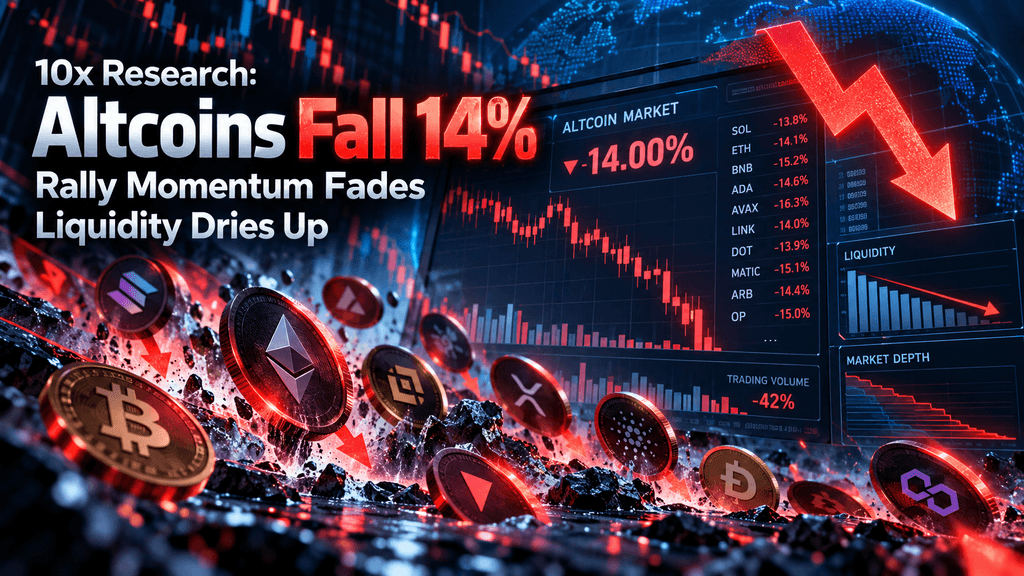
Can the altcoin market recover when capital is becoming harder to attract? On October 19, 2026, a market update citing 10x Research reported that a basket of 141 cryptocurrencies had fallen by an average of 14% over the previous week, while Bitcoin declined approximately 3%. The sharp performance gap highlights a growing divide between the largest cryptocurrency and the broader altcoin market. Declining trading volumes, shrinking stablecoin supply, and spot crypto exchange-traded fund (ETF) outflows have added to concerns about liquidity and investor demand.
The sell-off does not automatically mean that altcoin season is over. Instead, it suggests that the market's earlier recovery is facing a tougher test: whether improving prices can attract enough fresh capital to sustain a broad rally. Bitcoin's relative resilience, shifting investor positioning, and weaker demand for riskier tokens are central to understanding the latest move. The key question is whether this is a temporary correction or evidence of a deeper shift toward Bitcoin and away from smaller digital assets.
Key Takeaways
-
A market update citing 10x Research reported an average weekly decline of 14% across 141 tracked tokens, compared with approximately 3% for Bitcoin.
-
Falling trading volumes, contracting stablecoin supply, and ETF outflows point to pressure on crypto-market liquidity.
-
Bitcoin's relative strength may reflect defensive positioning rather than a broad inflow of new capital.
-
Earlier indicators showed improving altcoin market breadth, but that recovery has not guaranteed sustained momentum.
-
A durable altcoin rebound would require stronger spot demand, healthier liquidity, and wider participation across tokens.
What Did 10x Research Report About the Altcoin Sell-Off?
The latest figures point to a broad deterioration in altcoin performance, with the average decline across the tracked basket substantially exceeding Bitcoin's loss. A report published on October 19 said 141 cryptocurrencies fell by an average of 14% during the previous week, while BTC declined around 3%. The figures were reported by CoinNess, which attributed the assessment to 10x Research. The report also highlighted falling trading volume, shrinking stablecoin supply, and spot ETF outflows as signs of a weaker liquidity environment.
The 11-percentage-point difference between the two reported declines matters because it shows that market weakness was not evenly distributed. Bitcoin experienced a comparatively smaller drawdown, while altcoins faced substantially greater selling pressure. This pattern is consistent with investors becoming more selective about the assets they hold when market conditions deteriorate. However, the 14% figure represents the reported average for a particular basket, not a 14% decline in the entire altcoin market's aggregate market capitalization. The source summary also does not fully specify the basket's weighting methodology, so the statistic should not be interpreted as a universal return for all altcoin holders.
Why the Difference Between Bitcoin and Altcoins Matters
Bitcoin generally has deeper liquidity and broader institutional access than many smaller cryptocurrencies. When investors reduce risk, they may prefer to retain BTC exposure while cutting positions in assets with thinner order books, weaker demand, or greater volatility. That behavior can widen the performance gap even without a coordinated transfer of funds from every altcoin into Bitcoin.
Recent analysis from Bitfinex supports the view that altcoins were already showing greater downside sensitivity. In an October 12 report, Bitfinex said BTC lost 3.1% over the week it examined, while ETH declined 6.9%, SOL fell 8.4%, and XRP dropped 7.2%. At the October 8 low, the ten large altcoins tracked by the firm had fallen between 12% and 17% from the previous weekly close, compared with a 7% decline for Bitcoin. These figures cover a different measurement window from the October 19 report, but they reinforce the broader observation that altcoins have been more vulnerable during recent pullbacks.
Why Are Altcoins Falling Faster Than Bitcoin?
Altcoins are falling faster because weaker liquidity, selective capital allocation, and higher asset-specific volatility can amplify the impact of selling. The latest 10x Research-related report identified declining trading volume, contracting stablecoin supply, and ETF outflows as overlapping pressures. Together, these signals suggest that the market is struggling to attract consistent incremental demand at a time when investors are reassessing their exposure to riskier assets.
Capital Is Becoming More Selective
Bitcoin's relative strength can reflect a preference for liquidity and perceived resilience rather than an outright bullish view of the entire crypto market. Investors who want to maintain digital-asset exposure may choose BTC over smaller tokens because it generally offers more established trading infrastructure and greater market depth. If demand concentrates in Bitcoin while participation in smaller assets weakens, altcoin prices can fall even when BTC remains relatively stable.
The October 9 report from 10x Research, titled “Altcoin Season Isn't Over, but the Money Is Rotating”, described this shift directly. Bitcoin dominance had risen to 59.6%, and the firm's Bitcoin–Altcoin Rotation Model had switched back toward Bitcoin. At the same time, the firm noted that the share of tokens trading above their 200-day moving averages had risen from 14% three months earlier to 78%. The combination suggests that earlier market breadth had improved even as capital allocation began to favor Bitcoin again.
This distinction is important. Better technical conditions across many tokens do not guarantee that investors will continue funding a broad rally. Market breadth describes how many assets are participating in a recovery, while capital rotation describes where investors are directing their exposure. Those indicators can move in different directions.
Thin Order Books Can Magnify Selling Pressure
Smaller cryptocurrencies are often more sensitive to changes in market liquidity. When order books are thin, relatively modest sell orders can move prices more sharply than comparable orders in Bitcoin. Market makers may also widen spreads or reduce inventory during volatile periods, making it more expensive to enter or exit positions.
This mechanism helps explain why an average altcoin decline can greatly exceed Bitcoin's loss during a market-wide correction. It does not establish that every token experienced the same liquidity deterioration, nor does it prove that market makers caused the latest sell-off. Token-specific supply events, leverage, investor concentration, and project news can all contribute to individual price movements.
The practical implication is that the altcoin market cannot be evaluated through Bitcoin's price alone. A stable BTC price may conceal substantial stress among smaller assets, while a modest Bitcoin decline can coincide with much larger losses elsewhere. Investors and analysts should therefore compare returns, market depth, and trading activity across multiple tokens rather than treating the market as one uniform asset class.
How Liquidity and ETF Flows Are Affecting Crypto
Liquidity is central to the current debate because a sustainable rally requires more than rising prices: it needs enough buyers willing to absorb selling and support higher valuations. The latest report identified contracting stablecoin supply, lower trading volumes, and spot ETF outflows as warning signals. If these conditions persist, the market may struggle to turn short-lived rebounds into a broad recovery.
Stablecoins serve as a settlement and liquidity tool across cryptocurrency markets. Traders use dollar-pegged tokens to move between positions, fund exchange accounts, and hold funds without maintaining direct exposure to volatile assets. A contraction in aggregate stablecoin supply can therefore be consistent with reduced available capital. However, supply changes must be interpreted carefully. Tokens can move between blockchains, be redeemed, or shift between wallets and exchanges. A lower aggregate supply does not reveal exactly how much money has left altcoins or whether every segment of the market is experiencing reduced buying power.
ETF flows provide another perspective, but their scope is narrower. Spot crypto ETFs reflect demand for particular investment products, not all global cryptocurrency trading. Outflows can weaken an important source of institutional demand, but they do not necessarily mean that every investor category is selling. Exchange activity, private transactions, offshore venues, and derivatives markets can follow different patterns.
Macro Conditions Can Reinforce the Pressure
Interest rates and bond yields can influence how investors compare crypto assets with other investments. When fixed-income returns are attractive, investors may require greater potential returns to justify holding highly volatile tokens. Conversely, improving financing conditions and stronger risk appetite can support demand for speculative assets. These relationships are not mechanical, and crypto prices can diverge from broader markets because of industry-specific developments.
Recent market data illustrates why the macro backdrop needs to be considered alongside crypto-specific flows. Reuters reported on October 16 that global equity funds attracted $20.01 billion in the week through October 14, while global bond funds recorded $7.79 billion in inflows. The same report said technology-sector equity funds experienced outflows despite broader equity inflows. These figures do not prove that capital flowed directly out of cryptocurrencies and into traditional assets, but they show that investor allocation across markets was uneven.
For altcoins, the relevant question is whether demand improves across several channels at once. Stronger spot volume, stabilizing stablecoin supply, and sustained institutional inflows would provide more convincing evidence of a recovery than a temporary price bounce unsupported by broader participation.
Is Altcoin Season Over?
The latest sell-off weakens the case for an immediate, broad-based altcoin rally, but it does not conclusively establish that altcoin season has ended. The distinction depends on the time horizon and the indicators used. A sharp weekly decline can reflect a correction within a larger recovery, while a prolonged period of underperformance, weakening market breadth, and persistent capital outflows would provide stronger evidence of a structural change.
10x Research's October 9 analysis illustrates this tension. Bitcoin dominance had returned to 59.6%, and the firm's rotation model favored Bitcoin. Yet the proportion of tokens above their 200-day moving averages had increased substantially over the preceding three months. The firm also noted that altcoin–Bitcoin correlation had remained below 60% for six months, suggesting that altcoins were not moving as a single group. Its conclusion was not that every altcoin was finished, but that capital was rotating and different indicators were sending different signals.
Three Signals That Would Help Confirm the Trend
| Indicator | Evidence supporting recovery | Evidence of continued weakness |
| Bitcoin dominance | A sustained decline alongside improving altcoin performance | Continued increases while altcoins underperform |
| Stablecoin supply and trading volume | Stabilization or expansion accompanied by stronger spot demand | Persistent contraction and weak participation |
| Market breadth | More tokens regain key long-term moving averages | More tokens lose long-term trend support |
These indicators should be considered together. Bitcoin dominance can rise because BTC outperforms, because altcoins fall more sharply, or because market capitalization changes across assets. It is not a direct measure of capital inflows into Bitcoin. Likewise, a token trading above its 200-day moving average does not guarantee future gains; it is a trend indicator, not a forecast.
A convincing recovery would involve sustained improvement in relative returns, stronger liquidity, and wider participation across market segments. If only a handful of large tokens rally while most assets continue to lose ground, the move would be better described as selective strength than a broad altcoin season.
What the Sell-Off Means for BTC, ETH, and Other Altcoins
The current divergence suggests that cryptocurrency investors should evaluate each market segment separately rather than assume that all digital assets will recover together. Bitcoin's relative resilience, Ethereum's institutional-flow picture, and the performance of smaller tokens reflect different demand drivers. The latest sell-off makes those differences more important because broad market weakness can conceal both stronger assets and areas of persistent stress.
Bitcoin: Relative Strength Needs Confirmation
Bitcoin's approximately 3% weekly decline was considerably smaller than the reported 14% average decline across the 141-token basket. That relative performance may reinforce BTC's position as the preferred exposure for investors seeking to remain in crypto while reducing risk elsewhere. However, relative strength is not the same as a confirmed bullish trend. If ETF outflows persist and spot buying remains weak, Bitcoin could also face renewed selling pressure.
The key evidence to watch is whether Bitcoin can maintain its relative resilience while spot demand stabilizes. A recovery supported by sustained purchases and improving market liquidity would be more convincing than one driven mainly by short covering or declining selling pressure. Analysts should also distinguish price changes from changes in market capitalization, since token supply and asset composition can affect market-level comparisons.
Ethereum and Smaller Tokens: Demand May Diverge
Ethereum occupies a different position from smaller altcoins because it serves as infrastructure for decentralized finance, stablecoins, and other on-chain applications. Yet a strong ecosystem does not automatically translate into positive short-term price performance. Investors also consider ETF flows, derivatives positioning, network activity, valuation, and competing investment opportunities.
Smaller tokens face additional challenges, including lower market depth, concentrated ownership, token unlocks, and uncertain demand. Some may recover before Bitcoin if a specific catalyst attracts buyers, while others may continue to underperform even during a broader market rebound. The reported 14% average decline therefore should not be interpreted as a uniform forecast for every altcoin.
For analysts, the more useful approach is to compare sectors such as decentralized finance, Layer 1 networks, artificial intelligence tokens, real-world asset projects, and meme coins. If weakness is concentrated in particular categories, the sell-off may reflect sector rotation. If declines spread across nearly every category alongside falling liquidity, the evidence for a broader risk-off environment becomes stronger.
What Should Traders Watch Next?
The next phase of the market will depend on whether selling pressure eases and fresh demand returns. The most useful signals are observable market data rather than predictions based solely on recent price declines. Analysts should track Bitcoin's relative performance, spot trading volume, stablecoin supply, ETF flows, and the proportion of altcoins maintaining their long-term trends.
Three scenarios are worth considering. In a recovery scenario, stablecoin supply stops contracting, spot activity improves, and more altcoins begin outperforming Bitcoin. That combination would suggest that buyers are returning beyond the largest assets. In a continued-rotation scenario, Bitcoin remains relatively resilient while altcoins struggle, indicating that investors still prefer selective exposure. In a deeper risk-off scenario, Bitcoin also weakens while liquidity and market breadth deteriorate, raising the possibility of another broad market decline.
These scenarios are analytical frameworks, not predictions with assigned probabilities. No single indicator can establish the direction of the market, and short-term flows can reverse quickly. A rise in trading volume, for example, may reflect forced selling rather than healthy demand. Similarly, falling Bitcoin dominance is not sufficient evidence of an altcoin recovery unless altcoins are also showing improving prices and participation.
The most important confirmation would be a sustained combination of stronger spot buying, improving market breadth, and stabilizing liquidity. Until these signals align, the reported sell-off supports a cautious interpretation of the altcoin market rather than a definitive conclusion that a new long-term downtrend has begun.
Conclusion
The latest 10x Research-related market update highlights a widening divide between Bitcoin and the broader altcoin market. The reported 14% average weekly decline across 141 tokens, compared with Bitcoin's approximately 3% loss, indicates that altcoins have absorbed substantially greater selling pressure. Declining trading volume, contracting stablecoin supply, and spot ETF outflows add to concerns that the market lacks the consistent demand needed to sustain a broad recovery.
However, the figures do not prove that altcoin season is permanently over. Earlier October analysis from 10x Research showed improving market breadth even as capital began rotating back toward Bitcoin. This apparent contradiction illustrates why price performance, market dominance, and liquidity must be assessed together rather than treated as interchangeable signals.
The next stage will depend on whether spot demand improves, stablecoin supply stabilizes, and more altcoins regain relative strength. Bitcoin's resilience alone cannot confirm a market-wide recovery, just as one week of sharp losses cannot establish the end of the current cycle. For readers following cryptocurrency markets, the central question is whether the next rebound attracts sustainable capital or merely provides temporary relief in an increasingly selective market.
🔥 Beyond the Headlines: What KuCoin 5.0 Means for You
Market news moves fast — but where you act on it matters just as much. This October, KuCoin launches KuCoin 5.0, transforming KuCoin into a rebuilt platform. Here's what actually changes for you:
-
One account for everything. Older platforms split your money across separate "spot," "margin," and "futures" accounts and expected you to understand why. KuCoin 5.0's unified account removes that entirely — deposit once, and everything is simply there (only available to VIPs for now).
-
Stocks, indices, and commodities. KuCoin 5.0 expands beyond crypto into global markets. When crypto chops sideways and equities rally (or the reverse), you rotate in minutes instead of opening a brokerage account and waiting days for fiat rails.
-
Real-world assets (RWA). Tokenized exposure to traditional assets like commodities, right inside your crypto account. One of the fastest-growing segments in global finance is no longer reserved for institutions — you access it from the same balance you trade with.
-
Earn while you learn. Not ready to trade? KCUSD lets your stablecoins earn daily, auto-compounding interest. The lowest-stress way to put your idle deposit to work for 4% yield.
-
An AI assistant in plain language. Ask questions, get market context, understand what you're looking at — built into the platform, no jargon required.
-
An app that doesn't overwhelm. Faster, cleaner, and consistent — intuitive from the first tap, not after a tutorial.
-
Safety you can check, not just trust. A MiCAR-licensed EU entity, Proof of Reserves you can verify yourself, and internationally certified security (SOC 2 Type II, ISO 27001:2022).
Create your account in minutes — and start on the platform built for where crypto is going, not where it's been.
FAQs
What is the difference between an altcoin correction and a bear market?
A correction is a decline within a broader market trend, while a bear market generally describes a more sustained period of weakness. There is no single universally accepted threshold that distinguishes the two across all cryptocurrencies. Duration, market breadth, liquidity, and the behavior of major assets help provide context.
How does token unlock activity affect altcoin prices?
Token unlocks increase the amount of tokens that eligible holders can potentially sell or transfer. The impact depends on the size of the unlock, recipient behavior, existing liquidity, and whether demand can absorb additional supply. An unlock does not automatically result in selling or a price decline.
What is the difference between realized losses and unrealized losses?
Unrealized losses reflect a decline in the current market value of an asset that remains held. Realized losses occur when an investor sells or otherwise closes a position below its relevant acquisition cost. These measures provide different information about investor behavior and should not be treated as interchangeable.
Why can a cryptocurrency's market capitalization decline without an equivalent amount of cash leaving the market?
Market capitalization is calculated using an asset's price and circulating supply. A relatively small amount of selling can lower the marginal trading price, which then affects the calculated value of all circulating tokens. Consequently, a decline in market capitalization does not equal the amount of money withdrawn by investors.
Why do analysts use multiple exchanges when measuring cryptocurrency liquidity?
Liquidity conditions can vary significantly across exchanges because of differences in order-book depth, trading pairs, fees, market participants, and regional access. Looking at multiple venues helps analysts avoid relying on a single market that may not represent broader trading conditions. It also helps identify differences between reported trading volume and executable liquidity.
Disclaimer: This article is for informational purposes only and does not constitute financial or investment advice. Cryptocurrency investments carry significant risk, including the potential loss of principal. Market data and research interpretations may change as new information becomes available. Always conduct your own research before trading.