

Russian Banks Are Shifting En Masse to Long-Term Deposits: How to Lock In Yield for the Long Haul in 2026
Introduction
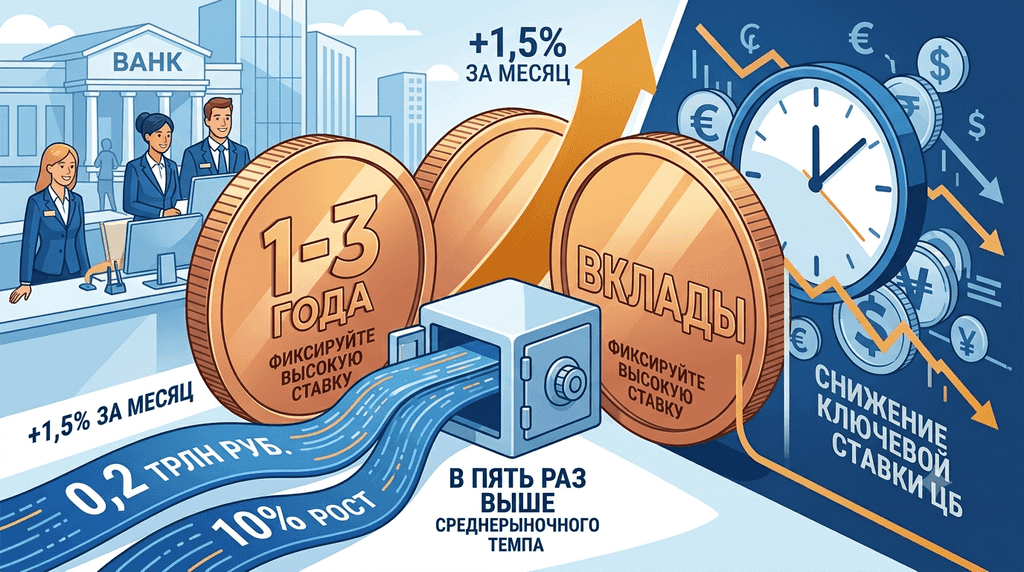
Russians' savings grew by 0.2 trillion rubles in June, and at some banks long-term deposit portfolios expanded by more than 1.5% in a single month — five times the market average pace. The answer to the main question is simple: banks are deliberately raising yields on one- to three-year deposits to lock in client money before the central bank continues its cycle of key rate cuts. For depositors, this means a rare window of opportunity — to lock in today's high rate for an extended period before it starts falling in step with the key rate. Below, we break down what conditions banks are offering, who benefits most, and what to watch for before opening a long-term deposit.
Why Are Banks Shifting to Long-Term Deposits?
Banks are changing their funding strategy because short-term high rates have stopped being a profitable tool amid monetary easing. Previously, lenders mainly competed for clients with short promotional offers of three to six months. Now that the Bank of Russia is steadily cutting the key rate, it is more advantageous for banks to "lock in" depositors early with a long-term product at today's still-high rate — this reduces the risk of an outflow of funds once rates across the market start falling.
On July 24, the Bank of Russia's board of directors cut the key rate from 14.25% to 14% per annum, having already lowered it to 14.25% a month earlier. The cut was smaller than the market had expected, so deposit yields did not react immediately. According to industry reviews, in July the average maximum rate fell by only a symbolic 0.05 percentage points — the gentlest decline since the start of the year. Some banks did not cut rates at all, and roughly a fifth of lenders actually raised yields, bucking the broader trend of monetary easing.
VTB's senior vice president, Alexei Okhorzin, commented on the situation this way: in his view, depositors are changing their preferences regarding specific banking products and terms, but are not abandoning the habit of saving itself — meaning that total savings continue to grow, while the structure of deposits within banks is simply shifting toward longer terms. According to VTB's forecast, the volume of depositor funds in Russia will grow by about 10% in 2026 and exceed 72 trillion rubles — noticeably above the growth rates of previous years, reflecting continued public trust in bank deposits as the primary savings instrument.
An additional argument in favor of long-term products is banks' desire to build a stable, predictable funding base in advance. The longer the term of funds attracted, the easier it is for a lender to plan its own lending policy without depending on sharp swings in short-term liquidity. That is precisely why major market players are simultaneously raising rates on one- to three-year deposits and offering bonuses for not terminating a contract early.
What Terms and Rates Are Banks Offering on Long-Term Deposits
A key feature of 2026's long-term offers is a tiered yield structure rather than a single fixed rate for the entire term. Banks most often set a higher rate for the first year of the deposit, then gradually lower it in subsequent years — this way the lender hedges against being locked into an inflated yield for years if the central bank's key rate keeps falling.
Tiered Rates and "New Money" Conditions
The maximum yield on one- to three-year deposits is almost always tied to a set of requirements. Most often, the elevated rate applies only to "new money" — that is, funds the client did not previously hold at that bank — or requires signing up for a premium service package or a payroll card. Without meeting these conditions, the rate is typically one to two percentage points below the advertised figure.
In July, several major banks noticeably improved their product lineups. VTB raised the welcome rate on its savings account to 13.5%, Alfa-Bank raised its rate to 14% while also boosting yields on certain term deposits, and Gazprombank updated rates across almost its entire deposit lineup. The average rate on three-month deposits among the top ten banks rose by about 0.15 percentage points over the month, and the increase subsequently spread to longer terms as well.
| Parameter | Short-term deposit (3–6 months) | Long-term deposit (1–3 years) |
| Average rate | around 13–13.5% per annum | varies by year — usually higher in year one |
| Yield structure | fixed for the entire term | tiered, declining year by year |
| Conditions for the max rate | new money, promotions | new money, premium package, payroll project |
| Early withdrawal | often partial loss of interest | typically full loss of interest |
Who Benefits from a Long-Term Deposit at Today's Yield
A long-term deposit is most beneficial for those who have a spare sum they won't need for the next one to three years. Financial market analysts point out that now may be a favorable moment specifically for those who want to lock in today's yield for an extended period, whereas depositors willing to regularly monitor the market may still prefer short-term promotional products.
Tellingly, the deposit market effectively split into two camps in July 2026. About a fifth of lenders raised rates against the broader downward trend, while roughly forty percent of banks did not react at all to the June rate cut and kept their existing terms. This market unevenness means that, before opening a long-term deposit, it is worth comparing offers from several banks rather than relying on just one — the yield gap between leaders and laggards can reach a full percentage point or more.
The specific term chosen within the "long-term" product lineup also deserves attention. After the June key rate cut, six-month deposits unexpectedly proved the most popular among depositors — attracting more applications than all other terms combined. This suggests that part of the population is not yet ready to lock money away for years and prefers an intermediate option, preserving the ability to reconsider its strategy within a few months.
How the Central Bank's Key Rate Decisions Affect Deposit Yields
A rate cut by the regulator does not translate into deposit yields instantly but with a certain lag — and it is precisely this lag that banks are currently exploiting to retain clients. The Bank of Russia attributed the summer's spike in inflation and inflation expectations mainly to one-off factors, while underlying inflation, in the regulator's assessment, remains in the 4–5% annualized range. This means further policy easing is likely to continue, albeit in moderate steps.
Last autumn's experience shows that banks often react to a key rate cut not immediately but one to two weeks later, after which deposit yields begin to fall in sync across the market. In 2026, however, the pattern partly changed: after the June meeting, deposit rates barely reacted, and then two weeks later the situation reversed — banks began raising yields to retain client money and attract new funds.
A yield gap between banks of even 0.25–0.5 percentage points can trigger a noticeable shift of client funds from one lender to another. That is why, under current conditions, banks are competing not only on rate but also on the convenience of terms — renewal bonuses, flexible savings accounts, and special offers for payroll cardholders.
The regulator's moderate move at the July meeting — a cut of only 0.25 percentage points instead of the sharper reduction the market had expected — signaled macroeconomic stability rather than the start of an aggressive easing cycle. That is why banks are in no hurry to sharply cut deposit rates: too rapid a decline in yields risks losing clients to competitors who still maintain their existing terms. Analysts note that this restrained pace of key rate changes may persist at upcoming meetings if underlying inflation stays within the target range, meaning sharp swings in deposit rates are unlikely in the coming months.
Is It Worth Opening a Long-Term Deposit Now?
Opening a one- to three-year deposit now is justified if it is part of a diversified savings strategy rather than the sole instrument for protecting capital. Financial analysts broadly agree: as long as the key rate remains elevated and its cutting cycle continues, current terms on long-term deposits can be considered attractive for locking in future income.
Advantages of Locking In a Rate
The main advantage of a long-term deposit is protection against a future decline in yield. Once the central bank continues easing policy, banks will inevitably lower rates on new deposits, while those who have already locked in a yield for one, two, or three years ahead will keep earning the original rate. This is especially relevant for those saving toward a specific major goal — a mortgage down payment, children's education, or retirement savings — where predictability of income matters more than flexibility.
Risks and Limitations of Long-Term Deposits
The main downside is loss of liquidity. Long-term deposits typically do not allow partial withdrawal without losing all accrued interest, and some products prohibit top-ups or withdrawal transactions altogether. That is why financial advisors do not recommend placing all available savings into a long-term deposit — part of the funds should be kept in more flexible instruments: a savings account, a short-term deposit, or an emergency fund with instant access.
Another nuance is the tiered rate structure. If a promotional offer advertises a high annual yield, it's important to clarify whether it applies only to the first year of the deposit or to the entire term: in the second and third years, the rate is often noticeably lower than advertised.
Before signing a contract, it's also worth clarifying how interest is capitalized — monthly payout to a separate account, or interest added to the deposit principal — and whether the contract can be renewed on new terms once it matures. Some banks automatically renew contracts at the rate in effect at that time, which may turn out to be significantly lower than the original rate if the central bank's key rate has fallen further by then.
How to Choose a Bank for a Long-Term Deposit
Choosing a specific bank should start with comparing the final rate, not the advertised one — the rate that applies without temporary bonuses and promotions for the first few months. It's useful to cross-check with several deposit aggregators and calculators at once, since the headline rates on bank websites are often quoted for the maximum possible amount and term, which rarely match a specific depositor's real conditions.
A second criterion is reliability and the bank's participation in the deposit insurance system, which in Russia covers up to 1.4 million rubles per depositor per bank. If the planned amount exceeds this limit, it makes sense to spread funds across several banks rather than concentrating the entire sum in one institution, even if it offers the highest rate.
A third criterion is service convenience: a mobile app that lets you track interest accrual, the speed of opening a deposit online without a branch visit, and the quality of customer support. For a long-term product that will run for one to three years, these service details matter just as much as the interest rate itself.
Join KuCoin 9th Anniversary Trading Campaign
KuCoin is celebrating its 9th anniversary with a special platform campaign filled with exclusive rewards, trading activities, and limited-time offers. Don’t miss the chance to participate and enjoy the benefits as the exchange marks nine years of growth and innovation. Visit the official campaign page now:

Conclusion
The trend toward rising yields on long-term deposits is a direct consequence of the Bank of Russia's key rate cutting cycle. Banks are seeking to lock in client money for the long term at today's high rates while the regulator continues easing monetary policy. At the same time, the maximum yield is almost always tied to "new money," premium packages, or payroll projects, and the rate itself is typically tiered, declining from the first year onward.
A long-term deposit is worth opening only with genuinely spare funds not needed in the next one to three years, and it's unwise to place all one's savings in it given the risk of losing interest on early withdrawal. A sensible strategy is to combine locking in a bank rate with more flexible instruments, including crypto assets on exchanges like KuCoin, to preserve access to part of one's capital and diversify risk. In the coming months, the central bank's key rate decisions will continue to determine how quickly banks adjust their deposit terms.
Frequently Asked Questions
1. Can you top up a long-term deposit after opening it?
It depends on the specific product: some banks allow top-ups throughout the entire term or during the first few months of the contract, while other deposits are closed to additional contributions immediately after opening. Top-up conditions are always specified in the contract and on the bank's website, so they should be checked before signing.
2. What happens to the interest if you withdraw a deposit early?
For most long-term deposits, early termination means interest is recalculated at the minimum rate — often at the level of an "on-demand" account rate, which effectively wipes out the return for the entire holding period. That is why such deposits are not suitable for funds that might be needed unexpectedly.
3. How often do banks revise deposit rates during the year?
Banks adjust rates almost after every Bank of Russia key rate meeting, and sometimes in between meetings as well — in response to competitors' actions or changes in funding needs. In 2026, revisions occurred on average every two to four weeks.
4. Are ruble deposits more profitable than saving in foreign currency at current rates?
Ruble deposits currently offer noticeably higher nominal yields compared to foreign-currency products, since the Bank of Russia's key rate is substantially higher than the rates of leading world central banks. However, the ultimate benefit depends on the ruble's exchange rate trajectory over the deposit's term, which cannot be predicted with full accuracy.
5. Should you open a deposit at the same bank where your payroll card is serviced?
Not necessarily, but it's often more advantageous: many banks offer a higher rate specifically to holders of payroll projects or premium packages, adding 0.5–1.5 percentage points to the base yield. Before opening a deposit, it's worth comparing final terms across several banks rather than limiting yourself to your payroll bank alone.
Disclaimer : This material is provided for informational purposes only and does not constitute financial, investment, legal, or tax advice. Transactions involving cryptocurrencies and tokenized assets carry substantial risks — including price volatility, limited liquidity, counterparty exposure, and the potential for total loss of invested capital. Readers should conduct their own research and, where appropriate, consult a qualified professional before making any financial decisions.