

Bank of Russia Cuts Key Rate to 14%: What It Means for Deposits, Loans, and Investments
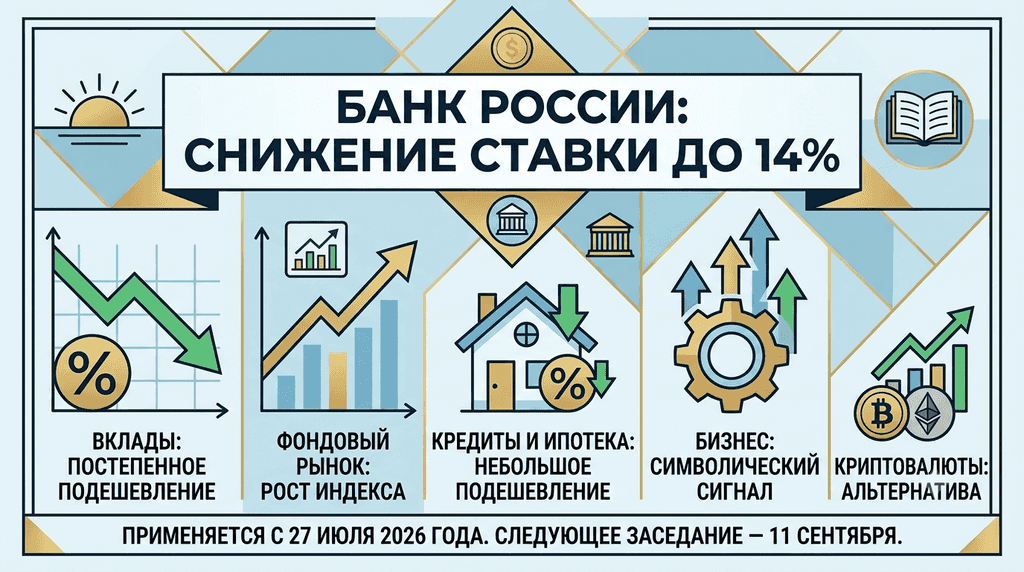
On July 24, 2026, the Bank of Russia unexpectedly cut its key rate to 14% per annum — defying most analysts, who had expected a pause amid accelerating inflation. The MOEX index, which had been down more than 2% ahead of the announcement, reversed course and closed up nearly 1%. This marks the tenth consecutive rate cut since the monetary easing cycle began in June 2025.
The key rate directly determines the cost of money in the economy: it drives deposit and loan interest rates, bond yields, and the appeal of the stock market. A cut to 14% means deposits will gradually become less rewarding for savers, while loans and mortgages will become somewhat cheaper for borrowers. At the same time, capital previously "locked" into deposits at ultra-high rates is beginning to look for higher-yielding alternatives — including the stock market and cryptocurrency.
This article explains why the regulator chose to cut rates despite the risks, how the decision will affect deposits, loans, business, and investment, and what those looking for an alternative to bank deposits should consider.
Why Did the Bank of Russia Cut Rates Despite Accelerating Inflation?
The Bank of Russia chose a compromise between containing inflation and supporting a real economy currently in a slowdown. On July 24, the board of directors decided to cut the rate by 0.25 percentage points — from 14.25% to 14% per annum — even though annual inflation had accelerated a month earlier from 5.31% to 6.02%, and household inflation expectations had jumped from 12.4% to 14.7%.
The key driver of accelerating inflation was a spike in gasoline prices — up almost 20% year-on-year — along with rising telecom and insurance tariffs. Instead of the usual summer decline in fruit and vegetable prices, prices actually rose. According to the Bank of Russia, the economy continued to grow in the second quarter of 2026, but at a slower pace than previously expected: the 2026 GDP growth forecast was lowered to 0–1%.
At the same time, labor market tightness is gradually easing, and wage growth is slowing, though it still outpaces productivity growth. Unemployment remains at historic lows. In effect, the regulator sent a signal to business: the easing cycle continues, albeit with more cautious steps than previously anticipated.
The Bank of Russia simultaneously worsened its 2026 annual inflation forecast — from 4.5–5.5% to 6–7% — and raised its forecast for the average key rate this year to 14.5–14.6%. The 2027 forecast was left unchanged at 10.5–12.5% per annum, with the rate not expected to fall below 10% until 2028. Analysts surveyed by Izvestia note that pauses in the easing cycle remain quite possible, but the cycle itself is not yet over.
Month-on-month price growth in June accelerated fivefold — from 0.17% to 0.87% — heightening concerns about a reversal of the disinflationary trend. As of July 20, annual inflation was estimated at 5.9%. Additional pressure on the market on the day of the meeting came from the EU's announcement of a new, 21st sanctions package and discussions in the U.S. Senate over a new sanctions bill — both factors added to investor caution even before the rate decision was announced.
What Will Happen to Bank Deposits After the Rate Cut?
Interest rates on new bank deposits will gradually decline in step with the key rate. The new rate takes effect from July 27, 2026, and banks typically begin adjusting their deposit lineups within a few weeks of each regulatory decision.
During the period of ultra-high rates — 18–21% per annum in 2024–2025 — Russians placed large amounts of free cash into bank deposits, since deposit yields notably outpaced inflation and stock-market risk. A key rate cut to 14% means banks will be forced to steadily lower the yields on both new and renewed deposits — money is getting cheaper for lenders, and maintaining previous deposit yields is no longer economically viable.
For depositors, this creates a practical dilemma: lock in the remaining high rate for a long term, or seek higher-yielding instruments. Some banks are already offering long-term deposits at current rates precisely because they expect further monetary easing before the end of 2026.
According to SberCIB's forecast, yields on fixed-rate ruble instruments could fall to 14.5–15.75% by the end of 2026, depending on maturity — meaning the window for locking in today's yield is gradually narrowing. The banking sector's logic here is simple: as the regulator's key rate falls, the cost of raising funds through deposits falls for banks themselves, making it economically unviable to maintain previous deposit rates. As a result, the most attractive deposit offers typically appear in the first few days after a key rate cut — before banks have had time to revise their product lineups.
How Will the Rate Cut Affect Loans and Mortgages?
A key rate cut to 14% moderately lowers the cost of commercial loans and standard mortgages without government subsidies, though the effect doesn't show up immediately. If a borrower has a fixed rate on an existing loan, the payment won't change — the key rate cut only affects new loans and floating-rate loans tied to the key rate.
For new borrowers, the signal is positive: banks are gradually revising the terms of mortgage programs, and the burden of servicing home loans on household budgets is easing slightly. Owners of old, expensive loans taken out during the 18–21% rate period should consider refinancing as banks update their product lines.
That said, the regulator emphasized that inflation risks remain elevated, so a sharp drop in the cost of borrowing shouldn't be expected. The Bank of Russia's board of directors is scheduled to next discuss the key rate on September 11, and until that date the 14% level will remain unchanged.
It's also worth noting that federal bond (OFZ) yields fall when the key rate is cut and rise when it's raised — this metric is also used to calculate certain tax penalties and fines; for example, penalties for delayed wage payments are calculated at 1/300 of the key rate per day of delay. Cutting the rate to 14% therefore also formally reduces the size of such penalties for employers.
How Will the Central Bank's Decision Affect Russian Business and the Economy?
The rate cut symbolically lowers borrowing costs for small and medium-sized businesses and signals the regulator's attempt to support the real sector of the economy. A prolonged period of high rates severely constrained corporate liquidity and investment appetite: expensive credit held back expansion, equipment upgrades, and hiring.
The Russian Union of Industrialists and Entrepreneurs (RSPP) called the cut to 14% a symbolic signal for the economy — that is, more a statement of monetary policy direction than a substantive stimulus for the business climate. Tellingly, the 2026 GDP growth forecast was lowered to 0–1% rather than raised, indicating that the effect of the rate cut will be delayed rather than immediate.
For businesses, the key takeaway is this: the easing cycle signals that companies can plan investments around a gradual decline in the cost of borrowed funds through 2026–2027, but shouldn't expect sharp near-term changes in lending conditions.
A further constraint on the pace of monetary easing is the state of the budget: according to the Bank of Russia, the structural budget deficit in 2026 will amount to about 2.0% of GDP. A high deficit and elevated inflation risks are the reasons the regulator paired the rate cut with an upward revision of its 2026 average rate forecast rather than a downward one. As RSPP head Alexander Shokhin noted, maintaining a high key rate in 2027 could hamper investment growth in the real economy, even as the easing cycle continues.
For companies in sectors with long investment cycles — industry, construction, logistics — the gradual decline in borrowing costs is especially important, since such projects are financed mostly with borrowed funds over several years. Even a modest 0.25-percentage-point reduction in a credit line's rate can meaningfully lower the total cost of servicing debt at the scale of a large investment project.
Where Is the Money Headed: Stocks and Bonds After the Rate Cut?
The key rate cut is redirecting part of the capital pool from bank deposits toward the stock market and bonds, as falling deposit yields make them less attractive relative to alternative instruments. The market's reaction to the July 24 decision confirms this mechanism: the MOEX index, which had been down more than 2% on expectations of a pause, reversed after the decision was announced and closed the session up 0.91–1%, at around 2,164 points, while the RTS index gained roughly 1.4%.
| Indicator | Before the Decision | After the Decision |
| MOEX Index | Down more than 2% | Up ~0.9–1% |
| RTS Index | Down ~2.5% | Up ~1.4% |
| OFZ Yields | Under pressure | Declining, supporting stock prices |
According to BCS World of Investments analyst Andrei Smirnov, the 25-basis-point rate cut came as an unexpected positive surprise for the market, since the analyst consensus had almost unanimously anticipated the rate being left unchanged. The key rate cut also helped push federal bond yields lower, supporting a rebound in stock prices.
The logic is simple: the lower deposit yields fall, the less justified it becomes to keep all free cash in a bank account, and the more actively investors seek instruments with potentially higher returns — stocks, bonds, and other market assets, including cryptocurrency.
At the same time, the market is also pricing in offsetting risks: Tsifra Broker analyst Alexander Dudnikov pointed out that the regulator cut the rate by only 25 basis points while simultaneously raising its 2026 average rate forecast — a combination that, in his view, doesn't suggest further active rate cuts before year-end and even leaves room for a modest hike if the inflation picture worsens. Freedom Global forecasts that in the week following the decision, the MOEX index will trade in the 2,100–2,200 point range, while the yuan will trade at 11.2–11.7 rubles. For investors, this means the shift of capital from deposits into stocks and bonds is likely to be gradual rather than a one-time move.
When Will the Bank of Russia Change the Rate Again?
The Bank of Russia's board of directors is next scheduled to discuss the key rate on September 11, 2026, and until that date the current 14% level remains unchanged. The regulator has explicitly stated that future decisions will be made cautiously given persistent inflation risks.
According to the Bank of Russia's updated baseline forecast, the average key rate for the remainder of 2026 is expected to range between 13.7% and 14.6% per annum, and between 10.5% and 12.5% in 2027. This means both modest further cuts and pauses remain possible before year-end, but under the regulator's baseline scenario there is no sharp move to single-digit rates — the rate is unlikely to fall below 10% before 2028.
Is It Worth Investing in Crypto on KuCoin Amid the Rate Cut?
Historically, a key rate cut coincides with growing interest from retail investors in alternative assets, including cryptocurrency, as falling deposit yields reduce the appeal of simply keeping money in a bank account. When deposits stop delivering their previous returns, part of that capital naturally looks for instruments with higher growth potential — and digital assets become one such direction, alongside stocks and bonds.
KuCoin provides access to a wide range of crypto tools — from spot trading in major coins to futures and staking — allowing investors to diversify their portfolios beyond traditional deposits and ruble-denominated assets. Before reallocating savings, it's important to soberly assess your own risk profile: the crypto market is significantly more volatile than a bank deposit, and the decision to shift from a deposit into digital assets should be made deliberately, taking into account your investment horizon and acceptable level of risk.
For those considering this move, a sensible strategy is not to withdraw all deposit funds at once, but to gradually test different asset classes, using KuCoin's tools to track the market and build positions incrementally.
This phased approach reduces the risk of poor timing: rather than moving all savings from a bank to an exchange at once, part of the capital can remain on deposit until maturity, while another part is used to open trial positions in the most liquid assets. This makes it possible to gradually build experience navigating crypto market volatility without exposing all of one's capital to risk at the same time.
Join KuCoin 9th Anniversary Trading Campaign
KuCoin is celebrating its 9th anniversary with a special platform campaign filled with exclusive rewards, trading activities, and limited-time offers. Don’t miss the chance to participate and enjoy the benefits as the exchange marks nine years of growth and innovation. Visit the official campaign page now:

Conclusion
The Bank of Russia's cut of the key rate to 14% was an unexpected decision made against a backdrop of accelerating inflation and rising household inflation expectations. The regulator chose a path of compromise, supporting the real economy at the cost of a slower pace of inflation containment. For ordinary Russians, this means gradually falling returns on bank deposits, to be followed, in time, by cheaper new loans and mortgages — though the effect won't be immediate.
For business, the signal is symbolic but meaningful: the monetary easing cycle continues, and the cost of borrowed funds is expected to fall gradually through 2026–2027. For investors, the rate cut has become an occasion to reallocate capital — some deposit funds have already begun flowing into the stock market and bonds, as confirmed by the positive reaction of the MOEX and RTS indices immediately after the decision was announced.
The Bank of Russia's board of directors will next meet on September 11, 2026, and until then the rate will remain at 14%. Investors and borrowers alike should keep an eye on the regulator's further signals, since both a pause and further cuts remain equally likely scenarios within the current easing cycle.
FAQs
1. By how much was the Bank of Russia's key rate cut in July 2026?
The rate was cut by 0.25 percentage points — from 14.25% to 14% per annum. This is the tenth consecutive cut since the monetary easing cycle began in June 2025.
2. As of what date does the new 14% rate apply?
The new key rate applies from July 27, 2026. Banks gradually revise their deposit and loan terms following each regulatory decision, but not instantly on the day it's announced.
3. Why did analysts expect a pause rather than a cut?
Most analysts expected the rate to remain at 14.25% due to annual inflation accelerating from 5.31% to 6.02% and gasoline prices rising nearly 20% year-on-year. The decision to cut came as a surprise to the market.
4. What is a monetary easing cycle?
It's a period of consecutive key rate cuts by a regulator following a phase of rate hikes. The current cycle began in June 2025 and has now reached its tenth consecutive meeting, though the Bank of Russia does allow for pauses at certain points.
5. How does the key rate affect the ruble exchange rate?
A lower key rate typically reduces the appeal of ruble-denominated assets for conservative investors, which can put pressure on the exchange rate. At the same time, oil prices, export volumes, and geopolitical factors influence the exchange rate simultaneously, so the relationship isn't always linear.