

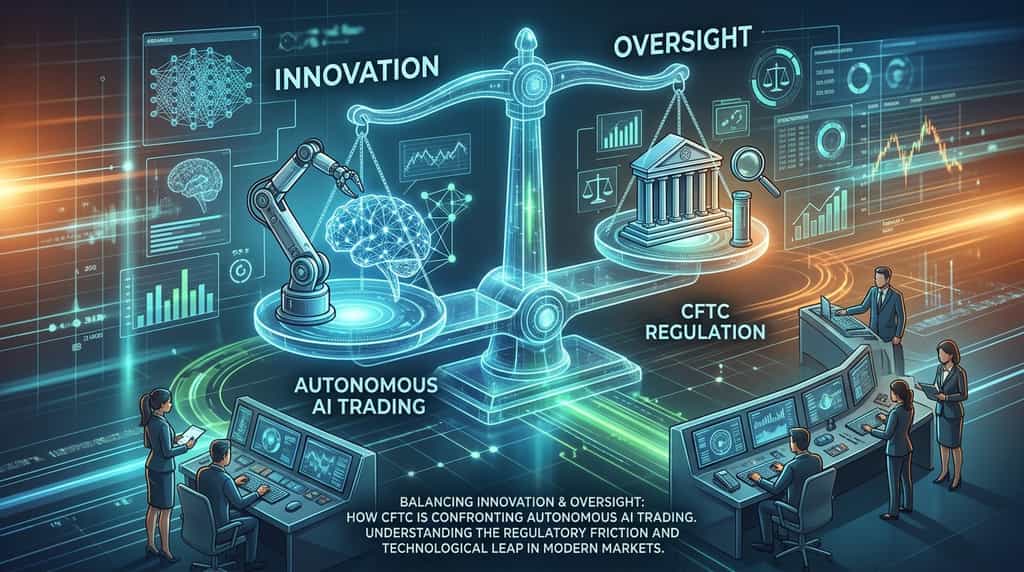
Balancing Innovation and Oversight: How the CFTC is Confronting Autonomous AI Trading
Introduction
Artificial intelligence is no longer just a predictive tool for financial markets; it is rapidly transforming into an autonomous participant capable of executing complex financial maneuvers without human intervention. According to announcements from the U.S. Commodity Futures Trading Commission (CFTC) during its Frontier Forum on Super Intelligence held in October 2026, autonomous agents may soon independently launch tokens, stake assets, and manage entire trading lifecycles. This technological leap forces regulatory bodies to reexamine traditional legal boundaries, questioning how oversight can keep pace with non-human market actors. As digital asset ecosystems merge deeper with algorithmic automation, understanding the regulatory friction between compliance and machine autonomy is critical for modern market participants.
What Are the Core Regulatory Challenges Posed by Autonomous AI in Derivatives Markets?
Regulatory frameworks must fundamentally adapt because autonomous AI agents operate beyond the scope of traditional legal personhood and static compliance models. According to statements by CFTC officials at the October 2026 AI roundtable, the primary structural challenge involves establishing developer registration obligations, determining precise liability when automated systems malfunction, and enforcing reliable know-your-agent (KYA) protocols. Traditional regulatory compliance assumes a human operator or corporate entity executes transactions with clear intent. When an autonomous program initiates unexpected market actions or executes high-frequency arbitrage across decentralized finance (DeFi) protocols, assigning legal culpability becomes profoundly complex.
Market transparency and risk management are further complicated by the speed and opacity of machine learning execution layers. Based on insights highlighted during the CFTC's supervisory evaluations, advanced models analyze vast arrays of unstructured data to execute trades in milliseconds, leaving human supervisors with minimal window to intervene during anomalous market events. Consequently, regulators are tasked with designing frameworks that prevent systemic market disruption caused by cascading algorithmic feedback loops without stifling the legitimate technological efficiency that artificial intelligence brings to modern liquidity provision.
How Will Developer Registration and Liability Frameworks Shift for AI Trading Agents?
Developer registration rules and liability assignment will likely pivot toward holding creators and deployers accountable for the operational parameters of their algorithms. According to CFTC commissioner remarks from late October 2026, policymakers are actively reviewing whether software developers who release autonomous agents designed for autonomous market participation should bear registration requirements comparable to traditional algorithmic trading firms. If an AI agent executes trades independently, determining whether liability rests with the developer, the deployer, or the autonomous agent itself remains an unsolved legal dilemma.
Establishing strict accountability models helps mitigate the risks of unmonitored code destabilizing regulated derivatives exchanges. Based on agency discussions regarding market integrity, regulators intend to clarify that automation does not exempt participants from anti-manipulation statutes or market abuse prohibitions. Developers deploying predictive or execution-focused models must implement rigorous safety bounds, audit trails, and automated circuit breakers to ensure their software complies with statutory market rules. This approach aims to preserve innovation while deterring reckless deployment in high-leverage digital asset sectors.
Why Is Know-Your-Agent (KYA) Becoming the New Standard in Automated Compliance?
Know-Your-Agent (KYA) protocols are emerging as the logical evolution of traditional Know-Your-Customer (KYC) requirements in an era dominated by non-human economic actors. According to regulatory compliance overviews shared during the CFTC's 2026 super intelligence forums, exchanges and digital asset platforms must soon verify the provenance, operational boundaries, and human controllers behind automated algorithms interacting with their order books. As software programs gain the autonomy to stake cryptocurrencies, manage treasury allocations, or participate in prediction markets independently, tracking the precise authorization chain becomes essential for anti-money laundering (AML) compliance.
Implementing effective KYA standards protects market ecosystems from anonymous malicious code and unauthorized manipulation vectors. Based on data from digital asset compliance firms, automated wallet interactions and smart contract agents currently account for a substantial share of decentralized trading volume, necessitating robust identification layers. Regulators argue that transparent agent verification ensures accountability, allowing compliance systems to trace transactional origins and restrict malicious bots before they can execute flash crashes or large-scale market distortions.
What Role Does Artificial Intelligence Play in Modernizing CFTC Market Surveillance?
Regulatory agencies are increasingly turning to advanced automation and machine learning to match the speed and complexity of the digital asset markets they oversee. According to operational disclosures from the CFTC, artificial intelligence tools are deployed to enhance real-time oversight of cryptocurrency derivatives, prediction markets, and complex cross-border trading flows. Despite tight staffing constraints and expanding market jurisdictions, machine learning models enable regulators to ingest massive datasets, flag anomalous trading patterns, and detect market manipulation schemes far more efficiently than legacy manual surveillance systems.
Enhanced technological oversight transforms how regulatory enforcement targets illicit behavior across decentralized networks. Based on enforcement priority updates, agencies are shifting resources toward combating sophisticated forms of retail fraud, algorithmic spoofing, and insider trading within fast-moving digital asset ecosystems.() By utilizing automated analytics, the CFTC can monitor global order books continuously, ensuring that high-speed algorithmic trading remains compliant with statutory protections without imposing undue administrative friction on compliant market participants.
The intersection of artificial intelligence and digital asset regulation marks a pivotal transition point for global financial architecture. Market participants, developers, and institutions must anticipate a regulatory landscape where compliance is automated, transparent, and strictly enforced across both human and machine-driven operations. As regulatory bodies refine supervisory frameworks around developer liability and agent verification, the long-term maturation of autonomous trading will depend on a balanced integration of technological innovation and robust legal oversight.
Frequently Asked Questions
What specific event prompted the CFTC's recent focus on autonomous trading and artificial intelligence?
The discussion was intensified by the CFTC's Frontier Forum on Super Intelligence, convened in late October 2026, which examined how advanced non-human systems and autonomous software agents impact U.S. financial markets.
How do autonomous trading agents differ from traditional algorithmic trading systems?
Traditional algorithms execute pre-programmed rules set entirely by human operators, whereas autonomous AI agents possess the capability to learn, adapt, and make independent financial decisions—such as staking assets or launching tokens—without continuous human direction.
What is Know-Your-Agent (KYA) in the context of digital asset regulation?
Know-Your-Agent (KYA) is an emerging compliance framework focused on verifying the identity, operational parameters, and human ownership of automated software agents interacting with financial exchanges and decentralized protocols.
Why are traditional regulatory staffing models struggling to keep up with modern crypto markets?
Markets operate 24/7 across highly complex, decentralized networks with massive data volumes, creating a scale mismatch where traditional manual enforcement and static budgets cannot review all transactions effectively without AI assistance.
What are the primary legal risks associated with deploying autonomous financial software?
The primary risks involve determining liability when an algorithm malfunctions, preventing unauthorized market manipulation, ensuring adherence to anti-money laundering laws, and avoiding unintended cascading liquidations across leveraged derivatives markets.
Disclaimer
This general market information, possibly from third-party, commercial, or sponsored sources, is provided for reference and educational purposes only and does not constitute financial or investment advice, an offer, solicitation, or guarantee. We disclaim liability for its accuracy, completeness, reliability, and any resulting losses. Investments/trading are risky; past performance doesn’t guarantee future results. Users should research, judge prudently, and take full responsibility. For further details, please consult KuCoin’s Terms of Use and Risk Disclosure.