

August Nonfarm Payrolls Beat Forecasts at 162K, but Underlying Growth Is Only ~60K—Fed Rate-Hike Odds Rise
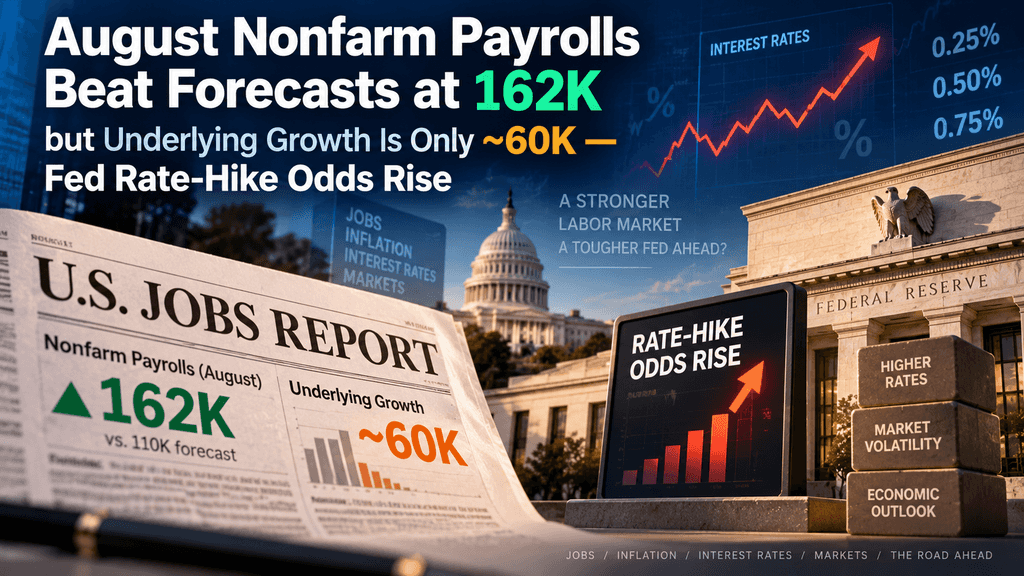
U.S. Adds 162,000 Jobs in August, Beating Expectations
The U.S. Bureau of Labor Statistics released a report on September 4, 2026, indicating that total nonfarm payroll employment experienced a significant increase of 162,000 jobs in August. This figure far surpassed the consensus forecast, which had anticipated an increase of approximately 55,000 to 56,000 jobs. The unemployment rate held steady at 4.1 percent, showing no signs of fluctuation. Additionally, revisions to the employment figures from prior months contributed a combined total of 55,000 jobs, which notably improved the July employment reading from an initial decline of 23,000 jobs to a revised gain of 21,000 jobs. Furthermore, adjustments were made to the June figures, reflecting a more positive employment landscape. In terms of sector contributions, private-sector payrolls were responsible for 127,000 of the total increase observed in August, while government employment saw a rise of 35,000 jobs.
Average hourly earnings for all private nonfarm employees saw an advancement of 0.3 percent, bringing the average hourly wage to $37.75. This increase in wages resulted in a year-over-year gain of 3.1 percent, indicating a positive trend in earnings for workers. While the headline figure of 162,000 jobs added may appear robust when compared to the subdued average monthly increase of approximately 31,000 jobs over the previous twelve months, it is important to note that roughly two-thirds of this advance was driven by the leisure and hospitality sectors, as well as local government education. This leaves an underlying growth pace closer to 58,000 to 60,000 jobs, which, despite being lower than the headline number, was still sufficient to elevate market-implied odds of a Federal Reserve rate hike in September to around 60 percent. This nuanced understanding of the employment data highlights the complexities behind the numbers and the factors influencing the labor market.
Concentrated Gains in Food Services and Local Education Drove the Headline Surprise
Employment in food services and drinking places rose by 59,000 in August, far above the prior twelve-month average monthly gain of 12,000. Local government education added approximately 42,000 jobs, largely reversing a sizable July decline. Together these two categories supplied more than 100,000 positions, or over 60 percent of the total nonfarm increase. Leisure and hospitality as a broader group advanced 62,000. The seasonal factors applied to these sectors have shown wider-than-usual swings during the extended summer calendar of 2026, contributing to the magnitude of the rebound after earlier soft readings. Unadjusted data for restaurants and bars indicated only modest net change before seasonal adjustment, underscoring how the adjustment process amplified the published figure. These dynamics explain why analysts described the report as less of a broad-based acceleration than the headline number first suggested.
Outside these two categories, the remaining payroll gain totaled roughly 58,000 to 60,000, a pace consistent with the moderated trend observed earlier in the year and only modestly above many estimates of the current breakeven rate needed to hold the unemployment rate steady. Manufacturing employment continued its recovery with a 16,000 increase and has risen 58,000 since a recent low in December 2025. Construction added 22,000 jobs. Health care and social assistance contributed solidly as well. The diffusion index for private industries improved, signaling wider participation across sectors even if the absolute numbers outside the seasonal rebound categories remained moderate. This composition points to a labor market that retains resilience without displaying the broad overheating that would unambiguously compel immediate policy tightening.
Prior-Month Revisions and the Three-Month Average Paint a More Measured Picture
June payrolls were revised upward by 11,000 to 31,000, and the July figure moved from an initial loss of 23,000 to a gain of 21,000, adding 55,000 jobs in total to the recent history. With the August advance included, the three-month average payroll gain stands near 70,000 to 71,000, while the six-month average reaches approximately 107,000. Both remain above the subdued twelve-month average of 31,000 through July yet fall short of the rapid expansions recorded in earlier phases of the current cycle. The household survey provided additional context: civilian employment rose 569,000, and the labor force expanded 683,000, lifting the participation rate from 61.4 percent to 61.6 percent. Full-time employment advanced substantially while the number of people working part-time for economic reasons declined.
These revisions and averages matter because Federal Reserve officials evaluate the trend rather than any single month. The combination of an upward-adjusted recent path and a participation rebound reduces the risk that the labor market is deteriorating sharply. At the same time, the underlying private-sector pace, excluding the two large seasonal categories, remains consistent with gradual cooling rather than renewed acceleration. Wage growth at 3.1 percent year-over-year continues to decelerate modestly from prior readings, offering limited evidence of intensifying cost pressures from the employment side alone. Market participants therefore interpret the data as supportive of a still-restrictive policy stance without eliminating the case for data dependence ahead of the next inflation releases.
Leisure and Hospitality Rebound Reflects Seasonal Payback After Earlier Softness
Leisure and hospitality employment had declined in the preceding two months before the 62,000 August rebound. Food services accounted for nearly all of that recovery. The calendar configuration of 2026 featured an early Memorial Day and a late Labor Day, stretching the summer season and producing larger seasonal adjustment factors than in more typical years. Before seasonal adjustment, restaurant and bar employment showed only a negligible net decline in August, yet the adjustment transformed that into a large seasonally adjusted gain. Over the three-month span, the sector still shows a small net loss, indicating that the August print largely restored earlier shortfalls rather than establishing a new higher trend.
This pattern carries implications for interpreting future reports. If subsequent months revert toward the prior softer trajectory once the seasonal payback is complete, the headline volatility will diminish, and the underlying pace near 60,000 will become more visible. Health care and professional services have supplied more consistent contributions throughout 2026, while information and financial activities posted declines in August. The sectoral mix therefore continues to favor service industries with steadier demand over cyclically sensitive goods-producing categories, even as manufacturing has stabilized. Analysts monitoring Bitcoin price movements and broader risk assets note that such labor-market composition often correlates with moderate consumer spending growth rather than boom conditions.
Manufacturing and Construction Provided Broader Support Beyond Seasonal Categories
Manufacturing employment increased 16,000 in August and has accumulated a 58,000 gain since its December 2025 low. Construction added 22,000 positions, one of the stronger monthly advances in recent periods. Goods-producing industries as a group rose 41,000. These figures demonstrate that the August report was not solely the product of education and restaurant seasonal factors. The manufacturing diffusion index improved to levels last seen several years earlier, suggesting more widespread hiring within the sector. Private education and health services also posted solid gains near 29,000.
The breadth of the advance, even if the absolute magnitude outside two categories was moderate, helped elevate the private-sector diffusion index to a multi-month high. This improvement reduces concerns that employment growth had become excessively concentrated. At the same time, the information sector lost 23,000 jobs and financial activities declined by 11,000, illustrating ongoing adjustment in technology-related and finance-related employment. Overall, the report supports a narrative of a labor market that has decelerated from earlier rapid gains yet retains enough momentum to keep the unemployment rate stable near 4.1 percent. That stability itself influences the Federal Reserve’s dual-mandate assessment as the September meeting approaches.
Household Survey Strength Complements the Establishment Data
The household survey recorded a 569,000 rise in employment and a 683,000 expansion of the labor force, producing the participation-rate increase to 61.6 percent. The unemployment rate held at 4.1 percent (unrounded near 4.14 percent). Full-time employment advanced by 735,000, the strongest such gain in several months, while the number of people employed part-time for economic reasons fell sharply. The broader U-6 underemployment measure declined to 7.7 percent. These household-survey details often move differently from the establishment survey because of sampling differences and the inclusion of self-employment and agricultural workers, yet the directional consistency in August reinforced the message of resilience.
Participation gains among prime-age workers and a rebound after the prior month’s low reading suggest that labor supply has begun to respond more elastically. Discouraged workers remained little changed near 441,000. The combination of rising participation and stable unemployment implies that the economy absorbed additional labor-force entrants without generating slack. For policymakers, this configuration supports the view that the current level of interest rates has not yet produced excessive softening. Market pricing of rate-hike odds responded accordingly, with the probability of a 25-basis-point increase at the mid-September FOMC meeting moving into the high-50s to around 60 percent range according to futures-implied measures.
Wage Growth Continues Its Gradual Deceleration
Average hourly earnings rose 10 cents, or 0.3 percent, to $37.75. The year-over-year increase eased to 3.1 percent from 3.2 percent in the prior month. Production and nonsupervisory employees saw a similar 0.3 percent monthly advance to $32.53. Aggregate weekly hours edged higher, contributing to a modest rise in overall payrolls. The continued moderation in wage growth, while still above the pace consistent with the Federal Reserve’s 2 percent inflation target under standard productivity assumptions, removes one potential source of upward pressure on the price level from the labor market.
Softening wage growth alongside moderate underlying employment gains reduces the likelihood that cost-push inflation will reaccelerate from this channel in the near term. Officials have repeatedly emphasized that labor-market conditions remain one input among several, with inflation data carrying greater weight at the current juncture. The forthcoming August consumer-price-index release will therefore receive heightened attention. Should that report show continued progress on core measures, the case for holding rates steady would strengthen even after the payrolls surprise; a firmer inflation print would reinforce the argument for a hike already supported by the employment data.
Market Reaction and the Repricing of September Policy Odds
Treasury yields rose following the release, with the two-year yield climbing as markets adjusted expectations for near-term policy. Equity futures initially traded lower before stabilizing. According to CME FedWatch data and contemporaneous reporting, the probability of a 25-basis-point rate increase at the September 15-16 meeting moved from the low-to-mid 50 percent range into the high 50s or approximately 60 percent. That shift reversed some of the decline in odds that had followed the weaker July payrolls print. Analysts noted that the composition of the August gain limited the hawkish interpretation relative to a more broad-based 162,000 advance, yet the combination of upward revisions and a participation rebound still favored a less accommodative outlook.
The market response illustrates the data-dependent framework currently guiding both investors and the Federal Open Market Committee. A single strong payrolls report does not dictate the outcome of the next meeting; the subsequent inflation data and any further communications from officials will carry substantial weight. Nonetheless, the direction of the adjustment in rate expectations confirms that the labor market retains sufficient strength to keep a September hike under active consideration rather than off the table.
Effects for the Federal Reserve’s Dual Mandate Assessment
The Federal Reserve operates under a dual mandate of maximum employment and price stability. With the unemployment rate stable at 4.1 percent and participation rising, the maximum-employment side of the mandate currently shows little sign of shortfall. Inflation remains the more pressing concern for many officials, particularly after earlier readings that kept core measures above the 2 percent objective. The August employment report supplies evidence that the economy can sustain moderate job growth without generating rapid wage acceleration, a configuration that in principle allows policy to remain focused on the inflation side.
Several FOMC participants had already expressed openness to further tightening if inflation progress stalled. The payrolls data, even after adjusting for composition, provides those participants with additional support for maintaining a restrictive stance or considering a further move. At the same time, the underlying pace near 60,000 remains consistent with gradual cooling, preserving the option for patience if the next inflation reports cooperate. The net effect is to keep the September decision finely balanced and highly sensitive to the forthcoming price data.
Sectoral Breadth and the Diffusion Index Signal Wider Participation
The one-month private diffusion index rose to 55.6 percent, a multi-month high, while the manufacturing diffusion index reached 61.1 percent. These measures track the share of industries adding jobs and therefore provide information about the distribution of gains beyond the largest categories. An index above 50 indicates that a majority of industries expanded employment. The improvement in August suggests that the recovery extended beyond the seasonal rebound in food services and education. Construction, manufacturing, and health-care services all contributed positively, supporting the assessment of broader resilience.
Diffusion indexes can move ahead of aggregate employment totals and therefore serve as leading indicators of labor-market momentum. The August readings reduce the probability that the headline gain was purely an artifact of two volatile categories. Still, sustained improvement will be required before the indexes confirm a decisive shift to stronger trend growth. For now they reinforce the view that the labor market has stabilized after the soft patch earlier in the summer.
Labor-Force Participation Rebound and Its Effect on Measured Slack
The rise in the labor-force participation rate from 61.4 percent to 61.6 percent absorbed a large increase in employment without lowering the unemployment rate. This dynamic is generally viewed as healthy because it expands the pool of available workers and limits upward pressure on wages. The participation rate had reached a multi-year low in July, so the August rebound partially reversed that decline. Prime-age participation trends and the decline in part-time employment for economic reasons further support the interpretation of improving labor-market efficiency.
Higher participation can temporarily keep the unemployment rate from falling even when employment rises strongly. In the current environment, that outcome helps keep measured slack from disappearing too rapidly, which in turn moderates the urgency for aggressive policy tightening on pure employment grounds. Officials monitoring both the quantity and the quality of labor-market recovery will note the combination of rising participation and stable unemployment as consistent with a balanced expansion rather than an overheating one.
Historical Context of Recent Payroll Volatility and Seasonal Adjustment Challenges
Payroll estimates have displayed elevated month-to-month volatility throughout 2026, with several large revisions and occasional negative prints that were later reversed. Seasonal adjustment factors for education and leisure sectors have been particularly challenging because of shifts in school calendars and tourism patterns following earlier disruptions. The August rebound fits this pattern of payback after soft readings. Analysts who adjust for these known seasonal quirks arrive at an underlying monthly pace near 60,000, a figure that aligns more closely with the longer-term deceleration observed since the rapid post-pandemic recovery phase.
Understanding these technical factors is essential for interpreting the signal rather than the noise in the monthly data. The Federal Reserve and market participants both emphasize three-month and six-month averages precisely because single-month readings can be distorted by seasonal and sampling issues. The current averages remain consistent with a labor market that has slowed to a sustainable pace without tipping into outright contraction.
Looking Ahead to Inflation Data and the September FOMC Decision
The August consumer-price-index report, scheduled for release before the September 15-16 FOMC meeting, will supply the final major inflation input before the policy decision. A reading that continues the recent deceleration in core measures would strengthen the argument for holding the federal funds rate steady even after the stronger payrolls print. A firmer inflation outcome would reinforce the case already made by the employment data for considering a 25-basis-point increase. Futures markets currently assign roughly 60 percent probability to a hike, leaving substantial room for adjustment once the price data arrives.
Officials have stressed that no single data release determines the outcome. The combination of moderate underlying job growth, stable unemployment, rising participation, and still-elevated inflation keeps both a hold and a modest hike within the plausible range. Subsequent communications and the detailed inflation breakdown will clarify which path the Committee ultimately chooses. Market participants tracking risk assets, including those following Ethereum market trends and related instruments, continue to price the decision as data-dependent rather than predetermined.
Broader Market and Economic Implications of the August Report
The payrolls surprise contributed to a firming of short-term interest rate expectations and a corresponding rise in Treasury yields. Equity markets digested the news with limited lasting damage, reflecting the view that the underlying pace remains consistent with continued expansion rather than overheating. Consumer spending, which has been supported by solid income growth and a resilient job market, is likely to remain the primary driver of near-term economic activity. Business investment and housing continue to face headwinds from the elevated level of interest rates, yet the labor-market data do not signal an imminent sharp deterioration in demand.
The report also carries implications for fiscal and monetary policy coordination. Stable employment reduces pressure for additional fiscal stimulus while preserving the Federal Reserve’s ability to keep policy focused on inflation. The moderate underlying growth rate near 60,000 leaves room for the economy to absorb further gradual cooling if required without generating a rapid rise in unemployment. That buffer remains an important element of the current policy discussion.
🔥 Beyond the Headlines: What KuCoin 5.0 Means for You
Market news moves fast — but where you act on it matters just as much. This October, KuCoin launches KuCoin 5.0, transforming KuCoin into a rebuilt platform. Here's what actually changes for you:
-
One account for everything. Older platforms split your money across separate "spot," "margin," and "futures" accounts and expected you to understand why. KuCoin 5.0's unified account removes that entirely — deposit once, and everything is simply there.
-
Stocks, indices, and commodities. KuCoin 5.0 expands beyond crypto into global markets. When crypto chops sideways and equities rally (or the reverse), you rotate in minutes instead of opening a brokerage account and waiting days for fiat rails.
-
Real-world assets (RWA). Tokenized exposure to traditional assets like commodities, right inside your crypto account. One of the fastest-growing segments in global finance is no longer reserved for institutions — you access it from the same balance you trade with.
-
Earn while you learn. Not ready to trade? KCUSD lets your stablecoins earn daily, auto-compounding interest. The lowest-stress way to put your idle deposit to work for 4% yield.
-
An AI assistant in plain language. Ask questions, get market context, understand what you're looking at — built into the platform, no jargon required.
-
An app that doesn't overwhelm. Faster, cleaner, and consistent — intuitive from the first tap, not after a tutorial.
-
Safety you can check, not just trust. A MiCAR-licensed EU entity, Proof of Reserves you can verify yourself, and internationally certified security (SOC 2 Type II, ISO 27001:2022).
Create your account in minutes — and start on the platform built for where crypto is going, not where it's been.
FAQs
How significant was the concentration of August job gains in just two sectors?
Leisure and hospitality plus local government education accounted for more than 100,000 of the 162,000 total increase, or over 60 percent. When those two categories are set aside, the remaining gain falls near 58,000 to 60,000. This concentration reflects seasonal payback after earlier soft readings rather than a sudden broad acceleration, although other sectors such as manufacturing, construction, and health care also contributed positively.
What do the revisions to June and July payrolls imply for the recent trend?
June was revised higher by 11,000 and July by 44,000, adding 55,000 jobs to the prior two months. The three-month average, including August, now stands near 70,000 to 71,000. These revisions remove the earlier appearance of an outright decline and present a more consistent picture of moderate growth that remains above the very soft twelve-month average but well below the rapid pace of earlier years.
Did the household survey confirm the establishment-survey strength?
Yes. Employment rose 569,000, and the labor force expanded 683,000, lifting the participation rate to 61.6 percent while the unemployment rate held at 4.1 percent. Full-time employment advanced strongly, and the U-6 underemployment measure declined. The directional consistency between the two surveys supports the assessment of underlying resilience.
How did markets reprice Federal Reserve rate-hike odds after the report?
Futures-implied probabilities of a 25-basis-point increase at the mid-September meeting moved from the low-to-mid 50 percent range into the high 50s or approximately 60 percent. Treasury yields rose, particularly at the short end, reflecting the adjustment in near-term policy expectations. The shift was meaningful yet remained contingent on the subsequent inflation data.
What does the 3.1 percent year-over-year wage growth signal?
The monthly 0.3 percent advance left the annual rate at 3.1 percent, a modest deceleration from the prior reading. This pace remains above the level fully consistent with 2 percent inflation under normal productivity assumptions, yet the continued slowing reduces the contribution of labor-cost pressure to overall inflation. Officials will continue to monitor both the level and the trend.
Is the current underlying pace of roughly 60,000 jobs per month sufficient to keep unemployment stable?
Many estimates of the current breakeven rate needed to hold the unemployment rate steady fall in a range that includes or lies near 60,000 once allowance is made for slower labor-force growth. The August underlying figure and the recent averages are therefore consistent with a roughly stable unemployment rate, matching the observed outcome of 4.1 percent.
Disclaimer: This content is for informational purposes only and does not constitute investment advice. Cryptocurrency investments carry risk. Please do your own research (DYOR).