

Are Sberbank Dividends at Risk? Which Central Bank Requirements Could Affect Future Payments
Introduction
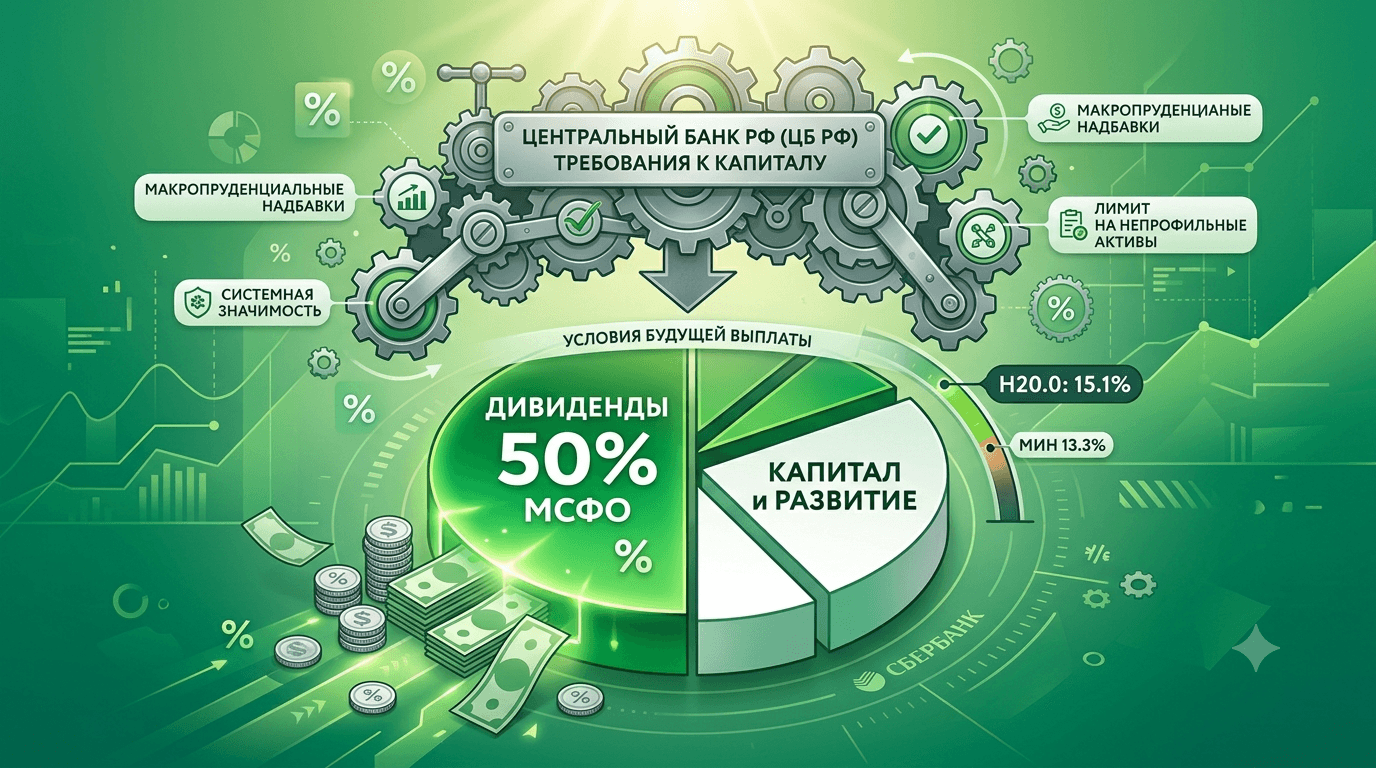
Sberbank has not abandoned its policy of paying 50% of IFRS net profit as dividends, but it has now clearly identified the condition on which future payments depend. On September 15, 2026, the bank's CFO Taras Skvortsov said that half of profit would be distributed to shareholders as long as business conditions allow it. The risk is not related to deteriorating operations at Sberbank, but to the possibility that the Bank of Russia will tighten capital requirements for credit institutions. The most important factors are macroprudential buffers, the systemic importance surcharge, and a future risk-sensitive limit on non-core assets. At the end of the first half of 2026, Sberbank's H20.0 capital adequacy ratio was 15.1%, compared with its internal minimum target of 13.3%, so an immediate dividend cut is not expected.
Will Sberbank Cut Dividends Below 50% of Profit?
In the short term, Sberbank does not plan to change its policy of paying 50% of IFRS net profit, but this policy is not an unconditional guarantee for every future year. This is how investors should understand the statement by the bank's CFO, published on September 15, 2026, in a News.ru report citing Vedomosti.
The current policy means that, provided the necessary financial and regulatory conditions are in place, half of profit under international standards is distributed as dividends. The remaining amount stays at the bank and strengthens its capital, supporting lending, investment, and the ability to absorb losses. For shareholders, this creates a clear link between financial performance and potential payments.
However, a fixed percentage does not override banking regulation. A credit institution must comply with capital ratios, finance asset growth, and meet regulatory requirements at the same time. If these objectives begin to compete for the same ruble of profit, the board may prioritize preserving the capital buffer over making a larger payment to shareholders.
Therefore, Sberbank's wording is not an announcement of an immediate dividend reduction. It is a warning that the 50% rule applies only as long as business conditions and the regulatory environment allow it to be maintained. This qualification is the key point for investors.
What Does the Risk to Future Dividends Actually Mean?
The risk refers to possible pressure on the bank's capital from new regulatory requirements, not to signs of an internal crisis or ineffective management at Sberbank. The bank directly links the uncertainty to decisions by the Bank of Russia, which is gradually strengthening its oversight of financial-system stability.
Dividends reduce the amount of profit retained within a credit institution. Under normal conditions, this is not a problem: capital grows through current earnings, and the bank can expand lending at a pace comparable to the market. But when capital requirements rise, the bank may need to retain a larger share of profit to maintain its ratios.
In other words, regulatory risk operates through the opportunity cost of dividends. Every ruble paid to shareholders cannot simultaneously be used to cover additional capital requirements or finance new assets. As long as the capital buffer is sufficient, paying 50% does not create a conflict. Under stricter rules, that balance could change.
This mechanism is particularly important for the country's largest bank. Sberbank has systemic importance, a large loan book, and a significant market share. Its capital decisions affect not only investor returns but also the bank's ability to continue lending to households and companies.
Which Bank of Russia Requirements Could Reduce Payments?
The most significant potential factors are higher macroprudential buffers, an increased systemic importance surcharge, and the introduction of a risk-sensitive limit on non-core assets. Each could increase the amount of capital Sberbank must retain on its balance sheet.
What Are Macroprudential Buffers?
Macroprudential buffers are additional capital requirements for types of loans or investments that the regulator considers a source of heightened risk to the financial system as a whole. They are intended to prevent excessive risk accumulation and create a reserve against a deterioration in asset quality.
For an individual bank, such a buffer means that more capital is required for a given volume of lending. If Sberbank continues to rapidly increase lending in a segment subject to higher risk coefficients, the capital burden will rise. As a result, part of its profit may be needed for internal financing rather than dividends.
The Bank of Russia has already demonstrated its willingness to use such instruments. For example, from October 15, 2026, the regulator introduced macroprudential buffers of 250% for certain bank investments in bonds backed by consumer-loan receivables, according to industry reports published on September 14, 2026. This does not automatically mean that Sberbank's dividends will be reduced, but it shows the direction of regulation — a more risk-sensitive approach to assets.
Could the Systemic Importance Surcharge Increase?
Yes. Sberbank's status as the largest systemically important bank could result in a higher additional capital burden. The systemic importance surcharge is intended to reflect the potential consequences of problems at an institution on which a significant part of the banking system depends.
Sberbank benefits from scale, brand recognition, and a broad customer base, but its systemic status also means higher resilience requirements. The regulator may conclude that the largest bank should maintain a more substantial capital buffer than smaller market participants.
An increase in this surcharge would not be a penalty and would not indicate weakness at Sberbank. It is a preventive mechanism. However, the effect on dividend policy could be material: all else being equal, more profit would remain inside the bank if additional requirements were introduced quickly or proved substantial.
Why Is a Limit on Non-Core Assets Needed?
A risk-sensitive limit on non-core assets is intended to restrict the concentration of bank resources in areas not directly related to core lending activities. Depending on the final methodology, the limit could take into account not only the volume of assets but also their risk.
For banks, this means they will need to manage balance-sheet structure more precisely. An asset that does not create immediate losses in accounting terms may require more capital after risk coefficients are changed. The bank would then have to reduce the relevant investments or offset the burden with additional capital.
For shareholders, the practical effect matters more than the mere introduction of a limit. If new rules restrict the growth of non-core assets while also requiring additional capital coverage, the room available for profit distribution could narrow. Until the specific parameters of the future restriction are defined, its exact effect cannot be assessed.
|
Factor
|
Effect on capital
|
Potential effect on dividends
|
|
Macroprudential buffers
|
Increase requirements for selected risky assets
|
May require the bank to retain more profit
|
|
Systemic importance surcharge
|
Creates an additional buffer for the largest banks
|
May reduce payout flexibility as requirements rise
|
|
Non-core asset limit
|
Restricts or revalues selected investments
|
May slow asset growth and increase capital needs
|
Does Sberbank Currently Have Enough Capital Buffer?
Sberbank currently has a meaningful capital buffer, so there is no basis for expecting an immediate suspension of its 50% payout. According to data provided by the bank for the first half of 2026, its H20.0 capital adequacy ratio was 15.1%, while its internal minimum target was 13.3%. The difference was 1.8 percentage points.
This buffer should not be interpreted as a guaranteed future dividend amount. H20.0 changes with profit, asset growth, loan-portfolio quality, risk structure, and regulatory decisions. If lending accelerates, the denominator in the calculation and the bank's capital needs may grow faster than capital itself.
Nevertheless, the current data provide an important short-term signal for shareholders. Sberbank is not close to its stated internal threshold and has not reported a need to urgently retain all profit within the business. This supports the conclusion that the discussion concerns a future scenario rather than an already adopted decision to reduce payments.
The capital buffer also acts as a temporary shock absorber. It allows the bank to adapt to new rules gradually, revise the pace of asset growth, or change the structure of its assets. The more gradual and extended the transition period, the more opportunities Sberbank will have to preserve its current dividend policy.
At its current return on equity and annual lending growth of approximately 10–12%, Sberbank, according to management's assessment, can expand with the market while directing 50% of profit to dividends. The problem would arise if demand for loans grew faster or if capital came under stronger regulatory pressure.
Lending growth is not inherently negative. New loans generate interest income and can increase the profit from which dividends are paid. But every increase in assets also requires capital coverage. If the return on new loans does not compensate for the capital they require, expansion begins to compete with shareholder payments.
A critical scenario could look like this: the market grows faster than 10–12% per year, customers borrow actively, and the Bank of Russia raises buffers at the same time. Sberbank would then have to choose between maintaining its market share and preserving the maximum payout ratio.
This choice would not necessarily be binary or abrupt. The bank could slow lending, change the risk profile of its portfolio, raise capital, and use the transition period. But if all these measures proved insufficient, reducing the payout ratio would be one available way to strengthen capital.
How Do High Interest Rates and Regulation Affect the Investment Scenario?
High interest rates and strict regulation increase the importance of capital discipline, but they do not prove that Sberbank's dividends will be reduced. When the key rate is high, borrowers face more expensive credit, while banks face changes in demand, funding costs, and the quality of new lending.
For Sberbank, the combination of conditions matters. If high rates restrict demand for loans, asset growth may slow, making it easier for capital to meet regulatory ratios. If demand remains strong, the bank may rapidly expand its portfolio while facing greater capital requirements at the same time.
Investors should distinguish among three separate statements. First, the 50% policy is currently in effect. Second, the current H20.0 ratio provides a buffer. Third, future requirements could reduce the room available for payments. Confusing these points can lead either to excessive optimism or to unjustified panic.
In practice, investors should assess the scenario through the dynamics of H20.0, loan-portfolio growth, return on equity, and management's wording. A single statement about a possible risk is not enough to conclude that dividends have actually been reduced.
The key indicators are the H20.0 ratio, lending growth, updated Bank of Russia buffer parameters, and decisions on profit distribution. Their combination will show whether regulatory uncertainty is turning into practical pressure.
First, investors should compare H20.0 not only with the formal minimum but also with the bank's own internal target. A decline toward 13.3% or a sustained reduction in the buffer would be more important than a one-off change in quarterly profit.
Second, investors should monitor whether lending growth is approaching the upper end of the 10–12% range or exceeding it. Rapid growth with an unchanged return on equity increases the likelihood of a compromise between expansion and payout.
Third, it is important to read the Bank of Russia's decisions in their final form. A headline about "new requirements" does not reveal the transition period, the assets covered, the risk coefficients, or the effective date. These parameters determine the actual capital burden.
Finally, investors should remember that the dividend decision applies to a specific financial year. Even if the 50% policy remains in place, the final amount per share depends on net profit and the number of shares outstanding. The payout ratio and dividend yield are not the same thing.
Beyond the Headlines: What KuCoin 5.0 Means for You
Market news moves fast — but where you act on it matters just as much. This October, KuCoin launches KuCoin 5.0, transforming KuCoin into a rebuilt platform. Here's what actually changes for you:
-
One account for everything. Older platforms split your money across separate "spot," "margin," and "futures" accounts and expected you to understand why. KuCoin 5.0's unified account removes that entirely — deposit once, and everything is simply there.
-
Stocks, indices, and commodities. KuCoin 5.0 expands beyond crypto into global markets. When crypto chops sideways and equities rally (or the reverse), you rotate in minutes instead of opening a brokerage account and waiting days for fiat rails.
-
Real-world assets (RWA). Tokenized exposure to traditional assets like commodities, right inside your crypto account. One of the fastest-growing segments in global finance is no longer reserved for institutions — you access it from the same balance you trade with.
-
Earn while you learn. Not ready to trade? KCUSD lets your stablecoins earn daily, auto-compounding interest. The lowest-stress way to put your idle deposit to work for 4% yield.
-
An AI assistant in plain language. Ask questions, get market context, understand what you're looking at — built into the platform, no jargon required.
-
An app that doesn't overwhelm. Faster, cleaner, and consistent — intuitive from the first tap, not after a tutorial.
-
Safety you can check, not just trust. A MiCAR-licensed EU entity, Proof of Reserves you can verify yourself, and internationally certified security (SOC 2 Type II, ISO 27001:2022).
Create your account in minutes — and start on the platform built for where crypto is going, not where it's been.
Conclusion
Sberbank has not announced an immediate dividend reduction. As of September 15, 2026, the bank continues to target the distribution of 50% of IFRS net profit, provided that financial and regulatory conditions allow it. Its current capital buffer remains sufficient: H20.0 stood at 15.1% at the end of the first half of 2026, compared with an internal minimum target of 13.3%.
The main risk to future payments is not an operating problem but a possible tightening of Bank of Russia requirements. Higher macroprudential buffers, an increased systemic importance surcharge, and a new limit on non-core assets could require the bank to retain more profit. Additional pressure would emerge if lending began to grow faster than 10–12% per year.
Sberbank's statement therefore gives investors both short-term reassurance and a long-term risk boundary. There is currently no basis for expecting a near-term dividend cut. But if expansion of market share conflicts with capital preservation, the bank could revise the share of profit distributed to shareholders. Future payments should therefore be assessed through H20.0 trends, loan-portfolio growth, return on equity, and the regulator's final decisions.
Frequently Asked Questions
1. Could Sberbank pay less than 50% of profit for 2026?
In theory, yes, if capital requirements or financial conditions change before the decision is made. However, the September 15, 2026 statement does not announce such a decision: the bank still expects to maintain the 50% payout as long as business conditions allow it.
2. What does the H20.0 ratio mean in Sberbank's statement?
H20.0 reflects the adequacy of a bank's own funds after taking regulatory risks into account. The higher the ratio is relative to the internal target, the larger the capital buffer available to cover potential losses and asset growth.
3. Is the systemic importance surcharge a penalty for Sberbank?
No. It is an additional capital requirement related to the bank's importance to the financial system. It functions as a preventive buffer and does not, by itself, indicate a violation or deteriorating management quality.
4. Why can lending growth reduce dividends even when profit is high?
New loans increase assets that require capital coverage. If capital does not grow quickly enough, the bank must retain more profit on its balance sheet even when nominal profit is increasing.
5. Does the 50% policy guarantee a particular dividend yield?
No. The policy specifies the share of net profit distributed to shareholders, not a fixed amount per share or a guaranteed yield. The final result depends on profit, the number of shares, the purchase price, and the bank's decision for the relevant year.
Disclaimer : This material is provided for informational purposes only and does not constitute financial, investment, legal, or tax advice. Transactions involving cryptocurrencies and tokenized assets carry substantial risks — including price volatility, limited liquidity, counterparty exposure, and the potential for total loss of invested capital. Readers should conduct their own research and, where appropriate, consult a qualified professional before making any financial decisions.