

Arc Studio Explained: How Circle’s AI Coding Agent Builds Onchain Apps and Smart Contracts
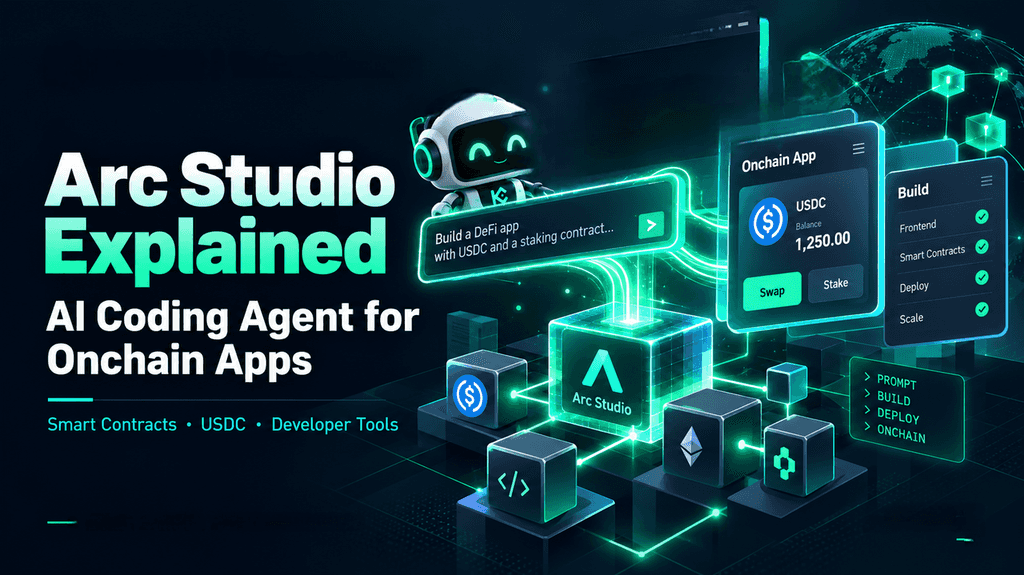
Arc Studio is bringing AI-assisted development deeper into the blockchain ecosystem by allowing developers to turn natural-language instructions into full-stack onchain applications. Built for Circle’s Arc ecosystem, the AI coding agent can help generate frontend interfaces, backend logic and Solidity smart contracts while connecting projects with USDC stablecoin, wallets and other Web3 services. The launch comes as AI coding tools become more common across software development and as blockchain teams look for faster ways to prototype payments, DeFi products and other onchain applications. Arc Studio does not remove the need for developers, testing or security audits, but it could reduce repetitive development work and shorten the path from an idea to a working blockchain prototype.
What Is Arc Studio and How Does Circle’s AI Coding Agent Work?
Arc Studio is an AI-powered onchain coding agent built for Circle’s Arc ecosystem that helps developers turn natural-language prompts into working blockchain applications. Instead of manually building every part of an app from scratch, developers can describe what they want to create and use Arc Studio to generate key components such as the frontend, backend logic and Solidity smart contracts. The platform is designed to shorten the distance between an idea and a functional onchain prototype, especially for developers working with payments, stablecoins, wallets and decentralized finance applications. By automating repetitive development tasks, Arc Studio can make blockchain development more efficient while still allowing developers to inspect, modify and control the code it produces.
How Arc Studio Turns Prompts Into Onchain Applications
The process begins with a natural-language prompt describing the type of application a developer wants to build, how users should interact with it and what onchain functions the project needs. Arc Studio can interpret those instructions, create a development plan and generate the smart contracts, application interface and supporting logic required for the project. A developer could, for example, describe a payment application, token-based service or DeFi interface without manually coding every component from the beginning. This prompt-based workflow makes it easier to experiment with new ideas and build working prototypes before committing significant time to a full production development cycle.
After the initial application is generated, developers can review the smart contracts, test the interface and inspect how different parts of the project interact with the blockchain. Arc Studio can provide visibility into transactions, RPC calls, decoded events and other application activity, which helps developers understand what the generated software is doing rather than treating the AI output as a black box. The code can also be exported for further editing, auditing or integration into an existing repository and development environment. This gives developers flexibility to use Arc Studio for rapid development while still applying conventional software engineering, testing and security practices before moving a project toward production.
Circle Integrations and Developer Tools Inside Arc Studio
Arc Studio is more specialized than a general-purpose AI coding assistant because it includes built-in knowledge of Circle’s blockchain infrastructure, stablecoin products and supported onchain protocols. This makes it particularly relevant for developers building applications around USDC payments, programmable financial services, cross-chain transfers and Web3 infrastructure. Instead of having to manually connect every external service or research each protocol separately, developers can use Arc Studio’s existing understanding of Circle tools and compatible blockchain ecosystems as part of the development process.
Key capabilities and integrations include:
-
USDC and stablecoin infrastructure for payments, settlement and programmable financial applications.
-
CCTP and Circle Gateway for cross-chain transfers and interoperability use cases.
-
Circle Wallets for projects requiring wallet functionality.
-
DeFi protocol integrations involving platforms such as Aave, Morpho and Uniswap.
-
Compatibility with AI development environments including Claude Code, Codex and Cursor.
-
Smart contract creation and deployment across supported EVM test networks.
-
Tools for inspecting contract behavior and blockchain activity during development.
These integrations can make Arc Studio useful for experienced blockchain developers as well as teams looking to prototype onchain products more quickly. However, the platform is designed to assist developers rather than remove human oversight. AI-generated smart contracts can still contain bugs, incomplete logic or security vulnerabilities, especially when prompts are unclear or an application involves complex financial logic. Developers therefore need to review, test and, where appropriate, independently audit generated code before deploying an application to a blockchain mainnet or allowing it to manage real user funds.
How Arc Studio Builds Full-Stack Onchain Apps and Smart Contracts From Prompts
Arc Studio is designed to turn a written product idea into several working parts of an onchain application rather than generating only isolated snippets of code. A developer can describe the app, the actions users should be able to perform and the blockchain functionality required, and the AI coding agent can help translate those instructions into a structured build. The workflow can cover smart contracts, frontend components, application logic, testing and blockchain integrations, giving developers a faster route from an initial concept to a testable onchain application.
Turning Natural-Language Prompts Into an Application Plan
The development process starts with the prompt. Instead of asking the developer to define every technical component immediately, Arc Studio can interpret a natural-language description and break it into the main parts required to build the application. A prompt might describe a USDC payment tool, an onchain revenue-sharing application, a DeFi interface or another blockchain-based service, along with rules governing how users and smart contracts should interact. The quality and detail of the original prompt can still matter because clearer requirements give the coding agent more context about the expected functionality.
From there, Arc Studio can organize those requirements into a development workflow covering the contracts, user interface and supporting application logic. This planning stage is important for full-stack onchain development because blockchain applications often involve several connected layers rather than a single contract. The smart contract may define the onchain rules, while the frontend needs to display information and allow users to interact with those rules through a wallet or transaction. By coordinating these components, Arc Studio can reduce some of the manual setup developers normally perform before testing a prototype.
Generating Smart Contracts, Frontend Code and App Logic
Once the application requirements are established, Arc Studio can generate Solidity smart contracts alongside the code required to connect them to the rest of the application. This is one of the main differences between a basic AI smart contract generator and a full-stack onchain coding agent. Rather than stopping after producing contract code, the platform can build interface components and supporting logic so developers can see how the smart contract functions within an actual application.
For example, an onchain payments project may require a contract that defines how funds are distributed, a frontend where users configure payment rules and blockchain connections that allow those instructions to be submitted as transactions. Arc Studio can help build these layers together, which may be useful during prototyping and early development. Developers can then refine the generated interface, adjust the contract logic and integrate additional blockchain infrastructure as the project becomes more complex. The generated code remains something developers should inspect and modify rather than treating it as automatically production-ready.
Several additional capabilities can support more advanced projects:
-
Existing smart contract addresses can serve as a starting point for building an interface around an already deployed contract.
-
Applications can incorporate USDC, cross-chain transfers, wallet functionality and DeFi integrations when these features are relevant.
-
Generated code can be moved into an existing repository and development workflow.
-
Teams can continue development with tools such as Codex, Claude Code or Cursor instead of keeping the project inside a single interface.
Testing, Debugging and Preparing Onchain Apps for Deployment
Generating an application is only one part of the development process. Arc Studio also gives developers ways to inspect how applications behave when interacting with blockchain infrastructure. During testing, developers can examine transaction activity, RPC requests and decoded blockchain events to identify problems in contract execution or application logic. This provides more context than simply receiving generated code and can make it easier to understand why a transaction succeeds, fails or behaves differently from what the original prompt requested.
Arc Studio can also support deployment to compatible EVM test networks, allowing developers to experiment without immediately placing real assets at risk. Testnet deployment is useful for checking contract behavior, wallet interactions and external protocol integrations before a project moves closer to production. Developers, however, remain responsible for testing edge cases, reviewing permissions and ensuring that external dependencies behave as expected.
Important production-preparation steps can include:
-
Testing unexpected inputs and transaction failure scenarios.
-
Reviewing administrator privileges and functions capable of moving funds.
-
Checking dependencies on bridges, price feeds and third-party protocols.
-
Conducting independent smart contract audits for high-value or complex applications.
-
Keeping private keys and mainnet signing under appropriate developer control.
This separation between AI-assisted development and production deployment is important when evaluating Arc Studio. The coding agent can accelerate development and experimentation, but it does not remove the security responsibilities associated with blockchain software.
Arc Studio Supported Blockchains, USDC Integrations and Developer Tools
Arc Studio is designed to work across a broader Web3 development environment rather than functioning only as an Arc-specific app builder. Its support for multiple EVM-compatible networks, Circle infrastructure and established developer tools gives teams more flexibility when building applications that involve stablecoins, cross-chain transfers or decentralized finance applications. For developers and crypto-focused teams, this matters because many modern onchain products need to interact with several blockchain networks and services rather than remaining confined to a single ecosystem.
Which Blockchains Does Arc Studio Support?
Arc Studio supports deployment and testing across nine EVM-compatible test networks, giving developers an opportunity to experiment with applications beyond Circle’s Arc blockchain. The supported environments include Arc, Ethereum, Base, Arbitrum, Avalanche, Polygon, OP Mainnet, Unichain and Monad. This multi-network approach can be useful for teams comparing transaction behavior, protocol compatibility or infrastructure requirements before deciding where a production application should eventually operate.
Supporting several EVM ecosystems may also reduce the amount of work needed when testing compatible smart contracts across different blockchain environments. Since many of these networks use Solidity and familiar Ethereum development standards, teams can experiment with similar application logic while evaluating factors such as liquidity, infrastructure maturity and ecosystem support.
The supported test networks include:
-
Arc
-
Ethereum
-
Base
-
Arbitrum
-
Avalanche
-
Polygon
-
OP Mainnet
-
Unichain
-
Monad
The availability of multiple test environments gives Arc Studio a wider development role, although each network still has its own technical considerations and production risks.
USDC, CCTP and Circle Infrastructure Integrations
One of Arc Studio’s more distinctive characteristics is its built-in familiarity with Circle’s stablecoin and payments infrastructure. This can be useful for applications involving USDC transfers, programmable payments, wallet-based services or cross-chain settlement. Instead of treating stablecoin functionality as an external layer added later, developers can consider Circle’s infrastructure as part of the application design process from an earlier stage.
Relevant Circle technologies include USDC, Cross-Chain Transfer Protocol, Circle Gateway and Circle Wallets. These services can support different parts of an onchain financial application, including asset movement, wallet functionality and cross-chain payment flows. Arc Studio also has knowledge of established DeFi protocols such as Aave, Morpho and Uniswap, which expands the range of lending, liquidity and decentralized trading concepts developers can explore.
The significance is not that every integration becomes automatically ready for production. External protocols and cross-chain systems introduce their own technical and security dependencies, so developers still need to verify integrations carefully before relying on them in live applications.
How Arc Studio Works With Codex, Claude Code and Cursor
Arc Studio is also intended to fit into existing AI-assisted development workflows rather than forcing developers to work exclusively inside one platform. Circle says the tool can operate alongside environments including Codex, Claude Code and Cursor, allowing developers to combine Arc Studio’s onchain-specific capabilities with broader software-development tools.
This approach may be particularly useful for established engineering teams that already use repositories, code-review processes and automated development pipelines. Developers can use Arc Studio for blockchain-specific tasks and continue refining application architecture, frontend code or backend services through their preferred environment. Generated projects can therefore remain part of a conventional software-development process rather than becoming isolated inside an AI builder.
Potential workflow advantages include:
-
Compatibility with widely used AI coding environments.
-
The ability to integrate generated code into existing repositories.
-
Easier coordination between blockchain engineering and conventional full-stack development.
-
A workflow that can combine smart contracts, stablecoin infrastructure and external Web3 services.
Together, these features position Arc Studio as a bridge between AI-assisted coding and onchain infrastructure. Its practical value will depend on how effectively development teams incorporate the generated code into their own testing, review and deployment processes.
Arc Studio Security, Limitations and What It Means for Onchain Development
Arc Studio can speed up blockchain development, but AI-generated smart contracts still require careful review. Because smart contracts execute blockchain rules automatically, coding errors can create security risks when applications manage digital assets or financial transactions. Developers should therefore treat Arc Studio as a development assistant rather than a replacement for testing, auditing and human oversight.
AI-Generated Smart Contract Security and Arc Studio Limitations
AI-generated code may contain hidden bugs, weak access controls or unexpected logic even when it compiles successfully. These risks are especially important in DeFi, payments and treasury applications, where contract flaws may affect user funds.
Developers should focus on:
-
Access controls and administrator permissions
-
External dependencies such as bridges, oracles and third-party protocols
-
Failure scenarios and unexpected user inputs
-
Independent audits for high-value or complex applications
Arc Studio can reduce development time, but secure deployment still depends on testing, code review and proper key management.
What Arc Studio Could Mean for Onchain Development
Arc Studio reflects the growing use of AI-assisted blockchain development. By automating repetitive coding tasks, AI agents may help developers prototype Web3 applications faster and spend more time on architecture, product design and security. AI is unlikely to remove the need for skilled developers. As AI-generated smart contracts become more common, security audits, transparency and developer oversight may become even more important across the Web3 ecosystem.
Conclusion
Arc Studio represents an important step in the convergence of AI coding agents and onchain development. By combining natural-language development, full-stack application generation, smart contract tooling, multiple EVM test environments and Circle’s stablecoin infrastructure, the platform gives developers another way to move from an idea to a working blockchain prototype. Its potential is particularly relevant for applications involving USDC, cross-chain payments, wallets and DeFi, where development often requires coordination across several technical layers. However, Arc Studio should be viewed as an engineering assistant rather than a replacement for developers or security professionals. Its long-term impact will depend not only on how quickly it can generate applications, but also on the reliability, transparency and security of the software produced with AI assistance.
🔥 Beyond the Headlines: What KuCoin 5.0 Means for You
Market news moves fast — but where you act on it matters just as much. This October, KuCoin launches KuCoin 5.0, transforming KuCoin into a rebuilt platform. Here's what actually changes for you:
-
One account for everything. Older platforms split your money across separate "spot," "margin," and "futures" accounts and expected you to understand why. KuCoin 5.0's unified account removes that entirely — deposit once, and everything is simply there.
-
Stocks, indices, and commodities. KuCoin 5.0 expands beyond crypto into global markets. When crypto chops sideways and equities rally (or the reverse), you rotate in minutes instead of opening a brokerage account and waiting days for fiat rails.
-
Real-world assets (RWA). Tokenized exposure to traditional assets like commodities, right inside your crypto account. One of the fastest-growing segments in global finance is no longer reserved for institutions — you access it from the same balance you trade with.
-
Earn while you learn. Not ready to trade? KCUSD lets your stablecoins earn daily, auto-compounding interest. The lowest-stress way to put your idle deposit to work for 4% yield.
-
An AI assistant in plain language. Ask questions, get market context, understand what you're looking at — built into the platform, no jargon required.
-
An app that doesn't overwhelm. Faster, cleaner, and consistent — intuitive from the first tap, not after a tutorial.
-
Safety you can check, not just trust. A MiCAR-licensed EU entity, Proof of Reserves you can verify yourself, and internationally certified security (SOC 2 Type II, ISO 27001:2022).
Create your account in minutes — and start on the platform built for where crypto is going, not where it's been.
FAQs
Is Arc Studio the same as a no-code blockchain app builder?
Not exactly. Arc Studio can reduce the amount of manual coding required to build an onchain application, but it is better understood as an AI-assisted development platform than a fully no-code product. Users can begin with natural-language instructions, while developers still need to understand the resulting application, test its behavior and make production and security decisions.
Who is Arc Studio designed for?
Arc Studio can be useful for blockchain developers, startup teams, protocol builders and engineers experimenting with Web3 applications. It may also help software developers who have limited experience with Solidity move more quickly into blockchain development. Applications that handle real assets, however, still require experienced technical and security oversight.
Can Arc Studio build DeFi applications?
Arc Studio can support the development of DeFi-related applications by working with smart contracts and integrations connected to lending, liquidity and decentralized trading infrastructure. How much additional engineering is required will depend on the complexity of the application and whether it relies on external protocols, price feeds, bridges or other financial components.
What types of businesses could use Arc Studio?
Potential users include fintech companies, stablecoin payment platforms, treasury-management services, DeFi projects, tokenization platforms and blockchain infrastructure teams. The strongest use cases are likely to be projects where programmable payments, onchain settlement or smart contract automation provide a practical advantage.
Disclaimer
The information provided on this page may originate from third-party sources and does not necessarily represent the views or opinions of KuCoin. This content is intended solely for general informational purposes and should not be considered financial, investment, or professional advice. KuCoin does not guarantee the accuracy, completeness, or reliability of the information, and is not responsible for any errors, omissions, or outcomes resulting from its use. Investing in digital assets carries inherent risks. Please carefully evaluate your risk tolerance and financial situation before making any investment decisions. For further details, please consult KuCoin’s Terms of Use and Risk Disclosure.