

Why Is Arbitrum (ARB) Up 30%? Robinhood Chain Revenue Fuels a New Value-Capture Story
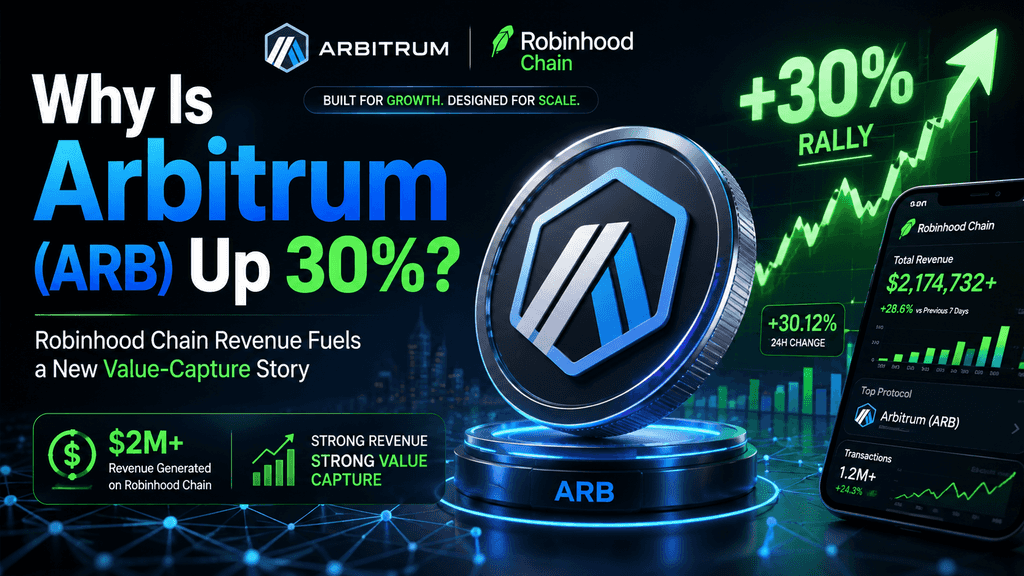
Arbitrum’s ARB token has suddenly returned to the spotlight after surging roughly 30% in 24 hours, outperforming most major cryptocurrencies. The immediate catalyst was a sharp increase in activity on Robinhood Chain, a dedicated Ethereum Layer 2 built with Arbitrum technology. Daily chain fees climbed above $2 million, while 24-hour chain revenue reached about $1.92 million, giving traders something that has often been difficult to identify around ARB: a measurable revenue story.
The rally, however, is about more than one strong day of blockchain activity. Under the Arbitrum Expansion Program, Robinhood Chain returns part of its protocol net revenue to the Arbitrum ecosystem. That has revived a much bigger question about ARB tokenomics: can the expansion of Arbitrum-powered chains eventually translate into sustainable value for ARB itself? The latest price surge suggests traders are beginning to price in that possibility, but the connection between ecosystem revenue and token-holder value remains more complicated than the headline numbers suggest.
Why Is Arbitrum (ARB) Up 30%?
ARB climbed more than 30% over a 24-hour period and moved toward $0.11, breaking out of the roughly $0.07-to-$0.10 range that had contained the token since June. Trading activity rose sharply alongside the price. CoinDesk reported approximately $618 million in 24-hour ARB trading volume, around eight times the previous day’s level. Futures positioning also strengthened: open interest increased by more than 10% as traders added exposure while ARB attempted to establish itself above resistance near $0.11. Annualized funding rates remained around 8%, suggesting bullish positioning had increased without yet reaching obviously extreme levels.
The catalyst was Robinhood Chain. Its 24-hour transaction-related revenue moved above the $2 million level according to figures cited by market participants, while DefiLlama data referenced by CoinDesk put chain revenue at approximately $1.92 million. Because Robinhood Chain uses Arbitrum’s technology and participates in its revenue-sharing framework, stronger network economics can produce a larger payment to the Arbitrum ecosystem. The market therefore began trading a relatively simple thesis: more Robinhood Chain activity could mean more revenue flowing back to Arbitrum.
| Metric | Recent Development |
| ARB Price | Rose roughly 30% in 24 hours |
| ARB Futures Open Interest | Increased more than 10% |
| ARB 24h Trading Volume | Around $618 million |
| Robinhood Chain Daily Fees | Above $2 million |
| Robinhood Chain 24h Revenue | Around $1.92 million |
| Main Market Narrative | Arbitrum revenue and ARB value capture |
The important distinction is that this is no longer simply a story about Robinhood choosing Arbitrum technology. That partnership has been known for some time. What changed is the scale of economic activity now being generated on Robinhood Chain. Adoption has started producing numbers that traders can use to build an actual revenue model, turning an infrastructure partnership into a potentially measurable economic relationship.
What Is Robinhood Chain and Why Does It Matter?
Robinhood Chain launched on public mainnet on July 1, 2026, after a testnet that processed more than 200 million transactions. It is a dedicated Arbitrum-based chain that settles to Ethereum and was designed to support Robinhood’s growing push into tokenized assets and onchain financial services. The network supports Stock Tokens, decentralized trading infrastructure, lending through Morpho and stablecoin liquidity built around USDG. Robinhood’s first generation of Stock Tokens had previously launched on Arbitrum One, while the newer products operate on Robinhood Chain.
Operating a dedicated chain gives Robinhood greater control over transaction performance, fees, application design and the user experience than simply deploying every product directly onto a shared network. The infrastructure is still connected to the broader Ethereum ecosystem, but Robinhood can configure the environment around its own products. That model is particularly relevant to financial companies that may want blockchain settlement without giving up control over the application layer.
For Arbitrum, the significance goes beyond having a recognizable financial brand use its technology. Robinhood Chain demonstrates how Arbitrum can potentially monetize infrastructure deployed outside Arbitrum One. If economic activity on an independent Arbitrum-powered chain produces recurring payments to the ecosystem, Arbitrum’s growth story becomes less dependent on activity occurring only on its flagship network.
How Robinhood Chain Revenue Surged
Robinhood Chain experienced a dramatic acceleration in activity toward the end of August. On August 30, the network processed a record 5.52 million transactions, while decentralized exchange volume reached roughly $875 million. A separate snapshot from The Block showed single-day DEX volume reaching a record $989 million around the same period, with TVL climbing to approximately $708 million and stablecoin supply reaching about $770 million. That represented nearly 100% month-over-month growth in TVL and about 47% growth in stablecoin supply.
The revenue figures accelerated even faster. CoinDesk reported Robinhood Chain generated approximately $1.92 million in chain revenue over a 24-hour period, compared with $5.92 million over the previous 30 days. In other words, roughly one-third of its monthly revenue was generated in a single day, while more than two-thirds of the 30-day total had arrived during the previous week. Another data series cited by CoinDesk showed gross chain revenue rising from about $54,676 on August 22 to more than $1 million by August 30, illustrating how quickly the economics changed.
It is important, however, to distinguish chain revenue from revenue generated by applications. Apps on Robinhood Chain earned around $2.66 million in one particularly active 24-hour period, but much of that came from speculative crypto activity. Memecoin trading platform GMGN and token launchpad Pons together generated roughly $2 million, while Uniswap contributed about $307,000. Pons also facilitated the creation of approximately 22,600 tokens in a single day. Robinhood Chain may have been designed partly around tokenized stocks and real-world assets, but memecoin and speculative token trading are currently playing a major role in proving that the network can generate significant economic activity.
How Arbitrum Earns From Robinhood Chain
The connection between Robinhood Chain activity and Arbitrum comes through the Arbitrum Expansion Program. Under the program, Arbitrum chains deployed outside Arbitrum One and Nova are required to return 10% of protocol net revenue for using the technology. Robinhood Chain falls within that arrangement because it operates as a dedicated Arbitrum chain that settles to Ethereum. Official Arbitrum documentation states that 8% of protocol net revenue flows to the ArbitrumDAO treasury, while another 2% goes to the Arbitrum Developer Guild.
That structure means the relationship can scale with Robinhood Chain’s economic activity. CoinDesk reported that the DAO received approximately $175,612 over one peak 24-hour period, compared with $363,153 over seven days and $531,641 over 30 days. The rapid difference between those time periods highlights how dramatically recent activity has accelerated.
This is an important evolution in the Arbitrum story. A large company adopting Arbitrum technology is valuable from a branding and distribution perspective, but adoption alone does not necessarily produce measurable returns for the ecosystem. A percentage-of-revenue licensing model changes that equation. If a successful Arbitrum-powered chain becomes more active, the amount flowing back to the ecosystem can grow alongside it. Robinhood Chain therefore turns infrastructure adoption into a potentially scalable revenue source rather than only a technology partnership.
Why the $73 Million Revenue Estimate Matters
One number has attracted particularly strong attention from traders: $73 million. The figure comes from annualizing the revenue-sharing mechanism at the recent daily activity level. If Robinhood Chain were to sustain approximately $2 million in protocol revenue per day, a 10% contribution would equal about $200,000 per day for the broader Arbitrum ecosystem. Multiplied by 365 days, that produces an annualized figure of approximately $73 million. CoinDesk cited the same calculation as part of the market narrative behind ARB’s rally.
| Illustrative Calculation | Amount |
| Robinhood Chain daily revenue assumption | $2,000,000 |
| 10% ecosystem share | $200,000 per day |
| Annualized amount | ~$73,000,000 |
The word annualized is essential. Robinhood has not guaranteed that Arbitrum will receive $73 million over the next year, nor has Arbitrum already earned that amount. The figure simply extends an unusually strong daily revenue level across 365 days. Blockchain activity can change rapidly, especially when a large share of revenue is connected to speculative trading. If daily revenue fell to $500,000, for example, the equivalent annualized ecosystem contribution would fall to about $18.25 million. The importance of the $73 million figure is therefore not that it represents guaranteed cash flow, but that investors can suddenly put a number on what an Arbitrum infrastructure relationship might be worth under strong usage conditions.
Does Robinhood Revenue Actually Add Value to ARB?
This is the most important question behind the entire rally. Robinhood Chain clearly creates revenue for the Arbitrum ecosystem, but that does not mean ARB holders automatically receive a proportional share. ARB remains primarily a governance token. The current mechanism directs revenue toward the ArbitrumDAO treasury and Developer Guild rather than distributing it directly to token holders. CoinDesk noted that converting treasury income into direct ARB value would require governance action, and no such proposal had been made at the time of the rally.
The distinction matters because “protocol revenue” and “token-holder revenue” are not the same thing. There is currently no automatic mechanism under which a Robinhood Chain transaction creates a dividend for someone holding ARB. The market is instead assigning value to an indirect relationship. A larger treasury could give ArbitrumDAO more resources to fund development, incentives, ecosystem expansion and strategic initiatives. More successful Arbitrum Chains could also make governance over those resources increasingly economically significant. Future governance could theoretically consider mechanisms such as token buybacks, burns, staking-related rewards or other forms of value distribution, but those possibilities should not be treated as existing features of ARB today.
That gap explains both the opportunity and the risk in the current valuation story. ARB’s market capitalization increased by roughly $170 million during the rally, while Robinhood Chain had contributed about $531,641 to the Arbitrum treasury over the preceding 30 days, according to figures cited by CoinDesk. The market is therefore not valuing ARB only on current cash flow; it is pricing the possibility that Robinhood Chain represents the beginning of a much larger revenue network. Robinhood strengthens Arbitrum’s revenue story, but it does not yet fully solve ARB’s token value-capture problem.
Why Robinhood Could Change Arbitrum’s Business Model
The longer-term opportunity becomes more interesting when Robinhood Chain is viewed as a template rather than a standalone project. Traditionally, investors evaluating a Layer 2 such as Arbitrum might focus heavily on how much TVL, trading volume, stablecoin liquidity and application activity exists on Arbitrum One. The expansion model adds another layer: economic activity does not necessarily have to occur directly on Arbitrum One for Arbitrum technology to generate ecosystem revenue.
Imagine multiple financial institutions, consumer platforms, gaming companies or real-world asset issuers launching their own customized Arbitrum chains. Each company could operate an environment designed around its particular requirements while sharing part of the economics generated by that chain. Arbitrum’s official Robinhood factsheet describes the model in similar terms: each business launching its own qualifying chain can add another licensing revenue line that scales with the activity of that network.
That creates a business model that resembles blockchain infrastructure licensing more than the traditional assumption that a Layer 2 must capture all activity on one shared chain. Robinhood is particularly significant because it brings a large retail distribution network and a growing tokenized-asset business into that framework. If other major businesses follow the same path, investors may eventually evaluate Arbitrum not simply by the activity of Arbitrum One, but by the combined economics of an expanding network of Arbitrum-powered chains.
Can the ARB Rally Continue?
There is a credible bullish case, but it depends on whether the underlying activity persists. Robinhood Chain’s growth has been substantial: TVL, stablecoin liquidity, transaction counts and DEX volume have all expanded, while revenue has risen sharply. Continued growth would make the Arbitrum revenue story harder to dismiss as a one-day anomaly. Additional institutional adoption of Arbitrum technology could strengthen the narrative further by showing that Robinhood is not an isolated case.
The main risk is the quality and durability of current revenue. Much of Robinhood Chain’s recent activity has been linked to memecoins, launchpads and speculative trading. Earlier in July, more than 80% of the network’s first $9 billion-plus in cumulative DEX volume had come from higher-risk memecoins, according to data cited by The Block. The network also experienced periods in which DEX volume and active-user metrics declined even while deposits continued to increase. That history shows how quickly speculative activity can change.
ARB’s own market positioning adds another variable. Rising price, an eightfold increase in spot trading volume and more than 10% growth in futures open interest show that the rally has attracted substantial attention. If open interest and funding rates continue climbing while Robinhood Chain revenue begins to decline, the trade could become more vulnerable to profit-taking and leverage unwinds. A sustainable rally would therefore be easier to justify if improving ARB market structure is accompanied by persistent onchain fundamentals rather than narrative momentum alone.
What Should ARB Traders Watch Next?
The most useful indicator may be Robinhood Chain’s daily revenue itself. A single $2 million day is impressive, but the investment case becomes much stronger if the network can repeatedly generate high fees across different market conditions. DEX volume should be considered alongside that figure because it can reveal whether revenue is being supported by sustained trading demand. TVL and stablecoin supply are also useful: rising capital and stablecoin liquidity may indicate that users are doing more than simply arriving for a short-lived speculative cycle.
Derivatives data provide another layer of information. ARB open interest, funding rates and trading volume can help determine whether price appreciation is being driven by healthy participation or increasingly aggressive leverage. A rapid rise in open interest combined with extremely positive funding would suggest that bullish positioning is becoming crowded, whereas more moderate leverage alongside stronger fundamentals would make the price move easier to sustain.
Finally, Arbitrum governance may eventually become more important than any short-term chart level. The central unresolved question is what happens if revenue flowing into the DAO treasury becomes genuinely significant. Proposals concerning treasury management, ecosystem spending or mechanisms that connect protocol economics more directly to ARB could materially change how investors value the token. Until that happens, the relationship remains indirect.
What Robinhood Chain Means for Arbitrum’s Future
ARB’s 30% surge has brought attention back to Arbitrum, but the price move itself may ultimately be less important than the reason behind it. Robinhood Chain is beginning to demonstrate that companies using Arbitrum infrastructure can generate measurable economic returns for the ecosystem. The story has therefore evolved from simple network adoption toward network adoption plus revenue.
The next stage is more difficult. Revenue going to ArbitrumDAO is not automatically revenue going to ARB holders, and recent Robinhood Chain activity is still heavily influenced by speculative trading. For the new value-capture narrative to mature, the ecosystem would need to demonstrate that these revenue streams are durable, scalable across additional chains and ultimately relevant to the economics of ARB itself.
For now, Robinhood Chain has given Arbitrum something the market has long wanted: a clearer way to quantify the economic value of its infrastructure. Whether that translates into lasting value for ARB will depend not only on Robinhood Chain maintaining its momentum, but also on how Arbitrum turns growing ecosystem revenue into a sustainable token-economic model.
FAQs
Is Robinhood Chain the same as Arbitrum One?
No. Robinhood Chain is a separate blockchain built using Arbitrum technology, while Arbitrum One is Arbitrum’s main general-purpose Layer 2 network. Robinhood’s earlier Stock Tokens were launched on Arbitrum One, whereas newer products are increasingly being integrated into Robinhood Chain.
Is Robinhood Chain an Ethereum Layer 2?
Yes. Robinhood Chain is designed as an Ethereum Layer 2 built with Arbitrum’s technology stack. It settles to Ethereum while allowing Robinhood to customize transaction execution, fees, applications, and other network features around its own ecosystem.
Can other companies build their own Arbitrum chains?
Yes. Arbitrum’s infrastructure allows companies and projects to launch customized chains for specific use cases. Depending on how these chains are deployed, they may participate in the Arbitrum Expansion Program and contribute part of their protocol net revenue back to the broader Arbitrum ecosystem.
What role does ARB play in Arbitrum governance?
ARB is primarily the governance token of the ArbitrumDAO. Holders can participate in decisions related to treasury management, ecosystem development, protocol upgrades, and other strategic matters. However, governance rights do not currently give ARB holders an automatic right to receive protocol revenue.
Where can investors track Robinhood Chain activity?
Investors can monitor Robinhood Chain through onchain analytics platforms such as DefiLlama, which provides data on TVL, stablecoin supply, fees, revenue, and DEX trading volume. Arbitrum’s official governance forum and ecosystem updates can also help users follow changes related to treasury revenue, chain expansion, and future governance proposals.
🔥 KuCoin Offers A More Stable Option in A Volatile Market
If you worry about the frequent ups and downs in the market, and pursue a more stable option to earn money passively, KuCoin is the right place to come:

Simple Earn: Deposit and withdraw tokens anytime, earning stable returns.
Kucoin Earn: Earn stable profits with professional asset management.
Hold to Earn: Earn rewards by holding assets in Funding, Trading, Margin, Futures, Mining, and Unified Accounts.
Staking: Unlock the earning potential of on-chain assets.
Advanced Investments: Advanced Investments offer a variety of structured products to help your money grow in any market.
Shark Fin: Principal Protection and Guaranteed Gains
Dual Investment: Buy low and sell high with transparent return calculations.
Snowball: High yields, with price protection.
Discount Buy: Buy crypto at discount prices.
KCS Loyalty: Level up to enjoy exclusive perks by staking ≥ 1 KCS.
KuCoin Wealth: Discover future value and begin your smart investing journey.
KCS Benefits: Hold and stake KCS to access benefits across the platform.
KCS Staking 2.0: Participate in KCS on-chain governance to earn yield.
Disclaimer: This content is for informational purposes only and does not constitute investment advice. Cryptocurrency investments carry risk. Please do your own research (DYOR).