

Aptos (APT) Tokenomics Overhaul: Will the 2.1B Supply Cap and Lower Staking Rewards Boost APT Price?
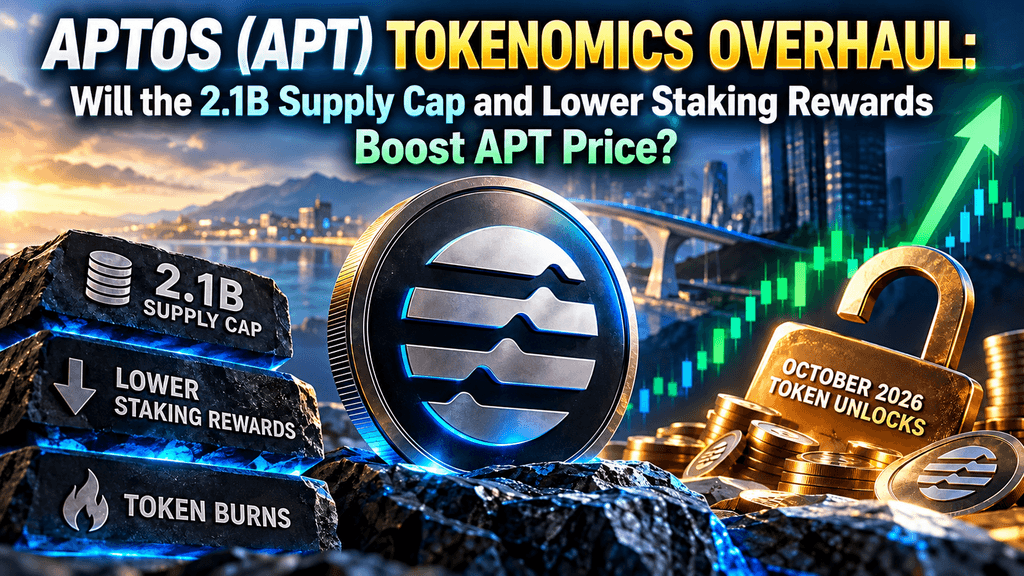
Aptos (APT) is entering a new phase of its tokenomics overhaul as the blockchain approaches a major reduction in scheduled token unlocks in October 2026. The Aptos Foundation's reforms include a 2.1 billion APT maximum supply, lower staking rewards, and higher transaction fees designed to increase token burning. Although the core changes were implemented in March 2026, the approaching end of early investor and contributor vesting has renewed attention on APT's supply outlook. The changes could reduce future selling pressure, but whether they support APT prices depends on investor demand, network adoption, and the balance between newly issued and burned tokens.
Aptos Tokenomics Overhaul With 2.1B Supply Cap and Lower Staking Rewards
The Aptos Foundation has introduced significant changes to APT tokenomics, shifting the blockchain's economic model toward controlled token issuance, lower inflation, and greater reliance on network activity. Originally announced on February 18, 2026, the core reforms were approved and executed through Aptos governance in March. The changes address long-term supply growth while adjusting incentives for validators and token holders. Rather than introducing an entirely new policy in October, the latest developments reflect the continued implementation and economic implications of reforms established earlier in the year.
Aptos Tokenomics Changes Before and After the Overhaul
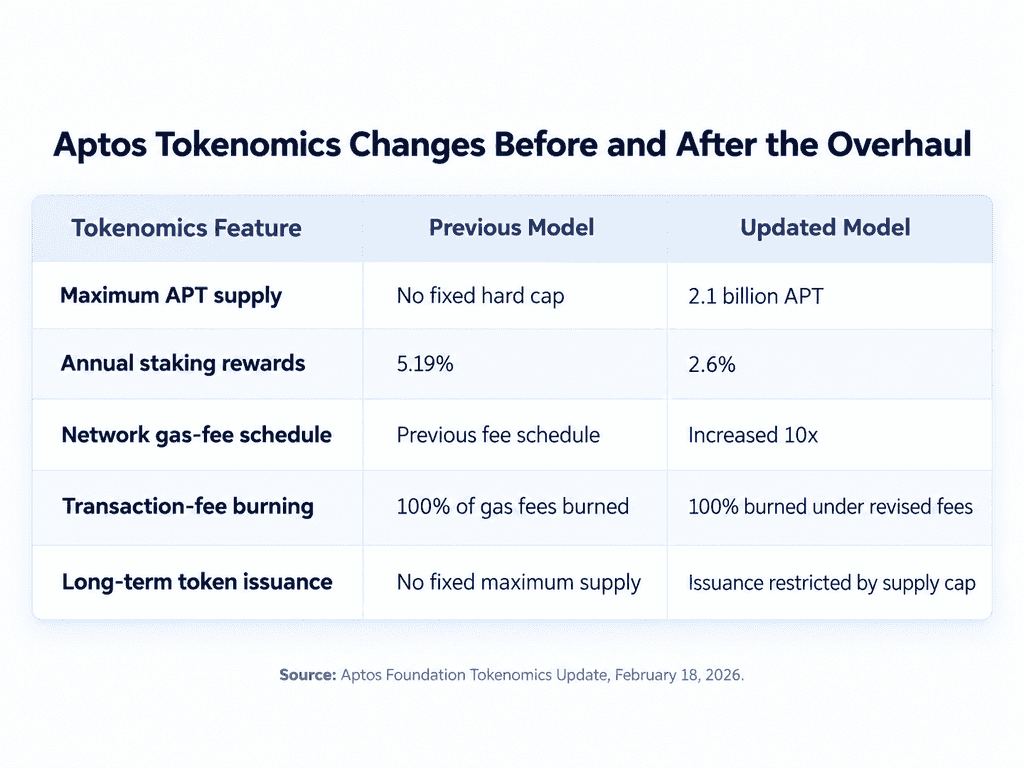
Source: Aptos Foundation Tokenomics Update and official Aptos governance proposals.
How the APT Supply Cap Changes Long-Term Issuance
The maximum supply restriction changes how Aptos manages token creation over time. Previously, staking rewards could continue expanding the total token supply without a fixed upper boundary. Under the revised model, newly issued tokens must remain within the governance-approved limit, providing a more predictable framework for long-term supply growth. However, the restriction does not automatically reduce existing supply or change the vesting conditions of previously allocated tokens. It also differs from circulating supply, which measures tokens considered available in the market rather than the maximum number the protocol permits.
The Aptos Foundation has positioned this approach as part of a transition toward performance-driven network economics, where future incentives are more closely connected to actual ecosystem development. The supply restriction also changes how investors can evaluate long-term dilution, although future governance decisions could alter the rules. Its economic effectiveness will depend on the relationship between token creation, network participation, and sustained demand rather than the existence of a maximum supply alone.
Lower Staking Rewards Reshape Validator Incentives
Reducing staking rewards directly affects the incentives available to validators and delegators participating in Aptos's proof-of-stake network. Validators help secure the blockchain, verify transactions, and maintain consensus, while delegators can support validators by assigning their tokens for staking. The revised reward structure reduces the creation of new tokens through this process, but it also changes the returns available to participants. For validators operating infrastructure, lower rewards may place greater importance on operating efficiency, transaction-fee economics, and the market value of their staking income.
The Foundation has also discussed additional measures intended to support long-term network participation, including differentiated incentives for longer staking commitments and improvements to validator infrastructure. These proposals aim to balance lower issuance with the economic requirements of maintaining a decentralized validator network. However, potential incentive adjustments should not be treated as implemented features until their governance and deployment status is confirmed. The longer-term effect will depend partly on whether validators and delegators continue participating under the revised reward structure.
Gas-Fee Burning and Aptos Foundation Treasury Plans
Transaction-fee burning provides another mechanism for managing APT supply. Under Aptos's existing fee model, APT paid for network transactions is permanently removed from circulation rather than redistributed to validators. The updated fee schedule increases the amount burned for comparable operations, although the total quantity destroyed still depends on transaction volumes and computational requirements. Higher network activity could therefore increase aggregate token burns, while weaker usage would limit their contribution to supply reduction. The Foundation has also emphasized keeping ordinary transactions affordable despite the revised fee structure.
Separately, the Aptos Foundation has committed to permanently staking 210 million APT from its treasury, restricting those holdings from ordinary market distribution. This commitment should not be confused with token burning because staked tokens continue to exist. The Foundation has also outlined performance-based ecosystem grants and explored a possible token buyback program, although these initiatives have different implementation requirements from the executed protocol changes. Their eventual contribution to Aptos's economic model will depend on how the commitments are carried out and whether the ecosystem generates sufficient activity to support its evolving incentive structure.
October 2026 APT Token Unlocks and Their Impact on Selling Pressure
Aptos is approaching a significant change in its token distribution schedule as the four-year vesting period for early investors and core contributors formally concludes on October 12, 2026. According to Everstake's September 30 analysis, scheduled monthly APT releases are expected to decline from approximately 11.31 million to 4.54 million tokens, representing a reduction of roughly 60%. The decrease could ease a recurring source of potential selling pressure by limiting the number of previously restricted tokens becoming available each month. However, fewer scheduled unlocks do not necessarily translate into immediate price appreciation, since actual market pressure depends on whether recipients sell their holdings and how much buying demand is available to absorb those sales.
Aptos Investor and Contributor Vesting Ends in October 2026
The original Aptos token distribution allocated 190 million APT to core contributors and approximately 134.78 million APT to early investors, collectively representing 32.48% of the 1 billion tokens created at mainnet launch. These allocations followed a four-year vesting schedule that prevented releases during the first 12 months before gradually making tokens available through monthly distributions. The investor and contributor portions accounted for approximately 6.77 million APT of the previous monthly release schedule, while the remaining 4.54 million APT came from community and foundation allocations. Once the initial four-year cycle concludes, those latter allocations will continue following their longer distribution schedule, extending through 2032. There is a timing discrepancy in available reporting: Everstake identifies September 12 as the final investor and contributor tranche, while DeFiLlama's unlock tracker lists another combined unlock for October 11 at 23:14 UTC, equivalent to October 12 in China. The original Aptos documentation confirms October 12, 2026, as the formal completion date.
Will Reduced APT Token Unlocks Ease Market Selling Pressure?
The smaller release schedule could improve APT's market supply conditions because fewer previously restricted tokens would become transferable during each monthly distribution period. Large unlocks can create selling pressure when early investors, employees, or other recipients decide to realize profits, rebalance portfolios, or convert tokens into other assets. However, the relationship between token unlocks and exchange selling is not automatic. Some recipients may retain their allocations, transfer them to long-term custody, or stake them rather than immediately placing sell orders. Tokens that are already staked may also require a withdrawal period before they become readily transferable. Consequently, the economic impact of reduced vesting depends more on actual holder behavior than on the nominal value of scheduled releases.
The remaining monthly distributions will still introduce additional potentially transferable APT into the market. Using the approximately 871.4 million APT circulating-supply estimate reported by DeFiLlama in early October, the expected 4.54 million monthly release represents roughly 0.52% of that circulation figure. Whether the market absorbs these tokens without significant price disruption will depend on exchange liquidity, trading volumes, and demand from existing and new holders. Changes in centralized exchange deposits, large-holder transfers, and spot market order-book depth could provide more useful evidence of selling pressure than the unlock calendar alone. A sustained decline in exchange-bound transfers following the vesting transition would be more informative than assuming that the scheduled reduction automatically removes an equivalent amount of selling activity.
APT Token Burns vs. Staking Emissions and the Shift Toward Deflation
Aptos is working toward a deflationary token model, but current on-chain data shows that APT supply continues to expand despite changes to its economic structure. The critical measurement is net issuance, which compares newly created staking rewards with tokens permanently destroyed through transaction fees. For Aptos to become deflationary, sustained token burns must exceed new issuance over a given period. Although burning activity has increased, the network has not yet reached that threshold. The official Aptos supply dashboard, updated October 9, 2026, provides a clearer picture of the difference between the project's long-term objectives and its current supply conditions.
APT Staking Emissions Still Exceed Token Burns
Aptos continues to issue more APT through staking rewards than it burns through transaction fees, keeping its supply inflationary. According to the official Aptos supply dashboard, cumulative burns reached approximately 1.9 million APT since the October 2022 mainnet launch. As of October 9, 2026, monthly staking emissions stood at roughly 1.5 million APT, compared with 171,080 APT burned over the previous 30 days. This means token burning offset only about 11.4% of new issuance, leaving estimated net monthly supply growth of 1.33 million APT. At the recent pace, annualized burns would reach approximately 2.1 million APT, indicating that supply continues expanding despite efforts to reduce inflation.
Network activity alone does not determine whether Aptos becomes deflationary. The blockchain recorded approximately 10.2 million transactions during its latest daily reporting period, generating around $4,650 in transaction fees. Despite substantial transaction activity, relatively low fees limit the amount of APT permanently removed from circulation. Future supply dynamics will therefore depend on sustained network usage, transaction complexity, fee revenue, and staking emissions. For Aptos to become deflationary, token burns must consistently exceed newly issued APT, rather than merely increasing alongside transaction volumes.
Decibel DEX Could Accelerate APT Token Burning
The Aptos Foundation expects Decibel, an on-chain decentralized exchange developed within the Aptos ecosystem, to become a potential source of additional transaction-fee burning. Unlike trading systems that process substantial order activity outside the blockchain, Decibel's architecture is designed to execute order placement, matching, and cancellations on-chain. This approach could generate considerable transaction activity as trading volumes, supported markets, and user participation expand. In its February 18 tokenomics announcement, the Foundation projected that Decibel could burn more than 32 million APT annually if the platform reaches a scale of over 100 trading markets under its stated operating assumptions.
That estimate remains a forward-looking scenario rather than an observed annual burn rate. Its realization would depend on sustained exchange usage, transaction throughput, market expansion, and the amount of gas consumed by trading operations. High trading volumes would not necessarily translate into proportionate token destruction if transactions become more computationally efficient or require minimal fees. The most useful evidence of Decibel's contribution will therefore come from actual APT burned by trading-related transactions, rather than projected transactions per second or the number of supported markets. Until those measurements demonstrate sustained growth, the Foundation's projections should be treated as potential outcomes rather than confirmed improvements in supply dynamics.
What Would Make Aptos Truly Deflationary?
The transition to net deflation would occur when the amount of APT permanently destroyed consistently exceeds the amount created through staking rewards. Based on the October supply figures, the current burn rate would need to increase by roughly nine times to match existing monthly emissions, assuming issuance remained unchanged. Alternatively, a combination of gradually declining emissions and increasing transaction-fee revenue could close the gap over time. The crossover point would depend on the network's actual economic activity, not simply the implementation of tokenomics reforms or the achievement of a particular transaction-count milestone.
Monitoring the relationship between gross issuance, transaction-fee burns, and net supply growth provides a more reliable assessment of Aptos's progress toward deflation. These figures should be evaluated over several reporting periods because temporary spikes in blockchain activity can distort short-term burn rates. A sustained period of negative net issuance would provide stronger evidence that the network's economic model has entered a deflationary phase, while continued positive issuance would indicate that APT remains inflationary despite improvements in its underlying supply mechanics.
Will Aptos Tokenomics Changes Boost APT Price in 2026?
The Aptos tokenomics overhaul could support APT price over the longer term, but its effectiveness will depend on whether market demand strengthens alongside the network's changing supply conditions. According to CoinGecko historical data, APT closed at approximately $0.736 on October 8, 2026, down from $0.845 on October 5, reflecting continued price weakness despite the earlier implementation of the reforms. The decline cannot be attributed to tokenomics alone, as cryptocurrency valuations are also influenced by Bitcoin movements, investor risk appetite, trading liquidity, and broader market sentiment. A sustained recovery would require stronger buying interest rather than relying exclusively on expectations of improved token scarcity. Investors will therefore need to assess whether Aptos can translate its revised economic policies into measurable ecosystem growth and stronger demand for APT.
Key Catalysts and Risks for APT Price in 2026
Network adoption, decentralized finance activity, institutional participation, and liquidity conditions could play important roles in determining APT's remaining 2026 price performance. According to DeFiLlama, Aptos had approximately $49.6 million in decentralized finance total value locked and $7.23 million in decentralized exchange trading volume over 24 hours in the October 10 market snapshot. These indicators provide useful measures of ecosystem activity, although neither directly establishes demand for APT itself. Growing stablecoin usage, increased application activity, and consistent capital inflows could strengthen the network's commercial relevance, particularly if they generate sustained demand for blockchain transactions. Conversely, weak investor sentiment, competition from established Layer 1 networks such as Ethereum and Solana, and declining trading liquidity could limit price appreciation even under more restrictive token economics. For the APT price outlook, the most meaningful confirmation would be sustained growth in genuine network usage accompanied by stronger spot-market demand, rather than a short-lived rally driven primarily by announcements or speculative positioning.
🔥 Beyond the Headlines: What KuCoin 5.0 Means for You
Market news moves fast — but where you act on it matters just as much. This October, KuCoin launches KuCoin 5.0, transforming KuCoin into a rebuilt platform. Here's what actually changes for you:
-
One account for everything. Older platforms split your money across separate "spot," "margin," and "futures" accounts and expected you to understand why. KuCoin 5.0's unified account removes that entirely — deposit once, and everything is simply there (only available to VIPs for now).
-
Stocks, indices, and commodities. KuCoin 5.0 expands beyond crypto into global markets. When crypto chops sideways and equities rally (or the reverse), you rotate in minutes instead of opening a brokerage account and waiting days for fiat rails.
-
Real-world assets (RWA). Tokenized exposure to traditional assets like commodities, right inside your crypto account. One of the fastest-growing segments in global finance is no longer reserved for institutions — you access it from the same balance you trade with.
-
Earn while you learn. Not ready to trade? KCUSD lets your stablecoins earn daily, auto-compounding interest. The lowest-stress way to put your idle deposit to work for 4% yield.
-
An AI assistant in plain language. Ask questions, get market context, understand what you're looking at — built into the platform, no jargon required.
-
An app that doesn't overwhelm. Faster, cleaner, and consistent — intuitive from the first tap, not after a tutorial.
-
Safety you can check, not just trust. A MiCAR-licensed EU entity, Proof of Reserves you can verify yourself, and internationally certified security (SOC 2 Type II, ISO 27001:2022).
Create your account in minutes — and start on the platform built for where crypto is going, not where it's been.
Conclusion
Aptos's 2026 tokenomics overhaul has introduced meaningful changes to the network's long-term supply structure, while the approaching completion of early investor and contributor vesting could further reduce potential selling pressure. However, the latest on-chain figures show that APT remains inflationary, with staking emissions continuing to exceed transaction-fee burns. The reforms may improve supply conditions over time, but their effect on market prices is neither immediate nor guaranteed. For the remainder of 2026, investors should focus on actual network adoption, sustained token-burning activity, trading liquidity, and changes in market demand. These indicators will provide stronger evidence of whether Aptos's revised economic model can translate into lasting support for APT price.
FAQs
Can the Aptos 2.1 Billion APT Supply Cap Be Changed?
Yes. The maximum supply is enforced through Aptos's protocol rules, but future changes remain possible through on-chain governance. Any increase would require an approved governance proposal rather than an automatic adjustment. Investors should therefore distinguish between the current supply ceiling and an economically irreversible restriction that cannot be modified.
Are Aptos Staking Rewards Guaranteed at 2.6%?
No. The protocol's annual staking reward rate does not guarantee that every participant receives an identical return. Actual staking yields can vary depending on validator performance, delegation-pool commissions, and reward compounding. Delegators should review a validator's operating history, fees, and estimated net yield before committing tokens.
How Long Does It Take to Unstake APT?
APT unstaking is subject to the validator or delegation pool's lockup schedule. Users can request to unlock their tokens, but withdrawals become available only when the applicable lockup expires. The remaining waiting period depends on the pool's current cycle, so investors should check their staking dashboard before assuming funds are immediately accessible.
Do Users Need APT to Pay Gas Fees When Transferring Stablecoins?
Aptos transaction fees are denominated in APT, including fees for stablecoin transfers involving assets such as USDC. However, sponsored transactions allow another account or application to cover the gas costs. This means users can potentially transfer stablecoins without holding APT themselves, provided the application supports sponsored transactions.
How Is APT's Fully Diluted Valuation Different From Its Market Capitalization?
APT market capitalization is generally calculated by multiplying its circulating supply by the current market price. Fully diluted valuation (FDV) uses a broader supply measure, often the total or maximum token supply, depending on the data provider's methodology. Investors should check which figure is used because FDV estimates can differ across platforms and do not represent the amount of capital currently invested in APT.
Disclaimer: This article is for informational purposes only and does not constitute investment advice. Crypto assets can be highly volatile, and market conditions, token liquidity and project developments may change rapidly. Readers should conduct their own research and assess their risk tolerance before making financial decisions.