

Anthropic Adds Invisible Watermarks to Claude: What It Means for AI-Generated Content
2026/08/12 16:07:00
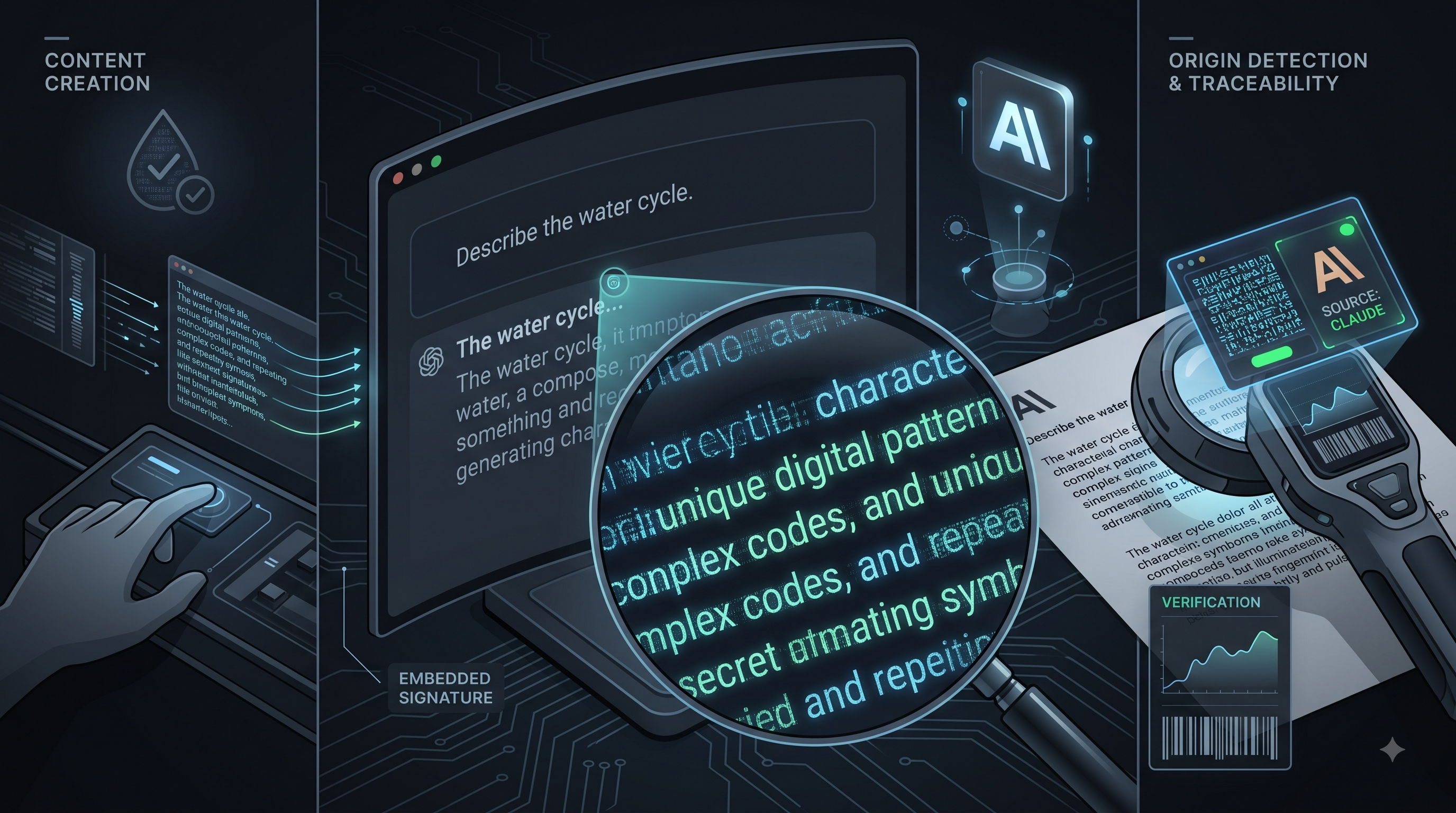
For years, detecting AI-written text has largely meant guessing. A document could look like it came from Claude, ChatGPT, or another language model, but once the text was copied into a document, website, or social post, there was usually no obvious machine-readable proof of where it came from. Anthropic is now trying to change that. Supported Claude models are beginning to embed imperceptible watermarks directly into generated text, while supported image and file outputs can carry signed provenance information.
The move is significant because it shifts the debate from simply asking whether writing looks artificial to asking whether digital content can carry evidence about how it was created or processed. But invisible watermarks are not a perfect AI detector. Editing, rewriting, translation, short passages, and mixed-source content can all complicate detection. For publishers, students, marketers, Web3 users, and developers building AI agents, the bigger story may therefore be the rise of machine-readable content provenance—and the new questions it creates about trust, identity, authorship, and verification across the internet.
What Exactly Is Anthropic Changing?
Anthropic is introducing two related but distinct approaches to marking Claude-generated content. For text, supported models embed an imperceptible watermark into the output itself. The mark is designed to be machine-readable without changing the normal meaning or readability of the text. For supported image and file formats, Anthropic is using signed provenance information that can record the involvement of Claude and help verify whether a file has subsequently been altered.
The marking happens at the model level rather than simply being attached to the Claude website interface. That matters because the same principle can extend to Claude accessed through APIs, developer tools, enterprise products, and supported cloud deployments. Anthropic says marking applies globally once a model supports the feature rather than being restricted only to users in Europe.
| Content or Access Method | Marking Approach | What It Is Designed to Do |
| Claude-generated text | Imperceptible embedded watermark | Provide a machine-readable Claude-origin signal |
| Supported images and files | Signed provenance metadata | Record processing history and support integrity checks |
| Claude.ai and supported products | Model-level marking | Keep provenance consistent across interfaces |
| API and supported cloud deployments | Model-level text marking | Extend the signal beyond the Claude website |
One important limitation is timing. The change does not mean that every historical piece of Claude-generated text suddenly contains a watermark. Anthropic says supported models released from August 2, 2026 onward include marking from launch, while support for older models is being expanded gradually.
How Does an Invisible AI Text Watermark Work?
The concept is easiest to understand by comparing a text watermark with conventional file metadata. Metadata usually belongs to a file container. A photograph might contain information about the camera, editing software, or creation date, but that information can disappear when the image is copied, compressed, converted, or uploaded to a service that strips metadata. Plain text is even more difficult because people constantly copy sentences between websites, emails, documents, messaging apps, and content-management systems.
Anthropic says its text watermark is instead embedded in the generated text itself. That means the intended workflow looks more like Claude output → copy → paste → publish, with the machine-readable signal potentially continuing to travel with the language. The user does not see an obvious label such as “Generated by Claude,” and the text should remain readable in the normal way.
What Anthropic Has Not Revealed
The technical implementation remains one of the biggest unanswered questions. Anthropic has not publicly disclosed the full watermark algorithm, the statistical or token-level mechanism involved, the exact detection threshold, or the minimum passage length required for reliable identification. It has also not said that the system relies on zero-width Unicode characters, despite that explanation appearing frequently in online speculation. For now, the accurate conclusion is much narrower: Anthropic has described what the watermark is intended to accomplish, but not exactly how the underlying encoding and detection system works.
Why Is Claude Watermarking Content Worldwide?
The timing is closely connected to the European Union's AI transparency regime. Article 50 of the EU AI Act introduces transparency obligations for providers of generative AI systems, including requirements intended to make AI-generated or manipulated content identifiable in machine-readable ways. Those transparency provisions became applicable from August 2, 2026, turning content provenance from a research question into an increasingly important compliance issue for major AI providers.
What makes Anthropic's approach particularly interesting is that the company is not treating watermarking as an EU-only product mode. Once a Claude model supports the marking system, the feature applies across regions where that supported model is offered. From a technical and operational perspective, a model-level implementation can be simpler than maintaining fundamentally different generation behavior for every regulatory jurisdiction.
This resembles the broader phenomenon sometimes called the Brussels Effect, in which rules created for the European market influence global product standards because multinational companies prefer a consistent system over maintaining fragmented regional versions. Anthropic has not described its global rollout in exactly those terms, but the outcome is similar: a transparency requirement associated with European regulation is helping shape how Claude-generated content is handled worldwide.
What Does Detecting a Claude Watermark Actually Prove?
The most important misunderstanding to avoid is this: detecting a Claude watermark would not necessarily prove that Claude wrote an entire document from scratch. Consider an author who researches and writes a 2,000-word article independently, then asks Claude to correct grammar and improve sentence flow. The returned version may contain a Claude-origin signal even though the original research, arguments, structure, and much of the language came from a human author.
The reverse assumption is also unsafe. Failing to detect a watermark does not automatically prove that a passage was written by a human. The text could come from an older unsupported model, could have been heavily modified, translated, mixed with other writing, or could simply be too short for reliable watermark detection.
| Detection Result | What It May Indicate | What It Does Not Automatically Prove |
| Claude watermark detected | Claude likely generated or processed the output | Claude created every idea and sentence |
| No watermark detected | No supported Claude signal was reliably found | The content is definitely human-written |
| Partial signal remains | Some model-origin signal may have survived editing | The text is identical to the original Claude output |
This distinction will matter enormously in education, publishing, journalism, and professional writing. Content provenance can provide evidence about tool involvement, but authorship is a much broader question involving who created the ideas, who made the editorial decisions, and how extensively AI participated in the final work.
Can Claude Watermarks Survive Editing and Rewriting?
Anthropic says the watermark is intended to survive ordinary copying and may remain detectable after some editing. That makes it fundamentally different from a label attached only to the original Claude interface. If a user copies generated text into a word processor or content-management system, the watermark may continue to exist because the signal is associated with the language output rather than only with the original webpage.
However, the system is not indestructible. Anthropic explicitly acknowledges that heavy editing, paraphrasing, translation, combining model output with other text, or working with very short passages can reduce or eliminate reliable detection. This is an important technical limitation because natural-language content is unusually easy to transform while preserving meaning.
Anthropic has not published a simple rule such as “editing 30% of the text removes the watermark,” and such claims should be treated cautiously. The useful way to think about the feature is therefore not as digital rights management for sentences, but as a provenance signal with limited robustness. It can increase the amount of information available about where content came from without guaranteeing permanent attribution under every transformation.
AI Watermarking Is Not the Same as AI Detection
Traditional AI-writing detectors usually analyze characteristics of a finished passage and estimate whether those characteristics resemble language produced by a model. They may look at statistical predictability, sentence structure, word choice, token patterns, or other linguistic signals. The result is normally probabilistic: a detector might say that a passage has a high likelihood of being AI-generated.
Watermarking changes the direction of the problem. Instead of asking a third party to infer authorship from writing style, the AI system intentionally places a detectable signal into its output at generation time.
| Traditional AI Detector | Embedded AI Watermark |
| Infers origin from language patterns | Searches for an intentional origin signal |
| Usually probability-based | More directly provenance-oriented |
| Can classify ordinary human writing incorrectly | Depends on the presence and survival of the mark |
| Does not require cooperation from the model provider | Requires the provider to implement marking |
| Answers “Does this look AI-generated?” | Answers “Is a known model signal present?” |
Neither system solves the entire problem. A watermark cannot tell a reader whether a statement is true, whether the author used AI appropriately, or whether a publication is trustworthy. It can add evidence about provenance, but provenance is not the same thing as credibility.
Text Watermarks and C2PA Solve Different Problems
Anthropic is using a different strategy for supported images and files because those media provide more natural containers for provenance information. C2PA, or the Coalition for Content Provenance and Authenticity, has developed an open technical framework commonly associated with Content Credentials. It allows digital content to carry cryptographically signed information about its origin and processing history.
That works well for media files because a file can preserve a structured record showing that a particular tool created or modified it. A verifier can then inspect the signed information and determine whether the provenance record remains intact. Text behaves differently. A paragraph copied from a chat window into an email may no longer have any relationship with the file in which it was first created.
The two approaches therefore address related but different problems. C2PA is particularly useful for recording a chain of provenance around media assets, while embedded text watermarking attempts to make an origin signal survive when the surrounding container disappears. Neither guarantees that the underlying claim is truthful, and neither should be confused with DRM. Their shared purpose is to make the history of digital content easier to inspect.
What This Means for Writers, Publishers and SEO
For writers, the most immediate consequence may be the collapse of the simple “human-written versus AI-written” distinction. Real creative workflows increasingly sit somewhere in the middle. A journalist may conduct original interviews but use Claude to summarize transcripts. A marketer may write an article manually and use AI only for editing. A researcher may generate a first draft with AI but completely restructure and fact-check the result. All of these involve very different levels of human authorship even though Claude may have touched the final text.
Publishers and content platforms could eventually add provenance screening to editorial workflows. A manuscript, article, or user-generated post might be checked for known AI-origin signals alongside plagiarism reviews, fact-checking, or disclosure policies. The dangerous shortcut would be treating a detected watermark as automatic evidence of misconduct. A provenance mark can indicate that Claude processed content; it cannot by itself determine whether the use complied with a publisher's rules.
SEO creates another important question. There is currently no basis for assuming that a Claude watermark automatically causes a search-ranking penalty. Search engines already evaluate content through much broader signals involving usefulness, originality, relevance, authority, and user experience. The longer-term change may be that content provenance becomes another source of contextual information. If that happens, the important SEO question will not simply be “Was AI used?” but whether the resulting content provides original value, accountability, and transparent authorship.
Why Crypto and Web3 Users Should Care
At first glance, invisible watermarks may appear to have little to do with cryptocurrency. But the underlying problem—how digital systems prove origin, identity, and processing history—is closely related to questions that Web3 developers have worked on for years.
From Content Detection to Digital Provenance
Anthropic's system is essentially a form of provider-issued provenance. Claude generates or processes the text, Anthropic's system inserts a recognizable signal, and compatible detection infrastructure can later identify that involvement. This model works well when users trust the AI provider and the provider maintains reliable verification tools.
Web3 approaches often start from a different architecture. A creator, software agent, organization, or device can cryptographically sign a claim. Decentralized identifiers, verifiable credentials, smart contracts, and on-chain attestations can then create records that other systems independently verify. This does not make blockchain a replacement for Claude watermarking. Instead, it raises the possibility of different provenance layers working together.
A future content system could, for example, distinguish between model provenance, which records that an AI system processed the content, and creator provenance, which records who approved, published, or owns a particular version. A blockchain can provide durable timestamps and signed attestations, but it cannot magically determine whether the underlying statement is correct. Crypto infrastructure is strongest at proving that a specific signed record exists—not at proving that reality matches the record.
AI Agents Could Make Provenance Even More Important
Today's debate still assumes a relatively simple workflow: a human asks an AI model for text and then publishes the result. The emerging AI-agent economy is much more complicated. One autonomous agent may search for information, another may summarize it, a third may rewrite it for a particular audience, and a fourth may publish the finished output or use it to trigger a financial decision.
That makes provenance more important because machines increasingly need to evaluate information created by other machines. An automated trading agent reading market analysis may want to know which model produced it, which sources were used, whether another agent altered it, and whether an authorized entity approved the final output. The same questions will arise for code generation, research reports, automated customer support, and machine-to-machine commerce.
Crypto infrastructure could intersect with this trend because AI agents are also beginning to use digital wallets, stablecoins, on-chain credentials, and programmable payment systems. Over time, agent identity, transaction provenance, and content provenance may become parts of the same trust architecture. Anthropic's watermarking initiative does not build that entire system, but it demonstrates why machine-readable origin information is becoming increasingly valuable.
What Claude’s Watermarks Still Cannot Solve
The first limitation is robustness. Human language can be restructured without significantly changing meaning, which makes text watermarking fundamentally harder than signing an unchanged digital file. Heavy rewriting, translation, summarization, or merging passages from different sources can weaken the signal. That means watermark detection will never be identical to reading an immutable creator signature from a file.
The second limitation is attribution. A Claude signal can indicate that Claude participated in a workflow, but participation is not authorship. Nor does a watermark prove truth. Claude can generate accurate content with a watermark, inaccurate content with a watermark, or simply edit human-written misinformation. Likewise, human-written content without any watermark can still be false.
The third challenge is interoperability. If every major AI company develops its own closed marking system, platforms may eventually need separate detection infrastructure for Anthropic, Google, OpenAI, Meta, xAI, and many smaller providers. Open provenance standards could become increasingly important if the internet moves toward a world where content routinely passes through several AI systems before publication.
What Happens Next for AI Content Verification?
Several developments will determine whether Claude's watermarking system becomes a major industry standard or simply one component of a much larger provenance ecosystem.
-
Technical documentation: Anthropic still needs to provide deeper information about detection accuracy, robustness, passage-length requirements, and implementation.
-
Third-party verification: The usefulness of the watermark will increase substantially if publishers, platforms, and independent tools can reliably detect supported Claude signals.
-
Older-model coverage: Expanding watermark support beyond newly released models will determine how consistent Claude provenance becomes across real-world workflows.
-
Platform adoption: Search engines, publishers, social networks, schools, and content-management platforms will decide whether provenance signals become part of everyday moderation and disclosure processes.
-
Cross-model standards: The long-term question is whether AI companies converge on interoperable provenance standards or build separate ecosystems that cannot easily verify one another.
These questions matter more than whether a single paragraph can be labeled “AI-generated.” The larger goal is to create a digital environment in which machines and humans can understand where content came from and how it changed.
Invisible Watermarks Are Only the Beginning
Anthropic's move is important because it turns content provenance from an optional experiment into part of the default behavior of supported Claude models. Together with the EU's new AI transparency requirements and the growing use of signed provenance systems such as C2PA, it points toward an internet where AI-generated media increasingly carries machine-readable information about its origins.
That will not eliminate misinformation, plagiarism, false authorship claims, or misuse of AI. Watermarks can be damaged, provenance can be incomplete, and even perfectly verified content can still be wrong. But the underlying direction is significant.
The future of AI-generated content may therefore be less about building ever more aggressive tools that attempt to guess whether a machine wrote something and more about making provenance part of the content lifecycle from the beginning. For Web3 users, publishers, developers, and AI-agent builders, the critical questions will increasingly become: Who generated this? Who changed it? Who approved it? And can those claims be independently verified?
Invisible watermarks are one early answer to that much larger problem.
FAQs
Do all Claude models already watermark their outputs?
No. The rollout is tied to supported models rather than retroactively applying to every historical Claude output. Anthropic says models released from August 2, 2026 onward support the new marking system when designated as compatible, while support for older models is being expanded over time. As a result, users should not assume that every piece of text ever produced by Claude contains a detectable watermark.
Does Claude Code also produce watermarked text?
Supported models used through Claude Code are included in Anthropic's broader model-level marking approach. The important distinction is that watermarking depends on the underlying model's support rather than on whether the user accesses Claude through the ordinary chat interface, a coding environment, or another supported product.
Are Claude API responses watermarked?
When developers use a Claude model that supports the marking system, model-level text watermarking can apply to API-generated output as well. This is one of the more important aspects of the rollout because enormous amounts of Claude-generated text are produced through applications and enterprise services rather than directly on Claude.ai.
Can a Claude watermark identify the individual user who generated the text?
Anthropic's public description focuses on identifying Claude involvement and content provenance, not on exposing the identity of the individual user behind a prompt. There is currently no basis for assuming that a detected text watermark automatically reveals a Claude account, personal identity, or exact user who generated the passage.
Will Claude watermarks determine who owns the copyright?
No. A provenance signal and copyright ownership are separate issues. A watermark may help establish that an AI system processed a piece of content, but copyright questions depend on applicable law, the extent of human authorship, contractual terms, and the actual creative process. Watermark detection alone cannot determine legal ownership.
Can a human-written article still contain a Claude watermark?
Yes. A writer could create an article entirely by hand and later ask Claude to proofread, translate, summarize, format, or rewrite portions of it. The output returned by a supported Claude model may then contain a Claude-origin signal. This is why detecting a watermark should be interpreted as evidence of AI involvement, not automatic proof that a machine created the original work.
Disclaimer: This content is for informational purposes only and does not constitute investment advice. Cryptocurrency investments carry risk. Please do your own research (DYOR).