

Ansem Says Crypto Market Is Still Early: Are Price Discovery Tokens Near Favorable Entry Levels?
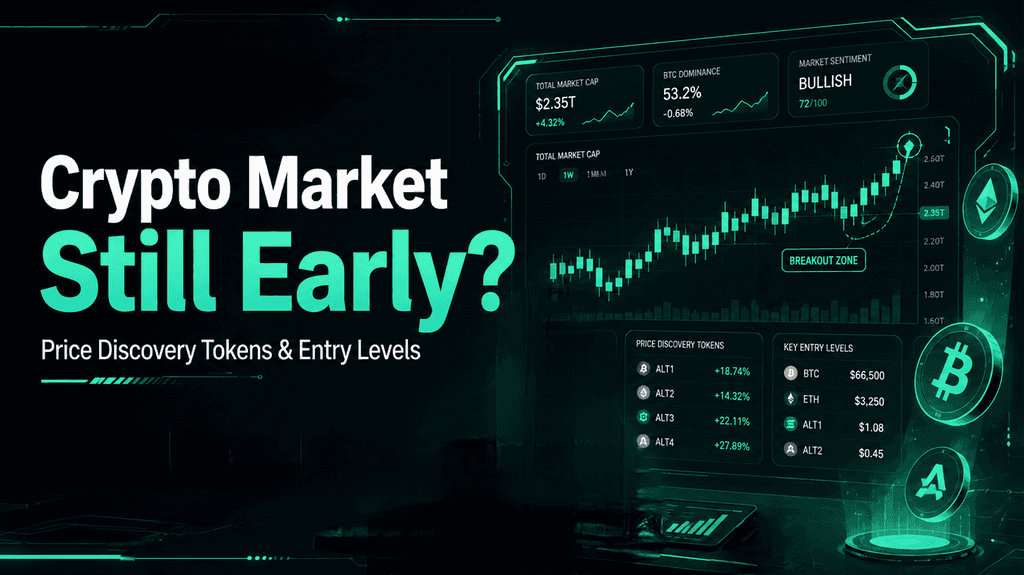
The cryptocurrency market has regained momentum in 2026, raising a familiar question for investors: is the current recovery already mature, or could the market still be in an earlier phase of a broader cycle? Crypto commentator Ansem recently argued that the market remains at a relatively early stage and suggested that traders should pay particular attention to tokens entering price discovery near their initial breakout levels. His comments have drawn interest as Bitcoin, institutional capital flows and overall crypto valuations recover from earlier weakness. Determining whether an asset offers an attractive entry, however, requires more than identifying a rising price. Market liquidity, trading volume, token supply, institutional demand and broader participation can all influence whether a breakout develops into a sustainable trend or reverses unexpectedly. Examining Ansem's argument alongside current crypto market data can therefore provide investors with a clearer understanding of price discovery, breakout levels and the signals that may shape the next phase of the market.
Why Ansem Believes the Crypto Market Is Still in an Early Stage
Crypto commentator Ansem believes the crypto market may still be in an early stage, even after Bitcoin's recent recovery and renewed interest across digital assets. In comments reported on August 30, 2026, he said investors who do not yet have exposure may still have time to monitor conditions, establish potential entry ranges and prepare a strategy instead of rushing into positions. His view is particularly focused on tokens beginning to enter price discovery, where price expansion may be starting rather than approaching the end of an established trend. The argument has attracted attention because investors are trying to determine whether the current recovery represents a larger shift in the market cycle or a shorter rebound following months of weakness. Ansem's outlook remains a market opinion, however, rather than evidence that Bitcoin, altcoins or the wider crypto market will necessarily continue higher.
-
Crypto Market Recovery Is Building After a Prolonged Correction
One factor behind Ansem's early-stage argument is that the broader market is emerging from a substantial correction rather than extending an uninterrupted rally. Total cryptocurrency market capitalization declined sharply through the first half of 2026, while Bitcoin, Ethereum and many altcoins experienced significant drawdowns and lower trading activity. CoinGecko reported that the market ended the second quarter near $2.1 trillion after another quarterly decline, illustrating how much valuation and investor risk appetite had contracted from the 2025 peak. Conditions improved considerably during August as Bitcoin recovered and interest in digital assets strengthened. Investors following real-time crypto market data can compare price movements, market capitalization and trading activity across different cryptocurrencies as conditions change. Still, several weeks of positive performance alone cannot confirm a new long-term crypto bull market. A more durable expansion would typically require sustained capital inflows, stronger spot-market activity and demand that persists through periods of volatility.
-
High Bitcoin Dominance Shows the Rally Has Not Spread Evenly
Another important feature of the 2026 crypto market cycle is the continued concentration of market value in Bitcoin. Bitcoin dominance remains near 58%, meaning BTC still accounts for well over half of total cryptocurrency capitalization. That differs from a broad speculative market in which capital moves aggressively across Ethereum, established altcoins, decentralized finance projects and smaller tokens simultaneously. For Ansem's thesis, this uneven participation is notable because many areas of crypto have not experienced the same recovery as Bitcoin. Previous cycles have sometimes seen capital move gradually from Bitcoin toward higher-risk assets as confidence improves, but that historical pattern is not guaranteed to repeat. Investors may instead watch altcoin volumes, liquidity, relative performance and sector-level demand for stronger evidence that participation is expanding beyond the largest digital asset.
-
What Could Support or Challenge Ansem's Early-Stage Crypto Thesis
Ansem's argument ultimately depends on whether the recent improvement in crypto develops into deeper and more sustainable demand. Rather than relying on one price move or market prediction, investors can examine several indicators that provide additional information about participation, liquidity and risk.
-
Spot trading activity: Consistently stronger spot volume may suggest that price gains are supported by wider participation rather than thin trading.
-
Stablecoin supply: Growth in dollar-linked crypto assets can increase liquidity available for trading, payments and decentralized finance activity.
-
Market breadth: More assets and sectors participating in an advance may indicate healthier market expansion than gains concentrated in only a handful of tokens.
-
Institutional flows: Persistent demand through regulated investment products can provide another measure of capital entering Bitcoin and the broader digital-asset market.
-
Leverage conditions: Excessive futures positioning, funding rates or open interest can increase liquidation risk even when market sentiment remains positive.
-
Macroeconomic conditions: Interest rates, bond yields, U.S. dollar movements and global risk appetite can significantly affect demand for volatile assets.
Taken together, these signals can help investors evaluate whether current conditions support the idea that crypto remains relatively early in its present recovery. They also highlight why an early-stage thesis should remain conditional rather than being treated as a prediction of higher prices.
What Crypto Price Discovery Means and Why Breakout Levels Matter for Traders
Understanding crypto price discovery can help traders interpret what happens when a token enters a market range with little or no previous trading history. In financial markets, price discovery is the process through which buyers and sellers establish an asset's market value based on supply and demand. Crypto traders often use the term more specifically when a token moves beyond a previous all-time high or major resistance zone. Historical price levels become less useful above that point, which means current demand, available supply and market liquidity play an increasingly important role in determining where the asset trades next.
-
How Crypto Price Discovery Works After a Breakout
When a cryptocurrency breaks above an important historical level, buyers and sellers begin establishing new areas where demand and supply can balance. Existing holders may take profits as prices increase, while new buyers may enter because of momentum, fundamental developments or expectations of further adoption. Understanding how crypto breakouts work is particularly relevant during price discovery because traders need to distinguish a meaningful move beyond resistance from a temporary price spike. The quality of crypto price discovery can therefore depend heavily on market structure rather than price movement alone. A highly liquid asset with deep order books may absorb larger transactions more efficiently, while a thinly traded token can move sharply after relatively small orders.
Factors that can influence price behavior during this stage include:
-
Order-book depth: More available buy and sell orders can reduce slippage and improve execution.
-
Exchange liquidity: Active markets across multiple established trading venues can contribute to more efficient price formation.
-
Circulating supply: Assets with limited tradable supply can experience stronger volatility when demand changes suddenly.
-
Holder concentration: A large percentage of supply controlled by a few wallets may increase the impact of significant selling.
-
Upcoming catalysts: Protocol upgrades, listings, ecosystem launches or regulatory developments can alter demand quickly.
These variables explain why two cryptocurrencies entering new price territory can produce very different outcomes even if their charts initially look similar.
-
What Separates a Strong Crypto Breakout From a False Breakout
A crypto breakout becomes more meaningful when the market can maintain trading above an important resistance area rather than moving through it briefly and then returning to its previous range. Traders often examine spot volume, longer-time-frame closing prices, liquidity and derivatives positioning to evaluate the strength behind a move. A rally driven heavily by leveraged futures activity may be more vulnerable to sudden reversals than one supported by consistent spot buying. Price acceptance is also important because sustained trading above former resistance can indicate that buyers are increasingly comfortable valuing the asset at higher levels.
Signals traders may use when evaluating breakout strength include:
-
Increasing spot volume: Rising participation can provide stronger confirmation than a price move on declining activity.
-
Multiple closes above resistance: Holding a new level over longer periods may suggest more durable market acceptance.
-
Controlled derivatives leverage: Moderate funding and open interest can reduce dependence on highly leveraged speculation.
-
Successful support tests: Former resistance that begins attracting buyers during pullbacks may indicate changing market structure.
-
Stable liquidity: Consistent depth can make the breakout less vulnerable to abrupt movements caused by thin order books.
None of these indicators can guarantee that a breakout will succeed, but using several together may provide a more useful framework than reacting to price alone.
-
How Traders Evaluate Entry Levels During Crypto Price Discovery
Finding a potential crypto entry level during price discovery involves balancing momentum with downside risk. Traders may compare the current price with the original breakout zone, assess how far the asset has already moved and determine whether a pullback would invalidate the original trade idea. Token-specific factors also become important at this stage, including upcoming vesting releases, circulating supply changes, protocol developments and liquidity across exchanges. Trade execution can become especially important in fast-moving or thinner markets because crypto slippage and trade execution may cause an order to fill at a different price than expected. Some traders may prefer to divide an intended position into several entries instead of relying on one exact price, while others wait for evidence that the market can hold above a previously important level. The appropriate approach depends on volatility, liquidity and individual risk tolerance. Most importantly, a cryptocurrency reaching a new high should not automatically be considered undervalued or a favorable entry simply because it has entered price discovery.
Is the Crypto Market Really Still Early? Key Data, Risks and Signals to Watch
Whether the market can genuinely be described as early depends on more than Bitcoin's recent rebound. Current data show a meaningful improvement from the weakness seen earlier in 2026, but they also reveal a market that remains uneven across different assets and investor groups. Looking at total capitalization, liquidity, institutional demand and trading participation together offers a more useful picture than relying on a single indicator.
-
Crypto Market Cap and Bitcoin Data Show a Strong Recovery
Global cryptocurrency market capitalization has recovered to roughly $2.7 trillion after falling to around $2.1 trillion at the end of the second quarter of 2026, representing a significant improvement from the mid-year downturn. Bitcoin also climbed back toward the $80,000 region during August after spending much of the year under pressure, while Ethereum and other large-cap assets recorded notable rebounds. The Bitcoin live price and market overview provides current BTC pricing, market capitalization, trading volume and circulating-supply data that can help put these movements into context. Even with those gains, the market remains below the valuation levels reached during the 2025 peak, meaning the recent advance is better described as a strong recovery than a complete return to previous cycle highs. For investors following the crypto market outlook for 2026, the durability of this rebound will matter more than any individual weekly or monthly gain. Continued demand over several months would provide stronger evidence that the market has transitioned into a more sustained expansion.
-
Stablecoin Liquidity and Bitcoin ETF Flows Offer Important Demand Signals
Liquidity within the digital-asset ecosystem provides another way to evaluate the strength of the recovery. The global stablecoin market has grown to more than $300 billion, maintaining a large pool of dollar-linked assets that can be used across trading platforms, decentralized finance applications and blockchain payments. At the same time, U.S. spot Bitcoin ETFs have continued to record periods of substantial inflows, demonstrating that regulated investment products remain an important channel for institutional and professional investors seeking Bitcoin exposure. Daily ETF flows can fluctuate significantly, however, so individual inflow records should not be interpreted as evidence of a guaranteed trend. A more meaningful signal would be persistent net inflows combined with stable or increasing crypto liquidity over an extended period, particularly if that capital begins supporting activity beyond Bitcoin.
-
Market Breadth, Trading Activity and Risk Signals Could Decide What Comes Next
The next phase of the crypto market cycle may depend largely on whether participation broadens while risk remains manageable. Trading activity weakened substantially during the second quarter, with average daily crypto volume declining and centralized exchange spot activity falling compared with the previous quarter. A sustained reversal of those trends could indicate that more investors are returning to the market, especially if volume growth extends across multiple sectors instead of remaining concentrated in Bitcoin. Investors should also monitor potential risks, including elevated leverage, large token unlocks, declining liquidity, regulatory developments and changing macroeconomic conditions. If market breadth, spot volume and capital flows improve together, the argument that the recovery still has room to develop may become stronger. If those indicators weaken while speculative leverage increases, the probability of sharper corrections could also rise.
Conclusion
Ansem's view that the crypto market remains relatively early offers one interpretation of a rapidly changing 2026 market environment. Bitcoin has recovered strongly, overall cryptocurrency capitalization has risen from its second-quarter lows and institutional demand continues to play an important role. At the same time, Bitcoin dominance remains high, participation across altcoins is uneven and several major assets are still below previous cycle peaks. These conditions leave room for further market development without proving that a sustained bull cycle is underway. For traders, price discovery and breakout levels can provide useful information about changing supply and demand, but they should be considered alongside liquidity, volume, token supply and risk-management factors. The strongest indication that the broader crypto recovery is becoming more established would likely come from sustained spot demand, healthier market breadth and consistent capital flows rather than one token reaching a new high. Ansem's early-stage thesis may therefore be useful as a framework for watching the market, but investors still need to evaluate each asset and market condition independently.
FAQs
How long can crypto price discovery last?
There is no fixed duration for a crypto price discovery phase. It can last for hours, days or much longer depending on trading volume, liquidity, investor demand, market sentiment and an asset's supply structure. Highly liquid cryptocurrencies may establish new trading ranges more gradually, while smaller tokens can move through price discovery much faster because relatively modest orders may have a larger impact on price.
Can a newly launched token also be in price discovery?
Yes. A newly launched cryptocurrency can enter price discovery immediately because there is little historical trading data available to establish a market value. Its early price may be influenced by available supply, exchange liquidity, project fundamentals and speculative demand. Investors should pay particular attention to circulating supply and future unlock schedules because low initial float can make early valuations unusually volatile.
What is the difference between price discovery and an all-time high?
An all-time high is simply the highest recorded price an asset has reached, while price discovery describes the process through which the market determines value in a new trading range. A cryptocurrency may enter price discovery after exceeding its previous all-time high, but the terms describe different concepts. One identifies a price record, while the other describes how buyers and sellers establish new prices.
Why do token unlocks matter during a crypto breakout?
Token unlocks can increase the amount of cryptocurrency available for trading. When previously restricted tokens become transferable, early investors, project teams or other holders may choose to sell part of their allocations. Large unlocks can therefore affect supply conditions even when demand remains strong, making vesting schedules an important consideration when evaluating newer crypto assets.
How can liquidity affect crypto trading during fast market moves?
Liquidity determines how easily an asset can be bought or sold without causing a large change in its market price. Highly liquid cryptocurrencies generally allow larger trades to execute with less slippage, while low-liquidity tokens may experience sharp price movements from relatively small orders. Order-book depth and exchange trading activity can help traders assess these conditions before entering a position.
Does high Bitcoin dominance mean altcoins are undervalued?
No. High Bitcoin dominance only indicates that Bitcoin represents a large share of the total cryptocurrency market capitalization. It does not prove that altcoins are undervalued or that an altcoin rally will follow. Each cryptocurrency still needs to be evaluated based on factors such as adoption, liquidity, token supply, development activity and investor demand.
What signs can show that crypto speculation is becoming excessive?
Possible warning signs include rapidly increasing leverage, unusually high funding rates, surging futures open interest, extreme social-media enthusiasm and sharp price gains in low-liquidity tokens without clear catalysts. One signal alone cannot identify a market top, but several appearing simultaneously may suggest that speculative risk is increasing and traders are becoming more aggressive.
Is dollar-cost averaging useful during an uncertain crypto market?
Dollar-cost averaging divides purchases across multiple periods instead of committing capital at one price, which can reduce the pressure of trying to time short-term market movements perfectly. It does not remove investment risk, however, and declining assets can continue losing value even when purchases are spread over time. Investors should still consider asset quality, portfolio exposure, investment horizon and their ability to tolerate volatility.
KuCoin Offers A More Stable Option in A Volatile Market
If you worry about the frequent ups and downs in the market, and pursue a more stable option to earn money passively, KuCoin is the right place to come:
Simple Earn: Deposit and withdraw tokens anytime, earning stable returns.
Kucoin Earn: Earn stable profits with professional asset management.
Hold to Earn: Earn rewards by holding assets in Funding, Trading, Margin, Futures, Mining, and Unified Accounts.
Staking: Unlock the earning potential of on-chain assets.
Advanced Investments: Advanced Investments offer a variety of structured products to help your money grow in any market.
Shark Fin: Principal Protection and Guaranteed Gains
Dual Investment: Buy low and sell high with transparent return calculations.
Snowball: High yields, with price protection.
Discount Buy: Buy crypto at discount prices.
KCS Loyalty: Level up to enjoy exclusive perks by staking ≥ 1 KCS.
KuCoin Wealth: Discover future value and begin your smart investing journey.
KCS Benefits: Hold and stake KCS to access benefits across the platform.
KCS Staking 2.0: Participate in KCS on-chain governance to earn yield.

Disclaimer
The information provided on this page may originate from third-party sources and does not necessarily represent the views or opinions of KuCoin. This content is intended solely for general informational purposes and should not be considered financial, investment, or professional advice. KuCoin does not guarantee the accuracy, completeness, or reliability of the information, and is not responsible for any errors, omissions, or outcomes resulting from its use. Investing in digital assets carries inherent risks. Please carefully evaluate your risk tolerance and financial situation before making any investment decisions. For further details, please consult KuCoin’s Terms of Use and Risk Disclosure.