

AI Compute Futures Explained: Why CME Is Turning GPU Power Into the ‘New Oil’
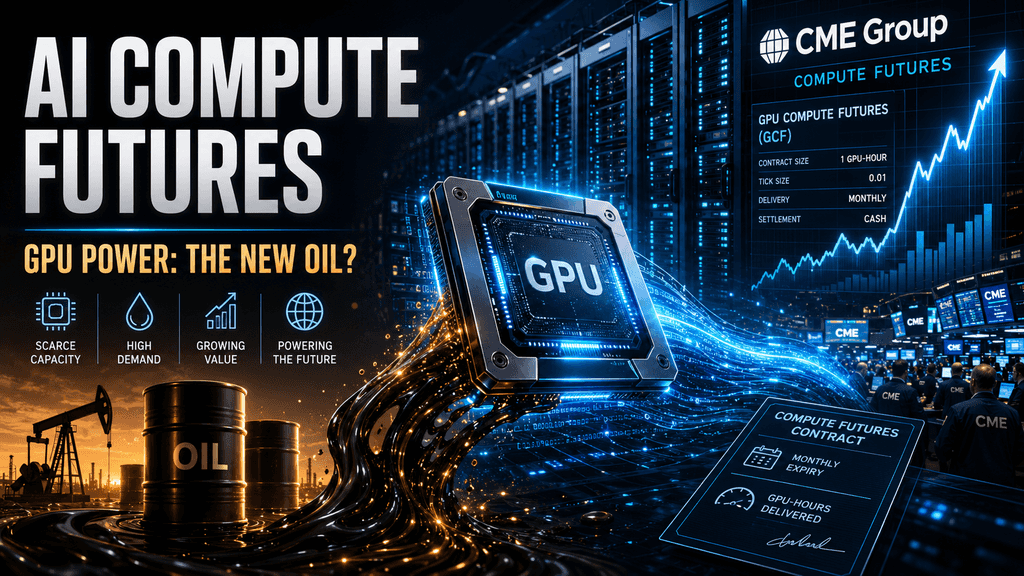
From Nvidia GPUs to Futures Contracts: CME Brings AI Compute Into Financial Markets
The quick expansion of artificial intelligence has changed high-performance computing from a specialized operational expense into a foundational economic input. Graphics processing units, particularly Nvidia’s H100 and newer Blackwell B200 models, power the training and inference of large language models and other AI systems. Their rental markets have exhibited sharp price swings driven by supply constraints, data center buildouts, and fluctuating demand from hyperscalers and AI labs. In response, CME Group partnered with Silicon Data to introduce the first standardized futures contracts tied to GPU rental rates.
Scheduled for launch on October 5, 2026, pending regulatory review, these contracts aim to provide transparent price discovery, hedging tools, and a public forward curve for what industry leaders describe as the new industrial resource of the digital economy. By converting opaque, fragmented GPU rental pricing into exchange-traded futures based on Silicon Data indices, CME is establishing compute as a financialized commodity that enables AI developers, cloud providers, and investors to manage cost risk in a market where capital expenditures on AI infrastructure have already surpassed those of traditional oil and gas.
CME’s October Launch Timeline and Regulatory Path for Compute Futures
CME Group and Silicon Data formally announced detailed plans on August 11, 2026, to list two contracts, Silicon Data H100 Rental Index Futures and Silicon Data B200 Rental Index Futures, effective for trade date October 5, 2026, subject to Commodity Futures Trading Commission review. The products will trade on the New York Mercantile Exchange under NYMEX rules and clear through CME systems. Each contract covers 730 GPU-hours, equivalent to roughly one month of continuous rental capacity for a single Nvidia H100 or B200 unit, and settles financially against Silicon Data’s daily published hourly rental benchmarks. Trading hours follow standard energy-product conventions on Globex, with monthly listings extending out 36 months.
The CFTC process includes potential public comment periods after White House regulatory review, reflecting the novel nature of treating compute as an underlying asset. Market participants have noted that early filings for related exchange-traded funds appeared within days of the initial May partnership announcement, signaling institutional interest. Success will depend on achieving sufficient liquidity so that the resulting forward curve can serve as a reliable signal of expected supply-demand balances in AI infrastructure. Without that depth, the contracts risk remaining niche instruments rather than the broad risk-management tools envisioned by exchange executives.
Silicon Data Indices as the Benchmark for GPU Rental Pricing
Silicon Data, backed by trading firm DRW, has developed daily GPU rental price indices that aggregate observations from hyperscalers, neo-cloud providers, colocation facilities, and private marketplaces. The H100 and B200 indices form the settlement reference for the new CME contracts, delivering a standardized hourly rate in U.S. dollars per GPU-hour. These benchmarks address longstanding fragmentation in which identical hardware capacity could command widely divergent prices depending on provider, region, contract duration, and negotiation leverage.
By publishing consistent, transparent readings, the indices create the first widely accessible reference price for on-demand compute. Carmen Li, Silicon Data’s chief executive, has emphasized that the absence of such a public mark previously forced buyers and sellers to negotiate without a common valuation anchor. The futures convert that benchmark into a tradable instrument, allowing market participants to lock in rates months ahead and observe implied expectations for future rental costs across the curve. Over time, the indices themselves may evolve into broader market indicators of AI infrastructure utilization and investment returns.
Contract Design Details: Size, Settlement, and Listing Structure
The Silicon Data H100 Rental Index Futures and B200 Rental Index Futures each represent 730 GPU-hours of capacity. Price quotation occurs in dollars and cents per GPU-hour, with a minimum fluctuation of $0.01, producing a tick value of $7.30. Settlement is purely financial against the relevant Silicon Data index; physical delivery of hardware never occurs. Contracts list monthly for 36 consecutive months, providing coverage deep enough for multi-year planning horizons common in large-scale model training and data-center operations.
This design mirrors energy futures in structure while adapting to the non-storable nature of compute. Idle GPU hours cannot be inventoried like barrels of oil, so pricing dynamics emphasize opportunity cost and utilization rates rather than inventory draws. Block-trade thresholds begin at five contracts, facilitating institutional size. The listing on NYMEX places the products alongside established energy and metals markets, underscoring the exchange’s view of compute as an industrial commodity rather than a pure technology exposure.
Why Terry Duffy Calls Compute the New Oil of the 21st Century
CME Chairman and Chief Executive Officer Terry Duffy has repeatedly framed computing power as the defining resource of the digital economy. “Compute is the new oil of the 21st century,” he stated, noting that every AI model trained, every transaction cleared, and every data byte processed depends on it. The comparison rests on scale: AI-related capital expenditures are projected to reach $765 billion in 2026, exceeding oil-and-gas spending of approximately $681 billion for the first time.
Just as oil futures evolved from physical trading into a global risk-management and price-discovery system, compute futures seek to standardize an opaque cost center. Pete Keavey, CME’s global head of energy and environmental products, reinforced the parallel, observing that oil fueled the twentieth-century economy and matured into derivatives markets; compute futures aim to perform the same function for AI infrastructure. The analogy highlights both opportunity and limitation: compute cannot be stored, yet its marginal cost volatility already rivals that of traditional commodities.
AI Capex Surpassing Traditional Energy and the Scale of Demand
Industry projections indicate that by the year 2026, capital expenditure on artificial intelligence (AI) is expected to reach an impressive $765 billion, thereby surpassing the oil-and-gas sector’s anticipated outlay of $681 billion. Analysts from Morgan Stanley, along with other financial experts, have characterized the extensive economic diffusion of AI technology as a multi-trillion-dollar opportunity that is fundamentally reliant on consistent and dependable access to computational resources. The process of training advanced frontier models can necessitate the use of tens of thousands of high-performance GPUs operating continuously for extended periods, ranging from several weeks to several months. This requirement translates into significant rental or ownership costs, which can dominate the operating budgets of numerous AI laboratories.
The intensity of this spending creates a heightened vulnerability to fluctuations in rental rates. Historical data reveals that Nvidia H100 hourly rental rates have experienced considerable volatility, moving from peaks that approached $7 to $10 during earlier periods, to troughs that dipped to around $1.70, before subsequently rebounding by more than 40 percent during later tightening cycles. Large-scale data center operators, who manage extensive clusters of approximately 100,000 GPUs, can experience substantial financial impacts even from relatively modest changes in rental rates. In this context, futures contracts serve as a valuable mechanism, allowing operators to convert their exposure to these fluctuations into manageable basis risk, rather than leaving them vulnerable to open-ended price risk.
Price Volatility in GPU Rental Markets and Hedging Needs
GPU rental rates exhibit a level of volatility that is strikingly comparable to that observed in energy commodities. This volatility is driven by a combination of factors, including supply bottlenecks at the chip-manufacturing level, constraints related to power and cooling at data centers, and sudden surges in demand for model training. These elements contribute to quick and often unpredictable price adjustments in the rental market. For instance, between late 2025 and early 2026, certain rental series of the H100 GPUs experienced an increase of more than 38 percent, which serves to illustrate the significant magnitude of price swings that can disrupt financial planning and budgeting processes.
AI developers who are engaged in multi-month training runs require a high degree of certainty regarding future costs; similarly, cloud providers and neo-cloud operators are in need of protective measures against declining utilization rates that can exert pressure on rental revenue streams. Unfortunately, existing equity or semiconductor instruments tend to correlate only weakly with the returns generated from pure compute rentals, which limits their effectiveness as hedging instruments. In contrast, dedicated futures contracts effectively close this gap by providing direct exposure to the rental-price series themselves, thereby offering a more reliable means of managing financial risk associated with GPU rentals.
How AI Labs and Hyperscalers Can Use Futures to Lock in Costs
An AI laboratory that is strategically planning a large-scale training run several months into the future has the opportunity to purchase H100 or B200 futures contracts. This action allows them to establish a maximum effective rental rate for the necessary hardware. In the event that spot rates increase, any gains realized from the futures contracts can effectively offset the higher physical rental costs that would otherwise be incurred. On the other hand, a hyperscaler or a neo-cloud operator that anticipates having excess capacity can take the proactive step of selling futures contracts, thereby locking in revenue floors that provide financial stability. Both parties involved in these transactions benefit significantly from the existence of a transparent forward curve, which serves to inform and guide their capital-allocation decisions.
Moreover, these contracts facilitate the creation of more sophisticated financial structures, including calendar spreads. These spreads allow market participants to express their views on the relative scarcity of current-generation hardware compared to next-generation hardware. As the market continues to grow over time, it is likely that it will support the introduction of options and other derivatives layered on top of the futures contracts. This development would further expand the toolkit available to infrastructure planners, enabling them to make more informed and strategic decisions regarding their hardware investments and resource allocations.
Investors Gaining Direct Exposure Beyond Chip Equities
Portfolio managers previously limited to Nvidia equity, semiconductor indexes, or private data center investments now gain a pure-play instrument on the price of compute itself. Futures allow tactical positioning on expected tightening or easing of GPU supply without taking operational ownership of hardware or facilities. Early interest from asset managers filing for related exchange-traded products indicates appetite for this exposure.
Because the contracts are cash-settled and exchange-traded, they carry the clearinghouse protections and margin efficiencies familiar to institutional commodity traders. Liquidity development will determine how readily large positions can be established or unwound, yet the structural demand from both commercial hedgers and financial participants supports a constructive outlook for volume growth.
Competing Efforts Including ICE and Emerging Platforms
The simultaneous emergence of multiple platforms in this space shows a broad recognition within the industry that compute pricing necessitates the use of standardized tools to ensure consistency and reliability. The competition that exists among index providers and exchanges is likely to accelerate advancements in methodology, expand coverage to include additional generations of chips, and enhance regional granularity in pricing. As the market evolves, participants will ultimately gravitate towards the contracts that offer the most dependable settlement references and the deepest liquidity, which are crucial for effective trading and risk management.
Challenges of Treating Non-Storable Compute as a Commodity
Unlike traditional commodities such as oil or metals, compute capacity has a unique characteristic: it expires if it remains unused. This inherent non-storability fundamentally alters the classical pricing relationships typically observed in commodity markets and can lead to dynamics that are prone to sudden jumps, particularly when new generations of chips are introduced or when significant training clusters become operational. Academic research that has focused on the examination of the GPU rental series has documented notably weak correlations with equity market proxies, as well as a limited effectiveness of cross-asset hedges.
This reinforces the argument for the development of dedicated financial instruments while simultaneously showing potential liquidity challenges that may arise during the early stages of market development. Moreover, the performance variation observed across GPUs that are nominally identical can sometimes exceed 30 percent in terms of measured throughput, which further complicates the assumptions regarding fungibility. Therefore, the construction of indices must be approached with great care to precisely define the representative unit of capacity. This precision is essential to ensure that the futures contracts remain a reliable and faithful hedge for commercial users who depend on these instruments for their operational needs.
Market Reaction for AI Infrastructure Financing
Transparent forward prices for compute have the potential to significantly enhance the underwriting processes associated with data center debt, GPU-collateralized lending, and long-term capacity agreements. By providing a clear and market-driven signal of anticipated utilization rates and rental revenue, lenders and equity investors can benefit from a more informed decision-making framework, which may ultimately lead to a reduction in capital costs for the establishment of new facilities. Notably, BlackRock’s Larry Fink has publicly expressed his support for the concept of compute futures, recognizing it as an emerging asset class that reflects a growing institutional acknowledgment of the substantial opportunities present in this market.
As the market continues to mature and grow, the futures curve itself may evolve into a leading indicator of various critical factors, including the intensity of AI investment, forecasts related to power demand, and the relative scarcity of different generations of accelerators. This evolution could provide valuable insights for stakeholders across the industry, further solidifying the role of compute futures in shaping the future landscape of AI infrastructure financing.
Potential Evolution Toward a Mature Compute Derivatives Complex
The successful launch of the initial H100 and B200 contracts has the potential to pave the way for the introduction of additional tenors, various chip types, regional variants, and a range of options. Both liquidity providers and commercial users stand to gain significant advantages from the development of denser term structures that facilitate finer risk transfer mechanisms. Historical precedents observed in energy markets clearly demonstrate that once a reliable benchmark is established, associated products and structured solutions tend to proliferate at a quick pace.
The ultimate measure of success for these contracts will be determined by whether they can achieve the necessary scale and participation levels that are essential to transform an operational cost into a transparent, hedgeable market price. This price would play a crucial role in informing decisions across the entire AI value chain, impacting various stakeholders and enhancing overall market efficiency.
FAQs
What exactly will the CME compute futures settle against?
The contracts settle financially to Silicon Data’s daily H100 and B200 rental price indices, which aggregate hourly rates observed across hyperscalers, neo-cloud providers, and other marketplaces. Settlement occurs without physical delivery of hardware, using the published index value as the final mark.
When are the contracts scheduled to begin trading?
CME has targeted the trade date of October 5, 2026, for the initial listing, subject to completion of all required Commodity Futures Trading Commission regulatory review processes. Monthly contracts will extend up to 36 months forward.
How large is each futures contract?
Each contract represents 730 GPU-hours, approximating one month of continuous rental for a single Nvidia H100 or B200 unit. Pricing is quoted in U.S. dollars and cents per GPU-hour with a $0.01 minimum tick.
Why do market participants describe compute as the new oil?
Industry leaders note that AI capital spending has overtaken traditional energy-sector outlays and that every major AI application depends on reliable access to high-performance compute. The analogy emphasizes both the resource’s centrality and the historical path from physical markets to mature derivatives.
Can companies already hedge GPU costs effectively with existing products?
Current equity and semiconductor instruments show only weak correlation with pure GPU rental-rate movements. Dedicated futures therefore fill a previously unmet need for direct price-risk transfer.
What role does Silicon Data play?
Silicon Data supplies the daily benchmark indices that serve as the settlement reference. The firm aggregates pricing data from multiple channels to produce standardized, transparent hourly rates for specific GPU models.
🔥 KuCoin Offers A More Stable Option in A Volatile Market
If you worry about the frequent ups and downs in the market, and pursue a more stable option to earn money passively, KuCoin is the right place to come:

Simple Earn: Deposit and withdraw tokens anytime, earning stable returns.
Kucoin Earn: Earn stable profits with professional asset management.
Hold to Earn: Earn rewards by holding assets in Funding, Trading, Margin, Futures, Mining, and Unified Accounts.
Staking: Unlock the earning potential of on-chain assets.
Advanced Investments: Advanced Investments offer a variety of structured products to help your money grow in any market.
Shark Fin: Principal Protection and Guaranteed Gains
Dual Investment: Buy low and sell high with transparent return calculations.
Snowball: High yields, with price protection.
Discount Buy: Buy crypto at discount prices.
KCS Loyalty: Level up to enjoy exclusive perks by staking ≥ 1 KCS.
KuCoin Wealth: Discover future value and begin your smart investing journey.
KCS Benefits: Hold and stake KCS to access benefits across the platform.
KCS Staking 2.0: Participate in KCS on-chain governance to earn yield.
Disclaimer: This content is for informational purposes only and does not constitute investment advice. Cryptocurrency investments carry risk. Please do your own research (DYOR).