

AI Bubble vs Dot-Com Bubble: Why Scott Bessent Says AI Is Different
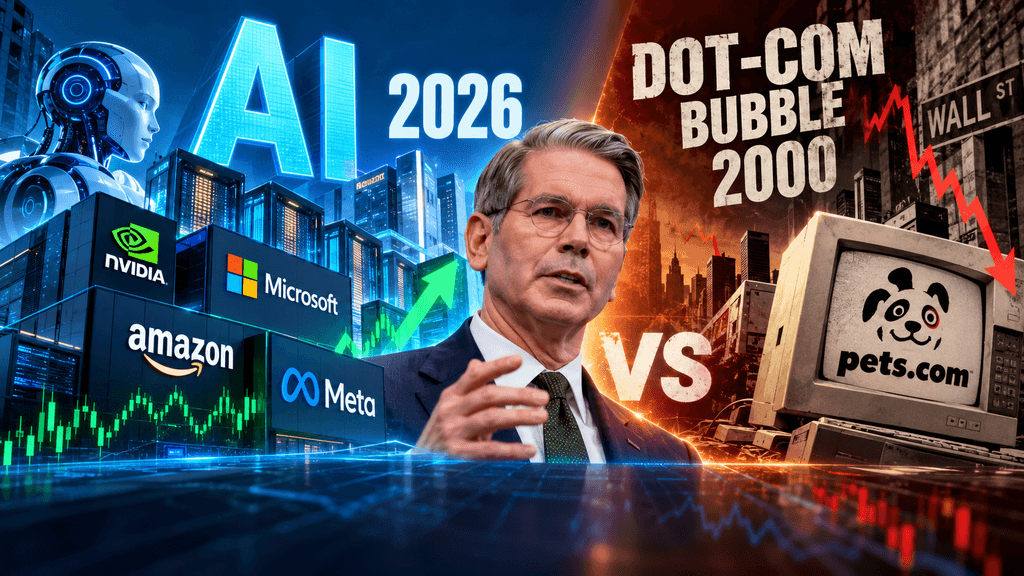
Is the 2026 AI boom another dot-com bubble? U.S. Treasury Secretary Scott Bessent argues that today's artificial intelligence investment cycle differs from the speculative internet boom of the late 1990s because major technology companies have stronger earnings, established businesses, and substantial financial resources. However, rising AI infrastructure spending, elevated stock valuations, and growing financing commitments have raised new questions about the industry's long-term sustainability. As investors assess whether AI-related growth can justify current market expectations, the comparison with the 2000 dot-com crash has become increasingly relevant. Understanding these differences requires examining Bessent's comments, Big Tech financial results, infrastructure investment risks, and the factors shaping the AI stock market outlook for 2027.
Scott Bessent Rejects AI Bubble Fears Amid Growing Market Concerns
U.S. Treasury Secretary Scott Bessent rejected comparisons between the 2026 artificial intelligence (AI) boom and the dot-com bubble, arguing that today's AI investment cycle is supported by financially established technology companies rather than speculative startups. Speaking at a private investor conference in New York on October 21, 2026, Bessent said he saw no systemic financial problems emerging from the sector. His remarks came amid growing concerns about AI stock valuations, rising infrastructure costs, and the ability of technology companies to generate sustainable returns from large-scale investments.
Scott Bessent Defends AI Investment Against Dot-Com Bubble Comparisons
During the annual Robin Hood investor conference, Bessent dismissed suggestions that the AI boom resembled the speculative internet expansion that preceded the 2000 dot-com crash. According to the Financial Times, he stated, "This isn't Pets.com," referencing the failed online retailer that became associated with excessive investor optimism during the internet bubble. His argument emphasized a fundamental difference between the two periods: today's leading AI investors include established corporations with substantial revenue, profitable businesses, and significant financial resources to support technology development.
Bessent also expressed confidence in AI's potential to improve productivity and strengthen long-term U.S. economic growth. His October 21 remarks reinforced a position he discussed during an October 3 interview with Axios, where he highlighted the financial strength of major technology companies investing in artificial intelligence. However, Bessent's assessment of systemic financial stability does not mean AI stocks cannot be overvalued. Even profitable companies can experience sharp market corrections when investors anticipate faster earnings growth than their businesses can deliver. This distinction is important because concerns about an AI investment bubble involve both the sustainability of corporate spending and the prices investors are willing to pay for future growth.
October 2026 Technology Stock Selloff Reflects Investor Concerns
Financial markets showed increasing sensitivity to AI-related investment costs following a series of corporate earnings announcements. On October 22, 2026, the technology-heavy Nasdaq Composite declined 2.60%, while the S&P 500 fell 1.21%, according to Reuters. Semiconductor stocks experienced particularly pronounced selling pressure as investors reconsidered the expected financial benefits of expanding AI infrastructure. The decline reflected concerns about capital-intensive development, future earnings expectations, and whether growing demand for AI computing services could justify elevated technology stock valuations. It also demonstrated how uncertainty surrounding a relatively concentrated group of major technology companies can affect broader market indexes.
Meta Platforms provided a prominent example of this shift in investor sentiment. On October 21, the company reported third-quarter revenue of $64.60 billion, representing 26% year-over-year growth, but also disclosed negative free cash flow of $2.12 billion as substantial infrastructure investment absorbed operating cash generation. Meta shares subsequently declined approximately 7% on October 22, despite strong revenue performance. The results highlighted growing investor attention to the relationship between business expansion and the cash required to finance it. Although the selloff did not establish that an AI bubble was collapsing, it showed that investors were increasingly evaluating AI companies on financial performance and investment returns rather than growth expectations alone.
AI Bubble vs. Dot-Com Bubble Through Big Tech Profits and Stock Valuations
The AI bubble vs. dot-com bubble comparison reveals important differences in corporate profitability, technology adoption, and stock market valuations. During the late 1990s, many internet startups attracted substantial investment despite limited revenue and uncertain business models. In contrast, the 2026 artificial intelligence boom is being driven partly by established technology companies with significant earnings, commercial customers, and growing demand for computing infrastructure. However, strong financial fundamentals do not automatically justify elevated share prices, making company profitability and valuation metrics essential to understanding the current AI market.
The Dot-Com Bubble Collapse Exposed Weak Business Fundamentals
The dot-com bubble expanded rapidly during the late 1990s as investors assigned high valuations to internet companies based largely on expectations of future growth. Many startups lacked sustainable revenue streams, while telecommunications companies invested heavily in network infrastructure before commercial demand fully developed. According to Goldman Sachs' historical analysis, the Nasdaq Composite reached approximately 5,048 points on March 10, 2000, before falling to 1,139.90 on October 4, 2002, representing a decline of roughly 77%. Although established technology companies also participated in the boom, speculative startups faced particularly severe financial pressure as investment funding weakened. The internet ultimately transformed global commerce, but its long-term success did not prevent widespread business failures and substantial shareholder losses. This historical experience demonstrates that technological innovation and investment profitability are separate considerations, a distinction that remains relevant to artificial intelligence stocks in 2026.
Microsoft, Nvidia, and Amazon Earnings Demonstrate Stronger AI Market Fundamentals
Unlike many speculative internet businesses in 2000, major technology companies financing the current AI expansion already generate substantial revenue and operating profits. Microsoft reported $331.8 billion in fiscal 2026 revenue, an 18% annual increase, alongside $133.7 billion in net income for the year ended June 30. Nvidia reported second-quarter fiscal 2027 revenue of $96.2 billion on August 26, 2026, up 106% year over year, with its data-center business contributing $89.0 billion. Amazon Web Services also recorded $42.2 billion in second-quarter 2026 sales, representing 37% annual growth. These financial results demonstrate established commercial demand for cloud services, computing hardware, and related digital infrastructure. However, Microsoft and Amazon earn revenue from numerous business activities beyond AI, while Nvidia's hardware sales do not establish the profitability of every company purchasing its products. Investors therefore need to distinguish proven corporate earnings from the future returns expected specifically from AI investments.
AI Stock Valuations Remain Vulnerable Despite Strong Corporate Earnings
Stock valuations provide another important distinction between the AI boom and the dot-com era. In a September 16, 2026 analysis, BlackRock estimated that four leading technology companies during the 2000 bubble traded at nearly 70 times their two-year forward earnings, compared with approximately 18 times for four major AI hyperscalers in its selected 2026 comparison. This suggests that certain leading technology businesses entered the current investment cycle with more moderate earnings-based valuations, although the comparison involves different companies and historical periods. Meanwhile, European Central Bank economists warned on August 17, 2026, that broader U.S. equity valuations, measured using the cyclically adjusted price-to-earnings ratio, were approaching historical peaks. These findings are not necessarily contradictory because they measure different groups of stocks using different valuation methods. For investors, the central consideration is whether future earnings growth can support current share prices. Even if AI adoption continues expanding, technology stocks could experience significant corrections if profit growth falls below expectations or investors become less willing to pay elevated valuation multiples.
AI Infrastructure Spending in 2026 and Rising Financial Risks
Artificial intelligence infrastructure spending has become a major financial consideration for technology companies in 2026, with investments expanding across data centers, advanced semiconductors, cloud computing, and electricity infrastructure. Although demand for AI computing continues to grow, the scale of these projects is increasing pressure on capital budgets, financing requirements, and expected investment returns. Recent research from S&P Global and Bank of America indicates that the AI infrastructure boom is entering a more capital-intensive phase, raising questions about whether future commercial demand can support the industry's ambitious expansion plans.
Global AI Data Center Investment Accelerates as Infrastructure Costs Rise
Global data center spending is projected to reach $1 trillion in 2026 and $2.1 trillion by 2028, according to Bank of America Global Research estimates reported on October 23, 2026. The forecasts reflect growing investment in AI servers, high-performance computing equipment, networking systems, and supporting infrastructure. Bank of America estimates that data center construction and equipment costs average approximately $49 million per megawatt of capacity, with information technology equipment accounting for about 78% of total expenditure. These estimates illustrate why expanding AI computing capacity requires significant upfront investment before facilities can begin generating sufficient revenue. However, the projected spending figures are not confirmed expenditures, and actual investment will depend on technology demand, construction progress, and financing conditions. Blockchain-based decentralized computing networks also represent an emerging approach to coordinating independently owned computing resources for AI workloads.
Meta Platforms provides a recent example of how infrastructure expansion is reshaping corporate investment plans. In its October 21, 2026 earnings release, Meta narrowed its full-year capital expenditure forecast to $135 billion–$145 billion, compared with its previous $130 billion–$145 billion range. The company reported third-quarter capital expenditures of $34.91 billion, including principal payments on finance leases, reflecting continued investment in computing capacity and supporting infrastructure. Beyond equipment costs, AI data center developers face constraints involving electricity supply, cooling systems, grid connections, and construction schedules. These challenges could delay the deployment of new computing capacity or increase project expenses. Conversely, stronger infrastructure utilization and more efficient AI hardware could improve long-term economics, making operating efficiency an important factor in evaluating the sustainability of the investment cycle.
AI Infrastructure Financing and Debt Exposure Raise Financial Stability Concerns
Financing arrangements are becoming increasingly important as AI infrastructure commitments extend beyond the cash generated by established technology businesses. On October 19, 2026, Reuters reported S&P Global's estimate that six major U.S. technology companies could spend more than $7 trillion combined on AI-related capital investments between 2025 and 2030. The credit rating agency also highlighted interconnected financing structures involving debt, equipment leases, financial guarantees, and commitments supporting specialized cloud providers. These arrangements can distribute development costs across multiple companies while creating financial exposures that are difficult to assess from individual balance sheets. S&P Global did not identify an immediate need for broad credit rating changes, but warned that weaker-than-expected investment returns could place pressure on borrowers and infrastructure providers.
The International Monetary Fund's October 2026 Global Financial Stability Report identified a potential correction in AI-related asset prices as a risk that could be amplified by financial leverage and concentrated investment exposures. Nevertheless, an increase in borrowing does not automatically indicate financial distress; the critical consideration is whether future operating cash flows can support financing commitments and infrastructure maintenance. Upcoming earnings reports will provide additional evidence, with Microsoft scheduled to release fiscal first-quarter 2027 results on October 28 and Amazon expected to report third-quarter 2026 results on October 29. Investors will closely examine cloud revenue growth, capital expenditure guidance, operating cash generation, and management commentary on AI capacity utilization. Strong demand and improving investment efficiency could support confidence in the expansion, while project delays, rising financing costs, or disappointing returns could increase pressure on AI infrastructure valuations.
AI Stock Market Outlook and Key Factors Shaping Future Investment Returns
The AI stock market outlook for late 2026 depends increasingly on whether commercial adoption, corporate profitability, and economic conditions can support investor expectations. Following the October 22 technology selloff, AI-related shares traded more steadily on October 23, although concerns about financing costs and investment returns remained unresolved. The next phase of the AI investment cycle will be shaped by measurable business performance, Federal Reserve policy, and the financial exposure of major stock market indexes. These factors could influence technology stock valuations even as artificial intelligence adoption continues expanding across industries.
AI Monetization and Earnings Quality Become Critical Growth Indicators
The sustainability of AI stock performance increasingly depends on companies converting technological adoption into recurring revenue and measurable improvements in operating profitability. Investors will be watching enterprise AI subscriptions, cloud computing consumption, software margins, and the ability of businesses to charge customers for advanced AI services. Revenue growth alone may provide an incomplete picture because infrastructure depreciation, research expenses, and customer acquisition costs can reduce the financial benefits of expanding AI operations. Upcoming quarterly reports from Microsoft on October 28 and Amazon on October 29, 2026, will provide additional evidence of commercial demand and earnings quality. Sustained customer spending and improving profit margins could strengthen confidence in AI-related investments, while slower monetization may lead investors to reassess future earnings expectations.
Federal Reserve Policy and Interest Rates Influence AI Stock Valuations
U.S. monetary policy represents another important factor affecting the 2026 technology stock market outlook, particularly for companies valued on expectations of substantial future earnings. The Federal Reserve is scheduled to conclude its October 27–28 policy meeting on October 28, with investors monitoring its interest-rate decision and economic outlook. Higher Treasury yields can reduce the present value of expected future profits, putting pressure on growth-stock valuations, while tighter credit conditions can make business expansion more expensive. Inflation, employment trends, and economic growth will also influence how investors assess the prospects of AI-related companies. Monetary conditions also influence digital-asset liquidity, making the relationship between interest rates and crypto markets relevant to investors following both asset classes. A more supportive interest-rate environment could improve financial conditions, although lower borrowing costs alone would not guarantee stronger AI earnings or higher stock prices.
Market Concentration and Investment Discipline Shape Long-Term Returns
The growing influence of major technology companies within the Nasdaq Composite and S&P 500 means changes in AI investment sentiment can affect broader equity-market performance. Investors therefore need to distinguish between semiconductor suppliers, cloud infrastructure providers, software developers, and businesses adopting AI to improve productivity, as each group faces different revenue opportunities and operating risks. Market indicators such as earnings revisions, valuation multiples, credit spreads, and the performance of stocks outside the largest technology companies can help assess whether an AI-driven rally is supported by wider corporate growth. Investors following both traditional and digital assets can also monitor the BTC/USDT spot market alongside technology indexes to observe broader shifts in market sentiment. Looking toward 2027, sustainable AI investment returns will depend on companies demonstrating economic value from their technology rather than relying solely on expectations of rapid industry expansion. A successful AI industry could still produce uneven investment outcomes, with companies delivering consistent profitability better positioned to support their valuations than businesses dependent on increasingly optimistic forecasts.
Conclusion
The AI bubble vs. dot-com bubble debate highlights a meaningful difference between the two investment cycles. Scott Bessent's confidence reflects the substantial earnings, established customer bases, and financial resources of companies leading today's AI expansion. Unlike many speculative internet startups in 2000, these businesses already generate significant revenue from commercial products and services. However, corporate profitability does not eliminate the possibility of excessive stock valuations, inefficient infrastructure investment, or financial losses when growth expectations become difficult to meet.
The outlook for AI stocks in 2027 will depend on whether expanding adoption translates into sustainable earnings, stronger cash flow, and returns that justify continued investment. Upcoming technology earnings, monetary policy decisions, and infrastructure financing conditions will provide important evidence. The success of artificial intelligence as a technology does not guarantee equal success for every AI investment, making financial discipline and realistic valuation expectations essential considerations for investors.
FAQs
What are the early warning signs of an AI infrastructure oversupply?
Potential warning signs include declining GPU rental prices, lower data center utilization, delayed construction projects, and weaker demand for new computing capacity. Investors should compare infrastructure expansion with actual customer usage and contract renewals. A temporary decline in prices does not necessarily indicate oversupply because improvements in computing efficiency can also reduce costs.
How does GPU depreciation affect AI company profitability?
AI computing equipment loses accounting value over its estimated useful life, creating depreciation expenses that can reduce reported operating profits. If newer processors make existing GPUs economically obsolete faster than expected, companies may face higher depreciation charges or asset impairments. Investors should examine equipment useful-life assumptions alongside capital spending and operating margins.
Why are long-term AI cloud contracts not the same as guaranteed revenue?
Long-term cloud agreements may establish future customer commitments, but revenue is generally recognized as services are delivered. Contract modifications, customer financial difficulties, deployment delays, and unused capacity can affect actual financial results. Investors should distinguish signed contract values and remaining performance obligations from revenue already earned.
What is the difference between AI hyperscalers and neocloud companies?
Hyperscalers such as Microsoft, Amazon, and Google operate large cloud platforms serving diverse enterprise customers. Neocloud providers specialize in GPU-based computing services, often targeting AI developers and model-training companies. Specialized providers may benefit from concentrated AI demand but can face greater customer concentration and financing risks because their businesses are less diversified.
Can lower AI computing costs improve the industry's profitability?
Lower computing costs can make AI applications more affordable, potentially increasing adoption among businesses and consumers. However, greater competition may also reduce the prices providers can charge for AI services. The financial outcome depends on whether expanding usage, operating efficiency, and customer retention can offset declining prices per unit of computing.
Disclaimer: This general market information, possibly from third-party, commercial, or sponsored sources, is provided for reference and educational purposes only and does not constitute financial or investment advice, an offer, solicitation, or guarantee. We disclaim liability for its accuracy, completeness, reliability, and any resulting losses. Investments/trading are risky; past performance doesn’t guarantee future results. Users should research, judge prudently, and take full responsibility. For further details, please consult KuCoin’s Terms of Use and Risk Disclosure.