

Zcash (ZEC) Surges to Nearly $1400 After NU7 Vote and Ledger Shielded-Pool Integration
Introduction
Zcash (ZEC) jumped into the top 10 digital assets after a privacy-preserving coinholder vote and new hardware-wallet support for shielded balances. According to CoinMarketCap live market data, ZEC traded near $1,358.10 with a 24-hour gain of about 16.46%, a session high of $1,385.08, a market cap near $22.91 billion, and 24-hour volume near $2.68 billion. Circulating supply stood at about 16.87 million ZEC against a 21 million maximum.
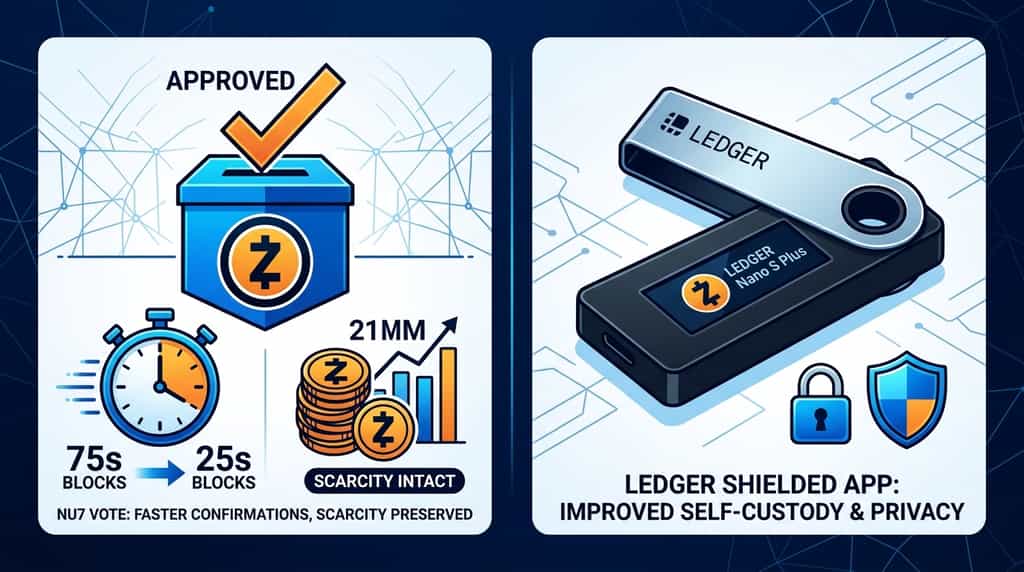
The immediate answer is straightforward: holders approved faster 25-second blocks while keeping Bitcoin-style halvings, and Ledger added a dedicated Zcash Shielded app for selected devices. Together those events improved usability, self-custody, and the scarcity narrative at the same time.
What Drove the Latest ZEC Price Move?
The latest ZEC move was driven by a high-turnout NU7 coinholder vote plus progress on Ledger shielded-pool support, not by a change in Zcash’s 21 million supply cap.
According to CoinMarketCap, ZEC ranked near #9 during the rally, with a 24-hour range from about $1,172.07 to $1,385.08. That range shows both the size of the breakout and the volatility that followed the vote close.
The vote closed on 14 September 2026 at 19:00 UTC after a snapshot at mainnet block 3,459,350 on 24 August 2026. Only spendable shielded ZEC in the Ironwood pool counted. Official vote pages from Zcash Labs and Zakura set those rules before ballots opened on 25 August 2026.
Nearly 2.4 million ZEC voted out of about 3.6 million eligible tokens. That is roughly two-thirds of eligible supply and well above the 1 million ZEC participation threshold organizers used to treat the result as representative.
Holders did not vote for more issuance. They voted for faster confirmations and for keeping the existing halving calendar. Daily issuance stays aligned with the current subsidy because the per-block reward is scaled to the shorter interval.
What Did Zcash Holders Approve in the NU7 Vote?
Zcash holders approved cutting target block time from 75 seconds to 25 seconds and keeping the Bitcoin-style halving schedule.
ZIP 218 and official NU7 materials describe the block-time change as a consensus adjustment, not a change to the 21 million cap. Faster blocks cut user wait time for one or two confirmations and raise network throughput without adding coins.
Vote tallies reported after the close showed about 99.9% support for 25-second blocks and about 98.9% support for keeping the current halving path. A large majority also backed launching NU7 as soon as ready features can ship, rather than waiting for every contested item.
The ballot also covered Network Sustainability Mechanism questions, including issuance smoothing and when any later reissuance of locked fees might begin. Holders favored preserving scarcity first and delaying more complex issuance experiments.
That mix is why markets treated the result as constructive. Speed improved. The scarcity story stayed intact. Activation height for NU7 is still unset on the official z.cash NU7 page, so the vote is a scope mandate, not an immediate hard-fork date.
How Did the Private Vote Work?
The private vote worked by counting only Ironwood shielded balances and encrypting ballots so validators could verify the result without publishing each holder’s balance.
Eligibility required three conditions at the snapshot: the ZEC had to be spendable, shielded, and in Ironwood. Transparent balances and older pools such as Sprout, Sapling, and Orchard did not count.
Supported software wallets included Vizor, Zodl, and Zkool. Keystone hardware wallets could vote through a compatible companion wallet without moving keys off the device.
Ironwood itself activated with NU6.3 on 28 July 2026 at block 3,428,143, according to Zcash network-upgrade records. The new pool added a public turnstile so supply can be audited even while individual notes stay private.
That design matters for governance. A large holder can vote with economic weight without posting a public scoreboard of wallet size and preference.
How Does Ledger Shielded Support Change ZEC Self-Custody?
Ledger shielded support changes ZEC self-custody by letting selected Ledger devices sign shielded transactions while a companion wallet builds the private notes.
According to Ledger’s official Zcash Shielded support article, last updated 21 July 2026, the Zcash Shielded app is available on Ledger Nano S Plus, Ledger Stax, and Ledger Flex. It is not yet supported on Ledger Nano X or Ledger Nano Gen5.
The device holds keys and signs. Companion wallets such as Zkool or Vizor manage shielded accounts and construct transactions. Keys stay on the hardware. The companion wallet does not take full custody.
For years, many Ledger users could only handle transparent ZEC, which behaves like a public-ledger coin. Shielded send and receive close that gap for the current Ironwood generation of privacy.
Zcash community grant and forum updates show the integration was re-based onto Ironwood after NU6.3 rather than shipped only on the older Orchard pool. That choice matches where voting power and new shielded activity now sit.
Users still need current firmware, the latest Ledger Wallet software, and a supported companion wallet. Device coverage is incomplete, so this is progress, not universal hardware support.
What Risks Remain After the NU7 Mandate?
The main risks are that NU7 is not live yet, hardware support is incomplete, and ZEC remains a high-volatility privacy asset.
Scope votes are not activation. Engineers still have to finalize ZIPs, set heights, ship node software, and coordinate wallets. Features that miss a readiness cutoff can slip.
Ledger support is limited to specific models. Users on unsupported devices still cannot sign shielded spends on Ledger. Companion-wallet quality and audit status also matter.
Older pools still exist. Funds left in Sprout, Sapling, or Orchard did not vote and may need migration, fees, and wallet updates before they can use new features.
Privacy coins also face listing, banking, and compliance pressure in some jurisdictions. Shielded features can be restricted on centralized platforms even when the base asset remains tradable.
Price risk is separate from protocol risk. A 16% session and a high near $1,385 can fade if the market rotates away from privacy narratives.
Beyond the Headlines: What KuCoin 5.0 Means for You
Market news moves fast — but where you act on it matters just as much. This October, KuCoin launches KuCoin 5.0, transforming KuCoin into a rebuilt platform. Here's what actually changes for you:
-
One account for everything. Older platforms split your money across separate "spot," "margin," and "futures" accounts and expected you to understand why. KuCoin 5.0's unified account removes that entirely — deposit once, and everything is simply there.
-
Stocks, indices, and commodities. KuCoin 5.0 expands beyond crypto into global markets. When crypto chops sideways and equities rally (or the reverse), you rotate in minutes instead of opening a brokerage account and waiting days for fiat rails.
-
Real-world assets (RWA). Tokenized exposure to traditional assets like commodities, right inside your crypto account. One of the fastest-growing segments in global finance is no longer reserved for institutions — you access it from the same balance you trade with.
-
Earn while you learn. Not ready to trade? KCUSD lets your stablecoins earn daily, auto-compounding interest. The lowest-stress way to put your idle deposit to work for 4% yield.
-
An AI assistant in plain language. Ask questions, get market context, understand what you're looking at — built into the platform, no jargon required.
-
An app that doesn't overwhelm. Faster, cleaner, and consistent — intuitive from the first tap, not after a tutorial.
-
Safety you can check, not just trust. A MiCAR-licensed EU entity, Proof of Reserves you can verify yourself, and internationally certified security (SOC 2 Type II, ISO 27001:2022).
Create your account in minutes — and start on the platform built for where crypto is going, not where it's been.
Conclusion
ZEC’s latest rally combined a clear coinholder mandate with better hardware-wallet access to shielded funds. According to CoinMarketCap, price traded near $1,358 with volume above $2.6 billion and a market cap near $22.91 billion as ZEC entered the top 10.
The NU7 vote backed 25-second blocks and the existing halving path, with about 2.4 million ZEC participating from 3.6 million eligible tokens. Daily issuance is not designed to jump just because blocks arrive faster. The 21 million cap remains the supply ceiling.
Ledger’s Zcash Shielded app on Nano S Plus, Stax, and Flex lets more users keep keys offline while using private transactions through companion wallets. Coverage is still incomplete, and NU7 itself has no set activation height.
The setup is constructive for usability and self-custody. It is not a finished upgrade and not a promise of higher prices. Traders can access ZEC liquidity on KuCoin. Long-term holders still need to watch node software, wallet support, and the final NU7 specification.
FAQs
Is NU7 already active on Zcash mainnet?
No. Official z.cash upgrade pages state that the NU7 activation height has not been set. The recent vote defined scope and readiness preferences, not a live consensus change.
Did the NU7 vote increase Zcash’s maximum supply?
No. Holders backed faster blocks while preserving the Bitcoin-style halving schedule and the 21 million maximum supply published on CoinMarketCap.
Which Ledger devices support shielded ZEC today?
According to Ledger’s Zcash Shielded support article, the app is supported on Nano S Plus, Stax, and Flex. It is not yet supported on Nano X or Nano Gen5.
Could transparent ZEC vote in the NU7 ballot?
No. Official vote rules required spendable shielded ZEC in the Ironwood pool at block 3,459,350. Transparent and older-pool balances were ineligible.
Does faster block time automatically mean higher inflation each day?
No. The design shortens target spacing to 25 seconds and scales the per-block subsidy so the existing issuance path can remain intact after activation.
Disclaimer: This article is for informational purposes only and does not constitute financial, legal, or investment advice. Always conduct your own research before interacting with digital assets.