

Zcash Surges 10%+ as Bitcoin, Ethereum, and XRP Crash: Why the Privacy Trade Is Getting Serious in 2026
2026/06/03 11:24:00
Introduction
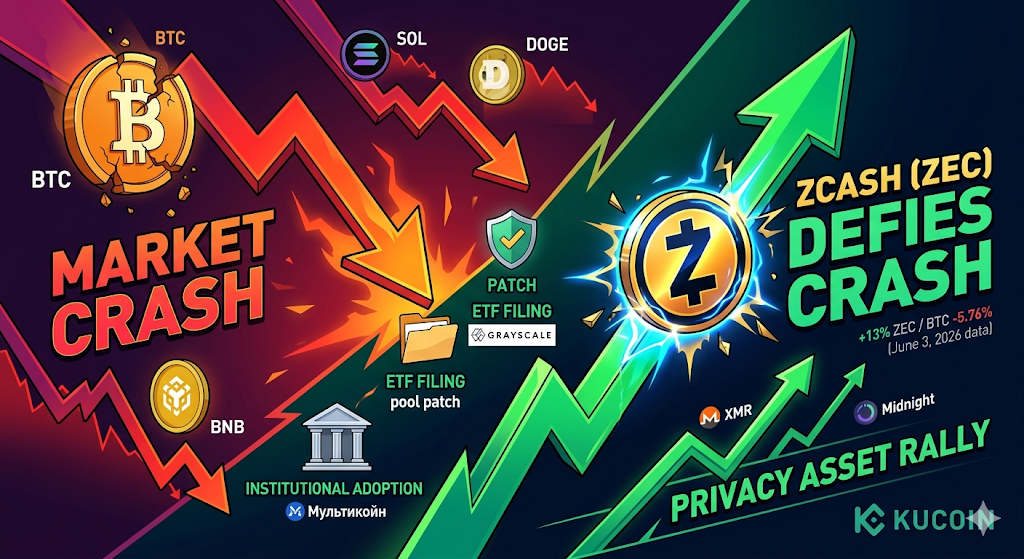
While the broader crypto market bled billions in a single session, one asset ripped higher in the opposite direction. On June 3, 2026, Zcash climbed 13% to $612 in 24 hours as Bitcoin fell 5.76% to $67,382, Ethereum dropped 2.95% to $1,922, and XRP declined 4.74% to $1.23, with the total crypto market cap sitting at $2.34 trillion, down 3.77% on the day. ZEC was the only major altcoin defying the sell-off — a clean signal that the "privacy trade" has graduated from niche thesis to mainstream rotation.
Why now? Three converging catalysts — Grayscale's spot ETF filing, Multicoin Capital's disclosed institutional position, and a transparent emergency security patch that traders rewarded rather than punished — have transformed privacy coins from regulatory pariahs into hedges against blockchain surveillance. This article breaks down what's driving Zcash's outperformance, what the data says, and how traders can position around it.
Why Did Zcash Surge While Bitcoin, Ethereum, and XRP Crashed?
Zcash decoupled from the broader market because privacy assets are increasingly treated as a hedge against the same risks pulling down transparent blockchains. While the broader crypto market bleeds, one asset is moving in the opposite direction — most top altcoins are following Bitcoin lower: Solana is down 4.63%, Dogecoin has lost 4.19%, BNB fell 2.99%, and Zcash is the notable exception in a sea of red.
The immediate trigger was network-specific. The Zcash development team coordinated an emergency protocol upgrade on June 2 after discovering a vulnerability in the Orchard shielded pool, the privacy layer that underpins one of Zcash's core value propositions — importantly, there was no evidence the vulnerability had been exploited before it was patched, and rather than selling on the news of a discovered vulnerability, traders bought the swift and transparent response.
On June 1, 2026, the Zcash Foundation also shipped a separate consensus fix. The Foundation rushed out Zebra v4.5.1 to fix a critical signature operation (sigop) counting bug — this flaw could have caused the Rust-based Zebra client to accept blocks that the legacy zcashd client would reject, risking a consensus split and network fork; the patch was released just one day after version 4.5.0, which itself addressed multiple RPC and mempool vulnerabilities, and the Foundation strongly urged all node operators to upgrade immediately.
What Is Driving the 2026 Zcash Privacy Trade?
The privacy trade has hardened into a structural narrative driven by some sequential catalysts — not retail speculation. Zcash's May 2026 rally to $642 was tied to Grayscale's ETF filing, SEC clearance, Multicoin Capital's position, and shielded pool growth, with the bull case seeing ZEC reaching $800 to $1,800 by 2030 if ETF approval, institutional demand, and FCMP++ deployment align.
Institutional Accumulation Is Real
According to CoinDesk reporting on May 6, 2026: Zcash surged nearly 30 percent to $543, extending its 30-day gain to more than 110 percent and triggering about $62 million in futures liquidations, mostly from short sellers — the rally followed Multicoin Capital's disclosure that it has been accumulating a large Zcash position, arguing that ZEC's shielded transactions offer protection against growing government efforts to scrutinize and tax visible crypto holdings.
"Zcash is a return to the cypherpunk ideals crypto was founded on," fund partner Tushar Jain wrote on X, framing the thesis around California's "wealth seizures" — calling those a warning shot for what comes next as governments globally move to claim more visibility over private holdings. "Bitcoin is censorship-resistant, no one can freeze your BTC or stop you from using it," Jain wrote, "But that doesn't stop the state from seizing known holdings through wealth taxes."
Shielded Supply Is Removing Liquid Float
Approximately 30% of the ZEC supply is now locked in shielded pools, up from 8% in 2024, and the November 2024 halving cut inflation from 4% to 2% annually. According to CoinDesk's May 6, 2026 analysis, roughly 30 percent of ZEC's supply now sits in shielded addresses, a record level that analysts say aligns this price move more with real adoption than with past, more speculative rallies.
Regulatory Overhang Has Lifted
The SEC closed its nearly two-year investigation into the Zcash Foundation on January 15, 2026, without enforcement action, removing the regulatory overhang that suppressed institutional participation for years.
How Big Is the Grayscale Zcash ETF Catalyst?
The Grayscale filing is the single most important structural catalyst for ZEC in 2026 because it creates the first regulated US on-ramp for privacy coin exposure. According to crypto.news reporting:
Grayscale's Form S-3 filing on May 12, 2026 to convert its Zcash Trust into a spot ETF (ticker ZCSH) on NYSE Arca represents the first US spot privacy coin ETF filing in history, with the trust currently holding approximately 391,103 ZEC ($99.4 million as of March 31, 2026 quarter-end).
The market has already started front-running the decision. According to KuCoin news coverage, the remaining 230,100 ZEC are worth roughly $126 million today — the trade rode Zcash's 2026 surge, driven by renewed interest in privacy assets, with Grayscale filing for a spot Zcash ETF earlier this month, a catalyst that pushed ZEC to a recent peak above $700.
What Are the Risks of Trading the Privacy Coin Narrative?
The biggest risk is consensus fragility — the same emergency patches that traders praised also expose how brittle the underlying network can be.
The current configuration looks like a structurally fragile chain, trading on a fat risk premium, that can still overshoot to the upside if the market chooses to interpret the rapid disclosure-and-patch cycle as evidence of institutional maturity rather than existential weakness.
A second risk is post-rally exhaustion. The post-peak consolidation to current $522 levels reflects normal post-rally profit-taking and futures market unwinding (futures open interest fell 30% from peak to approximately $1.05 billion) rather than a fundamental thesis breakdown — but futures unwinding can accelerate if support breaks.
Regulatory risk also remains binary. ETF approval would unlock waves of institutional flow; rejection would invalidate the core 2026 thesis. The bear case puts ZEC at $180 to $350 by 2030 if ETF rejection, regulatory pressure, or privacy coin competition weighs on adoption.
How Does Zcash Compare to Other Privacy Coins in 2026?
Zcash leads the privacy sector but does not have it to itself.
Monero's FCMP++ beta launched May 6, 2026, upgrading anonymity proofs against 150M+ blockchain outputs, while Midnight mainnet went live in 2026 with Google Cloud and Moneygram building on its zk-privacy infrastructure.
Monero (XMR) hit price levels between $500 and $800 so far this year, including multiple all-time highs, driven by on-chain resilience and the biggest protocol upgrade in years — on May 6, 2026, the FCMP++ (Full-Chain Membership Proofs) and CARROT upgrade launched on beta stressnet, replacing Monero's existing ring-signature model with proofs against the entire blockchain history, now exceeding 150 million outputs, resulting in a massively expanded anonymity set with improved scalability and lower transaction fees.
Midnight, developed by Input Output Global within the Cardano ecosystem with roughly $200 million in backing from Charles Hoskinson, launched mainnet in late March 2026 — it uses zero-knowledge proofs for selective disclosure, meaning users and institutions control exactly what data is visible to auditors or regulators while keeping everything else private, addressing a problem transparent blockchains have not solved, and launched with a partner set that includes Google Cloud, Moneygram, Worldpay, Bullish, Etoro, Pairpoint by Vodafone, and Blockdaemon.
How to Trade Zcash on KuCoin
KuCoin offers one of the deepest ZEC order books globally, with spot and futures access for both directional traders and short-premium strategies.
To get started:
-
Create a KuCoin account — registration takes minutes, and KYC verification unlocks higher deposit and trading limits.
-
Fund your account — deposit USDT, USDC, or fiat via supported channels. Bank card purchases of ZEC are supported directly.
-
Trade ZEC/USDT spot — search the ZEC/USDT pair to execute market or limit orders during high-volatility breakouts.
-
Use ZEC perpetual futures — for traders who want to express short-premium views or hedge spot exposure, KuCoin lists ZEC perpetuals with deep liquidity.
-
Set risk limits — given the 30–50% drawdown risk flagged by analysts, position sizing and stop-losses are essential.
New users can now register at KuCoin and Get Up to 11,000 USDT in New User Rewards.
Conclusion
Zcash's outperformance during a broad-market crash is not a fluke — it is the visible result of a thesis that has been quietly building since early 2024. The 10%+ rally against Bitcoin, Ethereum, and XRP weakness reflects shielded supply scarcity, Grayscale's first-ever US privacy coin ETF filing, Multicoin Capital's disclosed institutional position, and a transparent emergency patch cycle that the market interpreted as maturity rather than fragility.
The structural setup remains compelling: roughly 30% of supply is shielded and illiquid, post-halving inflation has dropped to ~2%, and the SEC's January 2026 case closure removed years of regulatory overhang. Technical analysts point to $928 as the cup-and-handle target if $688 breaks, while $500 remains the critical support that must hold.
Risks are real — consensus fragility, ETF rejection, and post-rally exhaustion can each invalidate the bull case. But for traders who want exposure to the privacy renaissance, ZEC is no longer a niche bet. It is the benchmark privacy asset. KuCoin offers spot and futures access to trade both sides of this narrative as it plays out.
FAQs
-
What is the all-time high for Zcash in 2026?
Zcash (ZEC) hit $642.18 on May 9, 2026, marking the peak of a 650-1,000% rally from 2024 lows that crowned it the largest privacy coin by market cap, overtaking Monero. Some sources reported intraday prints above $688 and even briefly above $700 during institutional accumulation phases.
-
Why did the broader crypto market crash while Zcash rallied?
The broader crypto market saw risk-off flows tied to macro positioning, with most major assets declining 3–6% in a single session. Zcash decoupled because its rally is driven by privacy-specific catalysts — Grayscale's ETF filing, institutional accumulation, and shielded supply growth — that are independent of Bitcoin beta. The June 2 emergency Orchard pool patch also produced a "buy the transparent response" reaction rather than a sell-off.
-
What is the Grayscale Zcash ETF ticker?
The ticker is ZCSH on NYSE Arca, filed via Form S-3 on May 12, 2026, representing the first US spot privacy coin ETF filing in history. SEC approval would create the first regulated US on-ramp for privacy coin exposure.
-
What percentage of Zcash supply is currently shielded?
Approximately 30% of the ZEC supply is now locked in shielded pools, up from 8% in 2024. This metric is closely watched because shielded ZEC is effectively removed from liquid float, tightening supply during demand spikes.
-
Is Zcash quantum-resistant?
Not yet — but it is on a defined roadmap to become so. Quantum-Recoverable Wallet Launch is rolling out in June 2026 with initial recovery features for future quantum threats, and the Full Post-Quantum Security Target is set for 2027 to make the entire protocol resistant to quantum computing attacks. This positions ZEC as a long-duration hedge against future cryptographic threats.