

Zcash Breaks $1,000: Why ZEC Is Suddenly Outperforming Bitcoin
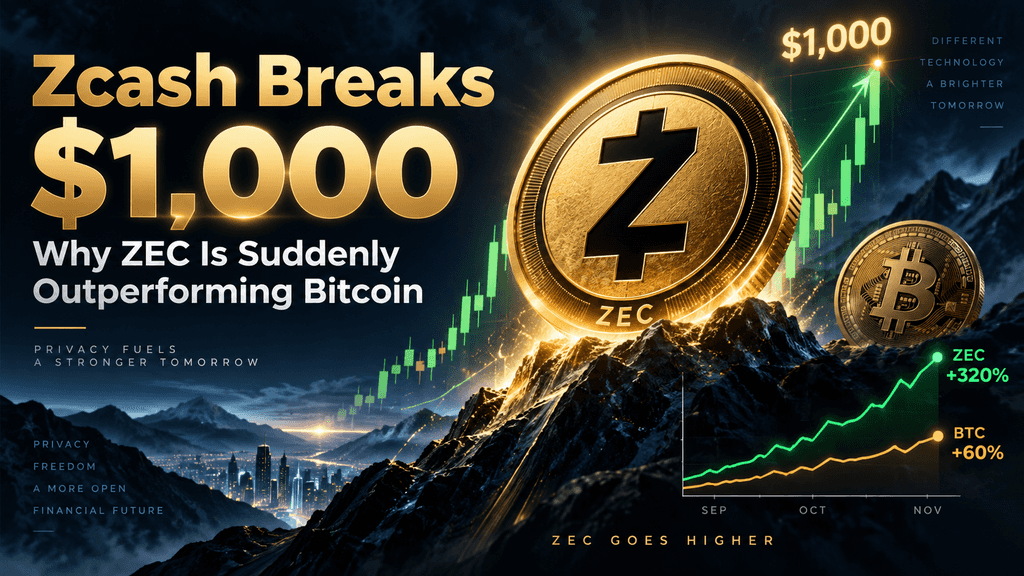
Zcash (ZEC) achieved a significant milestone by crossing the $1,000 threshold on September 4, 2026. This remarkable event marked its highest price point in nearly a decade, showcasing a substantial increase of approximately 28 percent over the preceding week. The privacy-focused cryptocurrency experienced an impressive intraday high, reaching close to $1,050 before ultimately settling in the range of $1,020 to $1,030 during subsequent trading sessions. This information is supported by data collected from various exchanges and market aggregators. During the same timeframe, Bitcoin was trading near the $80,000 level, but with more modest percentage gains compared to ZEC. As a result of this surge, ZEC’s market capitalization rose significantly, approaching $17 billion, which briefly positioned it among the larger assets in the cryptocurrency market by that measure.
This upward movement can be attributed to a combination of factors, including increased demand for regulated products, strategic positioning in derivatives markets, and a renewed focus on the importance of financial privacy features. The quick ascent of Zcash past the $1,000 mark can be primarily attributed to several key developments. Notably, the conversion of Grayscale’s Zcash Trust into a U.S.-listed spot exchange-traded fund (ETF) played a crucial role in this surge. Additionally, there were heavy short liquidations occurring in the futures markets, alongside a notable increase in on-chain privacy usage. These factors collectively produced percentage returns that significantly outperformed those of Bitcoin over the past month, showing ZEC's strong performance in the cryptocurrency ecosystem.
Grayscale Spot ETF Conversion Triggers Institutional Access
Grayscale converted its long-standing Zcash Trust into a spot exchange-traded fund trading under the ticker ZCSH on NYSE Arca beginning August 25, 2026. Coinbase serves as custodian for the underlying coins. The product opened a regulated brokerage-account route to ZEC exposure without requiring direct token custody. Assets under management rose from roughly $304 million at launch to more than $414 million by early September, according to Grayscale reporting and contemporaneous market coverage. This expansion occurred within two weeks and coincided with ZEC’s decisive break of the $1,000 level. The ETF structure attracted capital that previously faced operational or compliance barriers when dealing with privacy coins. Market participants noted that the vehicle’s fee schedule and marketing framing, which highlighted Zcash’s 21-million-coin supply cap and proof-of-work consensus, positioned the asset as a privacy-enhanced counterpart to Bitcoin’s monetary properties. Trading volumes in the underlying token increased in parallel with the fund’s inflows, contributing measurable bid pressure during the late-August and early-September advance.
The ETF’s rapid asset growth created a feedback loop between traditional finance channels and crypto-native markets. As brokerage platforms listed ZCSH, incremental demand translated into purchases of the physical ZEC held by the fund. This mechanism differed from pure speculative futures activity by locking coins into custody, reducing the circulating supply available for immediate sale. Analysts tracking the fund observed that the conversion itself resolved years of trust-product limitations, including higher fees and limited liquidity relative to a true ETF. The timing aligned with broader market conditions in which Bitcoin itself was advancing, yet the percentage impact on the smaller ZEC market proved far larger. By early September, the fund’s holdings and inflows had become a central reference point in discussions of ZEC’s price trajectory, illustrating how a single regulated product can accelerate price discovery for a previously under-allocated asset class.
Futures Open Interest Hits Record Levels Above $2 Billion
Perpetual futures open interest in ZEC reached an all-time high near $2.4 billion on September 4, 2026, more than triple the levels recorded in early July and exceeding the prior peak set in late August. CoinGlass data confirmed the expansion. Elevated leverage amplified price movements in both directions, yet the dominant recent effect was upward as longs gained the upper hand. The concentration of positions around key psychological levels, particularly the $1,000 threshold, set the stage for cascading liquidations once that barrier broke. Market depth on major exchanges showed that order books thinned at higher prices, allowing relatively modest additional buying to produce outsized percentage gains. The futures market’s scale relative to spot volume underscored the role of derivatives in the latest leg of the rally.
Open interest growth reflected both speculative interest and hedging activity tied to the new ETF. Professional traders increased exposure once the regulated product provided a clearer institutional narrative. The resulting leverage created mechanical buying when prices moved higher, as short positions faced margin calls. This dynamic is common in cryptocurrency markets during breakout phases but proved especially pronounced for ZEC because of its smaller absolute market size compared with Bitcoin. The record open interest also raised questions about sustainability; any sharp reversal could produce equally rapid liquidations in the opposite direction. Nonetheless, the data through early September showed that the futures complex had become a primary transmission channel for the price advance that carried ZEC past $1,000.
Short Liquidations Exceed $34 Million in 24 Hours
The breach of $1,000 triggered approximately $34.5 million in ZEC short liquidations within a single 24-hour window, part of a broader total near $36–$40 million, according to derivatives analytics. Forced covering required short sellers to buy ZEC in the open market, adding immediate demand precisely when momentum was already strong. This short-squeeze component accelerated the final push through the round-number barrier and contributed to the intraday spike above $1,020–$1,050. Liquidation maps from the period showed clusters of short positions concentrated just below and around $1,000, confirming that the level had become a focal point for leveraged bears.
The scale of the liquidations relative to ZEC’s daily volume illustrated how concentrated positioning can dominate short-term price action. In contrast to Bitcoin, where similar dollar amounts represent a smaller fraction of overall activity, the ZEC market absorbed the forced buying with sharper percentage moves. Traders monitoring funding rates and open interest noted that the squeeze resolved a multi-week buildup of negative positioning. Once the liquidations cleared, residual long interest and ETF-related demand sustained prices above the former resistance. The episode reinforced the importance of monitoring derivatives metrics when assessing privacy-coin volatility, as leveraged positioning frequently magnifies fundamental catalysts.
Privacy Narrative Strengthens Amid AI-Era Concerns
Demand for financial privacy has intensified as artificial-intelligence tools expand data collection and analysis capabilities across traditional finance and digital platforms. Zcash’s shielded transaction technology, based on zero-knowledge proofs, allows users to conceal sender, receiver, and amount details while still enabling network verification. Recent commentary from asset managers and protocol supporters explicitly linked this capability to “privacy in the age of AI.” On-chain metrics showed increasing migration of ZEC into shielded pools, with earlier reports indicating several million coins already residing in protected addresses. This usage growth provided a fundamental counterpoint to pure speculative narratives.
The privacy narrative differentiated ZEC from Bitcoin, whose transparent ledger remains fully public. Market participants seeking selective opacity for commercial or personal reasons found Zcash’s optional shielding model attractive. Protocol messaging emphasized that privacy features can coexist with regulatory compliance tools when required. The combination of technological capability and timely macro concerns around data surveillance contributed to sustained interest beyond the initial ETF announcement. As more capital entered via regulated vehicles, the privacy story helped retain holders who might otherwise have rotated into larger, more liquid assets.
Ironwood Network Upgrade Improves Shielded Transaction Performance
The Ironwood upgrade (NU6.3) activated on July 28, 2026, delivered measurable improvements to shielded transaction speed and reliability. Developers addressed earlier security concerns in legacy shielded pools by sealing older constructions and migrating activity into the new pool. Subsequent reports confirmed that more than 1.3 million ZEC had moved into the updated shielded environment within weeks of activation, representing a significant share of circulating supply. These technical steps restored confidence after a mid-year period of uncertainty and supported the narrative that the protocol continues to advance.
Improved usability of private transactions lowered friction for everyday use cases and institutional experimentation. Faster confirmation times and enhanced wallet support reduced the practical barriers that had previously limited shielded adoption. The upgrade’s timing, several weeks before the ETF launch, allowed market participants to evaluate the network’s readiness. On-chain data post-upgrade showed healthy migration rates without corresponding spikes in failed transactions, reinforcing the perception of technical competence. This foundation helped convert short-term trading interest into longer-term holding behavior once prices began their sustained advance.
ZEC Percentage Gains Far Outpace Bitcoin Over One Month
Over the thirty days leading into early September 2026, ZEC recorded gains near 94–100 percent, while Bitcoin advanced roughly 23 percent in the same window. Year-to-date and one-year figures showed even wider divergence, with ZEC delivering multi-thousand-percent returns from its 2025 lows near $40–$50. Relative performance on the ZEC/BTC pair itself improved by more than 100 percent over the month, confirming that the outperformance was not merely a function of a rising overall market.
The disparity arises from differences in market capitalization and liquidity. Bitcoin’s multi-trillion-dollar valuation absorbs large capital flows with a smaller percentage impact, whereas ZEC’s roughly $17 billion capitalization responds more dramatically to the same absolute dollar inflows. The arrival of a dedicated spot ETF, combined with derivatives leverage, produced a multiplier effect unavailable to the larger asset. Historical patterns in cryptocurrency markets frequently show smaller-cap assets with clear catalysts delivering temporary relative strength; the current episode fits that template while remaining grounded in measurable product and technical developments.
Supply Dynamics Mirror Bitcoin’s Hard Cap Model
Zcash maintains a maximum supply of 21 million coins, identical to Bitcoin’s design. Circulating supply stands near 16.8–16.9 million, leaving a remaining issuance schedule that continues to tighten over time. Grayscale and other commentators highlighted this parallel when framing ZEC as “hard money” with added privacy properties. The fixed supply removes open-ended inflation risk and creates a scarcity narrative that resonates with long-term holders.
Because issuance is predictable and capped, incremental demand from the ETF and speculative buyers encounters a gradually declining rate of new supply. This structural feature supported the argument that ZEC could capture a meaningful share of Bitcoin’s monetary premium if privacy demand persists. Market discussions occasionally referenced hypothetical valuations based on percentage capture of Bitcoin’s market capitalization, though such projections remain speculative. The concrete observation is that the shared supply schedule provides a familiar framework for investors already comfortable with Bitcoin’s monetary policy.
Market Capitalization Climbs Toward Top-Ten Ranking
ZEC’s market capitalization approached or briefly entered the top-ten cryptocurrency rankings by early September 2026, reaching approximately $17 billion. This represented a multi-year high in relative ranking and reflected both price appreciation and sustained trading interest. Volume figures on major platforms rose into the hundreds of millions to low billions of dollars daily during the peak of the move, providing sufficient liquidity for larger participants.
Higher ranking improves visibility on data aggregators and exchange listings, potentially attracting additional passive or algorithmic flows. The capitalization milestone also altered risk assessments for portfolio managers who previously viewed privacy coins as too small or illiquid. While rankings fluctuate with market conditions, the sustained elevation above previous multi-year levels marked a shift in market perception. Continued ETF inflows and on-chain activity will determine whether the new capitalization range proves durable.
Derivatives Funding and Positioning Support Momentum
Funding rates on perpetual futures remained elevated during the advance, indicating persistent long demand willing to pay premiums to maintain exposure. Open interest concentration and liquidation cascades created self-reinforcing price action once key levels broke. Traders monitoring these metrics treated the combination of rising open interest and positive funding as confirmation of momentum rather than pure speculation.
The derivatives complex effectively leveraged the fundamental catalysts of the ETF and network upgrades. Because funding payments transfer value from longs to shorts or vice versa, sustained positive rates rewarded early long positioning and discouraged aggressive short selling after the initial liquidations. This mechanical support helped prices consolidate above $1,000 rather than immediately reversing. Monitoring funding and open-interest trends remains essential for assessing whether the current momentum can extend or is approaching exhaustion.
On-Chain Shielded Pool Migration Accelerates
Post-Ironwood data showed accelerated movement of ZEC into shielded addresses, with earlier snapshots indicating several million coins already protected. This migration reduces the transparent circulating supply available for easy observation and trading, potentially supporting price by limiting visible sell pressure. Protocol supporters interpret rising shielded balances as evidence of genuine utility rather than pure speculation.
Increased private usage also aligns with the broader privacy narrative that accompanied the ETF launch. Institutions and individuals seeking confidentiality for specific transactions find the shielded pool more practical after the performance improvements. The on-chain trend provides a measurable fundamental metric that can be tracked independently of price charts. Sustained growth in shielded balances would strengthen the case that ZEC’s advance rests on more than temporary capital flows.
Relative Strength Against Broader Privacy Sector
ZEC’s performance in August and early September outpaced other privacy-focused assets, concentrating capital within the leading technical implementation. Comparative charts showed ZEC pulling ahead of peers on both absolute and relative bases during the ETF-driven phase. This leadership position attracted additional attention from traders rotating within the privacy category.
The concentration effect is common when a single asset gains a clear catalyst, such as the first U.S. spot ETF for its category. Capital that might have been allocated across several privacy tokens instead flowed preferentially into ZEC. The resulting relative strength reinforced the perception that Zcash currently offers the most liquid and institutionally accessible expression of the privacy thesis. Future developments in competing protocols could alter this ranking, yet the present data favors ZEC.
Technical Breakout Confirms Multi-Year Resistance Clearance
Price action in early September cleared multi-year resistance near previous cycle highs from 2018 and the psychological $1,000 level. The break occurred on elevated volume and was accompanied by the derivatives and ETF catalysts already noted. Chart structure shifted from a prolonged base-building phase into a more decisive uptrend, at least on intermediate time frames.
Clearance of long-standing overhead supply often attracts trend-following capital and algorithmic strategies that require confirmed breakouts. The combination of fundamental drivers and technical confirmation produced the rapid percentage gains observed. Subsequent consolidation above the former resistance will determine whether the breakout holds or requires retesting. For now, the price structure supports the narrative of renewed interest after years of relative underperformance.
FAQs
What specific event caused Zcash to cross $1,000 in September 2026?
The decisive catalyst was the combination of Grayscale’s ZCSH spot ETF accumulating more than $400 million in assets within two weeks of its August 25 launch and a wave of short liquidations exceeding $34 million once price breached the round number. These factors arrived after the July Ironwood network upgrade had already improved shielded transaction performance and after open interest in futures had climbed to record levels. The ETF provided regulated demand while the liquidations supplied mechanical buying pressure.
How does Zcash’s supply schedule compare with Bitcoin’s?
Both assets feature a hard maximum supply of 21 million coins. Zcash currently has approximately 16.8–16.9 million coins in circulation, leaving a declining issuance schedule that parallels Bitcoin’s design. Commentators have used this similarity to frame ZEC as a privacy-enhanced version of Bitcoin’s monetary policy.
Why has ZEC outperformed Bitcoin on a percentage basis recently?
ZEC’s smaller market capitalization near $17 billion responds more dramatically to absolute dollar inflows than Bitcoin’s multi-trillion-dollar valuation. The arrival of a dedicated U.S. spot ETF, elevated futures leverage, and concentrated short covering produced percentage gains near 100 percent over one month while Bitcoin advanced roughly 23 percent in the same period.
What role did the Ironwood upgrade play?
Activated on July 28, 2026, Ironwood improved the speed and reliability of shielded transactions and facilitated migration of more than 1.3 million ZEC into the updated private pool. The technical progress restored confidence after earlier security concerns and supported the privacy narrative that accompanied later capital inflows.
Is the current rally sustainable?
Sustainability depends on continued ETF inflows, ongoing shielded-pool growth, and the absence of large-scale liquidations in the opposite direction. Record open interest above $2 billion introduces both upside leverage and downside risk. On-chain and fund-flow data provide measurable indicators that can be monitored independently of price.
How significant are the short liquidations that occurred?
Approximately $34.5–$40 million in short positions were liquidated within 24 hours of the $1,000 break. Because these liquidations required forced buying, they amplified the upward move at a critical technical level and cleared a concentration of bearish leverage.
🔥 KuCoin Offers A More Stable Option in A Volatile Market
If you worry about the frequent ups and downs in the market, and pursue a more stable option to earn money passively, KuCoin is the right place to come:

Simple Earn: Deposit and withdraw tokens anytime, earning stable returns.
Kucoin Earn: Earn stable profits with professional asset management.
Hold to Earn: Earn rewards by holding assets in Funding, Trading, Margin, Futures, Mining, and Unified Accounts.
Staking: Unlock the earning potential of on-chain assets.
Advanced Investments: Advanced Investments offer a variety of structured products to help your money grow in any market.
Shark Fin: Principal Protection and Guaranteed Gains
Dual Investment: Buy low and sell high with transparent return calculations.
Snowball: High yields, with price protection.
Discount Buy: Buy crypto at discount prices.
KCS Loyalty: Level up to enjoy exclusive perks by staking ≥ 1 KCS.
KuCoin Wealth: Discover future value and begin your smart investing journey.
KCS Benefits: Hold and stake KCS to access benefits across the platform.
KCS Staking 2.0: Participate in KCS on-chain governance to earn yield.
Disclaimer: This content is for informational purposes only and does not constitute investment advice. Cryptocurrency investments carry risk. Please do your own research (DYOR).