

XRP Price Drops 10% to $1.30 After CLARITY Act Senate Setback
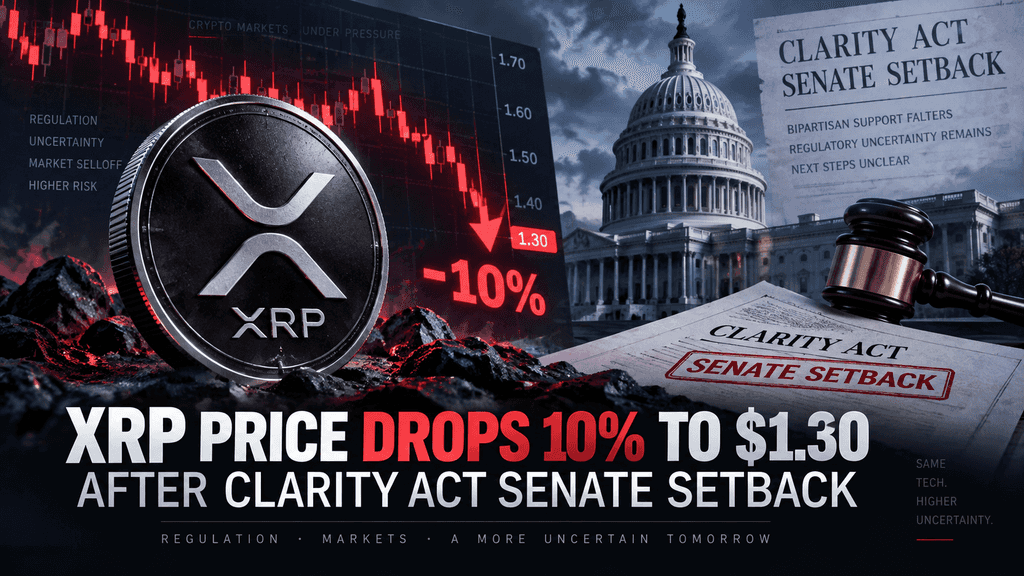
XRP suffered one of the sharpest losses among major cryptocurrencies after the U.S. Senate failed to advance the Digital Asset Market Clarity Act on September 15, 2026. The token fell almost 10% to around $1.30 during the sell-off, while Bitcoin slipped roughly 3% toward $76,000 and Ether, Solana and Dogecoin lost about 5%. The unusually large gap between XRP and Bitcoin immediately put regulatory risk back at the center of the XRP market narrative.
But the Senate vote alone does not fully explain a 10% move. XRP entered the event after rallying toward a major resistance zone, leveraged traders were heavily positioned for further upside, and broader financial conditions were turning less favorable. Understanding the decline therefore requires looking at several forces together: regulatory expectations, technical positioning, forced liquidations and the Federal Reserve’s renewed tightening cycle.
What Happened to XRP After the Senate Vote?
The Senate vote was a procedural step rather than a final vote to pass or reject the CLARITY Act. Senators were deciding whether to invoke cloture on the motion to proceed to H.R. 3633. The vote ended 49-50, below the three-fifths threshold required, so the legislation did not advance to the next stage of Senate consideration. The official Senate record describes the result as “Cloture on the Motion to Proceed Rejected.”
Crypto markets responded quickly. CoinDesk reported that XRP fell nearly 10% to $1.30, making it the weakest major token in the immediate sell-off. Ether and Solana declined about 5%, Dogecoin lost a similar amount and Bitcoin slipped roughly 3%. Crypto-related equities also fell as investors reassessed the timing of a comprehensive U.S. digital-asset framework.
| Asset | Approximate Move After the Setback |
| XRP | -10% |
| ETH | -5% |
| SOL | -5% |
| DOGE | -5% |
| Bitcoin | -3% |
The broad market decline explains part of XRP’s weakness, but it does not explain why XRP fell roughly three times as much as Bitcoin. That difference is where regulation, market positioning and leverage become more important.
Why Did XRP Fall Harder Than Bitcoin?
XRP has an unusually strong historical relationship with U.S. regulatory developments. The SEC’s lawsuit against Ripple in 2020 affected not only investor sentiment but also access to XRP on major U.S. trading platforms. Court decisions, the eventual end of the Ripple litigation and later regulatory clarification subsequently became important XRP catalysts. As a result, traders have spent years treating developments involving the SEC, Congress and crypto market structure as especially relevant to XRP.
Bitcoin comes from a different regulatory history. It has long had comparatively established commodity treatment and has never faced an issuer-specific securities dispute comparable to Ripple’s. That does not make Bitcoin immune to Washington. Market-structure legislation, ETF rules, banking policy and taxation still matter to BTC, but regulatory headlines have historically been less likely to raise questions about Bitcoin’s basic availability on U.S. exchanges.
There is also a market-structure difference. XRP generally behaves as a higher-beta crypto asset than Bitcoin, with thinner liquidity and more sensitivity to leveraged positioning during stressful periods. The better explanation for the 10% drop is therefore not that regulation alone caused every percentage point of the move. Regulatory disappointment provided the catalyst, while XRP’s trading structure amplified the reaction.
Was the CLARITY Act Rally Already Priced In?
One reason the reversal was so violent is that XRP had rallied sharply immediately before the Senate setback. Historical market data show XRP rising about 6% on September 14, opening around $1.34 and reaching a high near $1.49 before closing around $1.42. On September 15, the token opened near $1.42, reached approximately $1.46 and then collapsed toward $1.27, finishing the session down roughly 9.8%.
That sequence suggests at least part of the positive regulatory outcome had already been incorporated into market positioning. Traders were not reacting from a neutral starting point. XRP had moved toward a psychologically important $1.50 area while optimism around the legislation remained part of the market narrative. When the Senate failed to advance the bill, traders suddenly had to reprice the probability of near-term congressional clarity.
This is a familiar market pattern. Prices can fall sharply even when no new existential threat appears if an anticipated positive catalyst fails to materialize. In XRP’s case, the Senate setback removed part of the bullish thesis that had helped push the token higher in the preceding session, creating a classic expectation reversal rather than a completely new fundamental crisis.
Why Does the CLARITY Act Still Matter for XRP?
The importance of the CLARITY Act should not be confused with a return to the old question of whether XRP itself can legally trade in the United States. The broader XRP regulatory environment has changed considerably since the Ripple case began. What remains unsettled is the structure of the U.S. digital-asset market as a whole.
That distinction can be summarized as token clarity versus market-structure clarity. Even if an asset has relatively clear regulatory treatment, institutions still need rules governing exchanges, custody, intermediaries, derivatives, DeFi, anti-money-laundering obligations and the respective roles of the SEC and CFTC. The CLARITY Act was intended to establish a more comprehensive statutory framework across those areas rather than provide XRP with an individual license to exist.
The Senate setback therefore did not erase previous legal progress involving XRP. It delayed the prospect of Congress replacing a more fragmented system of agency interpretation, rulemaking and litigation with a broader framework enacted into federal law. Reuters reported that, with legislation stalled, more regulatory responsibility may remain with the SEC and CFTC under existing authority, although such rules can be more vulnerable to future policy changes and legal challenges than an act of Congress.
How Liquidations Made the XRP Sell-Off Worse
Leveraged Longs Were Forced Out
Once XRP began falling, derivatives markets appear to have accelerated the move. AMBCrypto, citing CoinGlass data, reported approximately $40 million in XRP liquidations during the decline, with more than 95% involving long positions. Different liquidation trackers can produce different totals because they cover different venues, but the direction of the data is clear: bullish leveraged positions absorbed most of the damage.
A liquidation cascade can turn an ordinary correction into a much faster decline. As XRP falls, highly leveraged long positions lose collateral value. Exchanges then automatically close positions that no longer meet margin requirements, creating additional selling. That selling pushes the price lower, threatening the next layer of leveraged longs and potentially producing another round of forced closures. In this framework, the Senate vote may have initiated the repricing, but leverage helped magnify it.
Why the $1.50 Area Mattered
Technical positioning made the setup even more fragile. XRP had traded as high as roughly $1.49 on September 14, only to fail to establish itself above the $1.50 region. The following session saw a high near $1.46 before the price dropped to around $1.27.
That combination created an unfavorable structure for bullish traders: a failed breakout near resistance, a negative regulatory catalyst and crowded leveraged longs. None of those factors alone necessarily produces a 10% decline. Together, however, they can explain why the reaction became much more violent than the initial headline might suggest.
Did the Fed Make the XRP Drop Worse?
The timing matters. XRP’s initial sharp sell-off followed the CLARITY Act vote, so it would be inaccurate to attribute the original 10% decline entirely to Federal Reserve policy. However, the macroeconomic environment became another source of pressure almost immediately afterward.
On September 16, the Federal Reserve raised the federal funds target range by 25 basis points to 3.75%-4.00%, its first rate increase in more than three years. Fed policymakers also projected another increase later in 2026, while Chair Kevin Warsh emphasized that inflation remained too high and underlying trends had not improved enough.
Higher interest rates and elevated Treasury yields generally tighten financial conditions for speculative assets. That meant XRP was absorbing multiple negative forces in a very short window: disappointment over regulatory legislation, leveraged deleveraging and a more hawkish monetary-policy environment. The CLARITY setback was an important immediate trigger, but the macro backdrop made it harder for risk appetite to recover quickly.
Is the CLARITY Act Dead?
Not formally. The September 15 result was a failed cloture vote on the motion to proceed, not a final passage vote rejecting the legislation itself. Senate records show that Senator Thom Tillis voted no specifically so he could make a motion to reconsider, and he did so later that afternoon.
That procedural route means another attempt remains possible, but it does not solve the underlying political problem. Any renewed effort still has to assemble enough support to clear the Senate’s 60-vote cloture threshold. Reuters reported that the legislation faced opposition involving ethics safeguards, banking concerns and other regulatory provisions, showing that the setback was broader than a single technical disagreement.
For crypto markets, the most important issue is therefore not whether one specific procedural mechanism still exists. It is whether lawmakers can rebuild a coalition broad enough to produce a durable U.S. market-structure framework. Until that happens, the timeline for congressional clarity remains uncertain.
What Should XRP Traders Watch Next?
The first category to monitor is regulation. Any renewed CLARITY Act negotiations, alternative digital-asset market-structure legislation or further SEC and CFTC rulemaking could change expectations around institutional access to XRP. The significance of future regulatory news should be judged by what it actually changes — market access, custody, exchange rules or capital flows — rather than by the political headline alone.
The second category is market positioning. XRP’s next sustained move will depend in part on whether open interest and leverage rebuild after the liquidation flush, whether spot demand stabilizes around current levels and whether the token can eventually reclaim the $1.40-$1.50 zone that rejected it before the decline. ETF flows, regulated derivatives and broader institutional activity are also increasingly relevant because XRP is becoming more integrated with traditional financial products.
Finally, macro conditions remain important. Bitcoin direction, Federal Reserve policy, Treasury yields and the U.S. dollar can either reinforce or offset token-specific catalysts. If XRP stabilizes while regulatory uncertainty remains unresolved, that would suggest leverage and positioning played a larger role in the sell-off than the legislation alone. If future Washington headlines continue producing much larger XRP moves than Bitcoin, the market may still be assigning XRP a substantial regulatory sensitivity premium.
Conclusion
XRP’s drop toward $1.30 was not the result of a single factor. The Senate’s failure to advance the CLARITY Act removed a regulatory catalyst traders had partly priced in, while XRP’s history of sensitivity to U.S. regulation made the reaction stronger than Bitcoin’s. A failed attempt to break above the $1.50 area and heavy long liquidations then amplified the decline, while renewed Federal Reserve tightening added another layer of pressure.
The more durable lesson is that XRP’s legal position and U.S. crypto market structure are now separate questions. The former has become considerably clearer over time; the latter remains unsettled. That distinction will continue to matter long after XRP moves away from the $1.30 level.
🔥 Beyond the Headlines: What KuCoin 5.0 Means for You
Market news moves fast — but where you act on it matters just as much. This October, KuCoin launches KuCoin 5.0, transforming KuCoin into a rebuilt platform. Here's what actually changes for you:
-
One account for everything. Older platforms split your money across separate "spot," "margin," and "futures" accounts and expected you to understand why. KuCoin 5.0's unified account removes that entirely — deposit once, and everything is simply there.
-
Stocks, indices, and commodities. KuCoin 5.0 expands beyond crypto into global markets. When crypto chops sideways and equities rally (or the reverse), you rotate in minutes instead of opening a brokerage account and waiting days for fiat rails.
-
Real-world assets (RWA). Tokenized exposure to traditional assets like commodities, right inside your crypto account. One of the fastest-growing segments in global finance is no longer reserved for institutions — you access it from the same balance you trade with.
-
Earn while you learn. Not ready to trade? KCUSD lets your stablecoins earn daily, auto-compounding interest. The lowest-stress way to put your idle deposit to work for 4% yield.
-
An AI assistant in plain language. Ask questions, get market context, understand what you're looking at — built into the platform, no jargon required.
-
An app that doesn't overwhelm. Faster, cleaner, and consistent — intuitive from the first tap, not after a tutorial.
-
Safety you can check, not just trust. A MiCAR-licensed EU entity, Proof of Reserves you can verify yourself, and internationally certified security (SOC 2 Type II, ISO 27001:2022).
Create your account in minutes — and start on the platform built for where crypto is going, not where it's been.
FAQs
Did the CLARITY Act Vote Change XRP’s Legal Status?
No. The September 15 vote dealt with whether a broader crypto market-structure bill would advance in the Senate. It did not itself redefine XRP or reverse previous court decisions and regulatory developments involving the asset.
Does XRP Need the CLARITY Act to Trade in the United States?
No. XRP already trades on U.S.-accessible markets. The CLARITY Act addresses the broader regulatory framework for digital-asset markets, including the roles of regulators and rules for market intermediaries, rather than serving as an individual trading authorization for XRP.
Can the Senate Vote on the CLARITY Act Again?
Procedurally, another attempt is possible. Senator Thom Tillis entered a motion to reconsider after the failed cloture vote. Whether the Senate actually votes again depends on negotiations, scheduling and whether supporters can assemble enough votes to clear the required threshold.
Could XRP ETF Demand Offset Regulatory Selling?
Potentially, but ETF demand is only one source of market flow. Spot selling, derivatives liquidations, hedging, Bitcoin weakness and macro conditions can overwhelm ETF inflows over short periods. Strong ETF demand therefore does not guarantee immediate price appreciation.
Does a 10% XRP Drop Mean the Long-Term Trend Has Changed?
Not by itself. A one-day decline can result from event risk, forced deleveraging or technical rejection without necessarily confirming a longer-term trend reversal. Assessing the broader trend requires looking at liquidity, trading volume, institutional flows, XRPL activity and macroeconomic conditions over a longer period.
Disclaimer: This article is for informational and educational purposes only and does not constitute financial, investment, legal or tax advice.