

Why Plasma’s TVL Surged to $2 Billion: Tether Integration and the Rise of the Stablecoin-Native L1
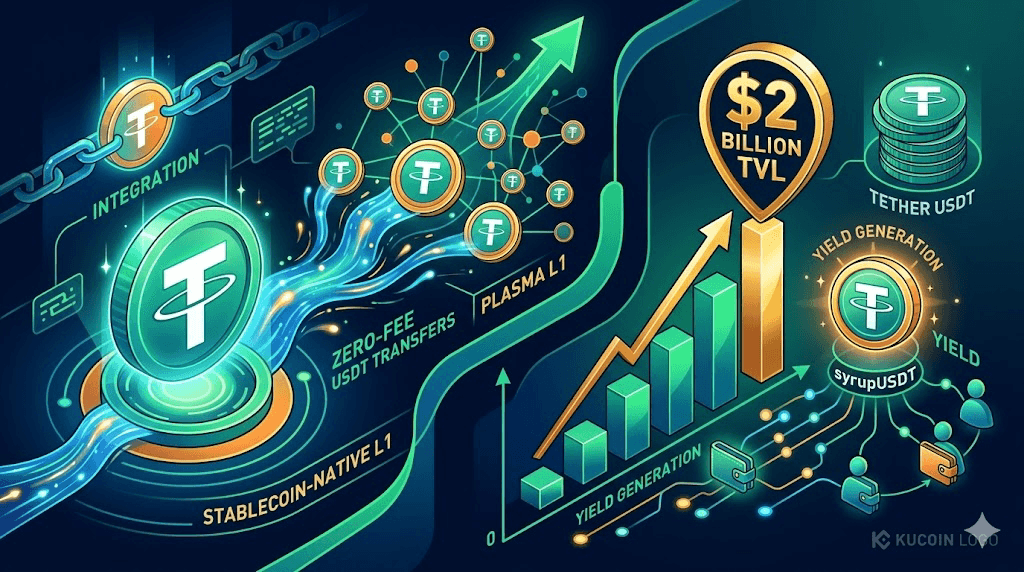
In the fast-paced blockchain landscape, where efficiency and utility have replaced speculative hype, the Plasma network has emerged as a titan of liquidity. Within just 30 days, Plasma’s Total Value Locked (TVL) rocketed past the $2 billion milestone, propelling it into the global top 10 rankings alongside giants like Ethereum and Solana. This unprecedented growth is not a random market fluke, it is the direct result of a calculated "Stablecoin-First" strategy, headlined by a historic integration with Tether’s self-custody ecosystem.
For traders, understanding Plasma's rise offers a masterclass in how institutional infrastructure can redefine retail accessibility.
Key Takeaways
-
As of April 16, 2026, Plasma reached $2.04 billion in TVL, officially ranking it as the 7th largest blockchain by liquidity, driven by a 80% monthly growth rate.
-
The April 14 launch of the tether.wallet designated Plasma as a core supported chain, granting it immediate access to Tether’s 570M+ global user base.
-
Plasma’s unique BFT-based consensus allows for zero-fee USDT transfers, making it the most cost-effective network for micro-payments and international remittances in 2026.
-
Over $1.1 billion of Plasma’s TVL is driven by syrupUSDT, providing institutional-grade yield that attracts long-term capital rather than short-term "mercenary" liquidity.
-
Strategic partnerships with global payment gateways have connected over 150 million merchants to the Plasma network, enabling seamless USDT spending via the "Plasma One" neobank interface.
Plasma’s Rapid Ascent to the Global Top 10
According to live data from DefiLlama, the Plasma (XPL) network officially surpassed the $2.04 billion Total Value Locked (TVL) threshold. This achievement represents an extraordinary 80% surge in liquidity within a single month, catapulting Plasma from a niche Layer 1 to the 7 spot on the global blockchain rankings, surpassing established competitors like Avalanche and Polygon.
In early March 2026, Plasma’s TVL hovered around $950 million, primarily serving as a playground for early adopters. However, the mid-April breakout has transformed the network into a top-tier institutional hub.
This "vertical" growth curve is largely attributed to Plasma’s pivot toward becoming a specialized settlement layer rather than a general-purpose "world computer." By focusing on high-velocity stablecoin transactions, the network has attracted "sticky" capital that seeks utility over speculation.
Market Insight: As of April 20, 2026, Plasma's weekly TVL increase remains steady at 27%, suggesting that the $2 billion mark is not a blow-off top but the new baseline for the network's burgeoning ecosystem.
The Tether Catalyst: Why "First-Class" Wallet Status Changed Everything
The single most significant driver behind Plasma’s April 2026 breakout was the launch of tether.wallet on April 14.
As Tether’s first foray into the self-custody software market, the application was designed to onboard the next 500 million users by stripping away the complexities of blockchain interaction.
Crucially, Plasma was selected as one of only four "first-class" networks supported at launch—alongside Ethereum, Polygon, and Arbitrum. This strategic designation effectively transformed Plasma from a promising Layer 1 into a core pillar of the Tether global payment infrastructure.
Redefining User Experience
The integration with tether.wallet solved the two biggest friction points for retail USDT holders: the "Gas Token" problem and the "Address" problem.
Native Gas Abstraction: Unlike traditional networks where users must hold a native token (like ETH or MATIC) to pay for transaction fees, Plasma’s integration allows for Gas Abstraction. Users can pay for network fees using the USDT they are already sending, or enjoy zero-fee transfers via the network’s built-in Paymaster contract.
Human-Readable Identifiers: The wallet replaces 42-character alphanumeric hex addresses with simple identifiers like
name@tether.me. By removing the fear of fat-finger errors, Plasma has become the preferred network for non-technical users in emerging markets.The Bitfinex and Tether Pedigree
Plasma was incubated by Bitfinex, the exchange that shares a parent company with Tether. With Tether CEO Paolo Ardoino acting as an early backer, the network was purpose-built to handle the massive throughput of the world’s most used stablecoin.
This pedigree provides an Institutional Seal of Approval that general-purpose chains lack. When Tether launched its wallet, it didn't just add Plasma as an option, it optimized the entire experience for Plasma architecture. This direct funnel from Tether’s 570-million-strong user base has created a perpetual liquidity engine that is now settling billions in value monthly.
The Zero-Fee Advantage
On traditional networks like Ethereum, a simple $10 USDT transfer can cost $15 to $25 in gas fees during periods of high congestion, rendering micro-payments and daily remittances economically unviable.
Plasma solves this through a groundbreaking Zero-Fee architecture that transforms USDT into a truly frictionless digital currency.
The Mechanics of the Paymaster System
Unlike legacy blockchains that require users to pay for computation in a native gas token (like ETH or MATIC), Plasma utilizes a protocol-level Paymaster mechanism. This smart contract-based system allows for Fee Abstraction, where the network itself or a third-party application sponsors the transaction cost.
Sponsored Transactions: When a user initiates a qualifying USDT transfer, the Paymaster contract automatically covers the XPL gas fee in the background. From the user's perspective, the transaction is completely free.
Custom Gas Tokens: For complex smart contract interactions where sponsorship isn't available, Plasma allows users to pay for gas using the whitelisted asset they are already sending (e.g., USDT), eliminating the need to acquire and hold the native XPL token solely for transaction costs.
PlasmaBFT and the UTXO+Account Model
Plasma achieves this zero-fee dominance not through temporary subsidies, but through architectural efficiency. At its core is the PlasmaBFT consensus mechanism (derived from Fast HotStuff), which allows for:
Sub-Second Finality: Transactions are confirmed in roughly one second, preventing the "pending transaction" bottlenecks that drive up fees on other chains.
The Hybrid Ledger: By organically combining the UTXO (Unspent Transaction Output) model with a flexible Account model, Plasma can precisely split high-value payments while efficiently tracking smart contract states.
This dual-model approach minimizes the computational resources required for value transfer, allowing the network to maintain its zero-fee promise at scale.
syrupUSDT and Institutional Yield: Anchoring Long-Term Capital
While retail-driven "zero-fee" hype often creates temporary spikes in volume, the true test of a blockchain’s maturity is the stability of its capital.
Plasma has passed this test by securing sticky liquidity, capital that remains on-chain for yield rather than chasing short-term speculation.
At the heart of this strategy is syrupUSDT, a yield-bearing stablecoin managed by Maple Finance, which has recently surpassed a staggering $1.1 billion in TVL on the Plasma network.
The Mechanics of Sustainable Yield
syrupUSDT offers institutional-grade returns derived from real economic activity. By integrating Maple Finance’s credit infrastructure directly into the Plasma ecosystem, the network provides a secure bridge between DeFi liquidity and over-collateralized institutional lending.
Real-World Asset (RWA) Backing: The yield for syrupUSDT is generated through senior secured lending to regulated financial institutions and fintechs.
Zero-Fee Compounding: Because Plasma eliminates transaction costs, users can harvest and compound their syrupUSDT rewards daily without losing a percentage of their profits to gas fees.
Why syrupUSDT is the "Cornerstone" of Plasma
The presence of a billion-dollar, RWA-backed pool acts as a stabilizing anchor for the entire ecosystem. This deep liquidity allows other protocols on Plasma to offer healthier lending rates and better execution for large-scale traders.
For many investors, syrupUSDT represents the risk-off portion of a 2026 crypto portfolio. It provides a sanctuary of yield that remains productive even when market volatility is high. This institutional validation, recently bolstered by allocations from major firms like Bitwise Asset Management, has turned Plasma into the premier venue for professional-grade on-chain asset management.
For those looking to diversify their stablecoin returns beyond on-chain vaults, exploring KuCoin Earn provides an excellent complementary strategy.
By balancing syrupUSDT’s on-chain yield with KuCoin’s professional lending and flexible savings products, you can optimize your digital dollar performance across both centralized and decentralized environments.
Real-World Adoption: Connecting 150 Million Merchants to Plasma
Plasma has set a new benchmark for adoption by bridging the gap between digital asset wallets and global commerce. Through strategic partnerships with payment processors like Rain, Oobit, and MassPay, Plasma users can now spend their USDT at over 150 million merchants worldwide.
Plasma One
The core of this retail expansion is Plasma One, the network’s flagship "stablecoin neobank" application.
Instant Virtual & Physical Cards: Users can generate Visa-compatible virtual cards instantly within the app, allowing for immediate spending at any terminal that accepts traditional credit cards.
The Spend and Earn Paradigm: One of Plasma’s most disruptive innovations is removing the choice between holding for yield and spending for utility. Through its integrated liquidity layer, your remaining balance in Plasma One continues to earn over 10% APY via syrupUSDT and other institutional pools, even while you use it for daily purchases.
Zero-Fee Remittances: For families sending money across borders, Plasma One offers sub-second finality with zero transaction fees. This is powered by the same Paymaster model that supports the broader network, ensuring that the "full value" of a transfer reaches the recipient without being eroded by intermediary bank fees.
Strategic Partnerships
Rain Integration: By acquiring and integrating cross-chain routing engines, Rain allows Plasma to function as a Chain-Agnostic payment rail. This means a merchant can receive fiat currency while the user spends USDT, with the conversion happening invisibly in milliseconds.
MassPay for Enterprise: For businesses, Plasma has become the preferred rail for global payroll and B2B settlement. Several multinational gig-economy platforms migrated to Plasma to pay thousands of contractors globally in USDT, citing the network’s sub-second finality and regulatory-friendly "Know Your Transaction" (KYT) tools.
Trading and Liquidity on KuCoin
As the Plasma network cements its position as a top-tier Layer 1, the focus for investors shifts toward liquidity and market access. KuCoin serves as a primary gateway for the Plasma ecosystem, providing the deep liquidity necessary for institutional and retail participation.
Traders looking to capitalize on Plasma’s $2 billion TVL milestone can utilize several professional-grade tools on the platform:
-
KuCoin Spot Trading: Access high-velocity stablecoin pairs with competitive fees.
-
Liquidity Provision: Participate in market-making activities to support the XPL ecosystem while earning a share of trading fees.
-
Advanced Order Types: Use Iceberg and Post-Only orders to manage large XPL positions during periods of high volatility.
The rise of Plasma highlights a broader 2026 trend: the disappearance of the wall between Centralized Exchanges (CEX) and Decentralized Networks. Through KuCoin's seamless wallet integration, users can move their USDT from the exchange to a yield-bearing syrupUSDT pool on Plasma in seconds.
Conclusion
Plasma’s ascent to a $2 billion TVL in April 2026 is a watershed moment for the stablecoin economy. By focusing on being a high-performance, zero-fee settlement layer for Tether, Plasma has solved the most pressing problems in global finance: cost, speed, and utility. As we look toward the remainder of 2026, the question is no longer if stablecoin-native chains will dominate, but how quickly you can position your portfolio to benefit from this tectonic shift.
FAQs
Why did Plasma’s TVL grow so fast compared to other L1s?
Plasma’s growth was driven by its Stablecoin-First strategy. By natively integrating with Tether’s self-custody ecosystem and offering zero-fee transfers, it attracted immediate utility from Tether’s 570M+ users, whereas general-purpose chains often struggle to find a specific use case.
Is the $2 Billion TVL on Plasma sustainable?
Yes. Unlike previous DeFi cycles driven by inflationary rewards, over 50% of Plasma’s TVL is anchored by syrupUSDT, which provides institutional-grade yield backed by Real-World Assets (RWAs). This "sticky" capital is far less likely to leave the network during market downturns.
How can I earn yield on my USDT using the Plasma network?
The most effective way to earn yield is through syrupUSDT, which currently offers 8-10% APY via over-collateralized institutional lending. You can also utilize KuCoin Earn to find complementary yield products that balance on-chain and off-chain performance.
Do I need XPL tokens to send USDT on Plasma?
No. Thanks to Plasma’s Paymaster and Gas Abstraction architecture, you can often send USDT for free or pay for transaction fees using the USDT you are already sending. This eliminates the need for users to buy and hold a native gas token.
Disclaimer:This content is for informational purposes only and does not constitute investment advice. Cryptocurrency investments carry risk. Please do your own research (DYOR).