

Why Did Tesla and SpaceX Fall After the 2026 US Midterm Elections? Elon Musk's Political Risk Explained
Introduction
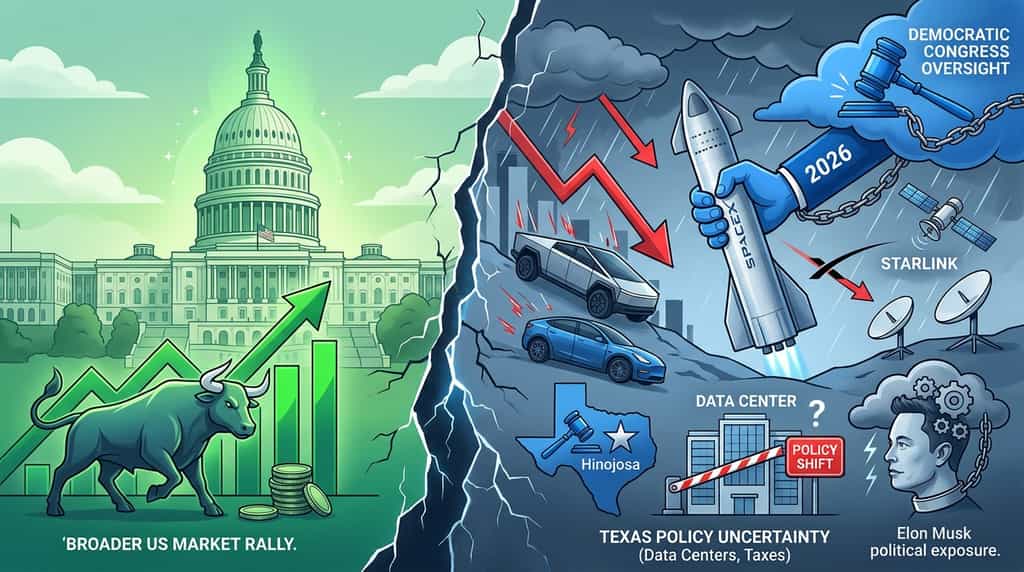
Tesla and SpaceX came under pressure after the November 3, 2026, US midterm elections, even as the broader US stock market rallied. The main reason was a shift in perceived political risk surrounding Elon Musk and his businesses. Democrats gained control of both chambers of Congress, while Democrat Gina Hinojosa defeated incumbent Greg Abbott in the Texas governor's race. These results raised questions about the future of federal oversight, government contracts, data center development, and tax incentives that could affect Musk's business interests.
The market reaction reflects more than a change in political leadership. Musk had committed substantial financial resources to Republican candidates, while Tesla and SpaceX have major operational and strategic interests in Texas. The election therefore introduced uncertainty across several areas of their business models, particularly AI infrastructure and a potential corporate combination.
Tesla and SpaceX shares fell because investors reassessed the political and regulatory risks facing Musk's companies after Democratic election victories.
The main factors were:
-
Greater congressional scrutiny: Democratic control of both chambers could increase oversight of federal contracts, subsidies, and business relationships involving Musk's companies.
-
A change in Texas leadership: Gina Hinojosa's victory introduced uncertainty around data center approvals, tax incentives, and infrastructure development.
-
Musk's political exposure: His substantial financial support for Republican candidates created a more visible connection between his political activity and the commercial interests of his companies.
-
AI infrastructure uncertainty: Proposed restrictions on data center development could affect projects that support Musk's broader AI ambitions.
-
Potential merger scrutiny: The proposed combination of Tesla and SpaceX could attract additional attention from lawmakers and regulators.
These developments do not mean that existing contracts, tax benefits, or projects will automatically be canceled. They indicate that investors may need to account for a wider range of political and regulatory outcomes.
Why Did Tesla and SpaceX Fall While the Broader US Stock Market Rallied?
Tesla and SpaceX declined because the election created company-specific political uncertainty that was not shared by the broader equity market.
The initial market reaction was unusual. Major US equity indexes advanced as investors assessed the implications of a divided political environment and changes in Treasury yields. However, Tesla and SpaceX moved in the opposite direction during premarket trading.
This divergence suggests that investors were not simply responding to the election as a general macroeconomic event. They were assessing how the results could affect companies with direct commercial, political, and regulatory exposure.
Three factors help explain this difference.
First, the election changed expectations about congressional oversight. Democrats gained control of both the House and Senate, giving the party greater influence over congressional investigations, committee hearings, legislation, and federal budget discussions.
Second, Texas became a particularly important source of uncertainty. Tesla and SpaceX have established major operations in the state, where the incoming administration may take a different approach to data center development and economic incentives.
Third, Musk's personal political involvement increased the visibility of these risks. His financial support for Republican candidates and public criticism of political opponents created additional attention around the relationship between his political activities and his companies.
For investors, the distinction is important: a broad market rally does not necessarily benefit every company equally. Businesses with concentrated regulatory, political, or geographic exposure can experience negative price movements even when overall market sentiment improves.
How Could Democratic Control of Congress Affect Musk's Companies?
Democratic control of Congress could increase political and regulatory scrutiny of Tesla and SpaceX, particularly in areas involving federal contracts, government support, and the use of public resources.
Congress has several oversight mechanisms that could become more relevant under the new political balance:
-
Committee investigations: Congressional committees can request documents, hold hearings, and investigate federal agencies or businesses connected to government programs.
-
Contract oversight: Lawmakers can examine how federal agencies award, administer, and monitor government contracts.
-
Budget and appropriations: Congress has influence over federal spending priorities, agency budgets, and funding conditions.
-
Legislative proposals: Lawmakers can introduce legislation affecting technology companies, AI infrastructure, transportation, energy, and federal procurement.
These mechanisms could matter because Musk's business interests extend beyond conventional consumer products.
SpaceX has a significant role in the US aerospace sector, including commercial launch services and government-related space activities. Tesla operates in the electric vehicle and energy storage markets, both of which have been affected by federal and state policy decisions.
However, greater congressional scrutiny does not automatically mean that existing government contracts will be terminated or that companies will face new restrictions. Congressional investigations, agency enforcement actions, and changes to federal procurement rules are separate processes. Each has its own legal requirements and institutional procedures.
The practical implication is that investors may begin assigning a higher risk premium to companies whose business models depend on government relationships or policy support.
Why Is the Texas Governor's Race Particularly Important for SpaceX and Tesla?
Texas is strategically important because it hosts major operations and development plans associated with Musk's companies.
The election of Democrat Gina Hinojosa as governor represents a significant political change for the state. The official Texas Secretary of State election results record Hinojosa's victory over incumbent Greg Abbott.
The result matters because Hinojosa campaigned on a different approach to data center development, tax incentives, and local infrastructure protections.
Her proposed policy direction includes:
-
A temporary halt to new data center approvals while lawmakers consider additional protections.
-
Greater scrutiny of the impact of data centers on electricity and water resources.
-
Changes to tax incentives available to data center operators.
-
Stronger local participation in decisions involving large infrastructure projects.
These positions could affect the operating environment for technology companies planning substantial infrastructure investments in Texas.
Why Are Data Centers a Political Issue?
Data centers are essential to modern AI development because they provide the computing capacity required to train and operate large AI models. However, their rapid expansion can create significant demands on electricity, water, land, and local infrastructure.
This has made data center development a political issue in several US states. Local communities may support the economic benefits of new facilities while raising concerns about utility costs, environmental effects, and the allocation of public resources.
Texas has attracted major data center investment partly because of its business environment and available tax incentives.
According to the Texas Comptroller's official data center tax exemption guidelines, qualifying facilities can receive temporary exemptions from certain state sales and use taxes on eligible purchases. The program includes requirements related to capital investment, job creation, and facility characteristics.
Consequently, a change in state policy could affect the economics of future infrastructure projects.
However, an important distinction must be made: a governor-elect's campaign commitments are not automatically effective laws. Changes to statutory tax exemptions may require legislative action, while permitting decisions depend on the relevant agencies and their legal authority.
The election therefore creates policy uncertainty rather than an immediate, universal suspension of all data center projects.
How Could Texas Data Center Policies Affect SpaceX's AI Plans?
SpaceX could face additional uncertainty if the incoming Texas administration pursues stricter data center approval policies.
Musk's broader business strategy increasingly connects aerospace, AI computing, and advanced infrastructure. SpaceX's Starbase operations near Boca Chica, Texas, are part of this wider industrial footprint.
The company has also been associated with plans to develop substantial AI computing capacity in the state. Such facilities require more than land and buildings. They depend on electricity connections, cooling systems, water access, permits, and long-term infrastructure commitments.
A temporary pause on new approvals could affect several stages of a project:
-
Site development: New facilities may face delays while local and state authorities review applications.
-
Power infrastructure: Data centers require reliable electricity supply, which may involve lengthy utility planning and grid connections.
-
Construction schedules: Delayed permits can push back construction milestones and increase project costs.
-
Tax planning: Changes to incentive programs could alter the expected cost of building and operating facilities.
-
Capital allocation: Companies may reconsider where to deploy future infrastructure investment.
The financial impact would depend on the scope and duration of any policy changes.
For example, a temporary pause affecting new applications would not necessarily prevent existing facilities from operating. Similarly, a change to future tax incentives would not automatically revoke benefits already granted under existing agreements.
Could Political Scrutiny Affect a Potential Tesla-SpaceX Combination?
A potential combination between Tesla and SpaceX could attract additional attention because the companies have overlapping strategic interests and are both closely associated with Musk.
The possibility is no longer purely speculative. Their September 2026 regulatory filings disclosed that both boards had established special committees to evaluate a potential business combination.
SpaceX stated in its quarterly filing that its special committee had not made a determination on whether to proceed. Any transaction would require further corporate approvals, and there was no assurance that an agreement would be reached or completed.
Tesla's filing also confirmed that its board had established a special committee to explore a deeper relationship with SpaceX, potentially including a business combination.
The relevant disclosures are available in the companies' respective SEC filings:
The election could make the political environment surrounding such a transaction more complicated. Potential areas of scrutiny include:
-
Corporate governance: Whether the proposed transaction serves the interests of shareholders in both companies.
-
Related-party transactions: How business relationships and financial arrangements involving Musk-controlled entities are evaluated.
-
Competition considerations: Whether the combination raises questions about market concentration or competitive effects.
-
Government relationships: Whether the combined business structure could affect federal contracts, procurement decisions, or regulatory oversight.
Nevertheless, congressional scrutiny and formal merger review are not the same thing. Congress can investigate, request information, and examine broader policy implications. Formal approval requirements for a transaction depend on applicable corporate, securities, and competition laws.
The existence of political opposition does not automatically prevent a merger. The transaction's structure, financial rationale, shareholder interests, and regulatory review would remain central to the outcome.
Conclusion
The 2026 US midterm elections introduced a new layer of political uncertainty for Tesla, SpaceX, and Elon Musk's broader business interests. Democratic control of Congress could increase federal oversight, while Gina Hinojosa's victory in Texas raises questions about data center development, tax incentives, and infrastructure policy. Musk's substantial political spending also made the relationship between his personal political activity and his companies' commercial interests more visible to investors.
However, the election results do not automatically invalidate existing government contracts, revoke previously granted tax benefits, or halt ongoing infrastructure projects. The actual consequences will depend on future congressional investigations, state legislation, regulatory decisions, and corporate developments.
The potential Tesla-SpaceX combination adds another dimension because it could attract attention involving corporate governance, competition, and related-party transactions. For investors, the central issue is whether political uncertainty eventually translates into measurable changes in costs, project schedules, revenue opportunities, or transaction conditions. Until those developments become clearer, political risk remains an important factor in assessing the companies' business outlook and valuation.
FAQs
-
Why did Tesla shares fall after the 2026 US midterm elections?
Tesla shares declined as investors assessed the potential impact of Democratic election victories on Elon Musk's businesses. Greater congressional scrutiny and changes to Texas data center policy could affect Tesla's strategic investments and operating environment.
-
Why is the Texas governor's election important for SpaceX?
Texas hosts SpaceX's Starbase operations and is an important location for its infrastructure plans. Incoming Governor Gina Hinojosa has proposed stricter data center policies, which could affect future permits, tax incentives, and infrastructure development.
-
Could Democrats cancel SpaceX's government contracts?
Democratic control of Congress does not automatically cancel existing contracts. Lawmakers can conduct oversight and influence federal spending priorities, but contract changes or termination depend on applicable laws, contract terms, and agency decisions.
-
Could the 2026 midterm results prevent a Tesla-SpaceX merger?
Not automatically. A potential combination could receive additional political and regulatory attention, but its completion would depend on corporate approvals, shareholder interests, and applicable regulatory requirements.
-
Will Texas end tax incentives for AI data centers?
That remains uncertain. Hinojosa has advocated changes to data center incentives, but existing tax programs are governed by state law. Any material changes would depend on the legislative and administrative process.
Disclaimer
This general market information, possibly from third-party, commercial, or sponsored sources, is provided for reference and educational purposes only and does not constitute financial or investment advice, an offer, solicitation, or guarantee. We disclaim liability for its accuracy, completeness, reliability, and any resulting losses. Investments/trading are risky; past performance doesn’t guarantee future results. Users should research, judge prudently, and take full responsibility. For further details, please consult KuCoin’s Terms of Use and Risk Disclosure.