

USDT on Bitcoin via RGB: How Tether’s 2026 Plan Could Reshape Crypto Liquidity
Introduction
What happens to crypto liquidity if the largest dollar token can settle on Bitcoin as fast as Lightning and as securely as a UTXO? Tether’s 2026 RGB plan is not only a technical homecoming. It is a bid to pull part of the world’s stablecoin float onto Bitcoin rails — and that shift can reshape how liquidity forms across exchanges, market makers, and payment corridors.
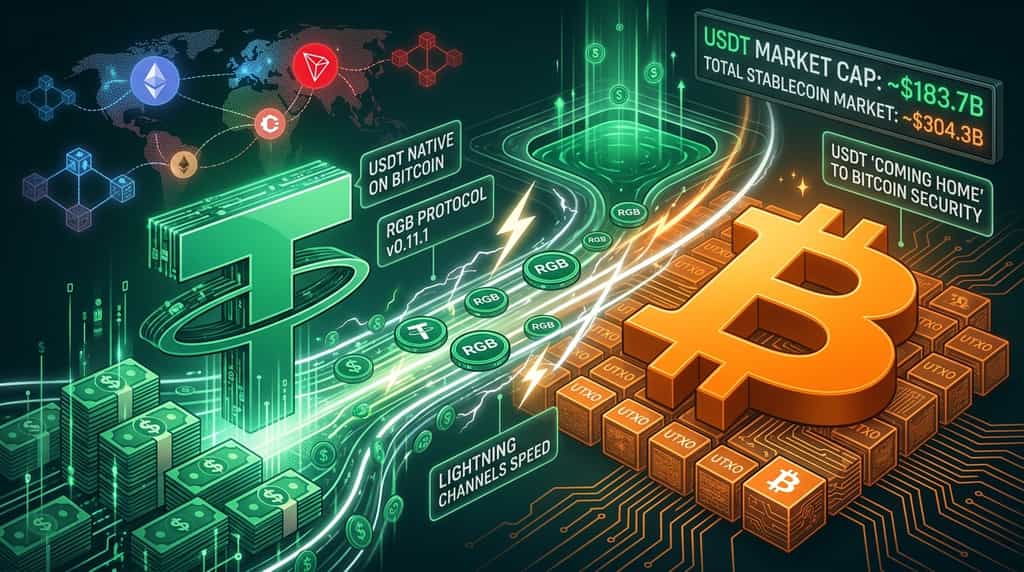
USDT on Bitcoin via RGB means Tether issues USDT as a native Bitcoin asset using RGB Protocol v0.11.1. Transfers use client-side validation, Bitcoin commitments, and Lightning channels instead of Omni-style on-chain token data. According to CoinMarketCap data around 25 September 2026, USDT’s market cap is about $183.71 billion, with circulating supply near 183.77 billion tokens and 24-hour volume near $82.9 billion. According to Stablecoin Beat on 24 September 2026, USDT stands at $183.5 billion inside a $304.3 billion stablecoin market.
Those numbers already set global crypto liquidity. If a meaningful share of that dollar stock can move natively on Bitcoin, order books, funding routes, and cross-venue inventory can change.
What Is Tether’s RGB Plan for USDT on Bitcoin?
Tether’s RGB plan is a native USDT issuance on Bitcoin, commercially rolled out with Utexo, not a wrapped token and not a new Tether blockchain. According to the RGB Protocol Association, RGB reached Bitcoin mainnet in July 2025 with v0.11.1. Asset state stays off-chain. Compact proofs are anchored to Bitcoin. Recipients validate only the history that belongs to their coins.
USDT first lived on Bitcoin in 2014 through Omni. According to Tether’s official August 2023 transition notice, the company stopped minting on Omni, Kusama, and Bitcoin Cash SLP and said it was contributing to RGB for a later Bitcoin return. The 2025–2026 work is that return.
Paolo Ardoino, CEO of Tether, said Bitcoin “deserves a stablecoin that feels truly native, lightweight, private, and scalable,” according to the RGB Protocol Association’s record of the plan. In September 2026 he added the shorter line: “USDT on Bitcoin. It’s coming home.”
The product promise is simple for users: hold bitcoin and dollars in one self-custodial stack, then move dollars over Lightning without leaving Bitcoin’s security model. The market promise is larger: give Bitcoin a liquid dollar that can compete with the rails that currently warehouse most USDT inventory.
How Could USDT on Bitcoin Reshape Crypto Market Liquidity?
USDT on Bitcoin via RGB can reshape crypto liquidity by changing where dollars sit, how they travel, and which venues can source inventory without hopping chains. Liquidity in crypto is not only trading volume. It is the ability to enter, exit, hedge, and settle in dollars with low slippage and low operational friction.
Today most of that friction is chain routing. Market makers park USDT on the networks exchanges already credit quickly. Traders bridge when they want bitcoin exposure on one venue and dollar inventory on another. Bridges, wrapping, and delayed deposits fragment books. A native Bitcoin dollar reduces that fragmentation if wallets and exchanges treat RGB as a first-class deposit network.
Three liquidity effects matter.
First, Bitcoin pairs can tighten. BTC-USDT is already the core risk pair on many books. If USDT can arrive and leave on Bitcoin itself, desks can rebalance BTC and dollars inside one asset stack instead of parking dollars on a separate chain and waiting on a bridge or an internal transfer.
Second, Lightning can turn USDT into an inventory rail, not only a spot ticker. According to rgb.info, RGB assets can move through typed Lightning channels. Channel liquidity is reusable working capital. If market makers fund RGB-USDT channels, they can recycle dollars across venues and OTC desks with seconds-level settlement. That is a different liquidity machine from waiting for an L1 token transfer to confirm.
Third, stablecoin market share can stop being a pure Tron-versus-Ethereum story. According to Stablecoin Beat on 24 September 2026, USDT is $183.5 billion versus USDC at $75.2 billion. That dominance is currently expressed on account-model networks. RGB does not automatically move $183 billion. It creates a new place for incremental minting, treasury inventory, and settlement flow. Even a single-digit share of USDT float on Bitcoin would be a large new dollar pool next to BTC collateral.
The risk on the other side is fragmentation. A new network without deep books can split liquidity instead of concentrating it. RGB only reshapes markets if listings, redemption, and channel depth follow the issuance.
How Does RGB Move Dollars Without Congesting Bitcoin?
RGB keeps USDT contract data off-chain and uses Bitcoin as the commitment and anti-double-spend layer. That is why the design can scale as a liquidity rail. Full nodes do not need to store every dollar balance. Counterparties validate the relevant proof bundle. Bitcoin seals the UTXO so the same state cannot be spent twice.
That architecture is the opposite of Omni. Omni embedded token activity in Bitcoin transactions and became expensive and unused. RGB tries to keep Bitcoin’s security while pushing the heavy state off the public ledger.
Lightning is the throughput layer. A dollar payment can settle inside a channel. The base chain is used when a commitment must be opened, closed, or disputed. For liquidity desks, that mix is familiar: fast inventory movement most of the time, final settlement when needed.
Privacy is a liquidity feature as well as a user feature. Public token graphs on account chains make inventory patterns easier to watch. RGB’s client-side model hides balances and flows from the global chain view. Market makers still face issuer controls. They may face less public copy-trading of treasury routes.
Protocol version discipline still matters. According to rgb.info on 23 September 2026, core v0.11.1 libraries dropped their release-candidate tags. Official maintainers have also warned against unofficial forks using the same version label. Liquidity will not form on software that wallets refuse to trust.
Why Is 2026 the Year This Liquidity Bet Became Concrete?
2026 is the year the plan moved from a 2023 promise to wallets, kits, and distribution partners. That is what turns a protocol into a liquidity venue.
According to RGB Protocol updates, Utexo is leading commercial rollout. Tether backed Utexo’s seed round earlier in 2026, according to rollout reporting around that financing. In late August 2026, Tether’s Wallet Development Kit added a Lightning module for RGB assets built by Utexo. In early September 2026, Utexo named UniSat as a wallet launch partner.
Builder density is rising too. The RGB Protocol Association is hosting “Agentic Dollars on Bitcoin” in Turin on 17–18 October 2026, with Tether as main sponsor. Every project must use RGB. That is how dollar apps, local wallets, and inventory tools get written.
Institutional conversation entered the same window. Utexo co-founder Viktor Ihnatiuk described talks in Washington with Morgan Stanley personnel about USDT on Bitcoin. No bank settlement product has been announced. The liquidity implication is still directional: large balance-sheet actors are asking whether Bitcoin can host dollars, not only store bitcoin.
Europe remains a limit on where that liquidity can be offered. USDT’s status on regulated EU platforms is constrained. RGB does not by itself create a MiCA license. Any European book that wants Bitcoin-native USDT still has to fit local listing and redemption rules.
Where Does RGB USDT Fit Against Tron, Ethereum, and Other Bitcoin Asset Protocols?
RGB USDT competes as a settlement network, not as a different dollar peg. The issuer and reserve claim remain Tether’s, according to Tether’s transparency model. The network is what changes.
Tron and Ethereum still hold the deepest USDT transfer liquidity because exchanges, OTC desks, and payment firms already credit those deposits. According to CoinMarketCap in late September 2026, USDT still turns over tens of billions of dollars per day. That flow will not vanish when RGB goes live. RGB has to earn routing share.
Omni is the failed Bitcoin precedent. Tether retired that mint path in 2023, according to its official notice, and later ended redemption obligations on several legacy rails. RGB is the replacement architecture, not a revival of Omni.
Taproot Assets is the other Bitcoin-native comparison. Both use UTXOs and can target Lightning. RGB’s stated difference, according to the RGB Protocol Association, is client-side validation of off-chain contract state. Traders will not choose based on white papers. They will choose based on which deposit tag an exchange shows and how fast a market maker can recycle inventory.
Bridges remain the liquidity tax RGB is trying to cut. Wrapped dollars import custodian and smart-contract risk. Native RGB issuance still carries Tether issuer risk — freeze, redemption policy, and reserve quality — but it avoids an extra wrap. That distinction matters when desks size basis trades between BTC and dollars.
Beyond the Headlines: What KuCoin 5.0 Means for You
Market news moves fast — but where you act on it matters just as much. This October, KuCoin launches KuCoin 5.0, transforming KuCoin into a rebuilt platform. Here's what actually changes for you:
-
One account for everything. Older platforms split your money across separate "spot," "margin," and "futures" accounts and expected you to understand why. KuCoin 5.0's unified account removes that entirely — deposit once, and everything is simply there (only available to VIPs for now).
-
Stocks, indices, and commodities. KuCoin 5.0 expands beyond crypto into global markets. When crypto chops sideways and equities rally (or the reverse), you rotate in minutes instead of opening a brokerage account and waiting days for fiat rails.
-
Real-world assets (RWA). Tokenized exposure to traditional assets like commodities, right inside your crypto account. One of the fastest-growing segments in global finance is no longer reserved for institutions — you access it from the same balance you trade with.
-
Earn while you learn. Not ready to trade? KCUSD lets your stablecoins earn daily, auto-compounding interest. The lowest-stress way to put your idle deposit to work for 4% yield.
-
An AI assistant in plain language. Ask questions, get market context, understand what you're looking at — built into the platform, no jargon required.
-
An app that doesn't overwhelm. Faster, cleaner, and consistent — intuitive from the first tap, not after a tutorial.
-
Safety you can check, not just trust. A MiCAR-licensed EU entity, Proof of Reserves you can verify yourself, and internationally certified security (SOC 2 Type II, ISO 27001:2022).
Create your account in minutes — and start on the platform built for where crypto is going, not where it's been.
Conclusion
Tether’s 2026 RGB plan puts USDT back on Bitcoin as a native asset and, if distribution works, it can reshape crypto market liquidity. The mechanism is client-side validation plus Lightning. The stake is where the industry parks its dollars.
According to CoinMarketCap around 25 September 2026, USDT’s market cap is about $183.71 billion with roughly $82.9 billion in 24-hour volume. According to Stablecoin Beat on 24 September 2026, USDT is $183.5 billion of a $304.3 billion stablecoin market. That stock currently lubricates books on other chains. A Bitcoin-native path can tighten BTC-dollar inventory, cut bridge friction, and create Lightning-based working capital — or it can fragment liquidity if listings stay thin.
2026 already shows the build-out: v0.11.1 on mainnet, Tether WDK Lightning support, UniSat as a launch partner, Tether-sponsored builder events, and public “coming home” comments from Tether’s CEO. The test after go-live is not total USDT supply. It is RGB balances, channel depth, and whether exchanges treat Bitcoin as a dollar network. Until those prints appear, liquid USDT markets — including KuCoin — remain the practical trading layer.
FAQs
Will RGB USDT trade at the same price as USDT on other chains?
It should if redemption and exchange conversion stay open and cheap. Temporary premiums or discounts can appear when one network is harder to deposit, withdraw, or hedge.
Does more USDT on Bitcoin automatically increase bitcoin’s price?
No. A new dollar rail can improve settlement and inventory around BTC markets. It does not by itself change bitcoin’s circulating supply or guaranteed demand.
Can market makers use RGB USDT as collateral the day it launches?
Only if venues accept that network as collateral. Listing and custody support decide collateral status, not the protocol announcement.
Is Lightning required to hold RGB USDT?
No. Lightning is the fast-transfer path. Holding can work in a compatible Bitcoin wallet that understands RGB assets even before a user opens channels.
What is the biggest liquidity risk at launch?
Thin books plus mis-routed withdrawals. A new network with weak exchange support can isolate inventory, and sending RGB USDT to the wrong chain address can make funds unrecoverable.
Disclaimer:
This article is for informational purposes only and does not constitute financial, legal, or investment advice. Always conduct your own research before interacting with digital assets.