

US-Iran Agreement 2026: Strait of Hormuz to Reopen After Historic Deal
2026/06/15 16:28:00
Key Takeaways
-
The Historic Accord: A comprehensive peace agreement officially halts the 2026 US-Iran conflict, with the formal signing scheduled for this Friday, June 19, in Switzerland. This marks the end of a multi-front escalation that paralyzed global diplomacy for the first half of the year.
-
Energy Chokepoint Unlocked: The immediate reopening of the Strait of Hormuz and the lifting of the US naval blockade on major Iranian ports are set to alleviate severe global supply chain bottlenecks, restoring the flow of millions of barrels of crude oil and liquefied natural gas (LNG).
-
Macroeconomic Shift: Anticipated drops in global crude oil prices are expected to act as a disinflationary shock, cooling persistent headline inflation data. This gives the Federal Reserve and other major central banks the required runway to accelerate dovish monetary policies and implement aggressive rate cuts.
-
Risk Asset Repricing: The geopolitical de-escalation is prompting massive institutional capital to rotate out of wartime safe-haven trades (like US Treasuries and gold) and back into highly liquid, risk-on assets. This pivot marks a pivotal moment for digital asset markets, high-beta equities, and the broader Web3 ecosystem.
The June 2026 Breakthrough: A Timeline of the Historic Accord
The global geopolitical and macroeconomic landscape experienced a seismic shift yesterday, June 14, 2026, when US President Donald Trump announced via social media that a historic peace agreement with Iran was "now complete." This breakthrough officially ends the intense, multi-front military conflict that has rattled the Middle East, disrupted global supply chains, and injected extreme volatility into international capital markets since late February. The formal signing ceremony, highly anticipated by international observers and capital allocators alike, is scheduled to take place this Friday in the neutral diplomatic hub of Switzerland.
To fully understand the magnitude of this agreement and its implications for risk assets, it is essential to contextualize the severity of the preceding months. In mid-April 2026, the US Navy implemented a stringent maritime blockade on major Iranian ports. This maneuver effectively severed the nation's primary economic lifeline and sent shockwaves through global energy distribution networks. Financial markets spent the entire second quarter pricing in a worst-case scenario: a prolonged regional war that could indefinitely paralyze international trade and trigger a global recession.
Crucially, the newly released 14-point memorandum of understanding extends far beyond a simple temporary ceasefire. It addresses long-standing international security anxieties by stipulating that, following the stabilization of the region, Iran's stockpile of highly enriched uranium will be systematically diluted and destroyed under international observation. By removing the nuclear tail-risk from the equation, this multifaceted accord fundamentally rewrites the near-term risk models for global security.
Crucially, the drafted memorandum of understanding extends far beyond a simple temporary ceasefire. It addresses long-standing international security anxieties by stipulating that, following the stabilization of the region, Iran's stockpile of highly enriched uranium will be systematically diluted and destroyed under international observation. By removing the nuclear tail-risk from the equation, this multifaceted accord fundamentally rewrites the near-term risk models for global security. For macro fund managers and digital asset investors, this means the geopolitical risk premium that has suffocated capital deployment for months is officially being unwound.
Unlocking the Strait of Hormuz: Immediate Relief for Global Supply Chains
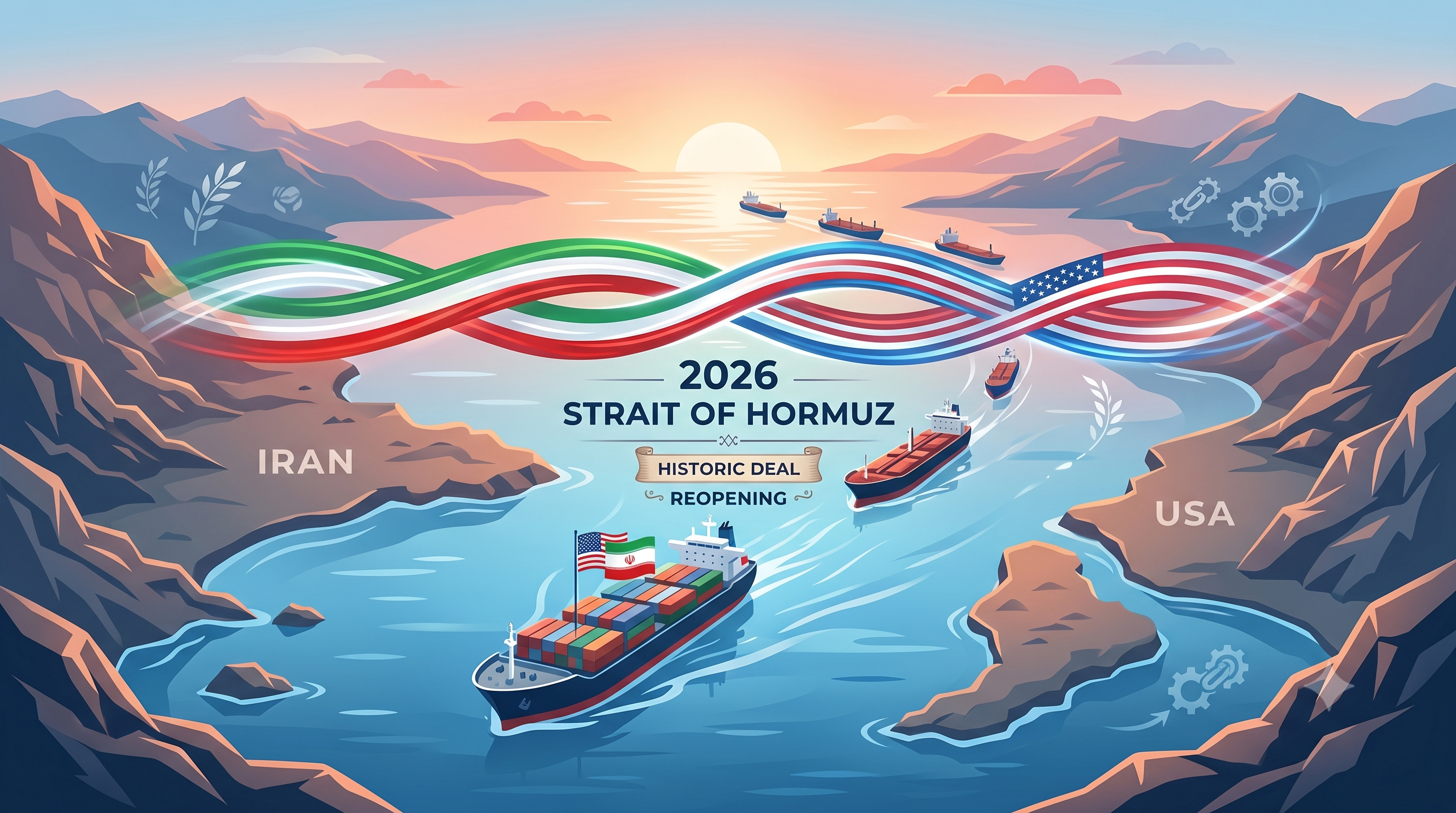
At the very heart of the economic relief triggered by this agreement is the immediate reopening of the Strait of Hormuz. For the past several months, this critical maritime chokepoint—a narrow waterway positioned between the Persian Gulf and the Gulf of Oman—has been the absolute epicenter of global supply chain anxiety.
According to baseline historical data established by the U.S. Energy Information Administration (EIA), the Strait is undeniably the world's most important oil transit chokepoint. In normal conditions, it facilitates the daily flow of over 20 million barrels of crude oil and petroleum products, representing roughly 20% of global petroleum liquids consumption.
The geopolitical risk premium attached to the Strait during the early 2026 conflict forced massive, systemic detours. As hostilities escalated, commercial shipping companies faced impossible logistical hurdles. War-risk insurance premiums for Very Large Crude Carriers (VLCCs) skyrocketed, echoing historical data trends tracked by maritime intelligence firms like Lloyd's List. When insurance becomes unviable, shipping fleets are forced to reroute around the Cape of Good Hope, adding weeks to transit times, burning millions of dollars in extra bunker fuel, and severely restricting the global supply of available maritime vessels.
The US-Iran agreement mandates that the Strait will immediately reopen to all commercial vessels, free from the threat of military harassment or seizure. Simultaneously, the lifting of the US naval blockade on key Iranian maritime hubs—most notably the port of Bandar Abbas—marks the imminent return of significant Iranian crude output to the global market. The physical unblocking of these ports means that millions of barrels of stranded commodities can finally begin flowing into the open market to meet global demand.
The downstream effects on global supply chains are profound and immediate. Beyond just crude oil, the Strait of Hormuz is a vital artery for Liquefied Natural Gas (LNG), particularly for energy-hungry industrial bases in Asia and Europe. The normalization of shipping routes in the Middle East significantly reduces the cascading delays that have plagued manufacturing sectors worldwide. Freight forwarders are already recalibrating their routes to address the massive shipping backlog built up over the past quarter, anticipating a sharp, structural decline in transit times and container costs. For the physical economy, this acts as a massive pressure release valve.
The Macro Ripple Effect: Oil Prices, Inflation, and Central Bank Policy
While the physical reopening of ports is a logistical triumph for global trade, its translation into macroeconomic indicators is what truly dictates global capital flows. The most immediate and violent reaction to the June 14 announcement has materialized in global energy and commodities markets. The market is aggressively transitioning from pricing in a worst-case supply destruction scenario to anticipating a sudden, sustained influx of Iranian barrels alongside normalized transit for Saudi and Emirati exports.
This sharp decline in wholesale energy costs serves as the vital first domino in a much broader macroeconomic sequence. For the past several years, central banks, led primarily by the US Federal Reserve, have been engaged in a grueling battle against sticky inflation. As traditionally tracked and weighted by the U.S. Bureau of Labor Statistics (BLS), energy costs are a foundational component of the Consumer Price Index (CPI). Supply-side energy shocks do not just make gasoline more expensive; they cascade into higher logistics and transportation costs, elevated manufacturing overhead, and ultimately, higher headline inflation for everyday consumer goods.
By suppressing crude oil prices, the US-Iran peace deal effectively acts as a massive, synchronized economic stimulus for the global consumer. As energy inputs become cheaper, headline inflation data is expected to cool aggressively in the coming quarters due to favorable base effects. This dynamic fundamentally alters the playbook for the Federal Reserve.
Prior to this diplomatic breakthrough, central bankers were constrained by the terrifying threat of stagflation—they were entirely unable to cut interest rates aggressively due to energy-driven price pressures, despite clear warning signs of broader economic slowing. The unlocking of the Strait of Hormuz provides the exact macroeconomic tailwind required to justify a dovish policy pivot. With inflation expectations now firmly anchored by falling oil prices, the Fed, the European Central Bank (ECB), and the Bank of England (BoE) now possess the necessary runway to implement sustained rate cuts. In the financial world, this shift in expectation is known as a "liquidity injection via policy anticipation." It is this specific chain reaction—from physical oil unblocked, to inflation cooling, to central bank easing—that acts as the primary catalyst for the repricing of all digital and traditional financial assets.
Risk-On Resurgence: How the Geopolitical Thaw is Reshaping Asset Allocation
The immediate macroeconomic consequences of the peace deal—cheaper energy and the imminent prospect of looser monetary policy—are driving a massive, systemic reallocation of institutional capital. During the absolute peak of the US-Iran conflict in early Q2 2026, global markets exhibited textbook "risk-off" behavior. Capital aggressively fled toward safe-haven assets; physical gold surged to test new highs, the US Dollar Index (DXY) strengthened as a flight to cash, and yields on short-term US Treasuries compressed as investors prioritized pure capital preservation over yield generation or growth.
The Sunday announcement violently reversed this entrenched market psychology. We are now witnessing a powerful "risk-on" resurgence across all major asset classes. As the fear of a systemic geopolitical shock completely dissipates, portfolio managers and algorithmic trading desks are rapidly unwinding their defensive macro hedges. The capital exiting these safe-haven trades requires a new destination, and it is aggressively hunting for beta—assets that offer high growth potential and network adoption in a liquid, low-interest-rate environment.
Because the news broke over the weekend, traditional equities and bond markets were closed to retail and most institutional flow. As frequently highlighted by financial data providers like Bloomberg Terminal and CoinDesk, 24/7 digital asset markets acted as the absolute primary real-time barometer for global sentiment. Decentralized networks, operating without market holidays, circuit breakers, or opening bells, instantly absorbed the macroeconomic implications of the Trump announcement.
High-beta tech equities (like the constituents of the Nasdaq 100) and blue-chip digital assets like Bitcoin (BTC) and Ethereum (ETH) are acutely sensitive to the global cost of capital. When the broader market prices in fewer geopolitical tail risks and a more accommodative, liquidity-injecting Federal Reserve, the discount rate applied to future network growth and corporate earnings drops significantly. Consequently, the valuation of these risk assets expands dramatically. Perpetual futures funding rates in crypto markets flipped instantly from negative (bearish) to highly positive (bullish), indicating massive speculative inflows. The de-escalation in the Middle East has thus removed the primary headwind holding back global liquidity, effectively giving the green light for risk-on assets to resume their secular upward trajectories.
Post-Blockade Realities: Shifting Strategies in State-Level Energy Utilization
While global markets react to the broad strokes of inflation and central bank liquidity, the lifting of the US naval blockade presents a deeply fascinating, niche economic dilemma for Iran regarding state-level energy utilization. To fully grasp this, one must look at how heavily sanctioned nations have historically optimized their stranded energy resources over the past decade.
Historically, comprehensive research from the Cambridge Centre for Alternative Finance (CCAF) has highlighted how sanctioned nations with vast, unexportable energy reserves utilize excess electrical grid capacity for Proof-of-Work Bitcoin mining. During the periods of intense economic sanctions and naval blockades, Iran possessed massive reserves of crude oil and natural gas but lacked the ability to export them through traditional maritime routes for US dollars. To monetize this stranded energy, state-sponsored entities increasingly turned to energy-intensive computing. By routing excess electrical grid capacity—often powered by flared natural gas that would otherwise be wasted—into massive arrays of ASIC computing machines, Iran was able to convert physical, unsellable energy into highly liquid, borderless digital bearer assets.
This process essentially served as a sophisticated, cryptographic mechanism to completely bypass the naval blockade. It allowed the state to generate non-sovereign capital that could be used to fund imports and bypass traditional Western financial rails like SWIFT. The state's conviction in digital bearer assets became so deeply entrenched during the conflict that, at the height of the maritime standoff, Iranian officials even proposed a Bitcoin toll for ships passing through the Strait of Hormuz. While the new June peace agreement restores normal fiat-based global trade, this radical wartime proposal highlights a permanent shift: sovereign nations now actively view decentralized networks not just as alternative investments, but as highly strategic geopolitical tools.
Now, with the blockade officially lifted and the legal resumption of oil exports permitted under the new agreement, the fundamental economic calculus shifts entirely. Iran can once again sell its physical crude and refined products on the open global market for hard fiat currency. This raises critical questions for the digital asset industry about the future of state-level computing infrastructure in the region. Will the state continue to allocate valuable gigawatts of power to cryptographic mining operations when that same energy can now be exported directly at premium global prices?
The likely outcome is a strategic, measured rebalancing. While some legacy infrastructure will undoubtedly continue to operate to provide the state with a diversified treasury of non-sovereign assets, the aggressive, state-subsidized expansion of grid-tied mining operations may slow considerably. This potential transition will have a measurable impact on the global distribution of network hashrate. If a major state actor scales back its energy allocation to decentralized networks, it slightly reduces the global computing difficulty. This creates a highly profitable environment for compliant, publicly traded infrastructure operators and miners based in North America and the Nordics, shifting the center of gravity for network security further West.
Predictive Markets and the Speed of Information in 2026
The rapid unfolding of the US-Iran peace deal also highlighted a profound evolution in how geopolitical information is processed, disseminated, and priced in 2026. Long before traditional media outlets published their breaking news chyrons, and hours before President Trump’s definitive social media post on June 14, the probability of a peace agreement was already quietly surging on decentralized predictive markets.
Web3 prediction platforms, which utilize advanced blockchain infrastructure and decentralized oracle networks to allow users to wager stablecoins on real-world outcomes, served as the ultimate aggregator of asymmetric information. Throughout the opaque shuttle diplomacy orchestrated by Pakistan, political insiders, military analysts, and highly sophisticated quantitative algorithms were utilizing these decentralized platforms to express their conviction in a diplomatic breakthrough. Unlike traditional political polling or cable news punditry, predictive markets force participants to put tangible capital on the line, creating a "wisdom of the crowds" effect that is highly sensitive to ground truth.
In the critical days leading up to the announcement, open interest on smart contracts resolving to "US-Iran Ceasefire by End of Q2 2026" saw massive, unprecedented influxes of capital. As noted by leading on-chain analytics firms like Glassnode and Dune Analytics when analyzing similar historical macro events, this influx pushed the implied probability from a highly skeptical 15% to over 80% in a matter of hours.
This dynamic allowed astute macro traders to engage in highly profitable information arbitrage. By monitoring the on-chain order flow and liquidity pool dynamics of these predictive markets, sophisticated investors were able to completely front-run the traditional news cycle. They positioned their digital asset portfolios and equity futures for the impending drop in oil prices and the subsequent risk-on rally before the broader public was even aware a deal had been struck. The 2026 US-Iran agreement stands as a definitive case study in the maturation of these Web3 systems. It proved conclusively that in an era of fragmented media and highly controlled state narratives, financially incentivized, decentralized markets provide the absolute most accurate, real-time barometer of geopolitical reality.
FAQs
When exactly will commercial shipping resume in the Strait of Hormuz?
Commercial shipping is authorized to resume immediately following the official announcement on June 14, 2026. Maritime logistics companies are currently recalibrating routes, and full operational capacity is expected to be restored shortly after the formal document signing in Switzerland on June 19, 2026.
How does the reopening of the Strait impact global inflation?
According to the EIA, the Strait of Hormuz facilitates roughly 20% of the world's petroleum liquids consumption. Unlocking this chokepoint increases global oil supply, driving down energy prices. Because energy is a heavily weighted component in the CPI, a sustained drop in oil prices directly contributes to cooling global headline inflation.
Why are high-beta risk assets reacting so strongly to the peace deal?
High-beta risk assets are acutely sensitive to central bank liquidity. By driving down oil prices and cooling inflation, the peace deal gives central banks the economic justification to lower interest rates. Lower borrowing costs make high-growth tech and digital assets much more attractive to institutional investors.
Disclaim: This article is for informational purposes only and does not constitute financial or investment advice. Cryptocurrency investments carry significant risk. Always conduct your own research before trading.