

Is the Dollar at Risk? Treasury Buybacks Raise Yield Curve Control Concerns and Bitcoin Questions
2026/08/24 14:20:00
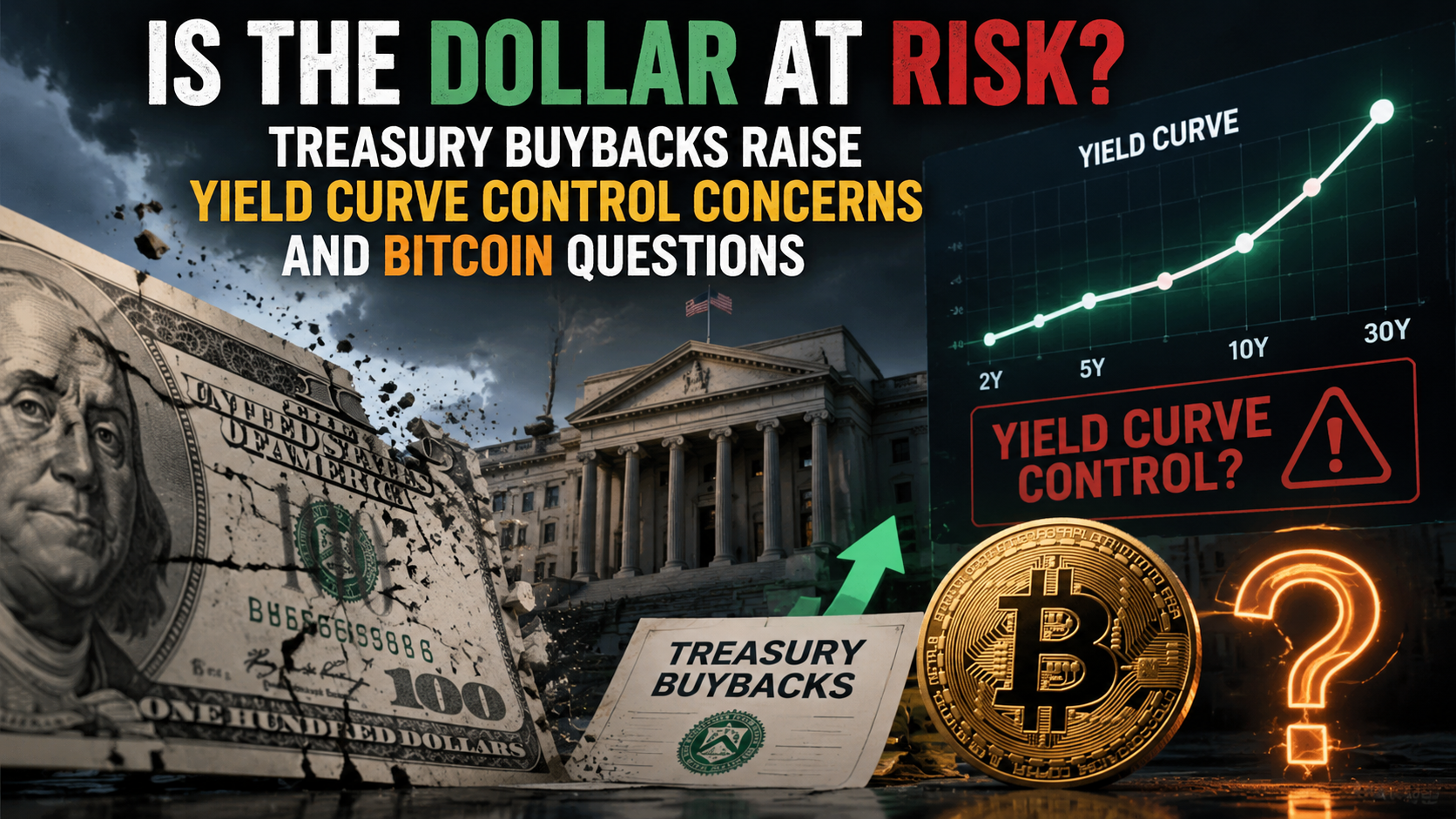
Treasury Buybacks Ease Bond Pressure as Bitcoin Benefits From Rising Dollar Concerns
US Treasury Secretary Scott Bessent’s significant decision in mid-August 2026 to at least double the size of liquidity-support buybacks for 10- to 30-year securities came after the 30-year yield reached its highest level since 2007, while public debt crossed the monumental threshold of $40 trillion. This strategic move briefly lowered long-end yields, weakened the dollar, and coincided with an impressive surge of approximately 25 percent in Bitcoin, which liquidated billions in short positions held by investors. In the aftermath, markets quickly engaged in a vigorous debate over whether this action represented ordinary debt-management practices or the early outlines of a softer yield-curve control strategy that could ultimately shift the burden of adjustment onto the currency itself.
The expanded Treasury buybacks effectively address immediate long-end liquidity strains, yet they leave unresolved critical issues such as persistent fiscal deficits, heavy private-sector issuance, and ongoing credibility questions that continue to exert pressure on the dollar. These factors simultaneously elevate interest in scarce digital assets, such as Bitcoin, which have gained significant traction among investors seeking alternatives in a volatile financial ecosystem.
Treasury Expands Long-Dated Buybacks After Yield Spike to Multi-Year Highs
On August 19, 2026, the Treasury Department announced it would raise the maximum size of liquidity-support buyback operations in the 10-to-20-year and 20-to-30-year sectors from $2 billion to at least $4 billion per operation. The change takes effect September 9 and runs through the next quarterly refunding on November 4. Officials cited consistent strong sponsorship and high-quality offers in those longer-dated segments as the rationale. The announcement followed a sharp sell-off that pushed the 30-year yield to approximately 5.34 percent, its highest reading since June 2007, while the 10-year approached 4.75 percent. Debt outstanding had just exceeded $40 trillion for the first time. The initial market reaction was decisive: the 30-year yield fell nearly nine basis points, and the 10-year dropped more than five basis points on the day. Long-dated Treasury futures rallied sharply amid thin late-summer liquidity and heavy short positioning that amplified the move.
Secretary Bessent later indicated the operations could exceed the $4 billion figure depending on market conditions. He framed the program as a tool to support orderly trading in a sector competing with elevated corporate issuance, particularly for artificial-intelligence infrastructure. Analysts noted that the absolute size remains modest relative to the multi-trillion-dollar long-end market, yet the timing, immediately after yields hit multi-decade highs, signaled official discomfort with the level of borrowing costs. The program is financed through regular short-term issuance rather than new money creation, distinguishing it from quantitative easing. Still, the rapid response raised questions about how far authorities are prepared to go if long-end pressure reappears after the current refunding window closes.
How Expanded Buybacks Function as Debt Management Tool
Treasury buybacks retire older, less liquid off-the-run securities and replace them with newer, more liquid on-the-run debt issued through regular auctions. Total debt stock remains unchanged; only the composition shifts toward securities that trade more readily. In the current program, the focus is explicitly on the long end, where liquidity has been thinner, and term premia have risen. By absorbing older 10-to-30-year paper, the operations reduce the volume of duration that private investors must hold, which can temporarily support prices and compress yields. Officials emphasize that the operations respond to observed demand rather than a predetermined yield target. Historical buyback programs have served similar liquidity and efficiency purposes without being interpreted as formal yield-curve control.
The mechanical impact is limited by scale. Even at $4 billion or higher per operation, the incremental volume over the remaining quarter is measured in the low tens of billions, modest against roughly $5.5 trillion of outstanding 20- and 30-year debt, and quarterly net issuance needs estimated near $550 billion. Market participants therefore view the announcement more as a signaling device than a decisive supply reduction. Some strategists described it as a weak-form Operation Twist: buying longer-duration securities while continuing to issue shorter-dated bills. This approach can ease near-term pressure on long yields but leaves the government more exposed to future rate fluctuations when the short-term debt must be rolled. The distinction between liquidity support and yield management has become the central analytical question for investors assessing the program’s durability.
Soft Yield Curve Control Signals and Investor Reactions
Several market observers characterized the buyback expansion as sitting close to the boundary of yield-curve control without crossing into an explicit commitment to defend a particular rate level. Formal yield-curve control, as practiced in Japan or briefly contemplated elsewhere, involves an open-ended promise to purchase whatever volume is required to keep yields at a stated ceiling. The Treasury program has a defined size, a fixed calendar window, and no published yield target. That mechanical difference is important. At the same time, the willingness to enlarge operations promptly after yields reached politically sensitive levels has led analysts to describe the action as “soft-form financial repression” or a “mini” version of earlier dollar-stress episodes.
Investor reaction mixed relief with skepticism. Long-end yields initially declined, yet by the following sessions much of the move had retraced as fundamental concerns, persistent fiscal deficits, above-target inflation, and heavy corporate supply reasserted themselves. Strategists at major houses argued that a moderately larger buyback program alone is unlikely to reverse the upward trend in term premia. Credibility concerns also surfaced: if markets conclude that officials will intervene whenever long yields become uncomfortable, private buyers may demand still higher premia in the future or reduce their willingness to absorb duration. The episode therefore illustrates both the short-term power of official signaling and the limits of that power when the underlying fiscal trajectory remains unchanged.
Rising Public Debt Surpasses 40 Trillion Milestone
US public debt crossed the $40 trillion threshold in the same week the buyback expansion was announced. The milestone arrived against a backdrop of elevated primary deficits and rising net interest costs that already exceed defense spending in absolute terms. Higher long-term yields amplify the fiscal feedback loop: each incremental basis-point increase raises the projected interest burden on the growing stock of debt. Officials have indicated that a new fiscal-consolidation effort is under discussion, yet markets have treated such statements with caution given the political calendar and the structural drivers of recent deficits.
The composition of the debt stock has also shifted. Greater reliance on shorter-dated issuance to fund expanded long-end buybacks reduces average maturity and increases rollover risk. When short-term rates eventually rise or remain elevated, the interest-cost impact arrives more quickly. Foreign official demand, once a reliable absorber of long-duration Treasuries, has shown signs of caution, partly reflecting currency and geopolitical considerations. Domestic buyers, banks, asset managers, and households must therefore absorb a larger share. The combination of a larger absolute debt stock, a potentially shorter average maturity, and elevated term premia creates a more challenging environment for debt management even if individual buyback operations succeed in smoothing day-to-day liquidity.
Dollar Weakness Emerges Amid Intervention Concerns
The dollar index declined sharply on the buyback announcement, recording one of its largest daily drops in months outside of prior intervention episodes, and traded near three-month lows against a basket of major currencies. Currency strategists noted that containing long-end yields through official purchases can reduce the interest-rate differential that has supported the dollar while also raising questions about the willingness of authorities to allow market-clearing prices. If investors conclude that yields will be managed rather than left to equilibrate, the currency itself may become the residual variable that absorbs adjustment.
Several houses explicitly linked the buyback expansion to renewed dollar-debasement concerns. The argument is not that the Treasury is engaged in monetary financing, new money is not being created, but that repeated efforts to prevent yields from rising fully can ultimately undermine the attractiveness of dollar assets. Lower yields reduce the opportunity cost of holding non-yielding or lower-yielding alternatives, while credibility frictions may encourage diversification. Gold rose more than 3 percent in the immediate aftermath, consistent with this interpretation. The dollar’s weekly performance turned negative even as yields partially recovered, suggesting that the intervention signal itself carried lasting weight for currency markets.
Bitcoin Rally Driven by Yield Compression and Short Squeeze
Bitcoin advanced roughly 25 percent in the days following the Treasury announcement, moving from the mid-$60,000 range to levels approaching $78,000–$80,000. The rally coincided with the compression of long-term yields and the liquidation of an estimated $4 billion in leveraged short positions across crypto markets. Lower nominal and real yields reduce the opportunity cost of holding a non-yielding asset, while the abrupt shift in risk appetite forced short covering that amplified price gains. Spot Bitcoin exchange-traded funds recorded hundreds of millions of dollars in inflows during the same window, reinforcing the move.
Analysts emphasized that the buybacks themselves are not quantitative easing and do not inject new reserves into the banking system. The transmission channel ran primarily through yields and positioning rather than direct liquidity creation. Nonetheless, the episode reinforced a pattern in which official actions that ease financial conditions or signal concern about high real yields have historically supported Bitcoin. The speed of the advance also highlighted the market’s elevated short interest heading into the announcement; once yields turned lower, the forced covering cascade became self-reinforcing. Subsequent sessions showed some consolidation, yet the weekly performance ranked among the strongest in recent years and drew renewed attention to Bitcoin’s sensitivity to Treasury-market developments.
Market Liquidity Challenges in Thin Summer Trading
August trading conditions are typically thinner, with many institutional participants operating at reduced capacity. The long end of the Treasury curve has historically exhibited lower secondary-market depth than the benchmark 10-year sector. When selling pressure intensified, driven by fiscal concerns, inflation data, and competing corporate supply, the resulting price moves were larger than they might have been in a more liquid environment. Treasury officials explicitly referenced the desire to provide greater liquidity support in sectors that routinely attract high-quality offers during buyback operations.
By increasing the size of those operations, the Treasury acts as a more significant buyer of older long-dated paper, which can improve market functioning and reduce the risk of disorderly yield spikes. Market participants noted that the program also discourages aggressive short positioning by introducing the possibility of sudden official demand. At the same time, reliance on buybacks to smooth liquidity does not expand the overall investor base or resolve the structural mismatch between supply and demand for duration. If private demand remains cautious; officials may face repeated pressure to enlarge operations or alter issuance patterns, extending the period of active debt-management intervention.
Fiscal Deficits and Corporate AI Borrowing Pressure Yields
Two concurrent supply factors have elevated term premia. Persistent federal deficits require continued heavy Treasury issuance across the curve. Simultaneously, technology and infrastructure firms have issued large volumes of corporate bonds to finance data center and artificial intelligence projects, offering higher yields that compete directly with longer-dated Treasuries. The combination has forced investors to demand greater compensation for holding government duration. Inflation remaining above the Federal Reserve’s 2 percent target has further limited the scope for a sustained decline in nominal yields.
Buybacks can absorb a portion of the long-end supply temporarily, yet they do not reduce the overall financing need. When the Treasury buys longer paper and issues shorter bills, it merely rearranges the maturity profile. Net issuance of government debt continues, and private-sector borrowers continue to compete for capital. Strategists have therefore described the buyback expansion as addressing a symptom, elevated long yields, while the underlying drivers of supply remain intact. Until fiscal trajectories or private investment demand moderate, the structural upward pressure on term premia is likely to persist beyond the current operational window.
Analyst Views on Temporary Relief Versus Structural Issues
Fixed-income strategists broadly characterized the buyback increase as capable of delivering short-term relief but insufficient to alter the medium-term outlook. One senior portfolio manager likened larger buybacks to “a band-aid on a bullet hole,” arguing that the volume is small relative to the forces pushing yields higher. Others noted that the signaling value may be more important than the mechanical absorption of securities: by demonstrating a willingness to act, the Treasury may reduce the risk of a self-reinforcing sell-off in the near term. A recurring theme is the distinction between technical market-functioning support and attempts to manage the level of yields.
When interventions are perceived as the latter, they can inadvertently raise the term premium demanded by private investors who worry about future policy unpredictability. Several houses also showed the interaction with Federal Reserve policy. If the Treasury is actively working to contain long-end yields while the central bank remains focused on inflation, the two institutions’ objectives may appear less aligned, complicating communication and market interpretation. Most analysts conclude that durable relief requires either a meaningful improvement in the fiscal outlook or a clear decline in inflation expectations, neither of which is guaranteed by the current buyback schedule.
Inference for Global Capital Flows and Foreign Demand
Foreign official institutions have historically been important buyers of long-duration Treasuries. Recent years have seen a more cautious stance, influenced by currency volatility, geopolitical considerations, and the availability of alternative reserve assets. An environment in which US authorities are perceived to manage yields more actively could further influence allocation decisions. If the dollar weakens as a result of lower yield differentials or credibility concerns, the total return on dollar-denominated holdings declines for foreign investors, potentially reinforcing diversification flows.
At the same time, any sustained compression of US long yields relative to those in other major markets can alter relative-value calculations and capital flows. Emerging-market and European assets may benefit from a softer dollar and reduced US rate pressure, while gold and other non-yielding stores of value have already shown sensitivity. The global implications therefore extend beyond the Treasury market itself: official actions that prioritize domestic borrowing-cost management can have spillover effects on currency markets, cross-border portfolio allocation, and the relative attractiveness of alternative reserve assets.
Potential for Further Buyback Increases Under Bessent
Secretary Bessent has stated publicly that the size of operations could exceed the newly announced $4 billion ceiling and that the Treasury possesses a “big toolkit.” The willingness to adjust parameters in response to market conditions leaves open the possibility of additional enlargements before or after the November refunding. Markets will watch the actual executed volumes beginning September 9 for evidence of how aggressively the program is being used.
Further increases would intensify the debate over the boundary between liquidity support and yield management. If operations scale significantly, the effective reduction in long-end private supply grows, raising the odds that investors interpret the program as a form of soft yield-curve control. Conversely, if volumes remain close to the stated minimum and yields continue to grind higher, the episode may be remembered primarily as a temporary smoothing exercise. The next quarterly refunding announcement in early November will provide the first formal opportunity to recalibrate the program and communicate longer-term intentions.
Asset Class Responses, Including Gold and Equities
The Gold price climbed more than 3 percent immediately following the announcement, reflecting the precious metal’s historical sensitivity to declining real yields and a weaker U.S. dollar. Equity markets also strengthened as lower discount rates supported valuations and improved overall risk appetite. The broad-based rally across cryptocurrencies, precious metals, and equities highlighted that investors viewed the Treasury action as a form of financial easing, despite the fact that it did not involve any direct expansion of the money supply.
The common thread across asset classes was the reduction in long-term yields and the associated decline in the opportunity cost of holding riskier or non-yielding assets. Positioning amplified the moves: elevated short interest in Bitcoin produced a cascade of liquidations, while equity futures responded to the sudden improvement in the rate backdrop. Subsequent sessions showed partial retracement in yields and some consolidation in risk assets, yet the initial reaction demonstrated how quickly official debt-management decisions can transmit across markets when liquidity is thin and positioning is one-sided.
Future Questions on Dollar Reserve Status
The episode has revived discussion of whether repeated official efforts to contain long-term yields could gradually erode the dollar’s relative attractiveness as a reserve currency. The concern is gradual rather than abrupt: if investors come to expect that US authorities will intervene to prevent yields from fully reflecting fiscal and inflation realities, the risk premium attached to dollar assets may rise and diversification into alternatives may accelerate. Bitcoin’s sharp response is one manifestation of that search for scarce, non-sovereign stores of value.
No single buyback program determines reserve-currency status. The dollar retains deep markets, network effects, and the backing of the world’s largest economy. Yet the combination of a $40 trillion debt stock, rising net interest costs, and visible official discomfort with market-clearing yields has prompted closer scrutiny of long-term sustainability. Markets will continue to test whether future debt-management tools remain limited to liquidity support or evolve into more persistent efforts to shape the yield curve. The answer will influence not only Treasury prices but also the dollar’s exchange value and the relative performance of alternative assets in the years ahead.
FAQs
How large are the expanded Treasury buybacks relative to the overall market?
The maximum size per operation has risen from $2 billion to at least $4 billion for the 10-to-20-year and 20-to-30-year sectors, running from September 9 through November 4, 2026. Even if operations consistently hit or exceed the new ceiling, the cumulative volume remains modest compared with several trillion dollars of outstanding long-dated debt and quarterly net issuance needs measured in the hundreds of billions. The program’s significance therefore lies more in its signaling content and its effect on near-term liquidity than in a decisive reduction of net supply.
Do the buybacks constitute quantitative easing or formal yield-curve control?
They do not create new bank reserves or involve Federal Reserve balance-sheet expansion, so they are not quantitative easing. Formal yield-curve control would require an open-ended commitment to purchase whatever volume is needed to defend a specific yield target. The current program has a defined size, a fixed calendar, and no published yield ceiling. Many analysts nonetheless describe it as a soft or limited form of yield management because of the timing and the willingness to enlarge operations after yields reached multi-year highs.
Why did the dollar weaken after the announcement?
Lower long-term yields reduced the interest-rate differential supporting the dollar. In addition, the perception that authorities are prepared to manage yields rather than allow full market clearing raised questions about the attractiveness of dollar assets. Currency strategists noted that if yields are contained through official action, the exchange rate may become the residual variable that absorbs fiscal and inflation pressures, contributing to the observed decline in the dollar index.
What explains Bitcoin’s sharp rally?
The compression of long-term yields lowered the opportunity cost of holding a non-yielding asset. Simultaneously, a large concentration of leveraged short positions was forced to cover as prices rose, producing liquidations estimated near $4 billion and amplifying the upward move. Spot Bitcoin exchange-traded funds also recorded meaningful inflows. The combination of a more supportive rate backdrop and extreme positioning produced one of the strongest weekly advances in recent years.
Will the buybacks permanently lower long-term yields?
Most analysts expect only temporary relief. Structural drivers, large fiscal deficits, elevated corporate issuance for artificial-intelligence projects, and inflation still above target remain in place. Once the initial short-covering and liquidity effects fade, yields tend to retrace a substantial portion of the decline. Durable lower yields would require either a clearer improvement in the fiscal outlook or a sustained decline in inflation expectations.
🔥 KuCoin Offers A More Stable Option in A Volatile Market
If you worry about the frequent ups and downs in the market, and pursue a more stable option to earn money passively, KuCoin is the right place to come:

Simple Earn: Deposit and withdraw tokens anytime, earning stable returns.
Kucoin Earn: Earn stable profits with professional asset management.
Hold to Earn: Earn rewards by holding assets in Funding, Trading, Margin, Futures, Mining, and Unified Accounts.
Staking: Unlock the earning potential of on-chain assets.
Advanced Investments: Advanced Investments offer a variety of structured products to help your money grow in any market.
Shark Fin: Principal Protection and Guaranteed Gains
Dual Investment: Buy low and sell high with transparent return calculations.
Snowball: High yields, with price protection.
Discount Buy: Buy crypto at discount prices.
KCS Loyalty: Level up to enjoy exclusive perks by staking ≥ 1 KCS.
KuCoin Wealth: Discover future value and begin your smart investing journey.
KCS Benefits: Hold and stake KCS to access benefits across the platform.
KCS Staking 2.0: Participate in KCS on-chain governance to earn yield.
Disclaimer: This content is for informational purposes only and does not constitute investment advice. Cryptocurrency investments carry risk. Please do your own research (DYOR).