

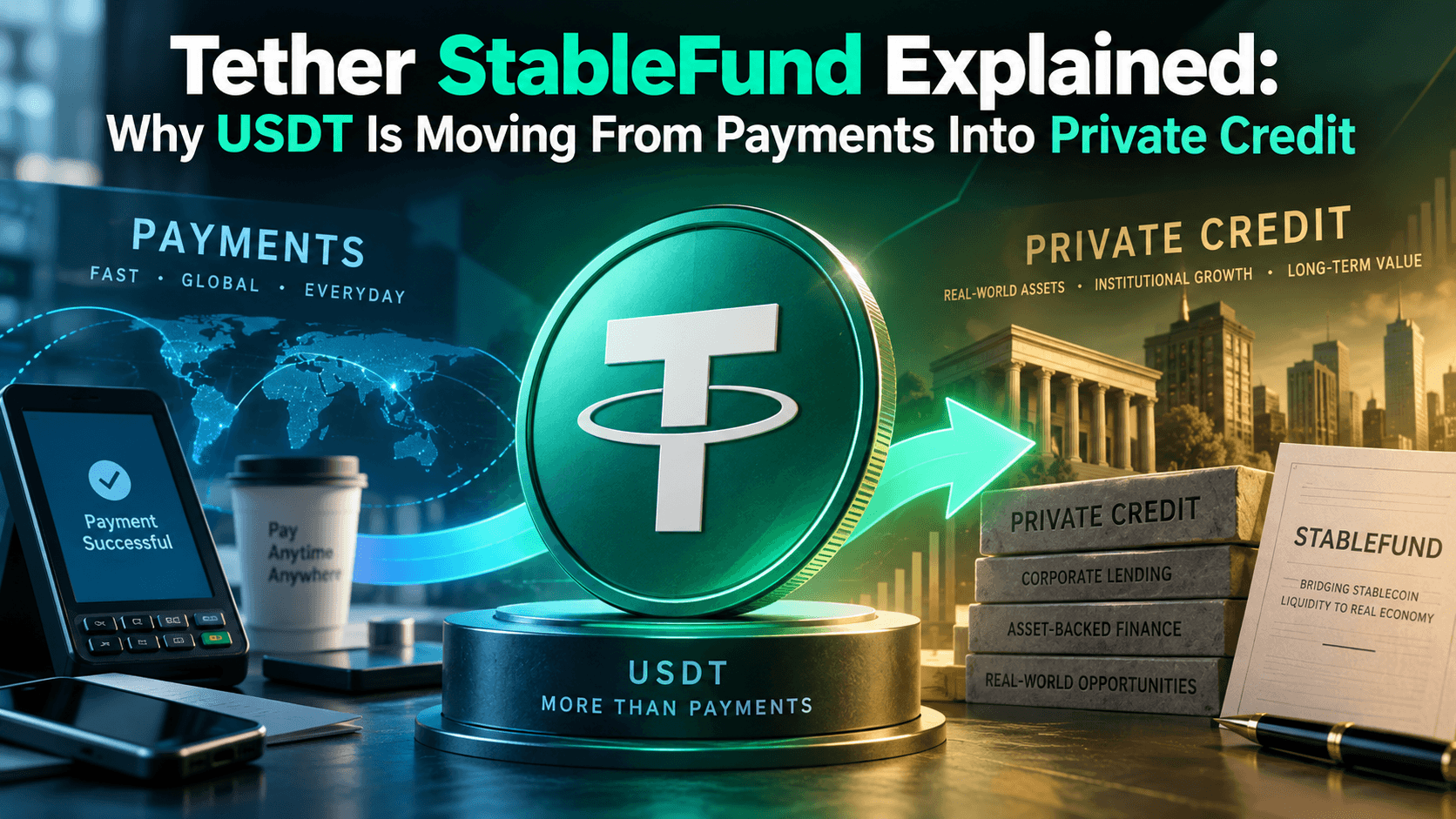
Tether StableFund Explained: Why USDT Is Moving From Payments Into Private Credit
Key Takeaways
-
Tether and Fasanara Capital have launched StableFund with $400 million in sponsor capital, while targeting up to $3 billion in third-party institutional investment.
-
StableFund does not simply mean small businesses will borrow USDT directly. Tether is positioning USDT as settlement, treasury and cross-border infrastructure supporting private-credit flows.
-
The opportunity is significant, but so are the risks. Private credit is growing rapidly, yet borrower stress, loan markdowns and redemption pressure show that blockchain settlement cannot eliminate traditional credit risk.
Tether is pushing USDT deeper into traditional finance. On September 9, 2026, the stablecoin issuer and London-based Fasanara Capital launched StableFund, an evergreen private-credit vehicle backed by $400 million in initial sponsor capital and designed to attract as much as $3 billion from outside institutional investors. The fund will target short-duration, asset-backed lending opportunities, particularly through fintech platforms serving small and medium-sized businesses and consumers.
The launch comes as USDT has grown to a market capitalization of roughly $183.4 billion, making it one of the largest dollar-linked digital assets in the world. Yet StableFund suggests that Tether increasingly sees USDT as more than a tool for crypto trading, remittances and payments.
The bigger question is whether stablecoins can become part of the infrastructure that moves institutional credit capital around the global economy.
What Is Tether StableFund?
StableFund, formally described as the Tether-Fasanara Lending Fund, is an evergreen private-credit vehicle jointly sponsored by Tether and Fasanara Capital. The two sponsors have committed $400 million in combined capital, while the fund is targeting up to $3 billion in additional third-party institutional commitments. Its mandate focuses on short-duration, asset-backed private-credit strategies designed to channel institutional money toward real-economy borrowers. Tether says the broader private-credit market is already worth about $3 trillion globally and could reach $5 trillion by 2029.
The term “evergreen” is important. Unlike a traditional closed-end private-credit fund that raises capital, invests for a fixed number of years and eventually winds down, an evergreen vehicle can continue reinvesting repayments and deploying new capital over time. That makes StableFund potentially more suitable for building a permanent lending platform rather than a one-off investment pool. The target areas include SME lending, consumer credit, receivables and other forms of asset-backed financing distributed through Fasanara's fintech network.
StableFund should therefore not be confused with a typical DeFi lending protocol. It is not simply an onchain pool where borrowers deposit crypto collateral and receive stablecoins. It is an institutional private-credit strategy that plans to use stablecoin infrastructure around the movement and settlement of capital.
How Does USDT Fit Into Private Credit?
The most common misunderstanding is that StableFund means businesses will simply apply for loans and receive USDT directly into a wallet. That may happen in certain cases, but it is not the only or even necessarily the main model described by the fund. Fasanara will act as investment manager, handling credit origination, underwriting, portfolio construction and risk management, while Tether will source USDT-linked financing opportunities and provide stablecoin settlement infrastructure. That infrastructure includes on- and off-ramp connections and treasury rails designed to move capital across borders more efficiently.
A more realistic flow could look like this: an institutional investor commits capital to StableFund, Fasanara deploys that capital through a fintech lender, and the fintech ultimately provides financing to an SME or consumer in local currency. USDT may operate in the background to move funds between institutions, jurisdictions or treasury accounts. In that model, the borrower may never interact directly with USDT at all. The stablecoin functions as financial plumbing rather than as the visible loan product.
That distinction is important because it changes the StableFund story from “Tether is lending stablecoins to businesses” into something much broader. USDT is being positioned as an infrastructure layer for credit-market settlement. If the model works, the value proposition of a stablecoin would no longer be limited to sending digital dollars quickly between two users. It could also help institutional investors move lending capital between funds, fintech platforms and real-economy borrowers.
Why Is Tether Moving Beyond Payments?
USDT's first major use case was crypto trading. Stablecoins made it easier for traders to move dollar value between exchanges without repeatedly using the banking system. The second stage expanded into remittances, cross-border payments and dollar savings, particularly in markets where access to U.S. dollars is expensive or unreliable. StableFund points toward a possible third stage: capital-market infrastructure.
That shift makes strategic sense for Tether. USDT already has a market capitalization near $183.4 billion and enormous daily transaction liquidity. If stablecoins are integrated into trade finance, private credit, treasury management and institutional settlement, financial institutions gain more reasons to hold and use them beyond crypto trading. That can strengthen network effects: more institutional usage creates more liquidity, which makes the settlement asset more useful, which in turn encourages additional integration.
StableFund is therefore not only an investment product. It can also be viewed as a distribution strategy for USDT. Tether's long-term opportunity is to make the stablecoin useful wherever dollar-denominated capital needs to move. Payments remain a large part of that market, but credit, securities settlement and corporate treasury flows could be significantly larger. StableFund tests whether Tether can take the infrastructure that already works in crypto markets and insert it into more traditional forms of lending.
Why Fasanara Matters
Private credit requires a different skill set from issuing a stablecoin. Moving money quickly does not determine whether a borrower deserves financing. Credit managers need to assess cash flow, collateral quality, leverage, default probability, recovery values and legal enforceability. That is why Fasanara's role is central rather than secondary.
Fasanara manages more than $6 billion and already invests across areas including SME lending, consumer credit, trade receivables and supply-chain finance. Its fintech network reaches more than 60 countries, giving StableFund access to existing origination channels instead of forcing Tether to build a lending operation from scratch. Tether brings capital, a global USDT network and settlement technology; Fasanara brings underwriting, borrower selection and portfolio management.
The division of labor highlights an important point about the broader tokenization and stablecoin trend. Blockchain technology may reduce friction around settlement, but it does not replace the need for traditional financial expertise. StableFund's success will depend at least as much on Fasanara's ability to price credit risk correctly as on Tether's ability to move dollars efficiently.
Why Private Credit Is Attractive — and Risky
The timing of StableFund reflects one of the biggest structural shifts in global finance. Private credit has expanded as banks have become more selective and companies have looked for alternatives to public bond markets. SMEs are particularly important because they often need more flexible financing than banks are willing to provide, while issuing public debt is usually unrealistic. Tether and Fasanara estimate the global SME financing gap at around $5.7 trillion. In Asia alone, private credit is projected to grow from about $59 billion in 2024 to $92 billion by 2027, with demand coming from businesses seeking flexible capital without giving up equity.
But private credit is also entering a more difficult phase. The IMF warned in April that payment defaults in direct lending had continued to rise from a low base and that a severe rate or earnings shock could push selective default rates two to three times above levels seen in recent years. It also highlighted liquidity risks in semiliquid private-credit vehicles, particularly when investors demand redemptions faster than illiquid loans can realistically be sold. Reuters has also documented markdowns across U.S. private-credit portfolios in 2026, particularly in software-related loans, while major funds have faced elevated redemption requests.
There are signs that pressure may be stabilizing. BlackRock's flagship HPS Corporate Lending Fund saw third-quarter redemption requests fall to about 11.5% from 13.3% in the previous quarter, although the fund still planned to repurchase only its customary 5% of shares. The mixed picture is important for StableFund. USDT may improve settlement speed and reduce cross-border friction, but it cannot improve a borrower's balance sheet. USDT can change how private-credit capital moves, but it cannot change whether a borrower can repay.
Does StableFund Put USDT Reserves at Risk?
This is the most important balance-sheet question around the launch. The answer, based on Tether's current disclosures, is that StableFund should not be treated as evidence that the company is replacing liquid USDT reserves with private loans. Tether has explicitly stated that proprietary investments held through Tether Investments are funded from company profits and excess capital and are segregated from the reserves backing USDT.
That distinction matters because the two pools serve different purposes. USDT reserves need to support redemption and maintain confidence in the stablecoin's $1 peg, making liquidity and asset quality critical. Private-credit assets are naturally less liquid, harder to price and exposed to borrower defaults. If those loans directly replaced short-duration reserve assets, USDT holders would face a very different risk profile. Tether's Q1 2026 disclosure instead reported about $191.8 billion in total assets, $183.5 billion in liabilities and an $8.23 billion excess-reserve buffer, while saying proprietary investments remain outside the token reserve portfolio.
The appropriate interpretation is therefore more cautious: StableFund appears to be a corporate investment and strategic infrastructure initiative rather than a change in USDT reserve policy. Investors should still watch future disclosures closely, especially the source of Tether's StableFund capital and whether the relationship between StableFund and USDT reserves changes over time. But the current announcement does not support the claim that Tether is backing USDT with SME loans.
Is StableFund the Next Stage of the RWA Boom?
StableFund fits into the broader real-world asset trend, but it is different from the tokenized Treasury model that has dominated much of the RWA narrative. A tokenized Treasury fund typically takes a traditional financial asset, represents ownership or economic rights onchain and lets investors hold that token directly. StableFund is more focused on using stablecoins around the movement of private-credit capital. The loans themselves do not necessarily have to become freely traded blockchain tokens.
That distinction may actually make StableFund more significant as an infrastructure experiment. The future of RWA finance may involve more than putting every loan, bond or share directly on a public blockchain. Stablecoins can also sit between investors, asset managers, lenders and borrowers as a settlement layer. In that model, private credit remains governed by traditional underwriting and legal agreements, while blockchain changes how capital travels through the system.
If the model expands, stablecoins could increasingly compete for roles in trade finance, corporate treasury, securities settlement and wholesale cross-border transfers. That would move the stablecoin industry beyond the idea of “digital cash.” USDT and competing digital dollars would instead compete over which asset becomes the preferred settlement unit for real-world financial activity.
What Comes Next for StableFund?
The first thing to watch is fundraising. The $400 million sponsor commitment is meaningful, but StableFund's larger ambition depends on attracting up to $3 billion from third-party institutions. That target is not guaranteed. Institutional investors will want evidence that Fasanara can produce attractive risk-adjusted returns, control defaults and maintain enough liquidity for the structure promised to investors.
The second test is whether USDT becomes genuinely useful inside the fund rather than simply appearing in the marketing narrative. Investors should watch how much settlement actually occurs through USDT, which jurisdictions use stablecoin rails, whether fintech partners adopt the infrastructure and how much capital reaches SMEs and consumers through the system. Credit performance will matter just as much. Default rates, loss severity, loan duration and collateral quality will ultimately determine whether StableFund is financially successful.
The biggest strategic test is whether the model can scale beyond one fund. If institutional investors become comfortable using stablecoins for private-credit settlement, the same infrastructure could potentially expand into trade finance, receivables, supply-chain lending and other forms of real-economy credit. StableFund's success will therefore depend less on proving that blockchain can move money quickly and more on proving that fast settlement can coexist with disciplined underwriting.
🔥 Beyond the Headlines: What KuCoin 5.0 Means for You
Market news moves fast — but where you act on it matters just as much. This October, KuCoin launches KuCoin 5.0, transforming KuCoin into a rebuilt platform. Here's what actually changes for you:
-
One account for everything. Older platforms split your money across separate "spot," "margin," and "futures" accounts and expected you to understand why. KuCoin 5.0's unified account removes that entirely — deposit once, and everything is simply there.
-
Stocks, indices, and commodities. KuCoin 5.0 expands beyond crypto into global markets. When crypto chops sideways and equities rally (or the reverse), you rotate in minutes instead of opening a brokerage account and waiting days for fiat rails.
-
Real-world assets (RWA). Tokenized exposure to traditional assets like commodities, right inside your crypto account. One of the fastest-growing segments in global finance is no longer reserved for institutions — you access it from the same balance you trade with.
-
Earn while you learn. Not ready to trade? KCUSD lets your stablecoins earn daily, auto-compounding interest. The lowest-stress way to put your idle deposit to work for 4% yield.
-
An AI assistant in plain language. Ask questions, get market context, understand what you're looking at — built into the platform, no jargon required.
-
An app that doesn't overwhelm. Faster, cleaner, and consistent — intuitive from the first tap, not after a tutorial.
-
Safety you can check, not just trust. A MiCAR-licensed EU entity, Proof of Reserves you can verify yourself, and internationally certified security (SOC 2 Type II, ISO 27001:2022).
Create your account in minutes — and start on the platform built for where crypto is going, not where it's been.
Conclusion
StableFund does not mean Tether has suddenly become a bank, nor does it mean USDT reserves are being replaced by private loans. Its significance is more structural. Tether is testing whether the world's largest stablecoin can move beyond crypto trading and payments into the infrastructure that supports institutional credit markets.
That opportunity is substantial. Private credit is already a multi-trillion-dollar market, and SMEs continue to face a large financing gap. At the same time, recent defaults, portfolio markdowns and redemption pressure show why private credit cannot be treated as a risk-free extension of stablecoin payments.
If StableFund succeeds, USDT's next important use case may not be buying crypto or sending money across borders. It may be operating quietly in the background, moving institutional capital through the plumbing of global credit markets.
FAQs
Can retail investors invest in StableFund?
StableFund is currently positioned as an institutional private-credit vehicle. Investor eligibility will depend on the fund's legal structure, distribution rules and local securities regulations, so it should not be assumed to be a retail investment product.
Does StableFund pay investors yield in USDT?
The launch announcement does not describe StableFund as a simple USDT yield product. Returns are expected to come from the underlying private-credit portfolio, while the currency and mechanics of distributions depend on the fund's final investor terms.
Is StableFund a public DeFi protocol?
No. StableFund is an institutional private-credit fund. The use of USDT settlement infrastructure does not mean fund shares or underlying loans are automatically available for public trading on a blockchain.
How is private credit different from DeFi lending?
Private credit generally depends on real-world borrowers, legal contracts, underwriting and repayment capacity. DeFi lending often relies more heavily on transparent onchain collateral and smart-contract liquidation mechanisms. The risk models are therefore very different.
Could StableFund eventually tokenize its loans?
It is technically possible for private-credit assets to be tokenized in the future, but Tether and Fasanara have not announced that StableFund will place all of its loans onchain. Stablecoin-enabled settlement and asset tokenization should be treated as separate concepts.
Disclaimer: This article is for informational purposes only and does not constitute investment advice. Crypto assets can be highly volatile, and market conditions, token liquidity and project developments may change rapidly. Readers should conduct their own research and assess their risk tolerance before making financial decisions.