

SK Hynix Scraps Solidigm IPO: What It Means for Shareholders and AI Memory Growth
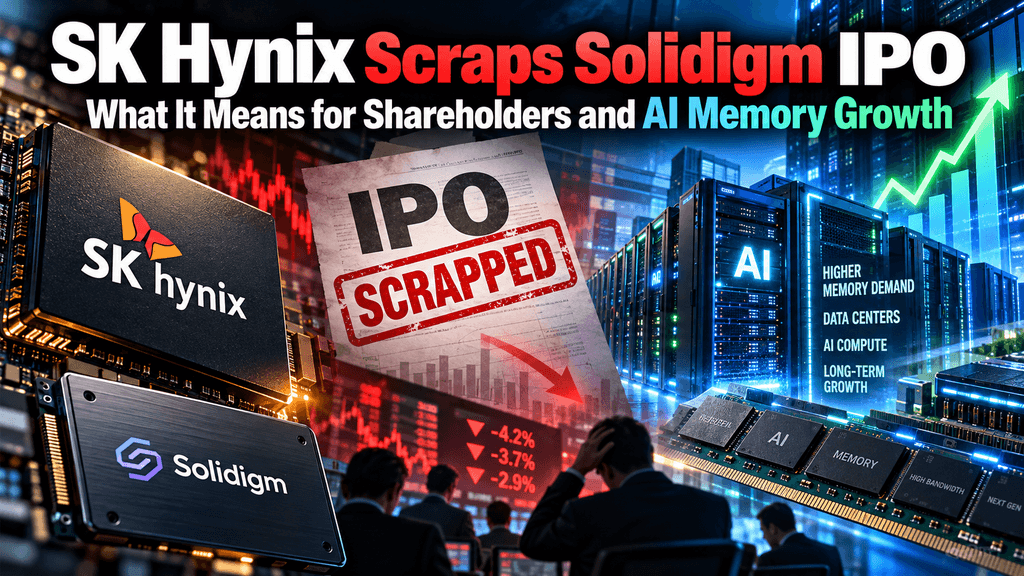
SK hynix has halted its review of a potential US initial public offering (IPO) for Solidigm, its US-based NAND flash memory and solid-state drive subsidiary, abandoning a fundraising route that could have supported a major expansion of its AI-related storage business. Announced on October 23, 2026, the decision reflects changing capital market conditions, semiconductor stock volatility, and questions about whether a separate listing would maximize value for existing shareholders.
The proposed IPO had attracted attention because Solidigm was reportedly considering a valuation of up to $150 billion and could have raised as much as $15 billion, according to Reuters. These figures were preliminary estimates, not finalized offering terms. SK hynix has emphasized that its commitment to Solidigm's growth remains unchanged and that alternative financing options will continue to be explored. The decision therefore changes the potential funding strategy rather than signaling an end to the company's AI storage ambitions.
Key Takeaways
-
Solidigm's IPO review has been halted: SK hynix cited capital market conditions and recent share price trends, while shareholder concerns and regulatory scrutiny over duplicate listings formed part of the wider debate.
-
The proposed fundraising was substantial: Earlier reports suggested proceeds of up to $15 billion and a potential valuation of $150 billion, but neither figure represented a completed transaction.
-
Shareholder dilution concerns may ease: Suspending the IPO removes the immediate prospect of a separate equity offering, although the long-term value impact depends on how Solidigm is financed.
-
AI storage demand remains relevant: Solidigm focuses on NAND flash memory and enterprise SSDs, which serve different functions from the high-bandwidth memory (HBM) used alongside AI accelerators.
-
Alternative financing is the next issue to watch: Direct investment, debt financing, and other capital allocation options could help support expansion without a separate public listing.
What Happened to SK hynix's Solidigm IPO?
SK hynix announced on October 23 that Solidigm would discontinue its review of potential pre-IPO fundraising and an IPO. The company explained that financial market conditions and share price trends had made it necessary to reconsider whether the proposed listing was the most beneficial option for SK hynix and its existing shareholders. Its official October 23 statement also reaffirmed that Solidigm's investment needs and growth priorities had not changed.
The decision followed reports that Solidigm was preparing for a possible US listing as early as 2027. According to Reuters' September 25 report, the offering could have raised up to $15 billion and valued the subsidiary at as much as $150 billion. Those estimates attracted investor attention because the proposed transaction could have provided substantial external capital for US manufacturing expansion while allowing the market to value Solidigm's business separately.
However, the distinction between suspending an IPO review and permanently abandoning a listing is important. SK hynix has stopped evaluating the current pre-IPO and IPO options, but it has not announced that Solidigm will never become a publicly traded company. The immediate question is how the parent company will finance its subsidiary's expansion and improve shareholder value without relying on the proposed offering.
Why SK hynix Planned a $15 Billion Solidigm Listing
Funding US Manufacturing Expansion
The potential IPO was intended to help Solidigm finance additional production capacity in the United States. Semiconductor manufacturing requires substantial upfront investment in facilities, equipment, process development, and production qualification. Raising external equity capital could reduce the amount SK hynix would need to fund directly and provide greater flexibility in allocating cash across its businesses.
Solidigm's expansion plans also reflect the growing importance of storage infrastructure in AI data centers. As operators deploy more computing capacity, they need systems capable of storing large datasets, model files, training checkpoints, and inference-related information. Enterprise SSDs are an important part of that infrastructure, although demand growth does not automatically guarantee that every planned manufacturing investment will generate attractive returns.
Establishing an Independent Market Valuation
A separate listing could have given investors a more direct way to assess Solidigm's NAND flash and enterprise SSD operations. Within a diversified semiconductor group, the market may value different business segments differently, making it difficult to determine how much each subsidiary contributes to the parent company's overall valuation.
The reported $150 billion valuation was an early estimate rather than an established market value. Any actual IPO valuation would have depended on financial performance, growth expectations, market conditions, investor demand, and the final offering structure. By suspending the process, SK hynix has avoided proceeding with an offering whose expected valuation or economic benefits might no longer justify the associated costs and shareholder concerns.
Supporting Capital Allocation and Shareholder Returns
SK hynix also presented the potential IPO as a way to strengthen consolidated cash flow and improve its ability to fund investments and shareholder returns. An equity offering could provide cash for expansion without requiring the parent company to finance the entire project from existing resources.
However, external fundraising is not automatically the most efficient option. Management must weigh the cost of capital, ownership dilution, market valuation, financing flexibility, and the strategic importance of retaining control. The decision to suspend the IPO indicates that SK hynix intends to reassess these trade-offs rather than proceed simply because an offering could raise a large amount of money.
Why South Korea's Duplicate-Listing Rules Matter
Understanding the Duplicate-Listing Controversy
The proposed Solidigm listing faced scrutiny because of concerns about how a separate offering could affect existing shareholders. In a typical subsidiary IPO, the parent company retains an ownership stake while outside investors purchase shares in the subsidiary. Depending on the structure, new share issuance can reduce the parent's ownership percentage or create a more complicated relationship between the subsidiary's standalone valuation and the value attributed to the parent.
This issue is particularly relevant in South Korea, where investors and regulators have increasingly focused on whether subsidiary listings adequately protect minority shareholders. In Solidigm's case, the proposed transaction attracted questions about whether the subsidiary's value could be better reflected through the existing parent company rather than through a separate US listing. Yonhap News Agency reported that regulatory scrutiny and shareholder opposition formed part of the backdrop to the decision.
Why a Subsidiary IPO Can Affect Parent-Company Valuation
A parent company's shares do not necessarily trade at the full market value of its underlying assets. Investors may apply a holding-company discount when they believe the corporate structure makes it difficult to realize subsidiary value, creates governance concerns, or limits the distribution of economic benefits.
A separate listing can help establish a transparent market valuation for a subsidiary, but it can also introduce uncertainty about ownership dilution and the allocation of future profits. The effect on the parent company therefore depends on whether the capital raised and growth enabled by the IPO outweigh any reduction in its economic interest or any additional valuation discount.
SK hynix's official explanation emphasized market conditions and shareholder value as the basis for suspending the review. Regulatory concerns should therefore be understood as part of the broader context, rather than presented as the company's sole stated reason for the decision.
The immediate consequence is that SK hynix will not proceed with the proposed Solidigm pre-IPO and IPO review. This removes the near-term prospect of a separate equity offering that could have changed the ownership structure, but it also leaves the company needing another way to fund Solidigm's growth. The long-term shareholder impact will depend on the alternative financing method, the return generated by future investments, and the extent to which the parent company can capture the resulting economic benefits.
| Area | Potential effect of suspending the IPO | What investors should monitor |
| Ownership dilution | Reduces immediate uncertainty about the proposed equity offering | Any future issuance or ownership restructuring |
| Financing | Removes one potential source of external equity capital | Debt levels, internal funding, and other financing arrangements |
| Valuation | Delays independent public-market price discovery for Solidigm | Segment disclosures and future valuation assessments |
| Capital investment | Expansion remains a priority but requires an alternative funding strategy | Investment timing, project scale, and cash flow |
| Shareholder returns | The company retains flexibility to assess dividends and repurchases | Official capital allocation announcements |
Why Share Prices May React Differently
Removing uncertainty about a potential subsidiary listing can support investor sentiment if shareholders believe the original proposal could have diluted their economic interests. However, the absence of a large fundraising option may also raise questions about financing costs and the pace of future expansion.
The broader semiconductor market adds another variable. Share prices respond to earnings expectations, industry valuations, interest rates, and demand forecasts, not just corporate announcements. Consequently, any movement in SK hynix shares following the decision should be assessed alongside the wider market environment rather than treated as definitive evidence that suspending the IPO creates or destroys value.
Can Solidigm Fund Its US NAND Expansion Without an IPO?
SK hynix has said it will continue evaluating alternative ways to support Solidigm's growth. Potential options include direct investment by the parent company, debt financing, or a combination of internal funds and external capital. Each approach has different implications for cash flow, leverage, ownership, and financial flexibility.
Direct investment would allow SK hynix to retain its existing ownership structure while funding additional production capacity. However, it would also increase the demands on the parent's capital budget. Debt financing could preserve ownership percentages and avoid issuing new equity, but it would create repayment obligations and expose the business to financing costs. The appropriate mix would depend on projected returns, the timing of investment needs, and the company's overall balance sheet.
The suspension does not establish that Solidigm's US manufacturing plans have been cancelled or that construction will necessarily be delayed. SK hynix has stated that the need to invest in Solidigm remains unchanged. Investors should therefore distinguish between the status of the IPO review and the status of specific manufacturing projects, for which separate announcements would be needed to confirm schedules, locations, capital expenditure, and production targets.
How Solidigm Fits Into the AI Memory and Storage Market
Solidigm was established after SK hynix acquired Intel's NAND flash memory and SSD business. Its core focus is NAND-based storage and enterprise SSDs, which support data-intensive workloads in servers and data centers. As AI infrastructure expands, storage becomes increasingly important for retaining training datasets, model parameters, checkpoints, and other information that must be accessed by computing systems.
However, NAND storage and HBM serve different purposes. HBM provides high-bandwidth memory close to AI processors, helping accelerators access data rapidly during computation. NAND flash and SSDs provide persistent, high-capacity storage. Both are relevant to AI infrastructure, but their technical characteristics, customer requirements, supply dynamics, and investment cycles differ.
This distinction matters when evaluating the significance of the Solidigm IPO decision. A change in Solidigm's financing strategy does not by itself demonstrate that AI memory demand is weakening. Instead, it changes how the company may fund its participation in the storage market. The key questions are whether enterprise SSD demand remains strong, whether Solidigm can expand capacity efficiently, and whether future investment produces returns that justify its cost.
The broader AI storage opportunity also carries risks. Customer investment plans can change, competitors may add capacity, and pricing can fluctuate with supply and demand. Higher demand alone does not guarantee higher margins. Solidigm's long-term performance will depend on product competitiveness, manufacturing efficiency, customer relationships, and the company's ability to match investment with sustainable demand.
What Investors Should Watch Next
The next stage will depend on decisions that have not yet been fully disclosed. First, investors should look for official details about alternative financing. The choice between direct parent-company investment, borrowing, and other funding arrangements will influence SK hynix's capital allocation and financial flexibility. Any future financing announcement should be evaluated on its actual terms rather than assumed to be equivalent to the previously discussed IPO.
Second, investors should monitor Solidigm's production expansion plans and operating performance. Updates on investment schedules, capacity, product qualification, and enterprise SSD demand would help clarify whether the subsidiary can continue its growth strategy without the proposed equity offering. Financial disclosures about profitability and capital expenditure would also provide a better basis for evaluating the potential return on investment.
Finally, future regulatory guidance and corporate governance disclosures may help explain how SK hynix intends to balance subsidiary growth with minority-shareholder interests. A revised listing proposal remains a possible future consideration, but it should not be treated as a confirmed plan. The most informative signals will be official announcements and measurable operating results rather than speculation about a new IPO timetable.
Conclusion
SK hynix's decision to halt the Solidigm IPO review marks a change in financing strategy, not an abandonment of its AI storage ambitions. The proposed listing could have raised up to $15 billion and valued Solidigm at as much as $150 billion, according to earlier media reports, but those figures remained preliminary estimates. The company ultimately determined that market conditions and shareholder value considerations made it necessary to reassess the offering.
For existing shareholders, the suspension reduces immediate uncertainty around the proposed subsidiary listing but leaves questions about how Solidigm's future expansion will be funded. Direct investment, debt financing, and other capital allocation options may provide alternatives, each with different implications for cash flow, ownership, and investment returns. The outcome will depend on the details of any replacement financing strategy and the performance of the resulting investments.
For the AI industry, the key distinction is between financing and demand. Solidigm's NAND flash and enterprise SSD business remains relevant to data center storage, but its outlook should be assessed separately from HBM demand. Investors should focus on official financing updates, manufacturing milestones, product competitiveness, and sustainable profitability rather than interpreting the IPO suspension as a standalone signal about the future of AI memory.
FAQs
What is Solidigm's relationship with SK hynix?
Solidigm is a US-based subsidiary of SK hynix that focuses on NAND flash memory and solid-state drives. It was established after SK hynix acquired Intel's NAND and SSD business, giving the Korean semiconductor company a larger presence in enterprise storage.
What is the difference between an IPO and a pre-IPO funding round?
An IPO is the process through which a company offers shares to public investors and lists them on a stock exchange. A pre-IPO funding round typically involves raising capital before the public listing, often from selected institutional or private investors. Both can provide financing, but they involve different investors, disclosure requirements, and transaction structures.
Does suspending an IPO prevent Solidigm from becoming a public company in the future?
No. The current decision means Solidigm has stopped reviewing the proposed pre-IPO and IPO options. It does not establish a permanent prohibition on a future listing. Any new proposal would depend on market conditions, regulatory requirements, corporate strategy, and the interests of existing shareholders.
How do NAND flash memory and DRAM differ?
NAND flash retains stored information without continuous power and is widely used in SSDs and other storage devices. DRAM is volatile memory that generally provides faster access for active workloads but loses its contents when power is removed. AI systems use both technologies for different purposes, with HBM being a specialized high-bandwidth form of DRAM.
Why does enterprise SSD performance matter for AI data centers?
Enterprise SSDs provide persistent storage for large datasets, model files, checkpoints, and other information used by AI workloads. Their capacity, latency, endurance, reliability, and energy efficiency can affect data access and overall infrastructure performance, although they do not replace the high-bandwidth memory required directly by AI accelerators.
What financial information would help assess Solidigm's standalone value?
Investors would benefit from clearer disclosures on revenue, operating profit, capital expenditure, production capacity, customer concentration, and expected investment returns. These metrics would help distinguish a high headline valuation from the business's ability to generate sustainable cash flow.
Disclaimer: This general market information, possibly from third-party, commercial, or sponsored sources, is provided for reference and educational purposes only and does not constitute financial or investment advice, an offer, solicitation, or guarantee. We disclaim liability for its accuracy, completeness, reliability, and any resulting losses. Investments/trading are risky; past performance doesn’t guarantee future results. Users should research, judge prudently, and take full responsibility. For further details, please consult KuCoin’s Terms of Use and Risk Disclosure.