

Can Semiconductor Demand Sustain AI Investment Growth Through 2027
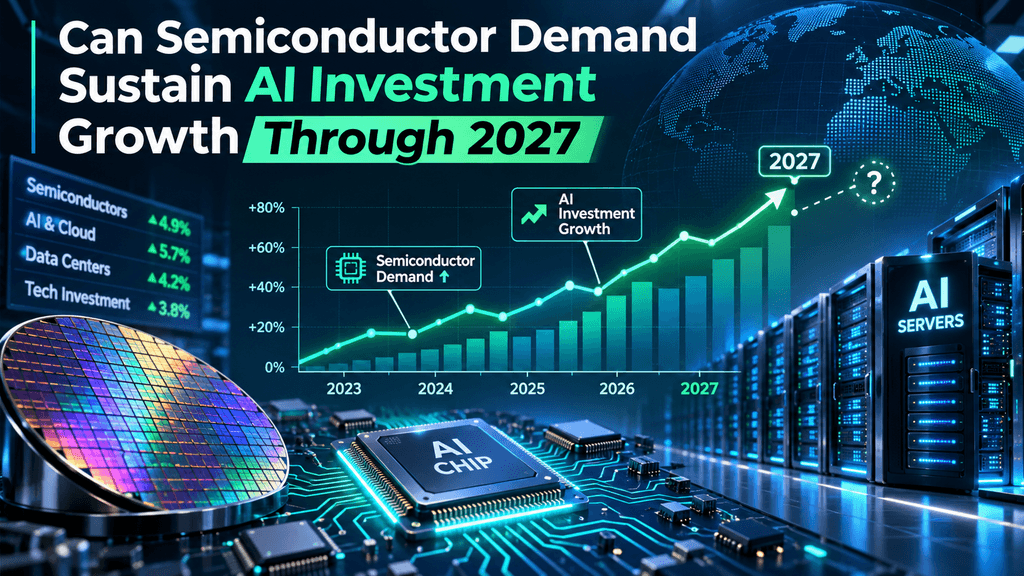
Artificial intelligence investment has expanded quickly over the past few years, driving substantial gains across the technology sector, particularly among semiconductor manufacturers and companies supplying the infrastructure behind AI development. However, recent volatility in AI-related stocks has raised questions about whether the industry can maintain its growth direction or if investors are beginning to approach the limits of the current investment cycle. Macroeconomic analyst Lyn Alden believes there is still room for further expansion, pointing to semiconductor demand as one of the clearest indicators of how much momentum remains in the sector.
Speaking in a November 24 interview, Alden said her base case is for major AI companies to deliver stronger revenue and financial results in 2027 than in 2026. She bases this outlook partly on recent performance from NVIDIA and memory manufacturers, whose results continue to reflect strong demand for the computing power and hardware needed to support AI development. For Alden, these industry figures offer a more useful picture of the investment cycle than short-term movements in financial markets alone.
Key Takeaways
-
Lyn Alden’s base case calls for improved AI company revenue and fundamentals in 2027 versus 2026.
-
Solid recent results from Nvidia and memory chipmakers show no clear signal of a weaker 2027.
-
Semiconductor capacity bookings, including Micron’s 2028 planning, act as a key demand indicator.
-
Prior multi-trillion-dollar market-value gains in AI-related firms make percentage growth harder to sustain.
-
Memory shares have historically peaked months before revenue, supporting further upside if revenue holds.
-
Frontier model companies face open-weight competition that limits durable advantages relative to semiconductors.
Why Could AI Growth Become Harder to Sustain as Valuations Rise
The increase in AI-related valuations could make it harder for companies in the sector to deliver the same level of growth seen in previous years. Around 25 AI-related companies, mostly chipmakers and businesses linked to the semiconductor industry, saw their combined market value climb from well below $3 trillion in 2022 to nearly $20 trillion by early 2026. With valuations and revenues already much higher, matching the percentage gains recorded during the early stages of the AI boom may become more difficult.
For Lyn Alden, the more important question is whether demand for AI infrastructure can continue to grow. She is paying particular attention to semiconductor capacity bookings, as a decline in new orders could signal that demand is starting to weaken. These figures could offer a clearer picture of the industry's direction than interest-rate movements alone, especially as investors assess whether AI spending can continue supporting stronger financial results into 2027.
Why Semiconductor Demand Matters for the AI Investment Cycle
Semiconductor production capacity and order books offer one of the clearest ways to assess whether major technology companies are still committed to spending heavily on artificial intelligence. Rather than relying solely on management forecasts or investor expectations, these figures provide a more practical indication of how much demand suppliers are receiving. Alden pointed to Micron as an example, noting that the company is already working to fill its production capacity for 2028. This suggests that demand for advanced memory products remains strong well beyond the current investment cycle.
If other semiconductor manufacturers continue reporting similar booking trends, it would strengthen the case that AI-related spending can remain elevated for several more years. However, a noticeable decline in new orders, particularly alongside slower earnings growth, could indicate that the investment cycle is beginning to lose momentum. This outlook is also consistent with developments across the semiconductor industry, particularly in the memory segment. Companies producing high-bandwidth memory (HBM), which is essential for powering AI accelerators, have benefited from growing demand as data center operators expand their computing infrastructure.
Latest company updates and financial disclosures point to supply conditions that could remain tight through 2027 and into 2028. Some manufacturers have already secured significant portions of their future production through multi-year agreements and take-or-pay contracts, giving them greater visibility into expected revenue and customer demand. These arrangements do not eliminate the possibility of a slowdown, but they provide some protection against sudden changes in purchasing decisions. As a result, even if annual growth rates begin to moderate from the unusually high levels recorded earlier in the AI boom, semiconductor companies could continue benefiting from substantial demand and committed customer spending.
What Recent Nvidia and Memory Results Reveal About Demand
Nvidia reported fiscal third-quarter revenue of $115.8 billion for the period ended October 25, 2026, more than twice what it recorded during the same period a year earlier. Its data-center business accounted for $107.6 billion of that total, showing the continued demand for the chips and computing infrastructure needed to support AI development. The company also projected revenue of approximately $130 billion for the following quarter and raised its longer-term growth expectations. At the same time, its supply commitments increased considerably, largely due to multi-year procurement agreements for memory components.
Micron also delivered strong results in fiscal 2026, reporting revenue of approximately $133 billion, a substantial increase from the previous year. Its high gross margins reflected strong pricing conditions across the DRAM and high-bandwidth memory markets, where demand from AI infrastructure providers has remained significant. Management indicated that roughly 75 percent of its expected 2027 output had already been committed, while discussions with customers about capacity for 2028 were also underway. These multi-year agreements provide greater visibility into future demand and cover a considerable portion of the company's expected revenue.
Taken together, these results offer some support for Alden's view that there is currently little evidence to suggest the AI sector will perform worse in 2027 than in 2026. Although the pace of expansion may moderate compared with the triple-digit growth rates recorded during earlier stages of the investment boom, that does not necessarily mean overall spending will decline. Companies can continue generating substantial revenue and maintaining high levels of investment even as year-over-year growth becomes less dramatic. For Alden, the distinction between slowing growth and weakening demand is important when assessing how much longer the current AI investment cycle can continue.
How Large Has the AI-Related Market Become
Several months before the November interview, Alden took a closer look at a group of roughly 25 companies benefiting from the growth of artificial intelligence. The basket excluded major hyperscalers and was made up mainly of semiconductor manufacturers and other businesses connected to the AI industry, including SpaceX. Between 2022 and early 2026, their combined market value grew from less than $3 trillion to nearly $20 trillion. Although the exact figure varies depending on which companies are included in the calculation, the scale of that increase shows just how much the AI investment boom has changed the technology market.
However, sustaining that level of growth becomes more challenging as the companies involved reach much higher valuations. When a business grows from a relatively small base, even a modest increase in revenue or market value can produce a significant percentage gain. As the starting figure gets larger, achieving the same growth rate requires considerably more money and stronger business performance. This does not mean the AI sector has reached its peak or that further expansion is unlikely. Rather, it suggests that future gains may come through steady increases in revenue, earnings, and market value instead of the rapid percentage jumps recorded during the earlier stages of the boom.
This move also changes what investors need to watch when assessing the industry's outlook. Instead of focusing only on how quickly AI companies are growing, greater attention is being placed on actual semiconductor demand, manufacturing capacity utilization, new bookings, and the ability of businesses to maintain strong earnings. These indicators can help show whether investment in AI infrastructure is still supported by real demand or whether spending is beginning to slow as the market matures.
What Historical Semiconductor Cycles Suggest About Timing
Alden also pointed to trends from around four previous semiconductor cycles, during which shares of memory manufacturers typically reached their peaks several months before their revenues did. Based on this pattern, she noted that there are currently no clear signs that Micron's revenue will reach its peak within the next six to twelve months. As a result, she believes shares of several semiconductor companies could still have room to climb under her base-case outlook.
This historical pattern also shows why investors should look beyond daily share-price movements when assessing the health of the semiconductor industry. A decline in stock prices can sometimes reflect expectations of weaker revenue before those changes become visible in company reports or new orders. On the other hand, companies that continue to record steady revenue growth and secure future capacity commitments may retain investor support even when their shares experience periods of market volatility.
How Are Competitive Dynamics Changing Across Different AI Segments
Alden also showed an important difference between semiconductor manufacturers and companies developing advanced AI models. In her view, chipmakers benefit from stronger and more lasting competitive advantages because of the technological expertise, manufacturing capabilities, and resources required to produce leading-edge semiconductors. Frontier model developers face a different challenge. They must compete in a market where open-weight models are becoming increasingly capable, potentially putting pressure on pricing and making it harder for individual companies to maintain a clear advantage. She was particularly cautious about some AI model developers carrying valuations of $1 trillion or more.
This difference also has important implications for how investors approach the AI sector. Semiconductor suppliers currently have greater visibility into future demand, supported by multi-year agreements and limited production capacity. AI model developers, on the other hand, operate in a more competitive market where technological advantages can disappear quickly as rival models improve and open alternatives become more widely available. As a result, their ability to maintain pricing power and protect long-term profitability may be less certain. This helps explain why Alden sees semiconductor demand as a more dependable measure of the broader AI investment cycle than the performance of individual model developers.
Is the AI Investment Slowdown Driven by Interest Rates or Weakening Demand
According to Alden, changes in Federal Reserve interest rates alone are unlikely to determine when the AI investment cycle reaches its end. Investment booms have historically followed a pattern of quick expansion, overbuilding, and eventual consolidation or correction. These downturns often occur when underlying demand begins to weaken rather than simply because borrowing costs change. For this reason, she believes capacity bookings and earnings growth provide more reliable indicators of when the current cycle could start losing momentum.
So far, however, available industry data continues to point to sustained demand. Semiconductor market forecasts for 2026 project significant year-over-year growth, with memory chips and advanced-node logic expected to account for a large share of the expansion. Spending on semiconductor manufacturing equipment and the development of additional foundry capacity also remain supported by the growing computing requirements of AI companies.
Capital expenditure plans from major cloud service providers, commonly known as hyperscalers, offer another indication of the industry's investment outlook. Although these companies may revise their spending plans as market conditions change, current projections still point to elevated levels of investment through 2027. Growth rates could moderate compared with previous years, but the overall amount of money being committed to AI infrastructure remains substantial. This suggests that demand for computing capacity, memory, and advanced semiconductor technology continues to support the industry's expansion.
How Can Capacity Bookings Signal Changes in Semiconductor Demand
The most useful near-term indicator Alden showed is how much semiconductor production capacity companies are booking in advance. Micron’s progress in securing capacity for 2028 offers one example of the demand outlook. However, a broader look at booking trends across the industry, alongside any noticeable slowdown in earnings growth, would provide stronger evidence of whether demand is beginning to weaken after several years of expansion.
Investors and analysts can monitor these developments through company earnings calls, management guidance, and reports from industry associations. If major memory and logic chipmakers continue reporting strong capacity bookings, it would support the argument that current investment levels are backed by sustained demand. On the other hand, a decline in new bookings could point to inventory adjustments, more cautious spending decisions, and a slower pace of capacity expansion across the semiconductor industry.
How Could These Developments Affect Broader Markets and Crypto
The semiconductor and AI infrastructure cycle intersects with other risk assets. Periods of strong AI-related equity performance have at times drawn capital that might otherwise flow into digital assets. Conversely, volatility in semiconductor valuations can influence broader risk sentiment. Alden noted that Bitcoin was in a bear market at the time of the interview but questioned the basis for setting substantially lower near-term price targets on limited evidence, while acknowledging further declines remained possible.
Semiconductor performance can also provide useful context for understanding movements across technology stocks and digital-asset markets. Strong demand for chip production may reflect continued confidence in AI-related investment, while signs of weakening demand could influence broader investor sentiment. Readers following both markets can also use resources such as the Bitcoin price tracker to monitor developments in the digital-asset sector alongside changes in technology equities.
What Are the Practical Factors Supporting Continued Absolute Spending
Even as percentage growth rates in AI-related semiconductor demand moderate from the extreme levels recorded earlier in the cycle, several structural and contractual elements continue to support elevated absolute spending. These factors help explain why capital commitments from hyperscalers and other buyers can remain high in dollar terms well after the most rapid phase of expansion has passed:
-
Multi-year take-or-pay and capacity-reservation agreements covering material shares of memory and advanced-logic output.
-
Hyperscaler guidance and analyst estimates pointing to hundreds of billions of dollars in continued annual capital expenditure.
-
Ongoing constraints in high-bandwidth memory, advanced packaging, and leading-edge node capacity that limit rapid supply responses.
-
Expanding use cases beyond initial large-language-model training into inference, agentic workloads, and broader enterprise deployment.
These factors do not guarantee uninterrupted acceleration. They do explain why absolute spending can remain elevated even after the steepest percentage-growth phase has passed.
What Are the Risks That Could Alter the Trajectory
Several risks could challenge the current growth outlook. Hyperscalers may reduce their capital expenditure more sharply than expected, particularly if returns from their AI investments take longer to materialize. At the same time, a faster expansion of semiconductor production capacity could ease existing shortages, reducing the pricing power manufacturers currently enjoy. Growing competition across key segments could put further pressure on margins, while geopolitical tensions and supply-chain disruptions may delay production plans and affect delivery timelines. However, Alden's analysis places greater emphasis on the possibility of a sustained decline in underlying demand than on individual interest-rate decisions or temporary movements in the stock market.
Changes in semiconductor capacity bookings, quarterly earnings, and the mix of long-term orders and spot-market demand can provide a better sense of where the industry is heading. Together, these trends help show whether demand is holding steady or starting to cool. Comments from major chipmakers also offer useful clues about what customers are spending, how much production capacity is available, and what suppliers expect in the coming quarters.
Conclusion
Lyn Alden’s outlook is largely based on semiconductor demand, which she considers one of the most practical ways to assess whether AI investment can sustain its growth over several years. Recent financial results from NVIDIA and memory manufacturers, alongside capacity commitments extending into 2028, support her expectation that AI companies could deliver stronger financial performance in 2027 than in 2026. Although the massive gains already recorded across the sector make it harder to repeat previous percentage growth, overall spending can remain strong as long as demand and new orders continue to hold up.
Looking further ahead, Alden believes the direction of the AI investment cycle will depend more on underlying demand than on interest-rate movements alone. For investors trying to understand where the market is heading, semiconductor capacity bookings and corporate earnings trends will be particularly important. These indicators could help show whether companies are still expanding their AI investments or beginning to scale back spending as the industry matures.
FAQs
What is Lyn Alden’s base-case outlook for AI companies in 2027?
Her base case is that revenue and fundamentals at major AI companies improve in 2027 compared with 2026, supported by solid recent semiconductor results and no clear signs of weakening demand.
Why does semiconductor capacity booking matter so much?
Bookings provide a leading indicator of future demand. Sustained strong bookings, including Micron’s work on 2028 capacity, support confidence in multiyear investment; weaker bookings would signal potential softening.
How large did the selected AI-related company group become?
A group of roughly 25 AI-related companies, mostly semiconductors and related firms, expanded from under $3 trillion in combined market value in 2022 to nearly $20 trillion by early 2026.
Do interest-rate changes determine the end of the AI investment cycle?
According to Alden, structural demand exhaustion and overbuild dynamics matter more than rate moves alone for the longer-term trajectory of the cycle.
Disclaimer: This general market information may come from third-party, commercial, or sponsored sources and is provided for informational and educational purposes only. It does not constitute financial or investment advice, an offer, a solicitation, or a guarantee. We assume no responsibility for the accuracy, completeness, or reliability of this information or for any losses arising from its use.
Investing and trading involve risks. Past performance does not guarantee future results. Users should conduct their own research, exercise sound judgment, and take full responsibility for their decisions. For more information, please refer to KuCoin's Terms of Use and Risk Disclosure