

Robinhood Chain Surges to Second in Global DEX Volume, Flipping Ethereum and Base Amid Memecoin Frenzy
2026/07/13 16:18:00
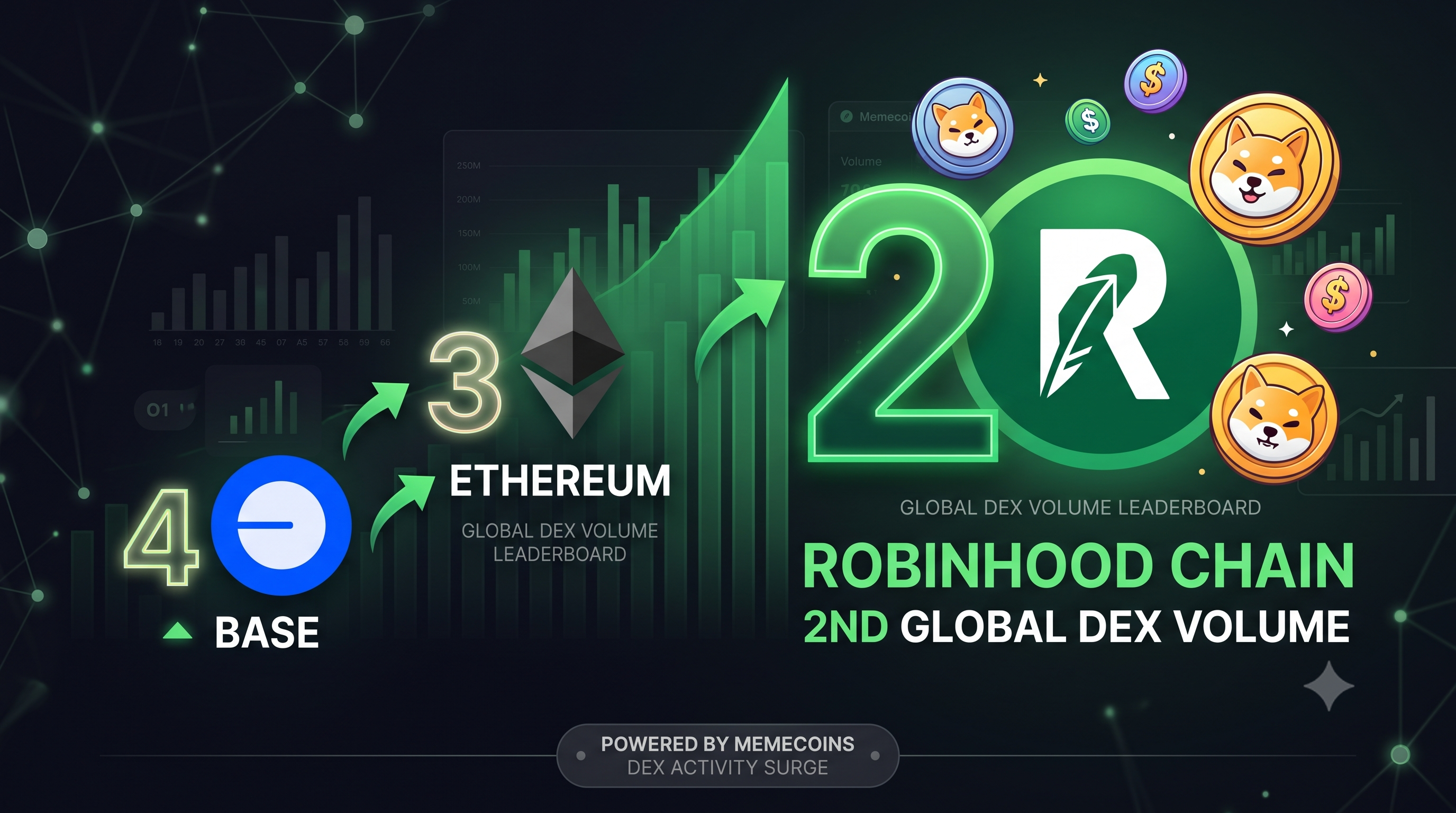
The Day Robinhood Rewrote the Layer-2 Rulebook
July 2026 will go down in crypto history as the month traditional finance permanently blurred the lines with decentralized degeneracy. When retail brokerage giant Robinhood announced its proprietary Ethereum Layer-2 network, the Robinhood Chain, industry analysts expected a slow, methodical rollout heavily focused on regulatory compliance and institutional onboarding. They anticipated a sterile environment built for tokenized equities and quiet yield farming.
Instead, the market witnessed an explosive, volatile, and highly lucrative memecoin frenzy that shattered expectations. Within a week of its mainnet launch, Robinhood Chain achieved what most legacy L2s take years to accomplish: it bypassed heavyweights like Ethereum mainnet and Coinbase’s Base network in daily decentralized exchange (DEX) trading volume.
The sheer velocity of capital migration caught the entire Web3 ecosystem off guard. For developers, it was a masterclass in infrastructure scaling. For retail traders, it was a nostalgic return to the chaotic energy of the 2021 bull run. This unprecedented surge not only solidified Robinhood’s foothold in the decentralized arena but also completely rewrote the Layer-2 rulebook, proving that the fastest way to stress-test a new financial ecosystem is to let the degens loose.
By the Numbers: How a Newcomer Outpaced the Giants
In the crypto ecosystem, narratives are driven by numbers, and the on-chain metrics for Robinhood Chain’s first week were staggering. By mid-July, data aggregators like DefiLlama painted a picture of absolute retail dominance. The network did not just gently enter the top ten; it aggressively claimed the number two spot globally.
At its peak, Robinhood Chain processed an astonishing $877 million in 24-hour DEX volume. This briefly pushed it past both Ethereum mainnet and Base, leaving only Solana ahead in the global rankings. Furthermore, over 500,000 unique wallet addresses bridged assets to the new chain, conducting more than 17 million transactions in a matter of days. Approximately $290 million in stablecoins and $141 million worth of ETH flowed across bridges, seeking early opportunities.
To understand the magnitude of this "flippening," a direct comparison of that peak 24-hour window highlights exactly how Robinhood Chain stacked up against established networks:
| Network | 24h DEX Volume | 24h Transactions | Primary Catalyst | Average Gas Fee |
| Solana | $1.13 Billion | 31.5 Million | Jupiter Aggregator / Memes | $0.00 |
| Robinhood Chain | $877 Million | 2.8 Million | Retail FOMO / New Token Launches | $0.02 |
| Ethereum Mainnet | $778 Million | 1.1 Million | Blue-chip DeFi / Whales | $2.45 |
| Base | $747 Million | 2.5 Million | SocialFi / Ecosystem Growth | $0.02 |
The data reveals a critical shift: while Ethereum retained its high-value, whale-dominated transactions, Robinhood Chain successfully captured the high-frequency, low-value retail trading volume that previously belonged almost exclusively to Base and Solana.
The Catalyst: Degens, FOMO, and the Memecoin Explosion
What exactly fueled this $877 million inferno? The answer lies in Robinhood’s inherent DNA. The platform has always been synonymous with retail mobilization—the very same energy that fueled the legendary GameStop short squeeze years prior. When Robinhood opened its decentralized doors, that massive retail army migrated on-chain, hunting for the next life-changing multiplier.
The undisputed king of this early migration was a memecoin aptly named Cash Cat. Launched with zero utility and entirely driven by community hype, Cash Cat rocketed to a $180 million market capitalization within 72 hours. Stories of traders turning $300 into $150,000 flooded X (formerly Twitter) and decentralized social platforms. This created a massive wave of FOMO (Fear Of Missing Out), drawing liquidity away from other chains as users scrambled to bridge their funds to catch the next "Cash Cat" or "Dog In Hood" token.
"I haven't seen this kind of raw, unfiltered retail panic-buying since the DOGE days of 2021. The Robinhood Chain UI is too smooth, bridging is too easy, and the degeneracy is off the charts. It's not a blockchain; it's a casino with a Wall Street facade." — @CryptoDegen2026 on X
This memecoin explosion served a dual purpose. While critics dismissed it as pure speculation, crypto veterans recognized it as the ultimate organic marketing campaign. The frenzy brought in hundreds of millions in Total Value Locked (TVL) and populated the network with active, hungry wallets, setting the stage for future, more serious decentralized applications (dApps).
Under the Hood: Why the Arbitrum Tech Stack Was Crucial
Processing 17 million transactions in a week without major outages, spiked gas fees, or network halts is a monumental engineering feat. Robinhood did not build this infrastructure from scratch; they heavily leveraged existing, battle-tested technology.
The seamless user experience and robust throughput were made possible by the underlying architecture. By utilizing the Arbitrum Orbit technology stack, Robinhood Chain secured high performance while maintaining a direct security link to Ethereum.
-
Arbitrum Orbit Integration: Building as an L3/Custom L2 on the Arbitrum stack allowed Robinhood to launch with out-of-the-box EVM compatibility. Developers could instantly deploy existing Ethereum contracts without rewriting code, which is why DEXs like Uniswap and Sushiswap were operational on day one.
-
Extreme Gas Efficiency: The memecoin frenzy would have died instantly if users were paying Ethereum-level gas fees. The Arbitrum stack compressed transaction data efficiently, keeping average swap fees around $0.015. This micro-transaction viability is the lifeblood of retail speculation.
-
Value Accrual to ARB: In a strategic partnership move, Robinhood agreed to route 10% of the chain's net sequencer profits back to the Arbitrum DAO. This revenue-sharing model financially aligned the Arbitrum community with Robinhood's success, turning potential competitors into active supporters.
The Grand Vision: Moving Beyond the Meme Hype
While dog and cat coins generated the headlines, they are merely the Trojan horse for Robinhood’s actual Web3 strategy. The executive team understands that meme-driven DEX volume is highly mercenary—it will migrate the moment a shinier, newer chain launches.
The memecoin frenzy was, in reality, a highly profitable, public stress test of their sequencer and bridging infrastructure. Now that the network has proven it can handle intense retail load and has successfully onboarded a massive user base, the pivot toward sustainable decentralized finance (DeFi) begins.
The long-term vision for Robinhood Chain hinges on Real World Assets (RWAs) and Tokenized Stocks. Robinhood possesses a unique regulatory moat and an existing infrastructure for traditional equities. By bridging these two worlds, Robinhood Chain aims to offer tokenized versions of Apple, Tesla, and S&P 500 ETFs natively on-chain, accessible 24/7. Furthermore, by integrating established lending protocols like Morpho, Robinhood plans to transition these short-term speculative capital injections into deep, sticky liquidity for institutional borrowing and lending. The memes brought the crowd, but the tokenization of Wall Street is designed to keep them there.
Winners and Losers in the Latest L2 War
The violent reshuffling of the DEX volume leaderboards created distinct ripple effects across the entire cryptocurrency landscape. In the zero-sum game of L2 liquidity, there are clear beneficiaries and victims.
The Winners:
-
Ethereum (ETH): As the settlement layer and the native gas token of Robinhood Chain, ETH benefited immensely. The massive bridging activity locked up circulating supply, and the underlying security fees paid to Ethereum mainnet burned a significant amount of ETH, reinforcing its deflationary mechanics.
-
Arbitrum (ARB): The 10% profit-sharing agreement and the validation of their Orbit tech stack caused a sharp rally in the ARB token. Arbitrum solidified its reputation as the premier "L2 factory" for institutional players.
-
Early Ecosystem Adopters: Liquidity providers on Robinhood Chain’s native DEXs earned astronomical yield from trading fees during the volatility spikes.
The Losers:
-
Base Network: Coinbase’s L2 saw its first major dip in active user growth as retail traders migrated to the newer, highly incentivized Robinhood ecosystem. It proved that retail loyalty is fleeting in Web3.
-
Alt-L1s: Smaller Layer-1 blockchains that lack the security of Ethereum or the massive retail funnel of a traditional brokerage found themselves further marginalized, unable to compete with the sheer volume of capital Robinhood commanded.
Final Thoughts: A Flash in the Pan or the New Standard?
The spectacular rise of Robinhood Chain in July 2026 is a testament to the power of retail liquidity and frictionless user experience. Hitting $877 million in daily DEX volume and briefly dethroning Ethereum and Base is an undeniable achievement. However, the true test lies ahead.
As the memecoin hysteria naturally cools off, DEX volumes will retrace to a baseline. Robinhood’s ultimate success will not be measured by how many dog-themed tokens were traded in its first week, but by its ability to execute its tokenized equity and RWA roadmap. If they can successfully convert degenerate speculators into long-term decentralized investors, Robinhood Chain will not just be a participant in the Layer-2 wars—it will be the new standard.
Frequently Asked Questions (FAQs)
What token does Robinhood Chain use to pay for gas fees?
Robinhood Chain does not have a separate, proprietary token for network fees. It uses bridged Ethereum (ETH) as its native gas token. You must have a small amount of ETH in your wallet on the Robinhood Chain network to execute any transactions or swaps.
Do I need a fully KYC-verified Robinhood brokerage account to use the network?
No. Robinhood Chain is a permissionless Layer-2 network. While Robinhood offers seamless fiat on-ramps and bridging directly through their official centralized app (which requires KYC), you can interact with the blockchain using standard self-custody Web3 wallets (like MetaMask or Rabby) without creating a traditional Robinhood brokerage account.
How can I safely bridge my assets to Robinhood Chain?
The safest method is to use the official Robinhood Native Bridge linked on their primary Web3 portal. Simply connect your wallet on Ethereum mainnet or Arbitrum, select the asset (usually ETH or USDC), and sign the transaction. Always verify the URL to avoid phishing scams. Third-party aggregators like Stargate also support the network, but the official bridge is recommended for first-time transfers.
Will there be an airdrop for a new Robinhood Chain native token?
As of now, Robinhood has explicitly stated that the network operates solely on ETH for gas and governance is handled at the corporate level, meaning there is no official "Robinhood Chain Token" ($HOOD is their traditional stock ticker). Users should be highly cautious of any social media posts claiming to offer a Robinhood L2 token airdrop, as these are universally phishing attempts and scams.
Disclaimer: This content is for informational purposes only and does not constitute investment advice. Cryptocurrency investments carry risk. Please do your own research (DYOR).