

Robinhood Chain Surpasses $100B in Cumulative DEX Volume as Robinhood Social Goes Live
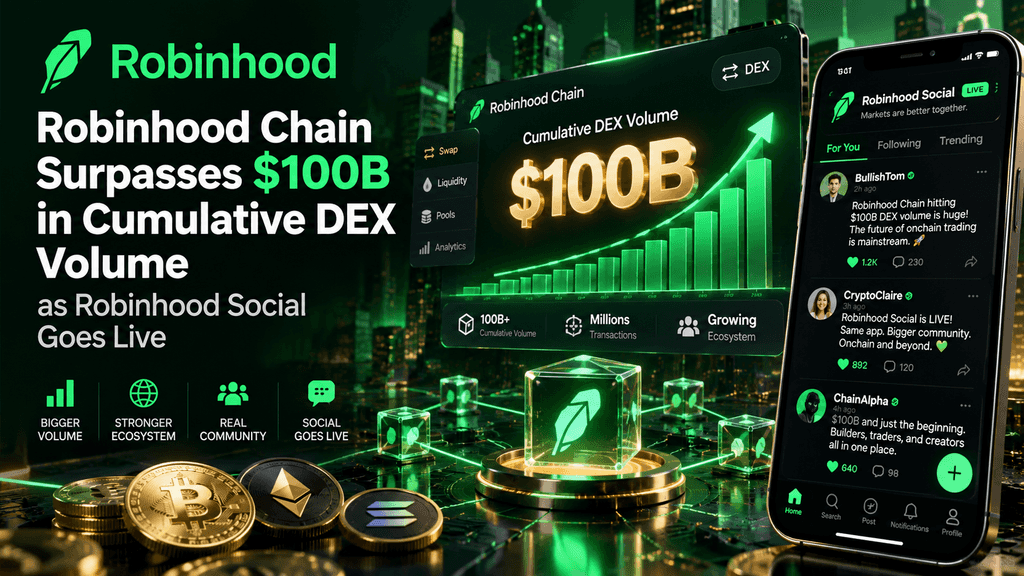
Can a traditional retail brokerage conquer the decentralized finance world in just 100 days? Yes, and it just broke a massive milestone. Robinhood Chain officially surpassed $100 billion in cumulative decentralized exchange (DEX) trading volume exactly as Robinhood Social goes live to the public. This explosive growth signals a paradigm shift in how retail investors interact with Web3. Rather than dealing with clunky wallets and high fees, users are flocking to Robinhood’s Ethereum Layer-2 network for tokenized stocks, stablecoin yields, and meme coin trading. The simultaneous launch of Robinhood Social creates a verified, community-driven trading hub that amplifies this on-chain activity. This article unpacks how the historic $100 billion milestone was achieved, what the network’s recent 40% activity drop means for its future, and why this dual ecosystem launch is fundamentally altering the cryptocurrency market.
Key Takeaways
-
Robinhood Chain crossed $100 billion in total DEX volume within three and a half months of its mainnet launch.
-
Robinhood Social is now officially live, allowing traders to share verified portfolios and on-chain trades in a unified community.
-
Tokenized stock trading has reached $15 billion in cumulative volume across 200,000 unique token holders.
-
Total Value Locked and stablecoin supply remain strong at $1.1 billion, despite a recent 40% cooling in daily network activity.
-
The network captured 42% of on-chain equity trading volume in September, directly challenging competitors like Solana and BNB Chain.
The $100 Billion Milestone: Unpacking Robinhood Chain’s DEX Explosion
Retail Momentum Drives Decentralized Trading Volume
Robinhood Chain achieved its $100 billion cumulative DEX volume by seamlessly bridging its massive Web2 retail user base into a frictionless Web3 environment. Approximately three and a half months after launching, the Layer-2 network has hit a volume metric that typically takes legacy blockchains years to accomplish. The primary catalyst for this massive volume is the platform's ability to abstract away the complexities of decentralized finance. Users are not required to manage complicated seed phrases or navigate third-party bridges to execute a trade. Instead, they enjoy a streamlined interface that connects directly to deep on-chain liquidity pools. While occasional bursts of memecoin speculation have driven spikes in daily transactions, the sustained volume is largely supported by consistent retail engagement and an intuitive user interface. This $100 billion milestone proves definitively that retail investors will enthusiastically adopt decentralized exchanges if the user experience matches centralized fintech applications.
The Surge in Tokenized Stock and Equity Trading
Tokenized equity trading has become the foundational pillar of the network, rapidly hitting $15 billion in cumulative volume and drawing in 200,000 individual token holders. Since the chain's inception, weekly trading volume for tokenized stock DEXs has skyrocketed by 447%, climbing from an initial average of $627 million to a massive $3.4 billion per week. In September 2026 alone, Robinhood Chain processed $6.57 billion in tokenized asset transactions, firmly establishing its dominance in the real-world asset sector. Retail traders now have unprecedented exposure to tokenized giants like Apple and Tesla on a blockchain network that did not even exist before the summer. Because the network is open, these 200,000 holders are not just passively holding assets; they are actively utilizing tokenized equities as productive capital. This deep integration of traditional finance assets into the cryptocurrency ecosystem represents a massive evolutionary leap for DeFi.
Robinhood Social Goes Live: Merging Web3 Trading With Community Validation
A New Era of Verified Social Trading
Robinhood Social officially launches today, revolutionizing retail investing by allowing users to share fully verified trades, profit-and-loss statements, and portfolios within a dedicated community hub. For years, cryptocurrency and stock traders have relied on easily manipulated screenshots on platforms like X and Reddit to boast about their gains or share complex trading strategies. Robinhood Social eliminates this friction by anchoring every single post directly to the user’s actual on-chain and off-chain trading history. When a user posts a decentralized trade executed on the Robinhood Chain, their followers can see the exact entry price, timestamp, and real-time performance of that asset. This level of transparency fosters a high-trust environment where retail investors can learn from top-performing peers rather than relying on anonymous influencers. By integrating this social layer directly into the trading interface, Robinhood ensures maximum transparency and accountability in the retail sector.
Amplifying On-Chain Engagement Through Social Networks
The launch of Robinhood Social is a calculated strategy to sustain long-term engagement on the Robinhood Chain by turning decentralized trading into a highly collaborative experience. Blockchain interactions are traditionally solitary, isolated activities. By introducing a live feed where users can comment, like, and discuss smart contract executions and yield farming strategies, Robinhood is building a localized ecosystem designed to keep users engaged on the platform. As retail momentum historically flows from major assets into specific on-chain ecosystems, having a native social hub acts as a powerful catalyst for liquidity retention. When a popular trader on Robinhood Social highlights a high-yield liquidity pool on the Layer-2 network, the social validation drives immediate capital inflows from their followers. This synergy between a high-speed blockchain and a verified social network provides Robinhood with a massive competitive moat against other crypto exchanges that lack built-in community infrastructure.
Robinhood Chain Performance Metrics
| Metric | Current Status | Market Implication |
| Cumulative DEX Volume | Surpassed $100 Billion | Demonstrates massive retail adoption of Layer-2 trading. |
| Tokenized Stock Volume | $15 Billion | Proves high demand for 24/7 blockchain-based equities. |
| Total Value Locked (TVL) | $1.1 Billion | Indicates strong capital retention and DeFi lending usage. |
| Token Holders | 200,000 Users | Shows broad user distribution beyond a few active whales. |
Network Health and Ecosystem Growth Indicators
Stablecoin Supply and DeFi Deposits Hit $1.1 Billion
Despite fluctuations in daily trading volume, Robinhood Chain has successfully anchored $1.1 billion in decentralized finance (DeFi) deposits and stablecoin supply, proving that users view the network as a secure place for capital storage. This $1.1 billion figure is prominently reflected in protocols like Morpho, a decentralized lending platform operating natively on the network. The significance of this metric is paramount: users are not merely flipping tokens and withdrawing their profits. Instead, they are supplying stablecoins and tokenized stocks as collateral to earn steady yield. Over the most recent tracking week, stablecoin supply actually increased by 1.4%, showcasing a continuous inflow of liquidity. This deep capital pool acts as the backbone for the network's decentralized exchanges, ensuring that large trades can be executed with minimal slippage and bolstering long-term investor confidence in the chain's underlying economic security.
Addressing the 40% Drop in Network Activity
Robinhood Chain recently experienced a 40% drop in daily transaction activity, highlighting a natural cooling-off period after the initial mainnet launch hype. According to mid-October 2026 data, daily transactions fell by 14.6% to 4.1 million, and daily active addresses declined by 18% to 268,900. Consequently, daily chain revenue plummeted 43% week-over-week to $33,700. While 24-hour DEX volume still clocked in at $569.19 million during this slowdown, the drop indicates that high-frequency, smaller retail trades have temporarily retreated. However, this contraction is a standard lifecycle phase for new Layer-2 networks. Initial airdrop farming and launch-day speculation frequently inflate early metrics artificially. Retaining nearly 269,000 active daily users during a statistical "slump" is a testament to the network's robust baseline adoption. As Robinhood Social gains traction, community engagement is expected to reverse this decline and stimulate organic on-chain activity.
Technical Foundations and Market Position
Ethereum Layer-2 Arbitrum Orbit Stack Mechanics
Robinhood Chain achieves its blistering speed and low transaction costs by utilizing the Arbitrum Orbit stack as an advanced Ethereum Layer-2 scaling solution. This architecture allows the network to process transactions entirely off the Ethereum mainnet while still inheriting its world-class cryptographic security. The chain utilizes standard ETH for its gas fees and consistently posts block confirmation times of under 100 milliseconds. This near-instant finality is crucial for a retail-focused exchange where users expect stock-market-like execution speeds without lag. Furthermore, by building on the Arbitrum framework, Robinhood ensures full Ethereum Virtual Machine (EVM) compatibility. External developers can easily port over existing decentralized applications, smart contracts, and liquidity protocols without needing to rewrite their codebase. The combination of under 100-millisecond block times and seamless EVM integration provides a flawless user experience that directly mimics centralized, high-frequency trading platforms.
Capturing Market Share from Solana and BNB Chain
Robinhood Chain is aggressively capturing market share from legacy networks like BNB Chain and Solana by dominating the rapidly expanding tokenized equity sector. By seizing an incredible 42% of all on-chain equity trading volume in September, Robinhood has sent a clear message to competing blockchains that it intends to rule the real-world asset market. While Solana and BNB Chain are actively chasing tokenized asset activity, Robinhood possesses a unique structural advantage: a massive, pre-existing base of retail investors. Competitors must convince traditional stock traders to create self-custodial wallets and navigate complex network bridges. Robinhood simply flips a switch, seamlessly migrating capital onto its proprietary blockchain. This closed-loop acquisition strategy allows Robinhood to siphon volume away from pure-play cryptocurrency networks at an unprecedented rate, cementing its position as the premier bridge between traditional equities and the blockchain.
Competitor Comparison in Tokenized Assets
| Feature | Robinhood Chain | Solana / BNB Chain |
| Retail Onboarding | Direct integration with brokerage app. | Requires third-party wallets and bridges. |
| September Equity Market Share | 42% ($6.57B Volume) | Fragmented across multiple protocols. |
| Gas Asset | Ethereum (ETH) | SOL / BNB |
| Target Audience | Existing Robinhood retail traders. | Crypto-native DeFi users. |
Regulatory Boundaries and Accessibility
Limiting Access to Key Global Markets
Robinhood is currently navigating strict global securities laws by restricting tokenized stock access to users outside of the United States, the United Kingdom, and Canada. The regulatory framework for blockchain-based securities in North America remains incredibly tight, forcing financial innovation into international jurisdictions. By targeting markets outside these three nations, Robinhood can legally offer frictionless trading of tokenized U.S. equities. This international expansion is the primary engine behind the network's 200,000 token holders and $15 billion in cumulative stock token volume. The global demand for dollar-denominated assets and prime American equities is exceptionally high, particularly in regions where local fiat currencies suffer from inflation. Robinhood Chain provides a decentralized, highly accessible gateway for these international investors to gain direct exposure to the U.S. stock market without relying on legacy banking infrastructure, thereby driving immense volume to the Layer-2 network.
Broadening the Wallet Base Beyond Day Traders
The network's success is defined not just by raw trading volume, but by the rapid expansion of its unique wallet base, which proves adoption reaches far beyond a small cohort of high-frequency day traders. With 200,000 distinct stock token holders verified on-chain, Robinhood has successfully distributed its assets across a wide retail demographic. Trading volume can easily be artificially inflated by a handful of active whales or automated arbitrage bots. However, unique wallet counts provide a much more accurate measure of genuine user adoption and network health. The fact that 200,000 individual wallets are holding tokenized equities demonstrates that retail users are adopting the chain for long-term holding and DeFi yield strategies, rather than just intraday speculation. This broad distribution is critical for the long-term decentralization and economic stability of the Robinhood Chain ecosystem.
Conclusion
Robinhood Chain's achievement of surpassing $100 billion in cumulative DEX volume within its first 100 days marks a permanent shift in the cryptocurrency landscape. By successfully combining frictionless Ethereum Layer-2 technology with massive retail distribution, the platform has dominated the tokenized equity sector, generating $15 billion in stock token volume and capturing 42% of all on-chain equity trading. Although the network faces standard post-launch hurdles, evidenced by a recent 40% dip in daily transactions, its foundational metrics remain incredibly robust, backed by $1.1 billion in stablecoin and DeFi deposits. The concurrent launch of Robinhood Social acts as a vital engagement multiplier, bringing verified transparency and community validation directly to the decentralized trading experience. As the ecosystem continues to expand its international reach, Robinhood has successfully evolved from a traditional stock brokerage into a foundational pillar of the modern Web3 economy, seamlessly bridging the divide between legacy finance and the blockchain.
🔥 Beyond the Headlines: What KuCoin 5.0 Means for You
Market news moves fast — but where you act on it matters just as much. This October, KuCoin launches KuCoin 5.0, transforming KuCoin into a rebuilt platform. Here's what actually changes for you:
-
One account for everything. Older platforms split your money across separate "spot," "margin," and "futures" accounts and expected you to understand why. KuCoin 5.0's unified account removes that entirely — deposit once, and everything is simply there (only available to VIPs for now).
-
Stocks, indices, and commodities. KuCoin 5.0 expands beyond crypto into global markets. When crypto chops sideways and equities rally (or the reverse), you rotate in minutes instead of opening a brokerage account and waiting days for fiat rails.
-
Real-world assets (RWA). Tokenized exposure to traditional assets like commodities, right inside your crypto account. One of the fastest-growing segments in global finance is no longer reserved for institutions — you access it from the same balance you trade with.
-
Earn while you learn. Not ready to trade? KCUSD lets your stablecoins earn daily, auto-compounding interest. The lowest-stress way to put your idle deposit to work for 4% yield.
-
An AI assistant in plain language. Ask questions, get market context, understand what you're looking at — built into the platform, no jargon required.
-
An app that doesn't overwhelm. Faster, cleaner, and consistent — intuitive from the first tap, not after a tutorial.
-
Safety you can check, not just trust. A MiCAR-licensed EU entity, Proof of Reserves you can verify yourself, and internationally certified security (SOC 2 Type II, ISO 27001:2022).
Create your account in minutes — and start on the platform built for where crypto is going, not where it's been.
FAQs
What is the Arbitrum Orbit stack that Robinhood uses?
The Arbitrum Orbit stack is a customizable framework for building dedicated Ethereum Layer-2 networks. It allows Robinhood Chain to process transactions with high throughput and sub-100 millisecond block times while inheriting the robust cryptographic security of the Ethereum mainnet.
Can United States citizens trade tokenized stocks on Robinhood Chain?
No. Access to tokenized stocks on the Robinhood Chain is currently restricted to users outside the United States, the United Kingdom, and Canada due to complex regional securities regulations regarding blockchain-based equities.
Why did Robinhood Chain experience a recent 40% drop in activity?
The decline in daily transactions is largely attributed to a natural cooling-off period following the initial mainnet launch hype. As short-term speculative trading subsides, the network is transitioning toward more sustainable, long-term DeFi engagement.
How does Robinhood Social verify user trades?
Robinhood Social verifies trades by directly linking community posts to the user’s actual on-chain and off-chain account data. This mathematically ensures that any profit-and-loss claims or portfolio allocations shared on the feed are 100% accurate.
What role does the Morpho protocol play on the network?
Morpho is a decentralized lending protocol where users can supply their cryptocurrency and tokenized stocks as collateral. It enables traders to earn interest on their holdings or borrow stablecoins against their assets securely.
Disclaimer: This article is for informational purposes only and does not constitute financial or investment advice. Cryptocurrency investments carry significant risk. Always conduct your own research before trading.