

October 2026 Bitcoin Ownership Report: Why 11.1 Million BTC Remain Unattributed
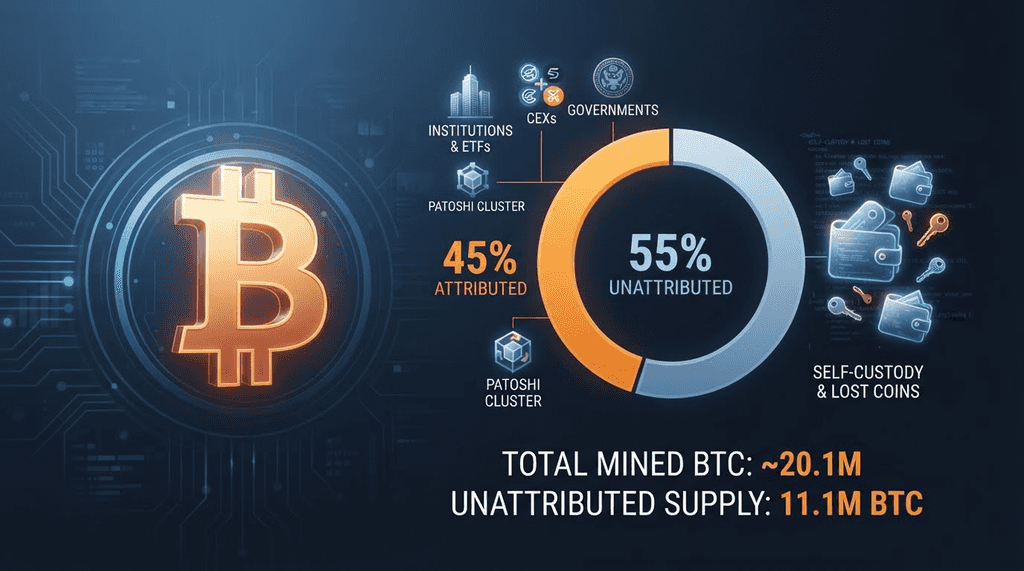
The institutionalization of digital assets has accelerated over the past three years, characterized by multi-billion-dollar inflows into spot exchange-traded products, the expansion of corporate treasury reserves, and the integration of regulated trust custodians. These developments led many market observers to assume that the distribution of Bitcoin had largely consolidated within Wall Street institutions.
However, empirical on-chain data published by Galaxy Research in its October 2026 Bitcoin ownership snapshot presents a contrasting market structure: out of the approximately 20.1 million BTC mined to date, roughly 11.1 million BTC—representing 55% of the total mined supply—remain unattributed to any known owner.
The term "unattributed" does not mean that all of these assets are abandoned, missing, or outside market circulation. Instead, it reflects an architectural reality of distributed public ledgers: Bitcoin’s blockchain records transaction states and cryptographic verification proofs rather than legal identity registries.
Despite sophisticated clustering heuristics deployed by blockchain analytics firms, more than half of the existing supply cannot be conclusively linked to any known corporation, exchange, government, or regulated fund.
Understanding the composition of the unattributed Bitcoin supply provides valuable context on the persistence of individual self-custody, the impact of permanently inaccessible coins, and the structure of the market's effective liquid float.
Mapping the 20.1 Million Supply: Attributed vs. Unattributed Ledger Holdings
To evaluate who holds Bitcoin in late 2026, researchers categorize UTXOs (Unspent Transaction Outputs) using on-chain clustering heuristics. These techniques analyze behavioral transaction patterns, common-input-ownership assumptions, and change-address flows to group related public addresses under identifiable entities.
Galaxy Research’s October 2026 snapshot establishes a clear baseline across the roughly 20.1 million mined coins: known entities account for approximately 9.0 million BTC (45%), while unattributed addresses hold approximately 11.1 million BTC (55%).
The Breakdown of Attributed Holdings (~45%)
The roughly 9.0 million attributed coins represent the publicly mapped layer of the digital asset economy:
-
Centralized Exchanges (CEXs): Custodial hot and cold storage reserves held on behalf of retail and institutional spot traders globally.
-
Regulated Spot ETPs and Funds: Physically backed exchange-traded products, led by BlackRock’s iShares Bitcoin Trust (IBIT), which held approximately 814,263 BTC in late October 2026, alongside funds from Fidelity and Grayscale, custodied with regulated institutions such as BNY Mellon.
-
Corporate Treasuries: Publicly listed corporations, most notably Strategy Inc. (formerly MicroStrategy), and private commercial firms that hold Bitcoin as a strategic treasury reserve asset.
-
Sovereign and Government Holdings: Digital assets held by national governments, including seized asset portfolios managed by authorities in the United States and the United Kingdom, alongside sovereign holdings in El Salvador and Bhutan.
-
The Patoshi Pattern: Exactly 1,123,658 BTC (roughly 5.6% of mined supply) attributed by Galaxy to the Satoshi-era mining pattern between 2009 and early 2010. Identified through historical mining patterns rather than confirmed real-world identity, these coins represent the single largest attributed category and have remained untouched for over sixteen years.
While these attributed holders dominate financial headlines, they collectively account for less than half of the total monetary network.
Deconstructing the 11.1 Million Unattributed BTC: The Four Core Pillars
Why does 55% of the Bitcoin supply remain unattributed? While Galaxy Research notes that on-chain data alone cannot precisely divide the 11.1 million unattributed total by owner type, Galaxy’s researchers and broader blockchain forensic models point to four primary categories within this unmapped bucket.
| Unattributed Component | Broader Industry Estimate (BTC) | Estimated Share of Mined Supply | Primary Underlying Driver |
| Individual Self-Custody | ~4.5M – 5.5M BTC | ~22% – 27% | Personal hardware wallets, cold storage, and long-term self-custody |
| Inaccessible / Lost Supply | ~3.0M – 3.7M BTC | ~15% – 18% | Forgotten private keys, discarded storage media, and unbacked early wallets |
| Unidentified Institutional Wallets | ~1.2M – 1.8M BTC | ~6% – 9% | Family offices, funds, and bespoke custody setups not yet mapped by analysts |
| Unclustered / Privacy-Conscious UTXOs | ~0.8M – 1.2M BTC | ~4% – 6% | Single-use addresses, Taproot (P2TR) scripts, and non-reused UTXO hygiene |
Individual Self-Custody and the "Not Your Keys" Ethos
A major portion of the unattributed supply is held by individual investors and early network participants practicing non-custodial storage.
Commenting on the October 2026 findings, Alex Thorn, Head of Firmwide Research at Galaxy, wrote that "more than half of all BTC supply" sits in addresses with no known attribution, noting that a substantial share is still "held by individuals in self-custody". Responding to the data, Bitcoin-focused institution Xapo Bank similarly observed that unnamed wallets reflect a bottom-up market where retail participants have "been here for over a decade".
Rather than leaving balances on exchanges or holding fund shares, many long-term holders custody their assets using hardware wallets, air-gapped devices, or personal multi-signature setups. Because modern wallet software automatically generates a fresh public address for each incoming transaction, clustering algorithms cannot link these individual wallets to a centralized corporate identity.
Permanently Lost and Inaccessible Supply
Galaxy Research explicitly notes that the unattributed total also includes coins whose owners can no longer access them. Independent on-chain studies generally estimate that between 3.0 million and 3.7 million BTC may be permanently out of reach:
The Early Mining Era (2009–2012): When Bitcoin traded for fractions of a dollar, early hobbyist miners frequently reformatted hard drives, misplaced backups, or abandoned low-value wallet files.
Hardware Loss and Damage: Well-documented cases of discarded storage drives and destroyed physical backups permanently locked significant early balances.
Absence of Estate Succession: Early holders who passed away without leaving seed phrase recovery instructions or multi-signature inheritance mechanisms.
While periodic movements of dormant wallets from 2011–2014 still occur occasionally, truly lost coins remain recorded on the ledger as unspent outputs while functioning in practice as a permanent reduction in circulating supply.
Unidentified Institutional Wallets and Complex Custody
Galaxy Research also pointed out that the 11.1 million unattributed figure includes institutional wallets and complex custody arrangements that researchers have not yet identified.
Not all high-net-worth capital enters the market through public ETFs. Private investment vehicles, family offices, and proprietary trading desks frequently source liquidity over-the-counter (OTC) and settle into bespoke multi-party computation (MPC) or distributed multi-signature vaults. Until those addresses interact directly with a tagged institutional cluster or undergo public disclosure, they remain classified in the unattributed bucket.
Modern UTXO Hygiene and Taproot (P2TR) Scripts
Protocol upgrades and improved wallet practices have also made automated address clustering more challenging.
Following the activation of the Taproot (BIP 341/342) upgrade, Pay-to-Taproot (P2TR) addresses utilize Schnorr signatures to make complex multi-signature arrangements, timelocks, and standard single-signature spends appear identical on-chain. When holders combine Taproot addresses with strict UTXO segregation and avoid address reuse, third-party analytics firms cannot reliably merge separate addresses into a single entity cluster.
Market Implications: Evaluating Effective Liquid Supply
The finding that 11.1 million BTC sit outside known institutional and exchange clusters has direct implications for how analysts model liquid supply.
Recalculating the Active Float
While headline market capitalization multiplies all ~20.1 million mined coins by the live Bitcoin price, the actual volume of Bitcoin readily available for trading is considerably smaller:
-
The Patoshi Cluster: The 1,123,658 BTC tied to Satoshi-era mining have never moved.
-
Inaccessible Coins: Millions of early unattributed coins are estimated to be permanently lost.
-
Long-Term Self-Custody: A large portion of individual self-custodied coins remains dormant across multi-year cycles, moving only during major price milestones.
-
Locked Institutional Vehicles: Coins held in corporate treasuries, sovereign reserves, and long-term ETF allocations largely sit in cold storage outside active exchange order books.
Accounting for dormant self-custody, lost keys, and long-term institutional reserves leaves only a modest fraction of the total mined supply actively circulating on spot exchanges at any given time.
Supply Dynamics in the Post-2024 Halving Era
This ownership distribution interacts directly with Bitcoin's programmatic issuance schedule. Following the April 2024 fourth halving, new daily issuance stands at roughly 450 BTC per day (approximately 164,250 BTC per year), representing an annual supply growth rate below 0.85%.
Because a meaningful portion of the 11.1 million unattributed supply is either permanently immobile or held by long-term self-custody advocates, large demand inflows from ETFs or corporate buyers must source liquidity from a relatively tight pool of active sellers—amplifying price sensitivity during periods of strong net inflows or outflows.
Structural Comparison: Institutional Custody vs. Non-Custodial Storage
As noted by security researchers such as Casa CSO Jameson Lopp alongside the October 2026 ownership debate, ETFs and self-custody serve distinct market preferences. The table below compares attributed institutional custody with unattributed self-custody:
| Operational Dimension | Attributed Institutional Custody (ETFs, CEXs, Trusts) | Unattributed Self-Custody (Hardware Wallets, Personal Multisig) |
| Control of Private Keys | Delegated to regulated third-party custodians | Controlled directly by the individual or private keyholder |
| On-Chain Visibility | Publicly clustered and tracked by blockchain analytics providers | Unattributed on-chain unless linked through exchange KYC or address reuse |
| Counterparty Structure | Relies on fund issuers, qualified custodians, and authorized participants | Relies on personal security practices |
| Regulatory & Tax Integration | Standardized tax reporting, brokerage integration, and estate administration | Requires independent record-keeping and technical inheritance planning |
| Trading & Settlement Window | ETF shares trade during equity market hours; CEXs offer 24/7 internal books | 24/7 peer-to-peer on-chain settlement governed by network consensus |
| Primary Operational Risk | Custodial concentration, platform restrictions, or management fees | Irreversible asset loss if seed phrases are compromised or misplaced |
This comparison illustrates why both models coexist. Regulated funds allow traditional investors to gain price exposure without managing cryptographic keys, while self-custody preserves direct bearer ownership for crypto-native participants.
Contextualizing the "Institutional Takeover" Narrative
Over the past two years, rapid growth in US spot ETFs and corporate treasury strategies fueled concerns that traditional financial institutions were absorbing the majority of the Bitcoin network.
Galaxy Research’s October 2026 data provides an empirical counterbalance to that narrative:
Institutional Share Remains Bounded
Even when combining all global exchanges, spot ETFs, corporate treasuries, governments, and the 1.12 million Patoshi coins, the entire attributed category accounts for 45% of mined supply.
Decentralized Distribution Persists
At 55% (11.1 million BTC), the unattributed bucket remains the single largest segment of the Bitcoin supply, underscoring that individual self-custody and unclustered holdings still form the foundational base of the network.
Conclusion
Galaxy Research’s October 2026 ownership snapshot demonstrates that despite landmark institutional adoption, Bitcoin’s supply distribution remains heavily rooted in self-custody and unattributed addresses. With 11.1 million BTC—or 55% of all coins mined—sitting outside known institutional, exchange, and government clusters, the network retains a broad, decentralized ownership base alongside a practically constrained liquid supply.
FAQs
What does "unattributed Bitcoin supply" mean?
Unattributed Bitcoin refers to the roughly 11.1 million BTC (55% of mined supply as of October 2026) held in on-chain addresses that blockchain analytics firms like Galaxy Research cannot link to any known exchange, ETF, corporation, government, or identifiable individual.
Why is 55% of Bitcoin unattributed in October 2026?
According to Galaxy Research Head of Research Alex Thorn, the 55% figure indicates that individual self-custody remains widespread despite institutional adoption. Galaxy also notes that the unattributed total includes lost or inaccessible early coins, early-mined balances, and institutional or complex custody wallets that have not yet been publicly identified.
Does Wall Street own most of the Bitcoin supply?
No. Galaxy Research’s October 2026 data shows that all attributed entities combined—including centralized exchanges, spot ETFs, governments, and the 1,123,658 BTC Patoshi cluster—account for 45% of the mined supply, while 55% remains in unattributed addresses.
How much Bitcoin is held in the Satoshi-era Patoshi pattern?
In its October 2026 ownership breakdown, Galaxy Research separately identifies 1,123,658 BTC (about 5.6% of total mined supply) under the "Patoshi pattern" linked to Satoshi-era mining, making it the single largest known holding category ahead of any individual ETF or corporate treasury.
Disclaimer
This general market information, possibly from third-party, commercial, or sponsored sources, is provided for reference and educational purposes only and does not constitute financial or investment advice, an offer, solicitation, or guarantee. We disclaim liability for its accuracy, completeness, reliability, and any resulting losses. Investments/trading are risky; past performance doesn’t guarantee future results. Users should research, judge prudently, and take full responsibility. For further details, please consult KuCoin’s Terms of Use and Risk Disclosure.