

NVIDIA Q3 2026 Holdings Drop $15.1 Billion as Intel Stake Falls 25% and SpaceX Takes Top Spot
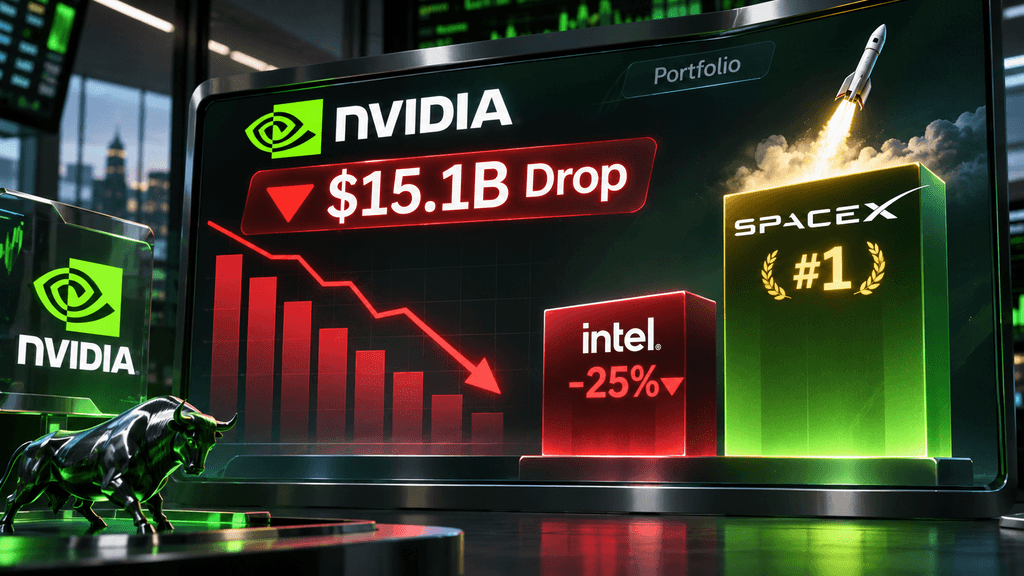
NVIDIA's reported securities holdings declined by approximately $15.1 billion in the third quarter of 2026, according to its latest Form 13F filed with the U.S. Securities and Exchange Commission (SEC) on November 16. The portfolio's reported value fell to $48.33 billion as the company reduced its Intel stake by 25% and increased its SpaceX holdings by approximately 6.3%. SpaceX consequently overtook Intel as NVIDIA's largest reported investment. The disclosure highlights a substantial shift in portfolio composition, raising questions about capital allocation, semiconductor exposure, and the broader implications for NVIDIA's investments across the artificial intelligence infrastructure ecosystem.
Key Takeaways
-
NVIDIA's reported portfolio declined 23.82%: Its Q3 2026 securities holdings totaled $48.33 billion, compared with $63.44 billion in Q2, representing a $15.11 billion decrease in quarter-end value.
-
Intel exposure fell significantly: NVIDIA reduced its Intel position by approximately 53.69 million shares, or 25%, while retaining a holding valued at $19.37 billion.
-
SpaceX became the largest reported investment: NVIDIA increased its SpaceX position by 6.28% to approximately 130.47 million shares, representing 40.73% of its reported portfolio.
-
Additional technology holdings were adjusted: Nokia and Synopsys positions declined, while CoreWeave, Coherent, Nebius, and Generate Biomedicines reported unchanged share counts.
-
Portfolio declines do not necessarily indicate realized losses: Form 13F reports securities positions and quarter-end values, rather than complete trading histories, realized investment returns, or corporate financial performance.
What Did NVIDIA's Q3 2026 13F Filing Reveal?
NVIDIA's November 16, 2026, Form 13F provides a quarterly snapshot of its reportable securities holdings as of September 30. The filing identified eight positions with an aggregate value of $48.33 billion, down from approximately $63.44 billion at the end of June. Although the $15.11 billion decline represents a substantial reduction in reported portfolio value, its significance extends beyond the headline figure. The filing also reveals a different distribution of investment exposure, with Intel losing its position as the largest holding and SpaceX assuming the leading position. Importantly, the number of reported holdings remained unchanged, indicating that the quarter's adjustments primarily involved existing positions rather than the addition or complete removal of reportable investments.
How Much Did NVIDIA's Reported Holdings Decline?
The reported portfolio declined by approximately 23.82% between June 30 and September 30, 2026. The change coincided with reductions in several positions, including Intel, Nokia, and Synopsys, alongside a moderate increase in the number of SpaceX shares. Because the two largest investments accounted for most of the portfolio, changes in their reported values had a disproportionate effect on the overall total.
| Portfolio Metric | Q2 2026 | Q3 2026 |
| Reporting date | June 30 | September 30 |
| Total reported value | $63.44B | $48.33B |
| Number of reported positions | 8 | 8 |
| Largest holding | Intel | SpaceX |
| Intel portfolio weight | 47.27% | 40.07% |
| SpaceX portfolio weight | 33.06% | 40.73% |
Source: NVIDIA's Q2 and Q3 2026 Form 13F filings. Values and percentages are rounded.
The figures should be interpreted as quarter-end holdings rather than a direct measurement of NVIDIA's investment performance. Form 13F is a regulatory disclosure used by qualifying institutional investment managers to report specified securities positions, generally within 45 days after each calendar quarter ends. It does not provide a complete record of transactions during the reporting period or capture every asset owned by a company. Furthermore, the September 30 reporting date differs from NVIDIA's fiscal earnings calendar, making it important to distinguish the securities disclosure from the company's operating results.
Does the $15.1 Billion Decline Represent a Realized Loss?
A reduction in reported portfolio value does not automatically translate into an equivalent realized investment loss. Portfolio values reflect both the number of securities held and their valuation at the reporting date. A position may decline because shares were sold, because market prices decreased, or because both occurred simultaneously. Conversely, a company can reduce its holdings while receiving cash proceeds, meaning the remaining portfolio becomes smaller without necessarily producing a realized trading loss.
This distinction is particularly relevant to NVIDIA's Intel investment, where both share count and reported value decreased substantially. Although the 13F identifies the difference between quarter-end positions, it does not disclose individual transaction dates, execution prices, or the accounting basis of the shares sold. Consequently, investors cannot calculate NVIDIA's realized profits or losses simply by subtracting the third-quarter portfolio value from the second-quarter total. A comprehensive assessment requires the company's financial statements, investment disclosures, and applicable accounting information.
Why Did NVIDIA Cut Its Intel Stake by 25%?
NVIDIA's reduction in Intel holdings was among the most consequential changes disclosed for the third quarter. Its reported position declined from approximately 214.78 million shares at June 30 to 161.08 million shares at September 30, representing a reduction of 53.69 million shares, or precisely one-quarter of the previous position. The reported value decreased from approximately $29.99 billion to $19.37 billion, while Intel's share of the portfolio fell from 47.27% to 40.07%. Despite the reduction, Intel remained NVIDIA's second-largest reported investment, demonstrating that the company retained substantial exposure to the semiconductor manufacturer.
How Did NVIDIA's Intel Investment Change?
| Intel Holding Metric | Q2 2026 | Q3 2026 |
| Shares held | 214,776,632 | 161,082,488 |
| Reported value | $29.99B | $19.37B |
| Portfolio allocation | 47.27% | 40.07% |
| Share-count change | — | -25.00% |
The approximately $10.62 billion decline in Intel's reported value accounted for a substantial portion of the overall $15.11 billion portfolio reduction. However, the value difference should not be interpreted as the proceeds generated from selling Intel shares. It combines the effect of a smaller position with changes in quarter-end valuation. Since Intel represented nearly half of NVIDIA's reported portfolio at the beginning of the quarter, even a moderate adjustment in its ownership would have meaningfully altered the portfolio's composition. The 25% reduction therefore provides clearer evidence of a change in NVIDIA's reported equity exposure than the dollar-value decline alone.
What Could the Intel Stake Reduction Indicate?
The reduction may attract attention because NVIDIA and Intel occupy important positions in the semiconductor industry, where competition, manufacturing capabilities, computing architectures, and AI infrastructure investment increasingly intersect. Large equity positions can serve different financial purposes, including strategic investment, balance-sheet diversification, and exposure to related industries. Reducing such a position could reflect portfolio rebalancing, liquidity considerations, or changes in capital allocation priorities. However, the 13F does not identify management's motivation, and these possibilities should remain analytical interpretations rather than established explanations.
It is equally important to distinguish equity ownership from commercial relationships. NVIDIA's decision to report fewer Intel shares does not, by itself, demonstrate reduced technological cooperation, altered supplier relationships, or a negative outlook for Intel's future operations. The disclosure establishes that NVIDIA held a smaller equity position at September 30 while maintaining substantial investment exposure. Further conclusions about the company's strategic intentions would require additional statements from management, corporate announcements, or subsequent regulatory filings.
How Did SpaceX Become NVIDIA's Largest Reported Holding?
SpaceX overtook Intel as NVIDIA's largest reported investment during the third quarter, with a position valued at approximately $19.68 billion compared with Intel's $19.37 billion. Although the difference was relatively narrow, the change represented a significant reversal from the previous quarter, when Intel's reported value exceeded SpaceX's by approximately $9 billion. The shift resulted from contrasting developments: NVIDIA increased its SpaceX share count moderately while substantially reducing its Intel holdings. Consequently, SpaceX became the largest position even though the reported dollar value of NVIDIA's SpaceX investment was lower than at the end of June.
How Much Did NVIDIA Increase Its SpaceX Position?
NVIDIA increased its SpaceX holding from 122,764,805 shares to 130,472,925 shares, adding approximately 7.71 million shares, or 6.28%. Despite the increase in ownership, the position's reported value declined from approximately $20.98 billion to $19.68 billion. Its portfolio weight nevertheless increased from 33.06% to 40.73%, reflecting the larger contraction in the portfolio's overall value. SpaceX was already included in NVIDIA's second-quarter filing, so the latest increase represents an adjustment to an existing position rather than the establishment of a new investment.
| SpaceX Holding Metric | Q2 2026 | Q3 2026 |
| Shares held | 122,764,805 | 130,472,925 |
| Reported value | $20.98B | $19.68B |
| Portfolio allocation | 33.06% | 40.73% |
| Share-count change | — | 0.0628 |
This distinction between ownership growth, reported value, and portfolio weight is central to understanding the filing. An investment can become the largest holding without generating positive returns or increasing in dollar value, particularly when other positions experience larger reductions. In NVIDIA's case, the transition from Intel to SpaceX at the top of the portfolio reflects relative changes across the investment portfolio rather than an isolated increase in SpaceX's reported valuation.
Why Is the SpaceX Investment Relevant to AI Infrastructure?
SpaceX operates in aerospace systems, space transportation, satellite communications, and related infrastructure. These industries depend on sophisticated engineering, computing capabilities, communications networks, and large-scale technology development. As artificial intelligence becomes increasingly integrated with advanced computing and industrial systems, investors may examine the relationship between aerospace technology and the broader AI infrastructure ecosystem. NVIDIA's SpaceX investment therefore offers an additional perspective on the diversity of its reported exposure beyond conventional semiconductor businesses.
Nevertheless, the investment should not be treated as evidence of a newly announced AI partnership, an exclusive technology supply arrangement, or a confirmed increase in demand for NVIDIA hardware. Equity ownership and operational collaboration are distinct matters, and the 13F establishes only the reported securities position. Its significance lies primarily in the scale of the investment, the increase in shares held, and the concentration it creates within NVIDIA's disclosed portfolio.
Which Other Stocks Did NVIDIA Buy, Sell, or Hold in Q3 2026?
Beyond Intel and SpaceX, NVIDIA's filing included six additional investments associated with computing infrastructure, semiconductor design, communications, photonics, and biotechnology. These smaller positions provide context for understanding the breadth of the reported portfolio, although their combined value was significantly below that of its two largest holdings. During the third quarter, NVIDIA reduced its Nokia and Synopsys positions while maintaining unchanged reported share counts in CoreWeave, Coherent, Nebius, and Generate Biomedicines. The contrast suggests that portfolio adjustments were concentrated in selected holdings rather than applied uniformly across all investments.
NVIDIA's Eight Reported Securities Holdings
| Company | Q3 Reported Value | Portfolio Weight | Share-Count Change |
| SpaceX | $19.68B | 40.73% | 0.0628 |
| Intel | $19.37B | 40.07% | -25.00% |
| CoreWeave | $4.11B | 8.51% | Unchanged |
| Coherent | $2.24B | 4.64% | Unchanged |
| Synopsys | $1.89B | 3.92% | -9.70% |
| Nokia | $0.74B | 1.53% | -56.21% |
| Nebius | $0.28B | 0.58% | Unchanged |
| Generate Biomedicines | $0.013B | About 0.03% | Unchanged |
Source: NVIDIA's Q3 2026 SEC Form 13F and quarter-over-quarter holdings comparisons. Figures are rounded.
Why Did Nokia and Synopsys Holdings Decline?
NVIDIA reduced its Nokia position by approximately 56.21%, bringing its reported holdings to 72.86 million American depositary receipts, compared with 166.39 million in the previous quarter. This was the largest percentage reduction among the positions NVIDIA reported. The company also reduced its Synopsys investment by approximately 9.70%, leaving 4.35 million shares at September 30. Nokia's relevance to telecommunications and networking infrastructure, alongside Synopsys' importance in semiconductor design software, makes both investments pertinent to the broader technology supply chain.
These reductions may be examined alongside NVIDIA's other portfolio adjustments, but the filing does not establish whether they were driven by changing valuations, liquidity requirements, or strategic considerations. Importantly, both companies remained in the portfolio, indicating reduced rather than eliminated exposure. Investors should therefore avoid interpreting the transactions as definitive judgments about the companies' business prospects, especially without supporting management commentary.
What Does NVIDIA's Portfolio Reveal About Its AI Investment Strategy?
NVIDIA's reported holdings cover several industries that contribute to the development, deployment, and operation of advanced computing infrastructure. Beyond GPUs and semiconductor systems, the AI ecosystem depends on cloud capacity, high-speed networking, optical components, software design tools, and substantial physical infrastructure. Investments in businesses operating across these markets may provide exposure to different sources of technological development and investment risk. However, the portfolio should be understood as evidence of reported financial interests rather than a complete representation of NVIDIA's corporate strategy.
How Are NVIDIA's Holdings Connected to the AI Ecosystem?
CoreWeave and Nebius participate in markets associated with cloud computing and AI infrastructure, where access to computing capacity is essential for training and deploying increasingly complex models. Coherent contributes technologies associated with optical communication and photonics, while Synopsys provides design automation tools important to semiconductor development. Intel occupies a broader position in computing and semiconductor technology, and Nokia operates in communications networks and related infrastructure. SpaceX adds exposure to aerospace and satellite communications, while Generate Biomedicines represents a comparatively small biotechnology investment.
Collectively, these businesses illustrate the extensive supply chain supporting advanced technology, but their commercial relationships with NVIDIA should be assessed individually. Equity ownership does not necessarily indicate purchasing commitments, preferential access to products, or shared development agreements. The more reliable observation is that NVIDIA's reported securities investments span several complementary industries, leaving its portfolio exposed to multiple technological and market developments.
Does the Portfolio Shift Signal a Strategic Change?
The increase in SpaceX shares and reductions in Intel, Nokia, and Synopsys provide evidence of selective changes in NVIDIA's reported investment exposure. Nevertheless, a single quarter's filing cannot establish whether those adjustments represent a long-term shift in strategy. Portfolio composition may change because of company-specific decisions, liquidity needs, relative valuations, or other financial considerations that are not disclosed in Form 13F.
One notable characteristic is the concentration of reported value: SpaceX and Intel together accounted for approximately 80.8% of the Q3 portfolio. This concentration means that changes affecting either investment could significantly influence future reported totals. Whether NVIDIA intends to maintain that structure, diversify further, or reverse certain adjustments remains unknown. Subsequent filings will provide a clearer basis for assessing whether the changes represent an enduring pattern.
What Could NVIDIA's Q3 Holdings Changes Mean for Investors?
For investors following NVIDIA, the latest 13F provides useful insight into portfolio composition, concentration risk, and exposure to companies operating across the technology sector. However, it should not be interpreted as a direct indicator of NVDA's future share-price performance. NVIDIA's business valuation also depends on operating results, AI computing demand, profitability, cash generation, regulatory developments, and broader financial market conditions. The investment portfolio is only one component of the company's financial position.
How Should Investors Interpret the $15.1 Billion Portfolio Decline?
The first consideration is the distinction between portfolio size and investment performance. The $15.11 billion decrease reflects the difference between two quarter-end values, not a verified realized loss. Investors should also assess how changes in share counts contributed to the decline, especially given the substantial reduction in Intel holdings. The second consideration is concentration: with approximately four-fifths of the reported value allocated to Intel and SpaceX, relatively large movements in either position can significantly affect the portfolio's reported value.
The third consideration is disclosure timing. The September 30 holdings were reported on November 16, creating a delay between the underlying positions and the public filing. NVIDIA could have made additional transactions after the reporting date, meaning the disclosed figures do not necessarily reflect current ownership. Investors evaluating the company's financial exposure should therefore consider subsequent regulatory filings and financial statements alongside the historical 13F data.
Could the Intel and SpaceX Changes Affect NVIDIA Stock?
Portfolio adjustments can influence investor perceptions of capital allocation, asset concentration, and financial flexibility. However, the available filing does not establish a direct relationship between NVIDIA's Intel reduction, SpaceX increase, and movements in its own share price. The company's operating performance remains influenced by factors such as demand for AI accelerators, data-center infrastructure investment, competitive conditions, production capacity, and regulatory constraints.
The broader significance of the disclosure is therefore informational rather than predictive. It helps investors understand changes in NVIDIA's reportable securities exposure while leaving important questions about management intentions and realized financial outcomes unanswered. Investors should distinguish these historical holdings from the company's wider financial performance and avoid relying on individual 13F changes as standalone investment signals.
Conclusion
NVIDIA's Q3 2026 Form 13F reveals a substantial change in its reported securities portfolio, with total value declining to $48.33 billion, Intel shares decreasing by 25%, and SpaceX becoming the largest reported holding following a 6.28% increase in ownership. Additional reductions in Nokia and Synopsys, combined with unchanged positions in several AI infrastructure-related companies, highlight selective adjustments across the portfolio.
The central takeaway is that the $15.11 billion decline reflects changes in reported securities exposure rather than a confirmed realized investment loss. While the filing provides valuable information about portfolio concentration and technology-sector exposure, it does not independently establish NVIDIA's investment motivations or future market performance. Subsequent SEC filings, financial statements, and official corporate disclosures will be essential for evaluating whether these changes indicate a longer-term pattern.
FAQs
Did NVIDIA Lose $15.1 Billion in Q3 2026?
Not necessarily. NVIDIA's reported portfolio value fell by $15.11 billion to $48.33 billion, reflecting changes in securities holdings and valuations rather than confirmed realized investment losses.
Why Did NVIDIA Reduce Its Intel Shares by 25%?
NVIDIA reduced its Intel holdings by approximately 53.69 million shares in Q3 2026. The SEC filing confirms the reduction but does not disclose the company's reasons for selling.
Is SpaceX a New Investment in NVIDIA's Q3 2026 Portfolio?
No. NVIDIA already held SpaceX shares in Q2 2026. It increased its position by 6.28% in Q3, making SpaceX its largest reported holding.
Which AI-Related Companies Does NVIDIA Hold?
NVIDIA's reported holdings include CoreWeave, Coherent, Synopsys, Nebius, Intel, Nokia, and SpaceX, providing exposure to computing infrastructure, semiconductor technology, networking, and other advanced technology sectors.
Does NVIDIA's Form 13F Disclose All Its Investments?
No. Form 13F covers specified reportable securities, not NVIDIA's entire investment portfolio or financial position. Investors should consult its financial statements for a broader view.
Disclaimer: This general market information, possibly from third-party, commercial, or sponsored sources, is provided for reference and educational purposes only and does not constitute financial or investment advice, an offer, solicitation, or guarantee. We disclaim liability for its accuracy, completeness, reliability, and any resulting losses. Investments/trading are risky; past performance doesn’t guarantee future results. Users should research, judge prudently, and take full responsibility. For further details, please consult KuCoin’s Terms of Use and Risk Disclosure.