

Micron Price Target Hits $1,549 as DRAM and NAND Price Hikes Expected to Continue Through Q4
Key Takeaways
-
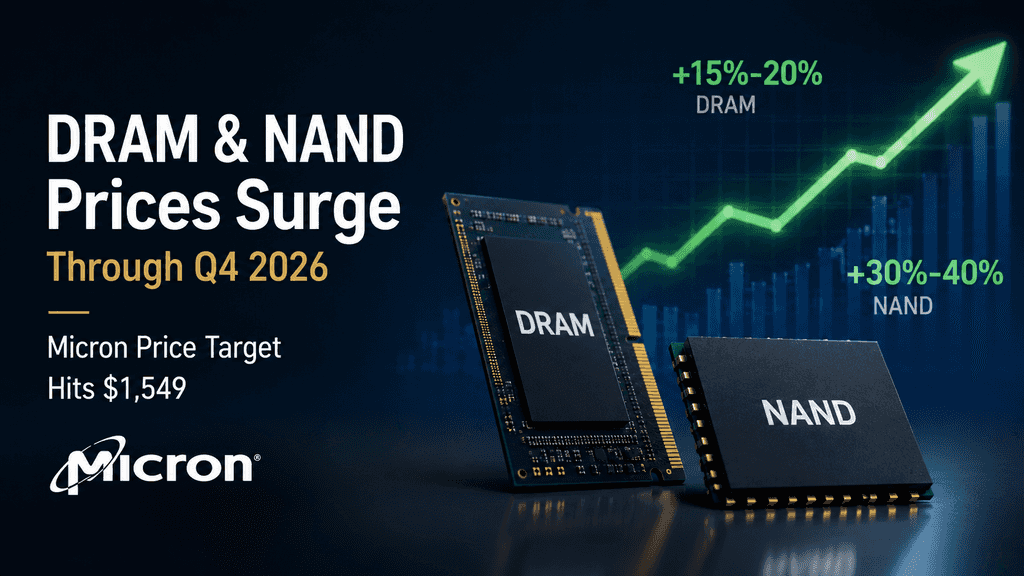
Sustained Memory Price Increases: KeyBanc forecasts DRAM prices to rise 15%–20% in Q3 and another 15% in Q4, while NAND flash prices jump 30%–40% in Q3 and 15% in Q4. Compounded, H2 prices are set to increase by up to 38% for DRAM and 61% for NAND compared to Q2 levels.
-
Wall Street Price Target Upgrades: Driven by High Bandwidth Memory (HBM) supply tightness, FactSet's aggregate consensus price target for Micron Technology (MU) has risen to $1,549, with top-tier institutional targets ranging from $1,625 (UBS) to $2,200 (Cantor Fitzgerald / Deutsche Bank).
-
Macro Shifts & Neocloud Convergence: Mild macro indicators allow market liquidity to shift toward high-growth AI sub-sectors. As traditional memory concepts re-rate, capital is rotating toward Neocloud infrastructure (like CoreWeave and Nebius) and decentralized compute networks where power and hardware tightness dictate operational margins.
-
Impact on Web3 & Crypto Ecosystems: Hardware shortages directly increase operational overhead for Decentralized Physical Infrastructure Networks (DePIN) such as Render, Akash, and Filecoin, reinforcing strong fundamental correlations between traditional semiconductor supply cycles and Web3 AI tokens.
The structural supply imbalance across global memory markets continues to drive unprecedented valuation re-ratings for semiconductor leaders. Wall Street analysts have pushed the consensus price target for Micron Technology (NASDAQ: MU) to $1,549, according to aggregate market data from FactSet, reflecting sustained spot and contract price increases across High Bandwidth Memory (HBM), DRAM, and NAND flash storage. Driven by hyper-scaler artificial intelligence infrastructure deployment and supply constraints, memory component pricing is projected to maintain strong quarter-over-quarter momentum through the fourth quarter.
The structural rotation toward AI hardware infrastructure has fundamentally altered memory supply-demand dynamics, creating tight market conditions that extend beyond equity markets into decentralized computing protocols, AI crypto tokens, and digital asset markets. As memory chipmakers secure long-term pricing power through multi-year agreements, understanding the mechanics of these price hikes provides vital insight for equity investors and digital asset traders navigating broader technology trends.
Why Are DRAM and NAND Memory Prices Rising Through Q4?
DRAM and NAND memory prices are rising due to severe capacity reallocations toward High Bandwidth Memory (HBM) alongside disciplined capital expenditure by major manufacturers. Based on industry forecasts from KeyBanc Capital Markets, DRAM prices are projected to rise 15% to 20% quarter-over-quarter in Q3, followed by an additional 15% sequential increase in Q4. Concurrently, NAND flash prices are anticipated to surge 30% to 40% in Q3 before advancing another 15% in Q4. Compounded across the second half of the year, DRAM prices are expected to achieve a cumulative 32% to 38% increase compared to Q2 levels, while NAND storage prices are set to expand by 50% to 61%.
The underlying catalyst for this pricing environment stems from wafer capacity diversion. Leading memory producers, including Micron Technology and SK Hynix, have prioritized advanced HBM3E and HBM4 silicon production to serve enterprise AI accelerators. Because HBM manufacturing consumes roughly three times the wafer capacity of conventional DDR5 memory for equivalent bit output, traditional server DRAM and enterprise SSD supply has entered an acute structural deficit. Furthermore, positive long-term storage demand guidance from peer storage suppliers like SanDisk (SNDK) has reinforced market expectations that price increases will persist through year-end rather than softening in the fourth quarter.
How Are Wall Street Analysts Valuing Micron Technology (MU)?
Wall Street analysts are valuing Micron Technology using forward-looking structural earnings multiples based on multi-year contract visibility rather than traditional short-term cyclical metrics. According to FactSet data, the consensus Wall Street price target for Micron stands at $1,549, representing substantial upside from its trading level near $970. Individual institutional targets extend higher, with KeyBanc establishing a target of $1,750, UBS placing its valuation at $1,625, and ultra-bullish scenarios from firms like Deutsche Bank and Cantor Fitzgerald reaching up to $2,000 to $2,200.
| Financial Institution / Data Provider | Price Target (USD) | Valuation Methodology & Core Thesis |
| FactSet Consensus | $1,549 | Aggregate Wall Street average across active semiconductor coverage analysts. |
| UBS (Timothy Arcuri) | $1,625 | Applied an 11x P/E multiple to projected FY2029 EPS, citing multi-year structural tightness. |
| KeyBanc Capital Markets | $1,750 | Driven by projected 32%–38% DRAM and 50%–61% NAND price increases in H2. |
| Deutsche Bank / Cantor Fitzgerald | $2,000 – $2,200 | Upper-bound estimates pricing in persistent HBM supply shortfalls through 2027–2028. |
UBS analyst Timothy Arcuri highlighted that traditional valuation methodologies based on near-term 2027 or 2028 earnings fail to capture the long-term structural shift in semiconductor profitability. UBS based its $1,625 price target on projected fiscal year 2029 earnings per share, applying an 11x price-to-earnings multiple. This long-term framing reflects the expansion of Strategic Customer Agreements (SCAs)—take-or-pay, multi-year contracts that now cover approximately 40% of Micron’s DRAM bit output and roughly one-third of its NAND production. These binding supply commitments reduce the historical boom-and-bust volatility of memory cycles, ensuring stable baseline profitability even during prospective industry downturns.
How Macro Shifts and Neocloud Stocks Are Shaping the Next AI Trading Narrative
While hardware producers like Micron provide the essential memory foundation, broader macroeconomic factors and cloud infrastructure trends are defining the next leg of the AI trade. Recent economic indicators, such as mild CPI data (where headline CPI rose 3.4% year-over-year and core CPI grew 2.5%, matching market expectations), have alleviated macro volatility. As discussed in KuCoin’s analysis on how mild CPI data shifts focus as Neocloud stocks emerge as the next AI trading narrative, stable inflation data allows market capital to aggressively pivot away from macro hedging and toward high-growth AI sub-sectors.
-
The Rise of Neocloud Platforms: Specialized GPU and AI cloud providers—such as CoreWeave and Nebius—are experiencing surge pricing and long-term contract backlogs as hyper-scalers struggle to keep up with enterprise AI demand.
-
Power as the Ultimate Bottleneck: While chipmakers continue to scale silicon production, electricity and data center power grid capacity have become the primary limiting factors. Neocloud operators with secured energy infrastructure and low-latency connectivity command significant market valuation premiums.
-
Synergy with Decentralized AI Infrastructure: The capacity pressure on centralized cloud platforms has created a natural overflow into decentralized computing and storage networks, cementing AI infrastructure as a key narrative across both traditional and digital asset markets.
How Do Semiconductor Shortages Impact AI Infrastructure and Crypto Markets?
Semiconductor shortages impact AI infrastructure and crypto markets by increasing the capital expenditure required to run decentralized compute networks, AI protocol nodes, and Proof-of-Work operations. High Bandwidth Memory and enterprise NAND flash chips form the hardware backbone of high-performance computing (HPC) environments. As memory prices rise 30% to 60% across the second half of the year, hardware acquisition costs for data centers and decentralized physical infrastructure networks (DePIN) increase proportionally.
This hardware squeeze directly affects the digital asset ecosystem in several key ways:
-
Elevated DePIN Operational Costs: Decentralized AI compute protocols—such as Render Network (RENDER), Akash Network (AKT), and io.net (IO)—rely on distributed GPU clusters. Rising memory prices increase node operator overhead, driving higher reward requirements to sustain network capacity.
-
AI Crypto Token Correlation: Market sentiment surrounding semiconductor hardware leaders frequently spills over into Web3 AI projects. Strong earnings performance from memory manufacturers reinforces broader institutional narrative around AI infrastructure, historically spurring trading volume across decentralized AI and machine learning altcoins.
-
Hardware-Intensive Mining Pressures: While Bitcoin ASIC miners rely on custom Application-Specific Integrated Circuits rather than general-purpose DRAM, enterprise storage protocols like Filecoin (FIL) and Arweave (AR) depend heavily on enterprise NAND flash and high-capacity SSDs. Sustained NAND price increases raise expansion costs for storage providers operating on decentralized storage networks.
How to Trade Memory and Semiconductor Trends on KuCoin
As global financial markets become increasingly interconnected, major technology and semiconductor trends frequently influence broader market liquidity and digital asset sentiment. Traders looking to capitalize on semiconductor supply dynamics, AI Neocloud expansion, and Web3 technology trends can access diverse spot, futures, and derivative markets on KuCoin.
To trade Web3 AI tokens, semiconductor-linked derivatives, and digital assets on KuCoin:
-
Register an Account: Create an account on the official KuCoin website or mobile app using an email address or mobile phone number, and complete Identity Verification (KYC) to unlock full account features and higher withdrawal limits.
-
Explore Spot & Futures Markets: Search for Web3 infrastructure tokens aligned with computing and AI sectors—including RENDER, AKT, FET, and IO—or navigate to KuCoin's futures and derivatives section to trade contract products.
-
Participate in Promotions: Visit the KuCoin Rewards Hub to complete beginner tasks, claim trading fee discount vouchers, and participate in ongoing AI sector trading competitions.
-
Execute Orders: Select your preferred trading pair, choose between Limit, Market, or Stop-Limit order types, set your entry parameters along with strict risk management controls (Stop-Loss and Take-Profit), and confirm your trade.
Conclusion
The projection of Micron Technology’s price target reaching $1,549 reflects a fundamental structural shift in global memory markets rather than a temporary cyclical spike. Driven by hyper-scaler AI infrastructure deployment, capacity reallocation toward High Bandwidth Memory has created structural deficits across conventional DRAM and NAND flash memory. With DRAM and NAND prices projected to compound up to 38% and 61% higher respectively through Q4, chipmakers are enjoying unprecedented gross margins and record cash flows secured through multi-year long-term agreements.
For equity investors and digital asset market participants alike, these semiconductor pricing dynamics demonstrate the immense capital commitment flowing into the hardware foundation of artificial intelligence. As hardware acquisition costs rise for data centers and decentralized compute networks, the impact of physical chip scarcity will continue to influence operational dynamics across both traditional tech equities and Web3 digital asset markets through the remainder of the year.
FAQs
What is the difference between DRAM and NAND memory?
DRAM (Dynamic Random-Access Memory) is volatile memory used for high-speed, short-term data processing in system RAM and GPU VRAM, whereas NAND flash is non-volatile storage used for long-term data retention in solid-state drives (SSDs) and flash memory cards.
Why does High Bandwidth Memory (HBM) creation reduce standard DRAM supply?
HBM requires advanced 3D-stacked silicon architectures that consume approximately three times more physical wafer capacity than standard DDR5 memory for the same bit output, directly reducing the wafer supply available for conventional memory.
What are Long-Term Agreements (LTAs) in the semiconductor industry?
Long-Term Agreements, or Strategic Customer Agreements (SCAs), are binding, multi-year take-or-pay contracts where enterprise buyers commit to purchasing fixed memory volumes at negotiated pricing structures, reducing revenue volatility for memory manufacturers.
How do rising memory prices impact AI crypto protocols?
Rising memory prices increase hardware acquisition overhead for decentralized compute and storage networks like Akash, Render, and Filecoin, raising operating costs for node operators providing distributed computing and data storage resources.
What is the primary downside risk to the Micron price target forecast?
The primary risk to Micron’s price target forecast is a premature expansion of global capital expenditures by major memory manufacturers, which could lead to unexpected market oversupply, rapid spot price degradation, and inventory accumulation in late 2027 or 2028.