

KuCoin Ventures Weekly Report: Jensen Huang Fallout, AI Repricing and Crypto Liquidity Pressure
1. Weekly Market Highlights
How the Jensen Huang Turmoil Is Rippling Into Crypto and Repricing Risk Appetite
On Nov. 12, Nvidia announced that Jensen Huang had stepped down as president, chief executive and board member, with Chief Financial Officer Colette Kress taking over as interim CEO. The shares fell more than 14% intraday before paring losses to close down 4.34%, bringing their five-session decline since Nov. 8 to 12.75%. On Nov. 16, reports that Huang was considering a return and that allies were pushing for his reinstatement sparked a rebound in perpetual futures markets. Investors are now reassessing the risks surrounding Huang himself, his commitments to customers and his role in coordinating the supply chain. That scrutiny is extending to valuations across the AI industry.
The immediate impact is on financing expectations across the AI supply chain. Cloud hyperscalers have operating cash flow and long-term demand for computing power, while new investment is expanding into AMD, ASICs, in-house chips and domestic computing providers. Neocloud companies that fund expansion with debt, customer prepayments and GPU-backed borrowing are more sensitive to shifts in valuations and credit spreads. As financing costs rise, project returns must cover interest, equipment depreciation and delivery costs. Some construction could be delayed, while compute rental rates and residual GPU values become key inputs as lenders reassess collateral. Pressure on the AI industry is thus spreading from equity markets into credit markets.
Source: https://www.anthropic.com/news/roadshow-launch
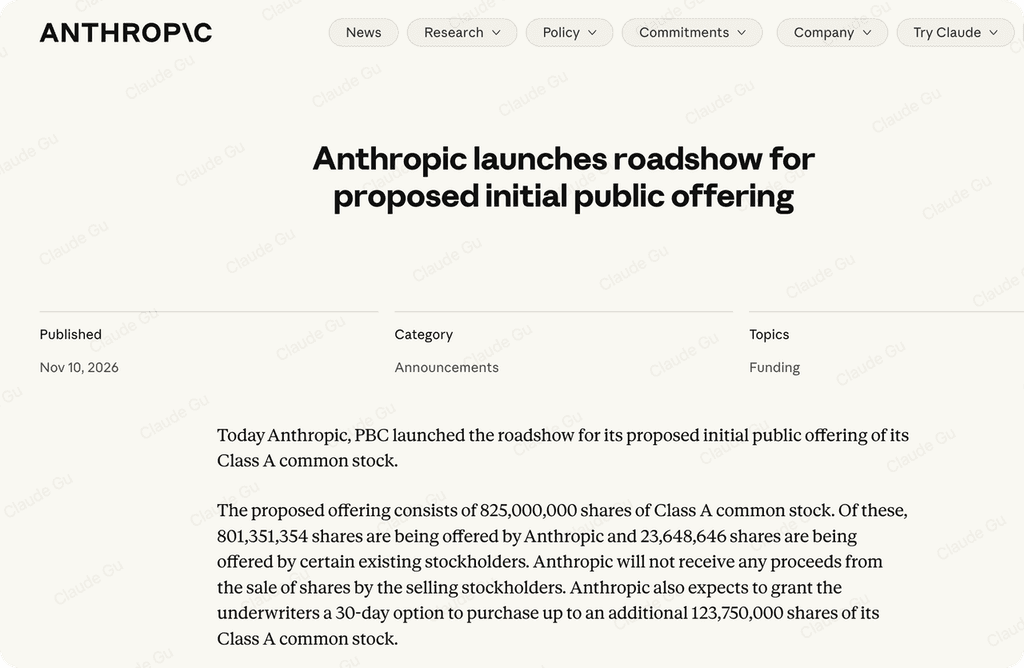
Anthropic is expected to list on Nasdaq under the ticker ANT this Thursday, offering a new window into the same financing chain. Its offer pricing and early trading performance will shape public-market valuations for large model developers and expectations for subsequent fundraising, while also influencing how technology growth capital is allocated among chips, models and applications. If investors remain willing to pay for model revenue and future earnings, risk appetite toward AI could recover. If valuations come under pressure soon after the listing, compute procurement and infrastructure financing will face tougher scrutiny of their returns.
Crypto miners’ pivot toward AI creates a more direct link between this supply chain and digital-asset markets. The valuation anchors for these companies have expanded from bitcoin prices and mining revenue to AI contracts, project delivery and financing capacity. As expectations for AI funding weaken, investors are marking down transition projects and demanding greater scrutiny of debt, share issuance and customer concentration. Bitcoin holdings can also become a source of liquidity when cash pressures mount. Mining stocks therefore carry exposure to both AI infrastructure and crypto assets, making them a transmission point between the two markets when risk appetite weakens.
The second channel into crypto is a reset of market narratives. Valuations built around scarce computing capacity, miners’ AI pivots and AI infrastructure are now being tested against rental rates, utilization, contracted cash flows and financing costs. Capital is likely to rotate away from companies valued primarily on expansion expectations and toward those with higher-quality revenue and stronger balance sheets, with greater emphasis on real demand and sustainable income.
BTC and ETH are absorbing much of this pressure through liquidity channels. When the same institutions and leveraged investors hold both technology stocks and crypto assets, rising volatility encourages them to cut overall exposure. Highly liquid digital assets can also be sold to raise cash. Thinner weekend order books and the closure of stock and spot ETF markets can leave perpetual futures liquidations amplifying price swings. Persistent ETF outflows, a shrinking stablecoin supply and widening AI credit spreads occurring together would point to a deeper contraction in risk appetite.
Even as prices remain under pressure, traditional finance continues to build on-chain infrastructure. On Nov. 12, DTCC announced plans to connect its tokenization service to Solana. Eligible assets held in custody by the Depository Trust Company are expected to be tokenized on Solana in the second half of 2027, while retaining the investor protections and regulatory framework that apply to conventional securities. The service is already live on Canton Network and DTCC’s own private Hyperledger Besu chain. Other public blockchains on its roadmap include Stellar, Solana and Arc.
Overall, markets still need to absorb the near-term pressure from tighter macroeconomic conditions and weakening expectations for AI financing. A recovery will depend on several interconnected signals: stabilization in Nvidia’s orders and governance, a sustainable public valuation for Anthropic following its listing, continued funding and on-time delivery of miners’ AI projects, and improving flows into crypto ETFs and stablecoins. Those developments would allow investors to move past cross-asset deleveraging and refocus on the value of AI infrastructure and on-chain finance.
2. Weekly Selected Market Signals
Inflation Resurgence Reinforces December Rate-Hike Expectations; Rising Dollar and Long-End Treasury Yields Tighten Liquidity, While U.S. Equities Rebound but Crypto Fund Outflows Continue
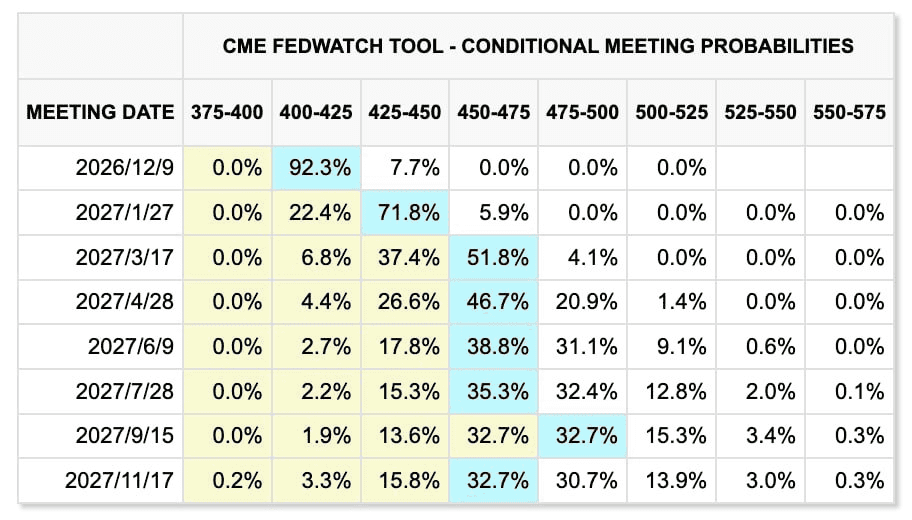
U.S. inflation in October further strengthened market expectations for a December rate hike. The Consumer Price Index (CPI) rose 0.4% month on month, above market expectations, while core CPI increased 0.3%. Due to missing baseline data caused by the government shutdown during the same period in 2025, the U.S. Bureau of Labor Statistics did not publish year-on-year growth rates for most CPI components. The subsequently released Producer Price Index (PPI) rose 0.3% month on month and increased to 6.5% year on year, the highest level since November 2022. Overall, inflation has yet to show a clear downward trend strong enough to prompt the Federal Reserve to end its tightening cycle.
As of November 13, the CME FedWatch Tool showed that the probability of a 25-basis-point rate hike in December was approximately 91.7%, making a hike the clear base-case scenario. Meanwhile, the 10-year U.S. Treasury yield rose to approximately 5.15% last week, while the U.S. Dollar Index closed at 103.42, a new high for the year. Market attention has gradually shifted from whether the Fed will hike in December to whether 25 basis points will be sufficient and how long the tightening cycle may continue.
Source: CME FedWatchTool
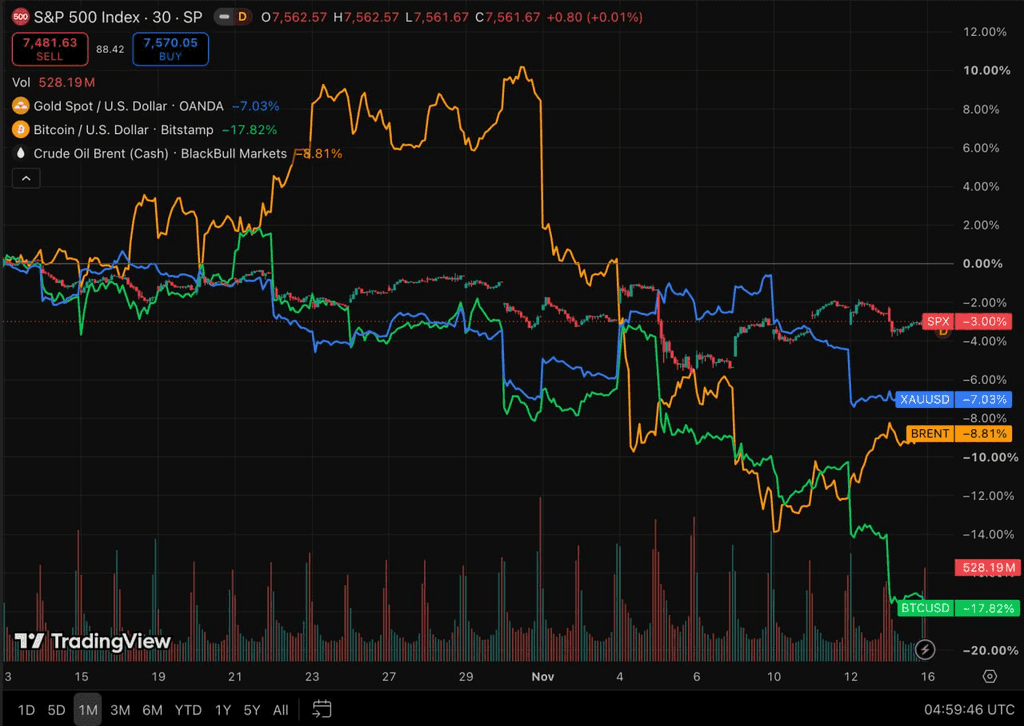
The more important development this week was not the rate hike itself, but the continued tightening of global liquidity as the U.S. dollar and long-end interest rates rose in tandem. A stronger dollar raises dollar-funding costs in non-U.S. markets, while higher long-end Treasury yields increase financing costs and valuation hurdles for companies and risk assets. The simultaneous pressure on gold, crypto assets and bonds also reflects the market’s growing sensitivity to liquidity conditions. As long as the dollar, long-end yields and energy prices remain elevated, even a temporary rebound in risk assets is unlikely to return markets to an environment where valuation expansion is primarily driven by abundant liquidity.
U.S. equities rebounded meaningfully last week following several weeks of declines. The S&P 500, Nasdaq and Dow Jones Industrial Average rose approximately 2.5%, 2.3% and 2.1%, respectively, marking their first broad-based weekly gains in several weeks. However, technology stocks weakened again on Friday, with the Philadelphia Semiconductor Index falling approximately 3.4% in a single session. Nvidia’s management transition further amplified volatility across the AI sector. Demand for AI infrastructure has not materially weakened, but elevated funding costs and uncertainty surrounding management transitions and earnings delivery are encouraging the market to shift from simply pursuing higher capital expenditure toward assessing whether revenue and cash flow can support sustained investment.
Japanese and South Korean markets also staged significant rebounds. South Korea’s KOSPI rose approximately 4.6% for the week, led by semiconductor stocks including Samsung Electronics and SK hynix. Japan’s Nikkei 225 gained approximately 6.5%, recovering most of the previous week’s losses. Both rebounds were supported by dip-buying in semiconductor stocks and expectations for continued AI demand. However, the two markets remain highly sensitive to U.S. long-term Treasury yields, Nvidia’s earnings and expectations for AI capital expenditure. The moves therefore appear closer to a recovery following a sharp previous decline than a full restoration of risk appetite.
Gold was clearly pressured by a stronger dollar and higher real interest rates. Spot gold fell approximately 4.5% to around $3,880 per ounce last week, reaching its lowest level in more than a year. Long-term support from fiscal and geopolitical risks remains in place, but with the 10-year Treasury yield moving back above 5% and December rate-hike expectations exceeding 90%, the opportunity cost of holding a non-yielding asset has again become the dominant short-term factor.
Crude oil declined for a second consecutive week, with both Brent and WTI falling approximately 2.5% to settle at $95.84 and $88.56 per barrel, respectively. Expectations of a global supply surplus from the International Energy Agency (IEA), together with signs of softer U.S. demand, have gradually shifted market attention from supply shortages toward supply-demand rebalancing. However, reported attacks involving oil tankers in the Strait of Hormuz and Houthi threats against Saudi energy facilities indicate that geopolitical risks have not fully disappeared. Lower oil prices may help ease future inflationary pressure, but they are not yet sufficient to materially alter market pricing for a December rate hike.
Source: TradingView
Crypto Assets and ETFs: BTC Falls into the $60,000 Range as Persistent ETF Outflows and Shrinking On-Chain Dollar Liquidity Intensify Pressure
The crypto market continued to underperform equities last week. BTC fell below $70,000 during the week, briefly reaching approximately $62,000 on November 15 before recovering to around $65,000. ETH also fell below $2,000 during the same period. The clear divergence from the rebound in U.S. equities suggests that, in addition to pressure from a stronger dollar and higher interest rates, crypto’s own funding conditions are continuing to weaken.
From a funding perspective, the current adjustment is increasingly difficult to attribute to any single event. Continued outflows from BTC and ETH ETFs, a sustained decline in total stablecoin market capitalization, and elevated U.S. dollar and Treasury yields together indicate that institutional capital and on-chain dollar liquidity are contracting at the same time. There may be some reallocation between crypto and other high-risk assets such as AI-related investments, but there is currently insufficient evidence to confirm a clear cross-market capital shift. Rather than focusing on a single negative catalyst, the more direct data signal is an overall tightening in dollar liquidity, alongside continued reductions in leverage and risk exposure.
Source: SoSoValue
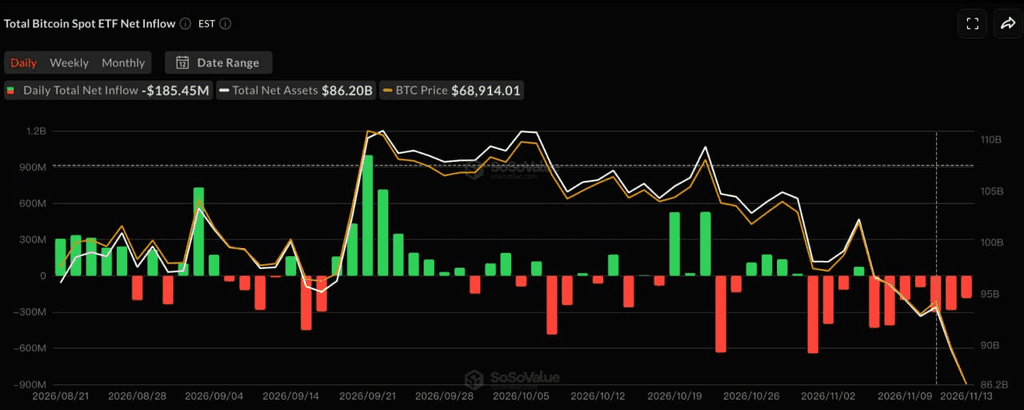
According to SoSoValue data, U.S. spot BTC ETFs recorded approximately $1.07 billion in net outflows from November 9 to 13. This marked the second consecutive week with outflows exceeding $1 billion, with all five trading days recording net outflows. Since November 5, cumulative outflows over seven consecutive trading days have reached approximately $1.91 billion, while cumulative BTC ETF net outflows in November have exceeded $2.3 billion.
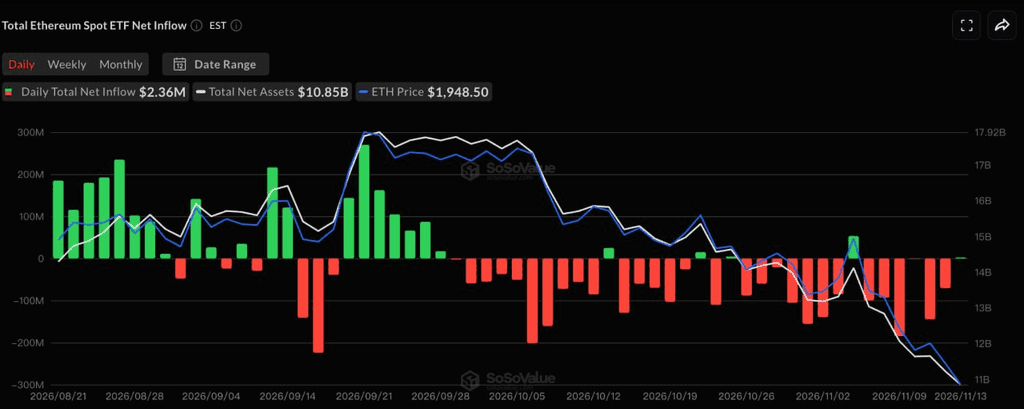
ETH ETFs recorded approximately $399 million in net outflows over the same period, marking the seventh consecutive week of net outflows. Although ETH ETFs recorded a small net inflow of approximately $2.4 million on Friday, this was insufficient to change the broader redemption trend. BTC, ETH and other U.S. spot crypto ETFs recorded combined net outflows of approximately $1.55 billion last week.
Unlike some previous periods in which capital rotated between BTC and ETH, this week was more consistent with institutional investors reducing overall crypto exposure. Continued ETF outflows during a period of price weakness have caused ETFs to shift from a previous source of price support to a pro-cyclical source of pressure. To assess whether funding conditions have genuinely stabilized, a sustained halt in daily ETF outflows would be more meaningful than a single price rebound.
Stablecoins: Continued Contraction in Total Market Capitalization Indicates Weak On-Chain Dollar Demand
Source: DeFiLlama
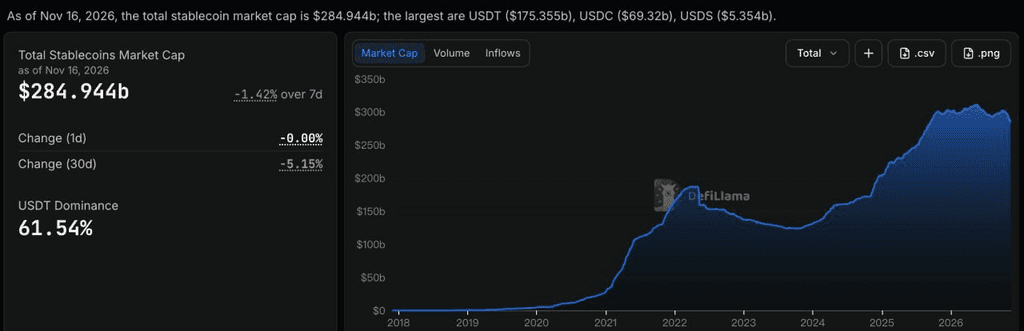
According to DeFiLlama data, total stablecoin market capitalization stood at approximately $284.9 billion as of November 15, down approximately 1.5% over the past seven days and 5.3% over the past 30 days. USDT’s market share was approximately 61.5%. Total stablecoin market capitalization has declined for several consecutive weeks, and the current contraction no longer appears to be limited to rotation between different products.
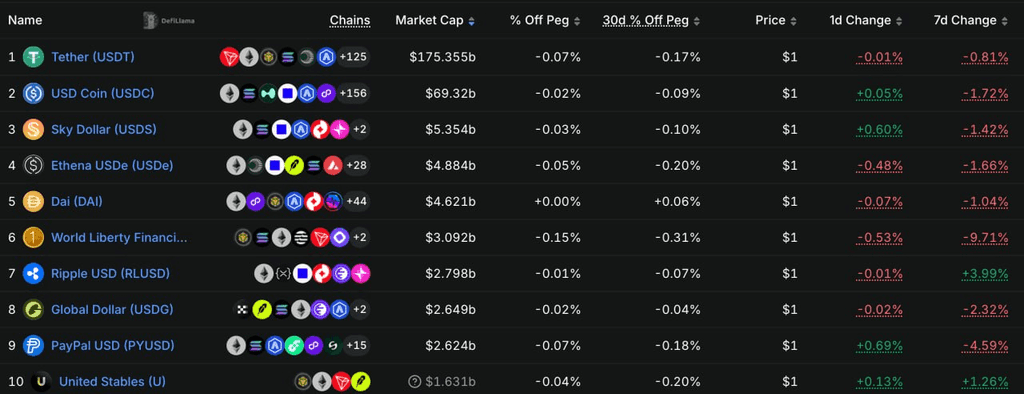
Among the top 10 stablecoins, USDT and USDC declined approximately 0.9% and 2.0%, respectively, on a weekly basis, while USDS fell approximately 4.1%. USDe remained broadly stable. The most notable change was USD1, which declined approximately 11.5% over the week, extending its recent contraction in supply. PYUSD and USDG declined approximately 5.7% and 2.8%, respectively. By contrast, RLUSD increased approximately 3.5%, although its overall scale remains insufficient to offset the contraction in major stablecoins.
Overall, ETF and stablecoin data are sending a consistent signal: institutional products continue to see net outflows while the total supply of on-chain dollars is also declining, indicating that available liquidity is contracting rather than simply rotating within the crypto market. Whether total stablecoin market capitalization can stabilize ahead of prices will be an important early indicator of whether a funding bottom is gradually forming.
Key Events to Watch This Week:
The market’s main focus this week will be on the October FOMC meeting minutes, Nvidia’s earnings, the Anthropic IPO and the APEC Economic Leaders’ Meeting in Shenzhen. With the market already pricing in a December rate hike at above 90%, attention is shifting toward whether the tightening cycle could extend further. At the same time, Nvidia and Anthropic will provide two key windows into the recent risk appetite for AI-related assets.
-
November 17: The U.S. releases October retail sales data. The market will assess whether high interest rates and the earlier rise in energy prices are beginning to weigh on consumer demand. A clear slowdown in consumption could constrain the scope for rapid further tightening in 2027.
-
November 18: Nvidia releases its first quarterly results since Jensen Huang’s resignation. The market will focus on data center revenue, forward guidance and business continuity following the management transition. The APEC Economic Leaders’ Meeting will also take place in Shenzhen on the same day, with potential meetings between the leaders of China, the United States and Russia, as well as related discussions on trade, energy and technology policy, worth monitoring.
-
November 18–19: Anthropic is expected to complete IPO pricing and list on Nasdaq. The company has formally begun its IPO roadshow, and its offering valuation and secondary-market performance will provide an important reference for reassessing risk appetite toward large AI companies.
-
November 19: The Federal Reserve will release the minutes of its October FOMC meeting. The market will focus on officials’ views regarding persistent inflation, the size of the December rate hike and differences over the subsequent tightening path. With the market already pricing in a 25-basis-point hike to a significant extent, whether the minutes show broader support for further tightening could have a greater impact on long-end yields and the dollar than the December action itself.
Overall, the core macro question has gradually shifted from “whether the Fed will hike in December” to whether 25 basis points will be sufficient and how long the tightening cycle will continue. For risk assets, the key focus will be whether Nvidia and Anthropic can help stabilize confidence in the AI trade. For crypto markets, if the dollar and long-end yields continue to rise, liquidity conditions may continue to limit price recovery even if technology stocks stabilize.
Primary Market Funding Observation: Funding Amounts Rebound but Event Count Remains Low, with Capital Concentrated in RWA and Institutional Financial Infrastructure
Source: RootData
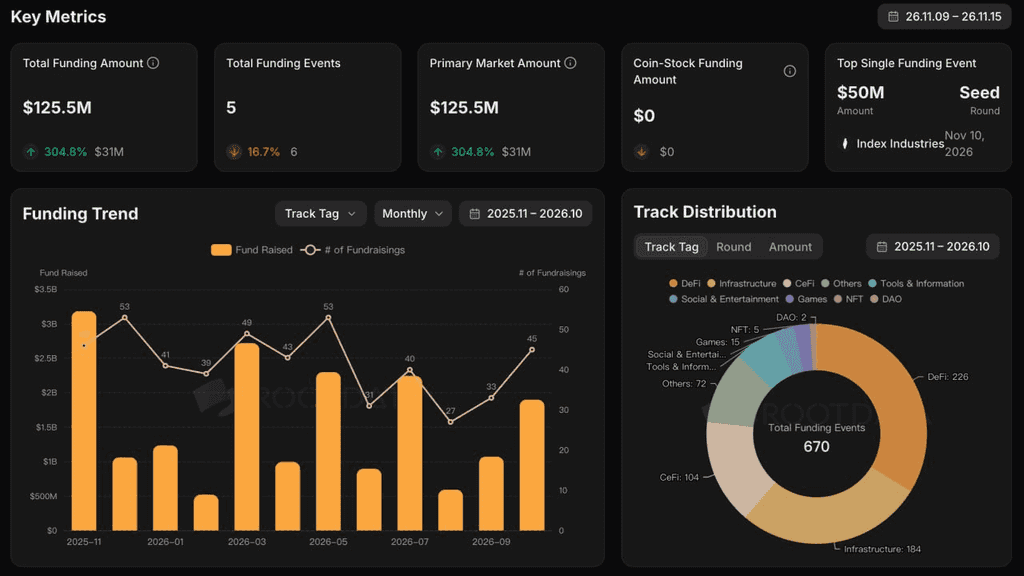
According to RootData’s statistics for November 9–15, five crypto primary-market funding events were disclosed, with total disclosed funding of approximately $125.5 million, up 304.8% week on week. However, the number of funding events declined to five, meaning that the increase in funding was driven primarily by a small number of mid-sized transactions. The largest transaction was a $50 million seed round for Index Industries.
In the RWA sector, Index Industries completed a $50 million seed round led by Lightspeed Venture Partners, with participation from Polychain Capital, Galaxy Ventures and Wintermute Ventures, among others. The project is building the USHP Index, a daily U.S. residential home-price index, and plans to provide asset tokenization, index management and capital-markets services based on the index. Compared with directly tokenizing individual properties, its core approach is to convert exposure to relatively illiquid residential real estate into a standardized index and investable product. This could address a broader market, but the project will ultimately need to validate its index methodology, regulatory positioning and secondary-market liquidity.
In the institutional financial infrastructure sector, Alta completed a $47.5 million Series A led by Index Ventures, with participation from GV, Blackbird Ventures and Square Peg, among others. Alta is positioning itself as a Layer-1 blockchain for banks and large financial institutions, with a focus on privacy, compliance and institutional asset transfers that may not be fully addressed by existing public blockchains. The project has previously received support from Airwallex and others. The round further reflects growing capital-market interest in how stablecoins and tokenized assets can be integrated into the actual settlement infrastructure of banks and payment institutions.
In addition, Marble completed an $11 million seed round led by Polychain Capital. The project is pursuing both institutional-grade multi-asset trading and private credit for AI computing capacity. Marble Markets provides a unified trading venue for digital assets, RWAs, prediction markets and computing capacity, while Marble Compute provides financing to GPU operators and emerging cloud-computing companies based on equipment and contracted cash flows. This direction reflects the continued extension of AI infrastructure investment into financing tools for computing assets and capital-markets products. However, the sustainability of loan demand, risk pricing and institutional liquidity still requires further validation.
Overall, the more important point this week is not the absolute funding amount, but that the two transactions by Index Industries and Alta accounted for approximately 78% of total disclosed funding. Capital remains clearly concentrated in projects with real-asset foundations, institutional clients and financial-infrastructure characteristics. At the same time, the continued low number of funding events suggests that early-stage crypto VC risk appetite has not yet recovered broadly.
About KuCoin Ventures
KuCoin Ventures, is the leading investment arm of KuCoin Exchange, which is a leading global crypto platform built on trust, serving over 40 million users across 200+ countries and regions. Aiming to invest in the most disruptive crypto and blockchain projects of the Web 3.0 era, KuCoin Ventures supports crypto and Web 3.0 builders both financially and strategically with deep insights and global resources.
As a community-friendly and research-driven investor, KuCoin Ventures works closely with portfolio projects throughout the entire life cycle, with a focus on Web3.0 infrastructures, AI, Consumer App, DeFi and PayFi.
Disclaimer This general market information, possibly from third-party, commercial, or sponsored sources, is not legal, compliance, financial, or investment advice, an offer, solicitation, or guarantee. We make no express or implied representations or warranties regarding its accuracy, completeness, or reliability, and disclaim liability for any resulting losses. Investments/trading are risky; past performance doesn't guarantee future results. Users should research, judge prudently, and take full responsibility. Please consult professional legal, tax, or financial advisors if necessary.