

Why Is the Japanese Yen Rising? Bessent’s ‘I Am the House’ Warning and the USD/JPY Outlook
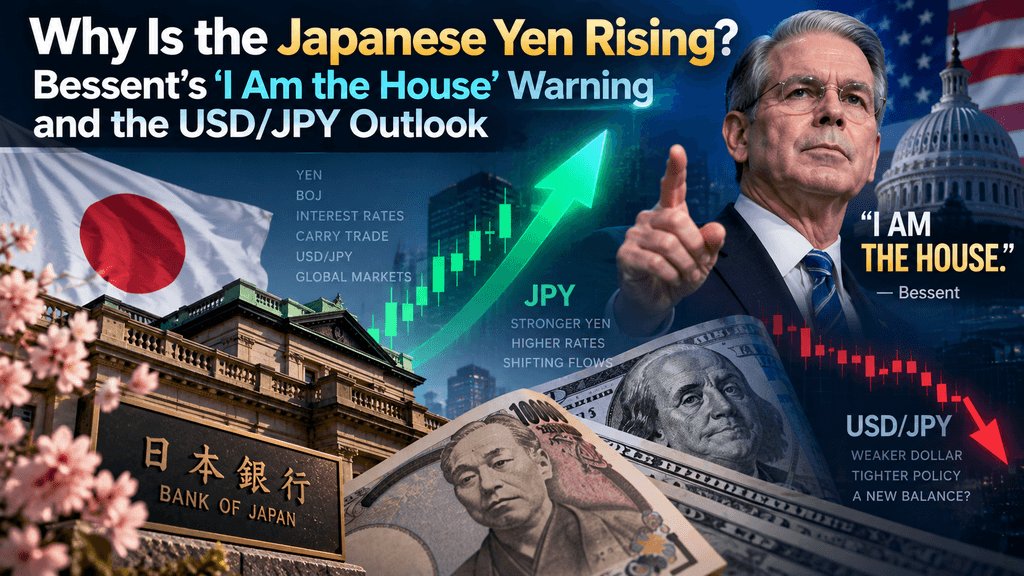
The Japanese yen has staged one of its strongest rallies of 2026, pushing USD/JPY below 155 and briefly to around 152.89, its strongest level against the dollar in nearly seven months. The move comes only weeks after the yen traded near a 40-year low close to 164, making the reversal unusually sharp. Expectations for another Bank of Japan rate hike, stronger Japanese economic data and aggressive short covering have all contributed to the shift.
The rally gained even more attention after U.S. Treasury Secretary Scott Bessent challenged traders betting against the yen. Referring to recent U.S.-Japan currency intervention, Bessent declared, “I am the house now,” and told traders they could bet against him if they wanted.
For crypto investors, this is more than an FX story. A rapidly rising yen can force leveraged carry trades to unwind, potentially tightening global liquidity and affecting Bitcoin, equities and other risk assets.
Why Is the Japanese Yen Rising Now?
The most important force behind the latest yen rally is a major change in expectations for Bank of Japan policy. Japan spent years operating with extremely low or negative interest rates, making the yen one of the cheapest funding currencies in global markets. That encouraged investors to borrow yen and move capital into higher-yielding assets elsewhere. The balance is now shifting. Markets are almost fully pricing another 25-basis-point BOJ increase at the September 17–18 policy meeting, which would take the central bank's key rate to around 1.25%. Tokyo Tanshi data cited by Reuters showed the probability of such a move at roughly 97%, up sharply from about 52% a month earlier.
Better Japanese economic data has reinforced those expectations. Revised second-quarter growth figures were stronger than initially estimated, while real wages have also improved. That matters because the BOJ has long argued that sustainable wage growth is essential for keeping inflation around target without relying only on imported price pressures. As markets become more confident that Japan can tolerate higher rates, the structural argument for maintaining large short-yen positions becomes weaker. The shift is especially significant because Japanese government bond yields have also risen toward multi-decade highs, meaning investors no longer need to move as much capital overseas simply to earn a positive return.
The final driver is positioning. The yen had become one of the world's most crowded short trades after falling toward 164 per dollar in July. Once USD/JPY broke below 155, stop-loss orders and short covering accelerated the move. Reuters reported that leveraged funds and real-money investors began reducing yen shorts after that level gave way, helping push the currency rapidly toward 152.89. The yen has also strengthened against other traditional carry-trade currencies such as the Mexican peso and Turkish lira. This means the current rally is no longer simply the result of government intervention: monetary policy expectations, improving domestic fundamentals and positioning are now reinforcing one another.
What Did Bessent Mean by “I Am the House”?
Bessent's comments attracted attention because they were unusually direct for a U.S. Treasury secretary. Speaking at Southern Methodist University in Texas on September 8, he argued that his position gives him an informational advantage when Washington coordinates currency policy with Tokyo. Referring to intervention in the yen, Bessent said he has insight into what Japanese authorities and the BOJ are likely to do and challenged traders to bet against him.
The phrase “the house” comes from casino terminology. Individual gamblers can win particular bets, but the casino possesses a structural advantage because it controls the framework within which those bets are made. Bessent was making a similar point about currency markets. A hedge fund trading USD/JPY can analyze interest-rate differentials, positioning and technical levels, but a finance ministry or treasury can also change the policy environment itself. Governments can intervene directly, coordinate with other authorities and influence monetary and fiscal policy expectations. Bessent's message was therefore less a specific USD/JPY forecast than a warning about policy risk.
That distinction is important. Yen shorts are no longer making only an interest-rate bet. They must now consider the possibility that U.S. and Japanese authorities could coordinate again, that the BOJ may tighten faster than previously expected and that official communication itself could trigger short covering. Bessent's warning effectively changes the risk-reward calculation. The important question is not whether the Treasury can permanently control a multi-trillion-dollar FX market. It is whether traders are being adequately compensated for taking the opposite side of policymakers who are increasingly aligned around preventing disorderly yen weakness.
How U.S.-Japan Intervention Changed the Yen Trade
The credibility behind Bessent's warning comes from the fact that Washington and Tokyo have already intervened. When the yen fell toward four-decade lows in late July, Japan entered the market to buy yen and sell dollars. The U.S. subsequently joined a coordinated intervention, with Japan later confirming that the two governments had acted together to address what officials described as excessive volatility and disorderly currency moves. The operation was particularly significant because direct U.S. support for the yen had been extremely rare in recent decades.
The scale of Japan's effort was substantial. Between July 30 and August 26, authorities spent roughly 15.4 trillion yen, or close to $99 billion, supporting the currency. Japan's foreign reserves fell by a record $79.6 billion in August to about $1.208 trillion, reflecting the scale of intervention and changes in the value of reserve assets. The action helped pull the yen away from levels near 164 and toward roughly 155 in early August. Yet the initial gains were not permanent. USD/JPY later recovered as traders continued to focus on the still-large interest-rate gap between the United States and Japan.
That experience showed both the power and the limitations of FX intervention. Governments can move markets sharply, especially when positions are crowded, but intervention alone rarely defeats underlying monetary fundamentals indefinitely. If U.S. yields remain high and Japanese rates remain too low, investors can eventually rebuild carry trades. The difference today is that intervention risk is increasingly aligned with BOJ tightening. A stronger yen supported by higher Japanese rates is more difficult to fight than a stronger yen created only by temporary official purchases. This is why the next BOJ decision may matter more for USD/JPY than another verbal warning from either government.
Why the BOJ Matters More Than Intervention
The long-term direction of USD/JPY is heavily influenced by the interest-rate differential between the United States and Japan. When U.S. rates are substantially higher, investors have an incentive to hold dollars rather than yen. They can also borrow relatively cheap yen and invest in higher-yielding dollar assets, generating positive carry. This structure helped drive USD/JPY higher for years and made shorting the yen one of the most persistent macro trades in global finance.
BOJ tightening attacks that logic from both sides. Higher Japanese rates increase the cost of borrowing yen and make domestic Japanese assets more attractive. At the same time, a rising yen can create currency losses for investors who borrowed it to fund overseas positions. Reuters reported that the yen has gained around 4% in September and is trading close to a seven-month high as expectations for faster BOJ tightening and possible capital repatriation increase. Markets will therefore focus not only on whether the BOJ raises rates in September, but also on whether Governor Kazuo Ueda signals further tightening later in 2026.
The case for continued yen appreciation is not one-sided, however. U.S. economic data remains relatively strong, keeping Treasury yields elevated and preserving a meaningful dollar yield advantage. Japan is also a major energy importer, which makes the current rise in oil prices a potential headwind. Brent crude has moved toward $100 per barrel as Middle East tensions escalate. Higher energy costs worsen Japan's import bill and can traditionally pressure the yen. The current USD/JPY outlook is therefore a contest between BOJ tightening and intervention risk on one side, and high U.S. yields and expensive energy on the other.
What Is the USD/JPY Outlook From Here?
The break below 155 changed the short-term technical and positioning picture. USD/JPY reached 152.89 on September 8 before trading around 153.3 the following day. Analysts are increasingly watching the 152 area as an important near-term level, with the psychologically significant 150 level likely to attract even more attention if yen strength continues. Some strategists believe the yen remains undervalued on a fundamental basis, with BNY Investments estimating fair value somewhere in the 140s. State Street has also suggested that a more extensive carry-trade unwind could push USD/JPY toward the mid-140s.
A stronger-yen scenario would become more credible if the BOJ raises rates and signals additional tightening while U.S. inflation softens enough to reduce expectations for further Federal Reserve hikes. Another coordinated intervention would add further pressure on yen shorts. Under that combination, a move toward 150 would become easier to justify. The opposite scenario is also plausible. If U.S. inflation remains sticky, the Fed stays hawkish, Treasury yields push higher and the BOJ delivers a cautious message after raising rates, the dollar's yield advantage could reassert itself. Continued oil strength would also make the yen's rally more difficult to sustain.
A third outcome may be the most realistic: elevated volatility rather than a clean directional move. Traders are simultaneously pricing BOJ policy, Fed policy, intervention risk, oil prices and carry-trade positioning. Three-month implied volatility in USD/JPY has already risen to a six-month high, according to Reuters. That means investors should be careful about treating Bessent's comments as a simple target call. The key question is not whether the Treasury secretary can “beat” yen shorts on his own. It is whether monetary fundamentals continue moving in the same direction as his preferred outcome.
Why the Yen Carry Trade Matters for Bitcoin
The yen carry trade explains why a currency pair can matter to Bitcoin investors. For years, traders have been able to borrow yen at relatively low interest rates, exchange those funds into dollars or other currencies and invest in assets offering higher expected returns. Those investments can include government bonds, credit, equities, emerging-market assets and, directly or indirectly, crypto. The exact size of the carry trade is impossible to measure because many positions use derivatives and leverage, but cross-border yen borrowing reached a record 360 trillion yen, or about $2.34 trillion, in March 2026, according to a Jefferies analysis of Bank for International Settlements data.
A stronger yen can turn this strategy against investors. Suppose a fund borrows yen, converts it into dollars and buys higher-return assets. If the yen suddenly rises 5%, the currency loss can erase months or years of interest-rate carry. A BOJ rate hike adds another problem by increasing funding costs. The investor may then reduce leverage, sell the asset purchased with borrowed money and buy yen to repay the loan. That creates a self-reinforcing sequence: yen rises → carry returns deteriorate → assets are sold → yen is repurchased → yen rises further. Markets saw how powerful this mechanism could become in 2024, when a surprise BOJ tightening sent USD/JPY rapidly from around 154 toward 141 and contributed to a 12.4% one-day drop in Japan's Nikkei.
Bitcoin can become part of the adjustment because it is highly liquid, trades around the clock and is often held by investors with substantial leverage. A yen rally does not automatically mean Bitcoin must fall. A gradual currency adjustment may be absorbed without broader disruption. The risk becomes more serious when USD/JPY falls very quickly and forces leveraged investors to reduce positions across multiple markets. For crypto investors, the speed of the yen move may therefore matter more than the absolute exchange rate. USD/JPY is not simply an FX chart; during periods of stress, it can become an indicator of changes in global leverage.
What Should Crypto Investors Watch Next?
The first major event is the BOJ's September 17–18 meeting. Markets already expect a 25-basis-point rate increase, which means the rate decision alone may not provide the strongest signal. Governor Ueda's guidance could matter more. If the BOJ indicates that another increase may follow relatively soon, traders may conclude that Japan is entering a sustained tightening cycle rather than delivering a one-off adjustment. That would make rebuilding large yen short positions more difficult. If the BOJ raises rates but emphasizes caution, some of the recent yen rally could reverse as investors take profits.
The second variable is the interaction between USD/JPY and U.S. monetary policy. Upcoming inflation data and the Federal Reserve's next decision could materially alter the rate differential. Strong U.S. inflation and another Fed hike would support dollar yields, while softer data could accelerate a move toward 150 in USD/JPY. Investors should also watch whether the yen's rise remains orderly. Reuters has noted that the current move differs from 2024 because the BOJ has signaled its intentions well in advance and global equities have so far absorbed the adjustment relatively well. A slow decline in USD/JPY could therefore have very different implications from a sudden collapse through major support levels.
For crypto markets, the most useful confirmation would come from cross-asset behavior. If USD/JPY falls while Bitcoin, the Nasdaq and other risk assets remain stable, the move may simply reflect a normal repricing of Japanese monetary policy. If the yen surges while equities, crypto and credit markets fall together, that would provide stronger evidence of a broader carry-trade unwind. Another actual U.S.-Japan intervention would also matter because it would reinforce the credibility behind Bessent's “house” warning. The central question is whether the yen rally remains an FX adjustment or develops into a wider global deleveraging event.
🔥 Beyond the Headlines: What KuCoin 5.0 Means for You
Market news moves fast — but where you act on it matters just as much. This October, KuCoin launches KuCoin 5.0, transforming KuCoin into a rebuilt platform. Here's what actually changes for you:
-
One account for everything. Older platforms split your money across separate "spot," "margin," and "futures" accounts and expected you to understand why. KuCoin 5.0's unified account removes that entirely — deposit once, and everything is simply there.
-
Stocks, indices, and commodities. KuCoin 5.0 expands beyond crypto into global markets. When crypto chops sideways and equities rally (or the reverse), you rotate in minutes instead of opening a brokerage account and waiting days for fiat rails.
-
Real-world assets (RWA). Tokenized exposure to traditional assets like commodities, right inside your crypto account. One of the fastest-growing segments in global finance is no longer reserved for institutions — you access it from the same balance you trade with.
-
Earn while you learn. Not ready to trade? KCUSD lets your stablecoins earn daily, auto-compounding interest. The lowest-stress way to put your idle deposit to work for 4% yield.
-
An AI assistant in plain language. Ask questions, get market context, understand what you're looking at — built into the platform, no jargon required.
-
An app that doesn't overwhelm. Faster, cleaner, and consistent — intuitive from the first tap, not after a tutorial.
-
Safety you can check, not just trust. A MiCAR-licensed EU entity, Proof of Reserves you can verify yourself, and internationally certified security (SOC 2 Type II, ISO 27001:2022).
Create your account in minutes — and start on the platform built for where crypto is going, not where it's been.
Conclusion
Scott Bessent's “I am the house” warning has added an unusual political dimension to one of the world's most important currency trades. But the yen is not rising simply because the U.S. Treasury secretary challenged traders. Expectations for higher BOJ rates, stronger Japanese economic data, official intervention risk and the unwinding of crowded short positions are all working in the yen's favor.
USD/JPY could continue lower if monetary policy reinforces that trend, although high U.S. yields and expensive oil remain significant obstacles to sustained yen appreciation.
For crypto investors, the most important issue is the carry trade. A controlled yen recovery may have little effect on Bitcoin. A rapid reversal that forces leveraged investors to sell assets could be very different. The yen therefore matters not only as a currency, but also as a window into the amount of leverage supporting global risk markets.
FAQs
Can the U.S. Treasury intervene directly in the yen market?
Yes. The U.S. can conduct foreign-exchange operations through the Treasury's Exchange Stabilization Fund, with transactions typically executed by the Federal Reserve Bank of New York. Coordinated intervention with another government can increase the market signal.
How much capacity does Japan have to support the yen?
Japan holds more than $1 trillion in foreign reserves, although not all reserves are equally liquid or intended for immediate FX intervention. Repeated large interventions can also create side effects, particularly if Japan needs to sell U.S. Treasury securities.
Does Japan need U.S. permission to buy yen?
No. Japan can intervene independently in foreign-exchange markets. However, U.S. cooperation can improve credibility because USD/JPY directly involves the dollar and coordinated action signals broader policy alignment.
Why can a stronger yen hurt Japanese stocks?
Many large Japanese companies earn substantial revenue overseas. A stronger yen reduces the value of foreign earnings when converted back into yen and can make Japanese exports more expensive internationally.
Can USD/JPY and Bitcoin fall at the same time?
Yes. USD/JPY falling means the yen is strengthening. If that move reflects a carry-trade unwind, investors may sell risk assets such as Bitcoin while simultaneously buying yen to repay borrowed funds.
Disclaimer: This content is for informational purposes only and does not constitute investment advice. Cryptocurrency investments carry risk. Please do your own research (DYOR).