

Japan 10-Year Bond Yield Hits 3% for First Time This Century: Global Market Implications
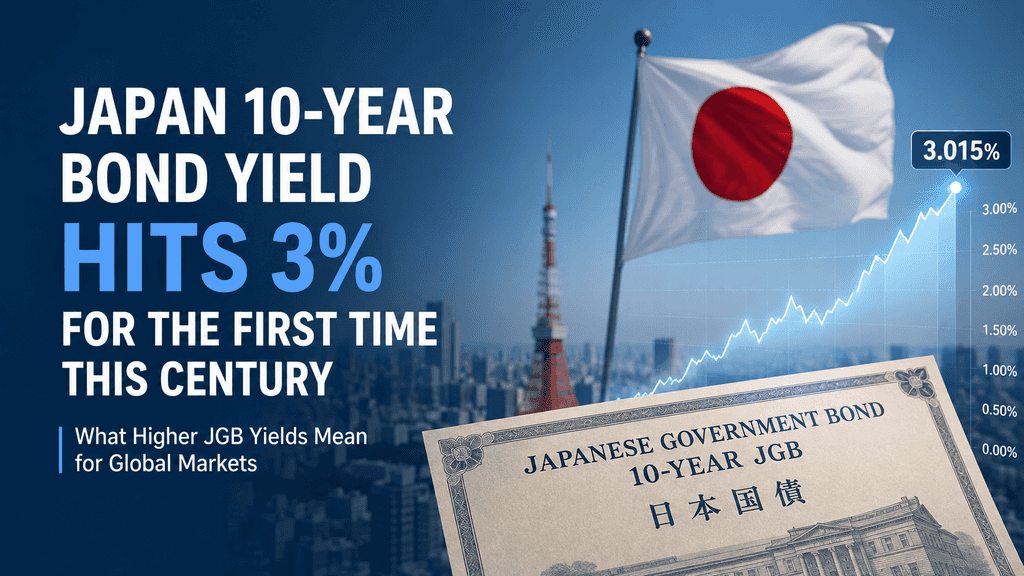
Japan’s benchmark 10-year government bond yield reached 3% on September 1, 2026, its highest level since 1996, before climbing to 3.015% on September 2. The milestone marks a major shift from Japan’s decades-long era of ultra-low interest rates and could change how domestic investors allocate capital between Japanese and overseas assets.The move also has wider implications for global markets. Higher JGB yields could influence demand for U.S. Treasuries, stock valuations, currency markets and yen-funded carry trades, making Japan’s bond market increasingly important to investors worldwide.
How Japan’s 3% Bond Yield Is Changing the Appeal of Japanese Government Bonds
Japan’s 10-year government bond yield reaching 3% is changing how investors assess JGBs after decades of near-zero returns. For Japanese banks, insurers, pension funds and households, government bonds can once again provide meaningful yen-denominated income without the foreign-exchange risk associated with overseas assets. At the September 1, 2026 auction, the average accepted yield reached 2.995%, while the yield at the lowest accepted price was 3.011%, showing that investor demand remained firm even at multi-decade yield levels. The return of higher yields is also making JGBs more relevant in portfolio construction, especially for investors looking for lower-risk domestic income.
Why 3% Makes JGBs More Attractive to Japanese Investors
For years, exceptionally low yields reduced the income appeal of Japanese government bonds and pushed many institutions to look abroad for better returns. That environment is now changing. As the Bank of Japan reduces bond purchases and market pricing becomes more flexible, higher JGB yields are making domestic fixed income more competitive again. A 3% benchmark also narrows the gap between Japanese and foreign government bonds, especially once currency volatility and hedging costs are considered. This gives investors more reason to compare overseas returns with what they can now earn at home.
This is particularly relevant for banks, life insurers and pension funds that need high-quality assets to match long-term yen-denominated liabilities. Higher domestic yields allow these institutions to generate more income without taking as much foreign-exchange or credit risk, strengthening the role of JGBs in long-term portfolio allocation. If yields remain elevated, domestic government bonds could gradually take a larger share of institutional fixed-income portfolios.
Higher JGB Yields Improve Returns but Increase Bond-Market Risk
Higher yields create better income opportunities for new JGB buyers, but they also introduce greater interest-rate risk. Bond prices generally fall when yields rise, which means investors holding existing long-duration bonds can face mark-to-market losses if Japanese yields continue climbing. The effect can be more pronounced for longer-maturity securities because their prices are typically more sensitive to changes in interest rates.
Inflation also matters because investors ultimately care about the real return after inflation, not just the headline yield. If price pressures remain high, part of the benefit from a 3% nominal yield can be eroded. Even so, the return of materially higher Japanese government bond yields marks a major shift from the country’s ultra-low-rate era, making JGBs more useful as income-producing assets while also bringing greater price volatility and interest-rate sensitivity.
Why Higher JGB Yields Could Bring More Japanese Capital Back Home
Higher Japanese government bond yields could gradually change one of the most important capital-flow patterns created during Japan’s long era of ultra-low interest rates. Japanese banks, insurers, pension funds and asset managers accumulated substantial overseas portfolios partly because domestic government bonds generated very little income. With the 10-year JGB yield now around 3%, that gap has narrowed considerably. Investors that measure liabilities and returns in yen can earn substantially more from high-quality domestic debt without taking the foreign-exchange exposure associated with U.S. Treasuries, European government bonds or other overseas securities.
That does not mean Japanese institutions will suddenly liquidate foreign portfolios. A more realistic scenario is a gradual adjustment in where new money is invested and where proceeds from maturing securities are reinvested.
Repatriation
Capital repatriation occurs when investors redirect money held abroad into assets in their home market. Sustained higher JGB yields could encourage this process because Japanese bonds now offer returns that are materially more competitive with foreign government debt. The adjustment could take place through portfolio rebalancing rather than aggressive selling. An insurer, for example, might allow an overseas bond to mature and reinvest a larger share of the proceeds into JGBs instead of purchasing another foreign security.
Over time, even incremental decisions of this kind can become important because of the enormous amount of capital managed by Japanese financial institutions.
Hedging
Currency hedging could become one of the most important factors determining whether Japanese capital remains overseas. A U.S. Treasury may still offer a higher headline yield than a JGB, but a yen-based investor must decide whether to accept fluctuations in the dollar-yen exchange rate or pay to hedge that exposure. When hedging costs are substantial, the effective advantage of owning the foreign bond can become much smaller than the headline yield difference suggests.
Higher JGB yields therefore improve the relative economics of remaining in domestic fixed income. The smaller the return advantage available overseas after hedging, the less incentive some institutions may have to assume the additional complexity and risk.
Institutions
Japanese banks, insurers and pension funds are particularly important because they control enormous pools of long-term savings. Their investment decisions are based on more than simply choosing whichever country offers the highest bond yield. Institutions must consider asset-liability matching, duration, capital requirements, liquidity, currency exposure and risk-adjusted returns.
Higher domestic yields give them more flexibility to satisfy those objectives within Japan. For an insurer with future obligations denominated in yen, owning longer-duration JGBs can provide a natural liability match without creating foreign-exchange risk. That does not eliminate the benefits of international diversification. It simply means the domestic option has become considerably more competitive.
Allocation
The most likely outcome is therefore not an abandonment of overseas markets but a change in asset allocation at the margin. Japanese investors will continue owning foreign equities, bonds and other assets when the expected returns justify the risks. Global diversification remains valuable, and different institutions have different investment mandates.
But a 3% Japanese benchmark creates a higher hurdle for allocating additional capital overseas than existed when comparable domestic yields were close to zero. This distinction is important. Global markets do not require Japanese institutions to sell trillions of dollars of foreign assets before feeling an effect. Changes in new purchases, reinvestment decisions and portfolio weights can influence demand over time.
Scale
Japan’s existing overseas holdings show why these decisions matter globally. Japan remained the largest foreign holder of U.S. Treasury securities in June 2026, with holdings of approximately $1.116 trillion, according to U.S. Treasury data reported by Reuters. Japanese holdings declined from roughly $1.143 trillion in May, although a single month’s movement does not establish that capital is already being repatriated because of higher JGB yields.
The significance is the scale rather than the monthly change. When one of the largest sources of international fixed-income demand gains a more competitive domestic alternative, global bond investors pay attention. If JGB yields remain near or above 3%, Japan could gradually move away from an environment in which investors routinely needed to search abroad for income. The speed of that transition will depend on currency movements, hedging costs, relative yields and institutional requirements, but the investment calculation has already changed significantly.
Global Market Implications: How Japan’s Bond Shift Could Affect U.S. Treasuries, Stocks and Carry Trades
Japan’s 10-year government bond yield moving above 3% is becoming part of a wider repricing across global financial markets. Japanese rates matter internationally because government bond yields influence relative returns across countries, while Japan remains deeply connected to overseas bond, currency and equity markets. The significance is not that Japan alone is driving the current global bond selloff. Inflation risks, higher energy prices, fiscal concerns and monetary-policy expectations are also pushing yields higher worldwide. However, the disappearance of ultra-low Japanese yields removes one factor that historically encouraged capital and cheap yen funding to flow toward international assets.
The market backdrop illustrates how closely connected these forces have become. On September 2, Japan’s 10-year JGB yield rose as high as 3.015%, while the benchmark U.S. 10-year Treasury yield reached 4.8122%, its highest level in almost three years. The simultaneous rise in sovereign yields has increased concern about tighter financial conditions across major economies.
Japan Bond Yields and U.S. Treasury Demand
The U.S. Treasury market is one of the most important areas to watch because Japan remains its largest foreign sovereign investor base. Higher Japanese yields do not automatically cause U.S. Treasury yields to rise. Treasury pricing is primarily influenced by U.S. inflation, Federal Reserve policy, economic expectations, government issuance and domestic investor demand. Nevertheless, international buyers remain an important part of the market.
If Japanese institutions become less willing to add foreign bonds because JGBs provide more competitive returns at home, U.S. debt may have to offer slightly higher yields to attract the same level of marginal demand. That possibility becomes more relevant when Treasury yields are already elevated. The U.S. 10-year yield reached 4.8122% on September 2, as global bond markets responded to renewed inflation and energy-price concerns. The effect should not be overstated. Japan is unlikely to determine the direction of the Treasury market by itself. But with Japanese investors holding more than $1.1 trillion in U.S. government securities, even gradual changes in demand can become an important piece of the broader global rates picture.
Higher Bond Yields Put Pressure on Global Stocks
Rising government bond yields can also influence stock valuations because sovereign debt provides a relatively low-risk alternative to equities. When bond yields increase, investors can earn higher returns without accepting the same level of corporate or market risk. That can raise the return investors require from equities and increase the discount rate used to value companies’ future earnings. Highly valued growth stocks can be particularly sensitive because a larger proportion of their expected value may depend on profits projected far into the future. Higher discount rates reduce the present value assigned to those earnings.
The pressure was visible across markets on September 2. Japan’s Nikkei 225 fell about 2.9%, MSCI’s broad Asia-Pacific index outside Japan dropped roughly 2%, and South Korea’s KOSPI declined almost 4% as rising oil prices and bond yields increased concern about inflation and tighter financial conditions. Those moves were driven by several simultaneous global developments rather than JGB yields alone, but they demonstrate how quickly bond-market stress can affect equity sentiment. The impact is also unlikely to be uniform across sectors. Banks and some insurers can potentially benefit from higher interest rates and reinvestment yields, while highly leveraged companies, property-related businesses and expensive long-duration stocks may face greater pressure from rising financing and discount rates.
Japan’s 3% Yield Raises Yen Carry Trade Risks
The yen carry trade is another major reason Japan’s transition toward higher rates matters internationally. Carry trades typically involve obtaining funding in a currency with relatively low interest rates and investing those funds in assets offering higher returns elsewhere. Japan’s extremely low borrowing costs made the yen one of the world’s most prominent funding currencies. That strategy becomes less attractive if Japanese interest rates rise and the gap between returns in Japan and other economies narrows.
The 10-year JGB yield itself is not the borrowing rate used in every carry trade, so a move to 3% does not automatically trigger a large-scale unwind. Short-term interest rates, foreign yields, currency movements and leverage are more directly relevant to individual positions. However, the 3% milestone is evidence of a broader change in Japan’s interest-rate environment. Currency movements can amplify the risk. If investors borrow yen, purchase higher-yielding foreign assets and then the yen strengthens substantially, converting those foreign returns back into yen can generate losses. Highly leveraged positions may then need to be reduced quickly. That is why markets closely watch the combination of BOJ policy, JGB yields and the yen rather than any one variable in isolation.
Global Bond Yields Could Tighten Financial Conditions
The wider issue is that Japan’s repricing is happening during a global rise in government borrowing costs. On September 1, the U.S. 10-year Treasury yield reached approximately 4.796%, while Germany’s benchmark borrowing costs touched their highest levels in about 15 years and UK yields reached levels not seen since 2008. By September 2, the U.S. 10-year yield had advanced further to 4.8122%. Higher sovereign yields can eventually feed into mortgage rates, corporate financing costs and government debt-service expenses. Companies considering new investments face a higher cost of capital, while consumers may encounter more expensive credit.
This is why Japan’s 3% JGB yield matters beyond Tokyo. It adds another major sovereign bond market to a worldwide shift away from the extremely cheap long-term financing conditions that characterized much of the post-global-financial-crisis period. For global investors, the important question is therefore not whether Japan’s 3% yield will single-handedly cause a Treasury selloff or stock-market correction. The more meaningful issue is whether higher Japanese yields become a permanent part of the global financial landscape. If they do, U.S. Treasury demand, equity valuations, yen-funded carry trades and global financing costs may all have to adjust to a world in which Japanese capital is no longer supported by near-zero domestic bond returns.
Conclusion
Japan’s 10-year government bond yield crossing 3% for the first time since 1996 marks a major shift from the country’s decades-long era of ultra-low interest rates. Higher JGB yields are making Japanese government bonds more attractive to domestic investors and could gradually influence how banks, insurers, pension funds and asset managers allocate capital between Japan and overseas markets.
The broader impact will depend on whether yields remain elevated. If higher Japanese rates become a lasting trend, investors will closely watch BOJ policy, inflation, the yen, JGB demand and global bond yields for signs of further change. A sustained shift could affect U.S. Treasuries, global equities, currency markets and yen-funded investment strategies, making Japan’s bond market increasingly important to the global financial outlook.
FAQs
1. Is a 3% Japan 10-year bond yield high by historical standards?
A 3% yield is exceptionally high compared with Japan’s recent history, although it would not necessarily be considered unusually high in many other developed bond markets. Japan spent years with 10-year yields close to zero under extremely loose monetary policy. The return to 3% in September 2026 is therefore significant because the benchmark had not reached that level since 1996.
2. Does a 3% JGB yield mean investors earn a 3% real return?
No. The 3% figure is a nominal yield, while the real return depends on inflation. If inflation remains close to the bond’s nominal yield, much of its purchasing-power return can disappear. If inflation falls substantially below 3%, the same nominal yield becomes more attractive in real terms.
3. What happens to existing Japanese government bonds when yields rise?
Bond prices generally move in the opposite direction to yields. When newly issued bonds offer higher yields, older bonds with lower coupons become less attractive and their market prices typically decline. Long-maturity bonds are usually more sensitive to changes in interest rates, so rapid increases in yields can produce larger mark-to-market losses for holders of longer-duration JGBs.
4. Could higher JGB yields increase Japanese mortgage and business borrowing costs?
Yes, especially if higher yields persist. Government bond yields help establish benchmarks for longer-term financing across an economy. Sustained increases can eventually influence fixed-rate mortgages, corporate bond yields and other borrowing costs, although the size and timing of the effect varies according to the type of loan and the benchmark used.
5. Are higher Japanese bond yields good or bad for banks?
They can create both benefits and risks. Banks may earn more from new loans and securities as market interest rates rise, potentially improving interest margins. At the same time, rapid increases in yields can reduce the market value of lower-yielding bonds already held on their balance sheets. The net effect depends on each institution’s portfolio, funding structure and interest-rate exposure.
6. Could a 3% JGB yield attract more foreign investors to Japan?
Potentially. Higher JGB yields make Japanese government debt more competitive for international fixed-income investors, particularly those seeking highly liquid developed-market sovereign securities. Foreign investors must still evaluate Japanese inflation, exchange-rate movements, BOJ policy and the returns available from government bonds in other major markets.
7. Does Japan’s 3% bond yield mean the country is facing a debt crisis?
No. A 3% yield alone does not indicate a sovereign debt crisis. Japan’s September 1 bond auction continued to attract substantial bids even as yields approached the historic threshold. However, sustained higher borrowing costs could become increasingly important over time because refinancing government debt at higher rates gradually raises interest expenses.
8. How quickly do higher JGB yields increase Japan’s government interest costs?
The effect occurs gradually rather than immediately. Existing Japanese government debt does not suddenly reset to the latest market yield. As older bonds mature and new bonds are issued at higher rates, a larger portion of the debt stock becomes subject to higher borrowing costs. Persistent elevated yields therefore matter much more for long-term fiscal finances than a temporary spike.
🔥KuCoin Offers A More Stable Option in A Volatile Market

Disclaimer: This article is for informational and educational purposes only and does not constitute financial or investment advice.