

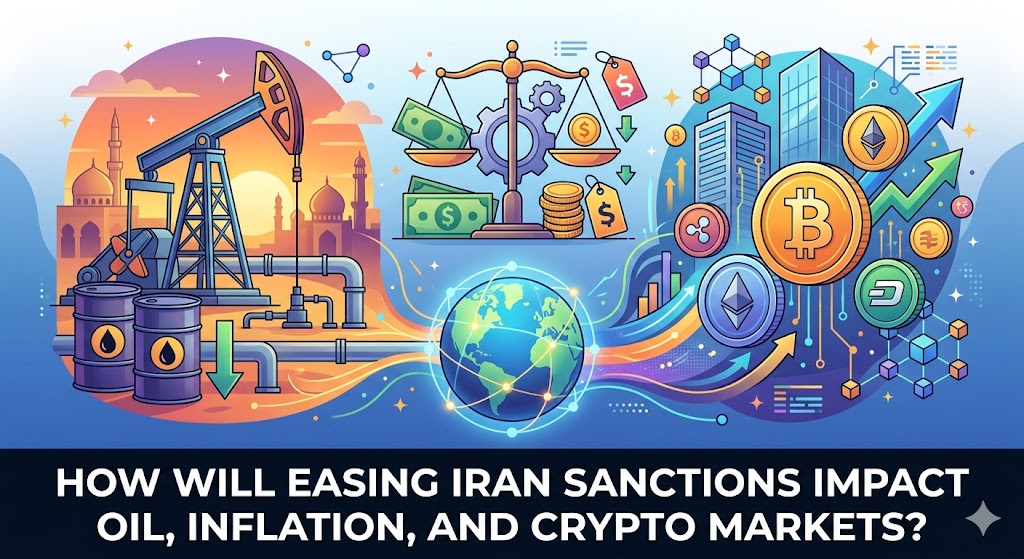
How Will Easing Iran Sanctions Impact Oil, Inflation, and Crypto Markets?
Introduction: Geopolitics Meets Markets
Global markets react sharply to geopolitical events, especially when they involve energy supply. Iran, as a leading OPEC member, has historically played a significant role in the global oil market, both as a supplier and as a strategic force due to its control over the Strait of Hormuz. U.S. and Western sanctions, re-intensified in 2018 and revisited in subsequent years, have restricted Iranian oil exports and contributed to volatility in global energy markets. These sanctions, combined with regional tensions and conflicts in 2025–2026, have kept oil prices elevated, indirectly feeding into global inflation and influencing risk assets, including cryptocurrencies.
Recent developments in March 2026 indicate a temporary easing of sanctions, allowing Iranian barrels already at sea to enter the global market. While this is not a full lifting, it has reignited discussions about how such measures could affect not only oil prices and inflation but also digital asset markets such as Bitcoin (BTC) and Ethereum (ETH). The interconnection between these markets is subtle but significant: energy price shifts influence inflation, which drives monetary policy decisions that affect liquidity, risk appetite, and speculative investments, including crypto.
This article delves into each dimension: the macro-economic implications, oil supply mechanics, inflation impacts, crypto market responses, and geopolitical complexities. We also include actionable insights for crypto traders and investors to navigate these intertwined markets. By analyzing historical patterns, recent events, and expert opinions, this article aims to equip readers with a nuanced understanding of how easing Iran sanctions may shape global financial and crypto markets in 2026.
Iran’s Role in Global Oil Markets
Iran historically produced between 1.4–1.7 million barrels of oil per day, contributing roughly 4% of global supply. Its exports largely transit the Strait of Hormuz, a strategic chokepoint responsible for transporting nearly 20% of the world’s crude. The imposition of sanctions has significantly reduced Iran’s capacity to participate in global markets, tightening supply and increasing the risk premium on oil prices.
Beyond just raw supply, Iran’s role has implications for market psychology. Traders price in geopolitical risk as a premium, which can amplify volatility in times of regional tension. Even a temporary easing of sanctions can have outsized effects on expectations. Currently, reports indicate that around 140 million barrels of Iranian oil are awaiting sale and shipment, and allowing these barrels to reach global markets could offer a modest easing of supply constraints.
However, structural challenges remain. Iran’s oil infrastructure faces underinvestment, aging equipment, and limited capacity for rapid production increases. Even if sanctions are eased broadly, these constraints mean Iran may not be able to return to pre-sanctions output levels immediately. This creates a scenario where the market reacts to expectations as much as actual physical flows.
The broader context is also critical: OPEC+ strategies, U.S. shale production, and European energy policy all intersect to influence the net effect of sanctions relief. For instance, OPEC+ members may adjust their quotas in response to Iranian barrels entering the market, either offsetting or amplifying price movements. Understanding Iran’s role requires seeing the interplay between geopolitical factors, supply-side economics, and investor sentiment, which together shape both oil and risk asset markets.
How Sanctions Easing Could Affect Oil Prices
The oil market is inherently forward-looking, meaning prices respond not just to current supply but also to expectations of future flows. Sanctions relief could affect prices through multiple channels:
1. Immediate Supply Impact: The injection of 140 million barrels already in transit could mitigate the tight supply that has driven Brent and WTI crude above $100 per barrel. While this is a relatively small portion of global daily demand (~100 million barrels/day), even a modest increase can ease speculative pressure and limit rapid price spikes.
2. Market Volatility and Risk Premium: Geopolitical events contribute a risk premium to oil prices. Temporary relief reduces uncertainty, which may lower this premium. Traders often adjust positions based on these risk-adjusted expectations, meaning the market can stabilize even before physical barrels arrive.
3. Long-Term Constraints: Iran’s production capacity cannot instantly rebound due to technical limitations and investment shortfalls. Even with sanction relief, infrastructure issues may cap the output for months, tempering expectations of a dramatic supply surge.
Historical precedents support this behavior. For example, partial sanction relief in the early 2010s produced temporary price dips but did not lead to sustained low prices due to capacity constraints and regional uncertainties. Similarly, traders are cautious to fully discount the effects of geopolitical risks, including the ongoing threat of conflict near the Strait of Hormuz.
The net effect of easing sanctions is likely to be moderate short-term price relief rather than a collapse. Analysts also note that energy traders and hedge funds are pricing in risk scenarios, meaning that even a small increase in supply could stabilize markets, influence investor sentiment, and affect broader financial assets.
Inflation Implications: Global and Emerging Markets
Global Inflation Dynamics
Oil is a critical input for the global economy, impacting transportation, manufacturing, and consumer prices. Any reduction in oil costs can directly ease inflationary pressures. For 2026, easing Iran sanctions could help:
-
Reduce consumer fuel prices, benefiting households globally.
-
Lower corporate operational costs, enhancing profit margins and investment potential.
-
Moderate headline inflation, giving central banks more flexibility in monetary policy.
Lower energy prices can help temper the need for aggressive interest rate hikes by major central banks. This, in turn, increases liquidity in the financial system, benefiting risk assets such as equities and cryptocurrencies. Historically, energy price stabilization has been correlated with improved market sentiment, as seen during previous OPEC interventions and sanctions adjustments.
Emerging Market Effects
Emerging economies are particularly sensitive to energy price fluctuations. High oil prices can strain fiscal budgets, weaken currencies, and increase import-driven inflation. Sanctions relief could:
-
Reduce import bills, freeing resources for infrastructure and social programs.
-
Stabilize local currencies, lowering the cost of imported goods and debt servicing.
-
Provide a macroeconomic buffer that supports growth and investment.
These impacts are nuanced: the effectiveness depends on actual oil flows, market reception, and geopolitical stability. Countries with high energy dependency and weak fiscal buffers stand to benefit most from even modest oil supply improvements.
Crypto Market Reactions
Cryptocurrencies are indirectly affected by energy and inflation dynamics. Major factors include:
1. Liquidity and Risk Appetite: Reduced inflation and moderated interest rate expectations improve liquidity, which can support higher-risk assets, including crypto.
2. Geopolitical Sentiment: Relief in tensions can boost investor confidence, though uncertainty remains regarding Iran’s broader export potential.
3. Macro-Narrative Influence: Media coverage and market expectations can amplify short-term price swings, with crypto often reacting to sentiment rather than direct fundamentals.
For instance, Bitcoin (BTC) fell below $70,000 during peak tension periods in early 2026 but showed resilience when easing narratives emerged, illustrating its sensitivity to macroeconomic and geopolitical events rather than energy markets alone.
Geopolitical Complexities
Sanctions relief alone does not resolve structural geopolitical risks:
-
Strait of Hormuz: Conflict or disruptions can offset supply gains.
-
Partial Relief Limitations: Temporary waivers only ease supply modestly.
-
OPEC+ Interactions: Member production strategies may counterbalance Iran’s export increase.
Analysts caution that markets often overreact to news, and lasting stability requires sustained, credible policy changes. Traders must monitor not only Iranian supply but broader regional developments.
KuCoin Learn Insights: Risk Management for Crypto Traders
-
Diversify portfolios across multiple asset classes.
-
Monitor macroeconomic indicators: oil prices, inflation, interest rates.
-
Stay informed via KuCoin Learn resources for market correlations between macro and crypto.
Understanding these dynamics allows traders to make informed decisions, particularly in volatile environments influenced by geopolitical events.
Perspective and Verdict
Easing Iran sanctions has the potential to moderate global oil prices, which in turn could influence inflation dynamics and create more favorable conditions for risk assets, including cryptocurrencies. Oil is a critical input for multiple sectors, transportation, manufacturing, and energy production, and even modest reductions in oil costs can ripple across the economy, reducing operational expenses for companies and discretionary spending pressures for households.
Lower energy costs can help central banks ease aggressive interest rate policies, which improves liquidity in the financial system. Improved liquidity tends to benefit high-risk assets such as equities and crypto, as investors are more willing to allocate capital to assets that are sensitive to macroeconomic conditions.
In this sense, easing sanctions does not only have a direct effect on energy markets but also an indirect influence on global capital flows and investor sentiment, which can drive crypto market activity.
However, the magnitude of the impact is highly dependent on multiple factors. First, the scale of sanctions relief matters: temporary waivers or limited shipments of Iranian oil may provide only short-term moderation of oil prices, whereas a broad, sustained lifting could lead to more pronounced changes in supply dynamics and global price levels.
Second, the duration of relief is critical; one-off shipments or short-term exceptions are unlikely to produce lasting effects, while longer-term policy adjustments could gradually reshape market expectations. Third, the credibility of the policy change also plays a role. Markets are forward-looking and highly sensitive to news; therefore, even if sanctions are eased on paper, skepticism about the implementation or the ability of Iran to actually scale production can dampen market reactions.
Geopolitical and structural constraints further complicate the picture. Regional risks around the Strait of Hormuz, potential conflicts with neighboring states, and ongoing tensions with global powers could offset some of the positive effects of sanctions relief. Additionally, Iran’s oil infrastructure has suffered from years of underinvestment, limiting its ability to rapidly increase output to meet global demand. These structural challenges mean that while easing sanctions can create downward pressure on oil prices, the impact is unlikely to be uniform or immediate.
For crypto investors, the situation highlights the interconnectedness of global markets. Cryptocurrencies are not directly tied to oil, but they are sensitive to macroeconomic indicators, investor sentiment, and liquidity conditions, all of which can be affected by energy prices and inflation. As a result, investors should remain vigilant to volatility, macroeconomic feedback loops, and narrative-driven market movements.
FAQ: Easing Iran Sanctions and Market Impacts
1. How could easing Iran sanctions affect global oil prices?
Easing sanctions allows Iranian oil barrels currently at sea to enter the global market, increasing supply and potentially reducing the short-term price spike seen in Brent and WTI crude.
2. Will easing sanctions lead to lower inflation globally?
Lower oil prices typically ease production, transportation, and consumer energy costs, directly affecting headline inflation. If Iranian oil contributes meaningfully to global supply, central banks like the ECB or Fed may have more flexibility in interest rate decisions, potentially reducing inflationary pressures.
3. How might cryptocurrencies respond to these developments?
Cryptocurrencies, particularly Bitcoin (BTC) and Ethereum (ETH), respond indirectly to oil price changes via macroeconomic conditions and investor sentiment. Lower inflation and stable energy costs could encourage central banks to maintain or lower interest rates, improving liquidity in financial markets.
4. Are crypto markets sensitive to Middle East geopolitical tensions?
Yes. Geopolitical tensions can create risk-off behavior in financial markets, driving temporary dips in cryptocurrencies as investors seek liquidity or perceived safe havens.
5. Does easing Iran sanctions guarantee lower oil prices?
Not necessarily. The actual effect depends on several factors
6. How long could sanctions easing impact markets?
Short-term effects can occur immediately as traders react to news, influencing oil, equity, and crypto prices. Long-term effects require sustained policy changes, Iran’s consistent export capability, and resolution of regional tensions.
7. Can emerging markets benefit from sanctions relief?
Yes. Lower energy costs reduce import bills, ease inflation pressures, and stabilize currencies in energy-importing nations. This can also improve fiscal balances and create a more favorable environment for investment.
8. What should crypto investors consider amid these developments?
Crypto investors should monitor:
Macroeconomic indicators, Geopolitical developments, and Liquidity conditions
Conclusion
Short-term spikes or dips in crypto prices may reflect not just market fundamentals but also reactions to news and expectations surrounding sanctions, oil supply, or inflation data. Incorporating risk management strategies, diversifying across assets, and following reliable educational resources like KuCoin Learn can help traders navigate these complex interactions.
Easing Iran sanctions has the potential to stabilize markets, moderate inflation, and indirectly support crypto through improved liquidity and risk sentiment. Yet, investors must consider the broader context: scale and duration of relief, geopolitical tensions, structural limitations, and macroeconomic feedback loops. Being informed and strategically prepared is key to navigating the uncertainties that sanctions relief and associated market reactions may bring.