

How Uber's Blockchain Pilot with HSBC and Franklin Templeton Revolutionizes Corporate Cash Management
Introduction
Corporate treasuries have long faced a frustrating compromise: keeping cash safe and immediately accessible means leaving capital idle in low-yielding operating accounts, while investing in money market funds (MMFs) introduces multi-day settlement friction and cutoff constraints. According to a landmark announcement from Tradeweb and HSBC Bank USA, N.A., ridesharing giant Uber recently completed a groundbreaking pilot utilizing the Canton Network, HSBC tokenized deposits, Franklin Templeton tokenized money market funds, Tradeweb, and Fireblocks infrastructure. By successfully executing delivery-versus-payment (DvP) transactions over a weekend, the test demonstrated how blockchain tokenization can capture up to 1.5 days of additional yield on idle cash reserves without sacrificing liquidity. This article explores the mechanics, implications, and future outlook of tokenized corporate treasury management.
What is Tokenized Cash Management and Why Does It Matter?
Tokenized cash management integrates blockchain-based digital assets—such as tokenized bank deposits and tokenized money market fund shares—into corporate treasury workflows to enable 24/7 settlement. Based on data from Tradeweb and HSBC, traditional institutional treasury departments face rigid cutoff times and T+1 (or longer) settlement cycles when liquidating MMF shares or moving commercial funds outside standard operating hours.
This structural inefficiency forces multinational corporations to maintain large, uninvested cash buffers or rely on expensive credit lines to cover weekend or after-hours payment obligations. By leveraging distributed ledger technology on the Canton Network via Fireblocks, corporate treasurers can programmatically trade, settle, and liquidate assets around the clock. Consequently, businesses can minimize idle cash reserves, drastically reduce reliance on overdraft facilities, and significantly optimize working capital yield.
How Did Uber's Pilot with HSBC and Franklin Templeton Work?
The pilot executed by Uber combined bank-issued digital cash with tokenized investment products to solve traditional weekend liquidity traps. According to Tradeweb, Uber utilized HSBC Tokenized Deposits to purchase Franklin Templeton tokenized money market fund shares on Tradeweb through secure delivery-versus-payment transactions on the Canton Network.
Crucially, the setup allowed Uber to liquidate a portion of its tokenized holdings over the weekend—such as buying on a Thursday and selling or redeeming on a Sunday. In traditional finance, redeeming MMF shares before a weekend often requires cashing out prematurely on Friday, sacrificing earnings over Saturday and Sunday. By keeping funds invested through the weekend and capturing approximately 1.5 days of extra yield, the pilot proved that blockchain rails can bridge the gap between continuous liquidity needs and fixed traditional market hours.
What Are the Key Benefits for Enterprise Treasury Operations?
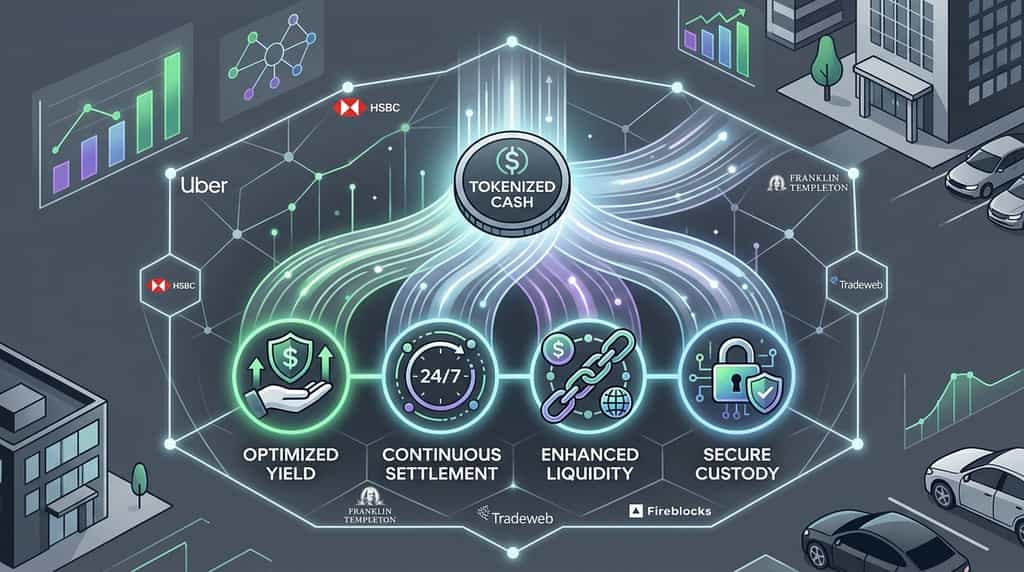
Adopting tokenized liquidity solutions delivers immediate financial and operational advantages for large-scale corporate treasuries. Based on insights from HSBC and Fireblocks leadership, key advantages include:
-
Elimination of Idle Cash Buffers: Organizations no longer need to keep massive pools of uninvested fiat currency on hand solely to cover unexpected weekend or holiday liabilities.
-
Continuous 24/7 Settlement: Delivery-versus-payment transactions settle instantaneously on-chain, removing the multi-day delays associated with legacy clearing houses.
-
Maximized Capital Efficiency: Keeping cash fully deployed in yield-bearing instruments for an extra 1.5 days compounds significant returns across multi-million or multi-billion-dollar corporate treasuries.
-
Enhanced Risk Management: Platforms like Fireblocks provide institutional-grade custody and cryptographic security, ensuring that digital asset workflows comply with stringent corporate risk policies.
What Challenges Remain for Mass Corporate Adoption?
Despite the success of Uber's pilot, several technical and regulatory hurdles must be cleared before 24/7 tokenized treasury management becomes universal. According to industry analyses, challenges include:
-
Interoperability Standards: Integrating diverse bank-issued tokenized deposits with various asset manager tokenization platforms requires standardized messaging and cross-chain communication protocols.
-
Regulatory Compliance: Corporate treasurers operate under strict legal frameworks governing liquidity, asset custody, and counterparty exposure, requiring clear regulatory guidance for public-private hybrid networks.
-
ERP System Integration: Connecting corporate enterprise resource planning (ERP) systems directly to blockchain infrastructure requires robust middleware and API integrations that legacy financial software does not natively support.
Conclusion
Uber's successful treasury pilot with HSBC, Franklin Templeton, Tradeweb, and Fireblocks marks a watershed moment for real-world blockchain utility in corporate finance. By demonstrating that tokenized money market funds and tokenized bank deposits can interact seamlessly over the Canton Network to capture weekend yield, the initiative highlights a clear path forward for automated, 24/7 working capital management. As digital asset infrastructure matures and regulatory frameworks align, tokenization is poised to transform idle corporate cash from an administrative headache into an optimized, continuously compounding asset.
FAQs
What specific blockchain network was used in the Uber pilot?
The pilot was executed on the Canton Network, a privacy-enabled interoperable blockchain network designed for institutional finance, utilizing infrastructure provided by Fireblocks.
How did Uber gain extra yield during the test?
By purchasing tokenized money market funds using HSBC tokenized deposits and executing weekend liquidations via delivery-versus-payment transactions, Uber stayed invested over the weekend instead of cashing out early on Friday, capturing approximately 1.5 days of additional yield.
Are tokenized money market funds considered safe for corporate treasuries?
Tokenized MMFs generally represent shares in underlying portfolios of short-term, high-quality U.S. government securities and cash equivalents, maintaining the same regulatory protections as traditional MMFs while adding blockchain settlement efficiency.
Will this technology replace traditional bank accounts entirely?
No, tokenized deposits and blockchain rails complement traditional banking by upgrading payment rails and settlement speeds, rather than replacing the underlying banking relationships and regulatory structures.
How quickly do industry experts expect broader corporate adoption?
Industry executives from firms like Fireblocks have projected that hundreds of enterprise corporations could adopt tokenized treasury and liquidity management models within the next 18 months as infrastructure and compliance standards solidify.
Disclaimer
This general market information, possibly from third-party, commercial, or sponsored sources, is provided for reference and educational purposes only and does not constitute financial or investment advice, an offer, solicitation, or guarantee. We disclaim liability for its accuracy, completeness, reliability, and any resulting losses. Investments/trading are risky; past performance doesn’t guarantee future results. Users should research, judge prudently, and take full responsibility. For further details, please consult KuCoin’s Terms of Use and Risk Disclosure.